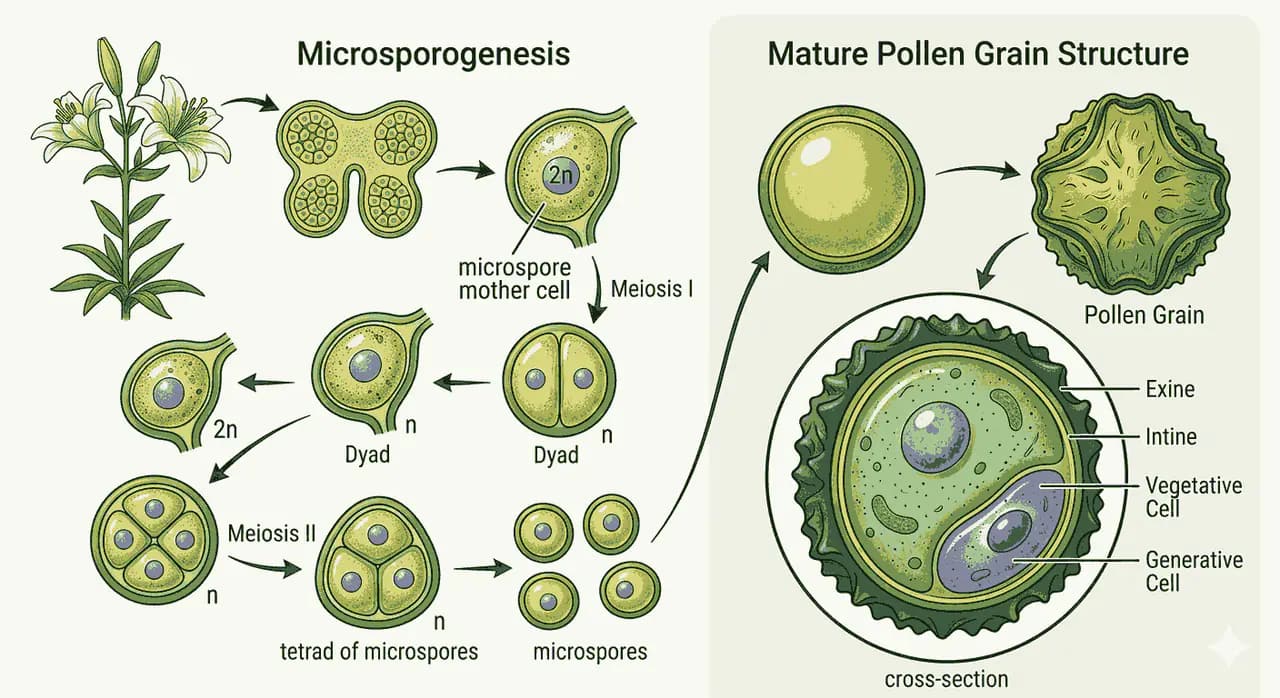
Understanding the topic of reproduction in flowering plants is essential for Class 12 Biology aspirants, especially for competitive exams like NEET. One of the most important sections in this chapter is microsporogenesis and pollen grain formation. That is why practicing Microsporogenesis And Pollen Grain MCQs Class 12 Biology With Answers becomes crucial for mastering the concepts thoroughly.
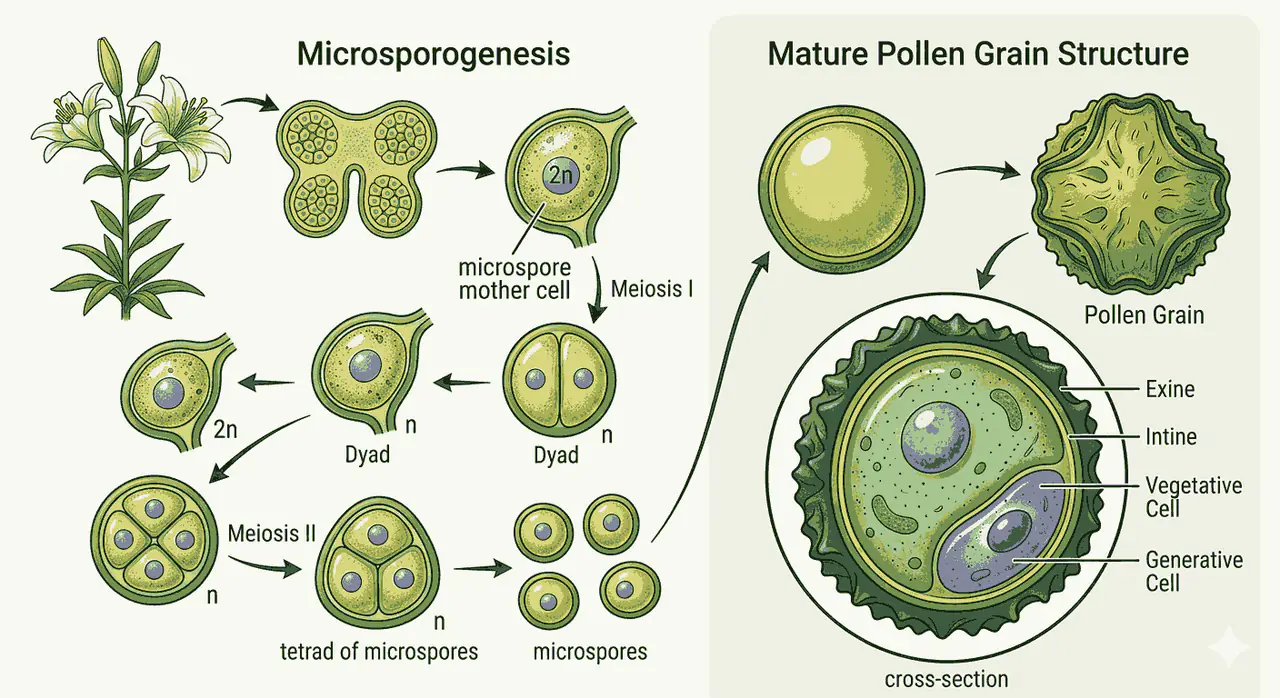
When aspirants begin preparing, they often realize that Microsporogenesis And Pollen Grain MCQs Class 12 Biology With Answers help simplify complex biological processes into easy-to-understand patterns. Microsporogenesis refers to the formation of microspores from microspore mother cells through meiosis, and this process is a key focus area in exams. By solving Microsporogenesis And Pollen Grain MCQs Class 12 Biology With Answers, aspirants can better understand how meiosis contributes to genetic variation.
Another important concept is the structure and development of pollen grains. Practicing Microsporogenesis And Pollen Grain MCQs Class 12 Biology With Answers allows learners to clearly understand the difference between exine and intine, as well as the role of sporopollenin. These details are frequently tested, and repeated exposure through Microsporogenesis And Pollen Grain MCQs Class 12 Biology With Answers ensures better retention.
Moreover, Microsporogenesis And Pollen Grain MCQs Class 12 Biology With Answers are extremely helpful in identifying tricky conceptual questions. For instance, students often confuse the functions of tapetum, endothecium, and other layers of the anther. By revising through Microsporogenesis And Pollen Grain MCQs Class 12 Biology With Answers, such confusion can be eliminated effectively.
Time management is another major advantage of solving Microsporogenesis And Pollen Grain MCQs Class 12 Biology With Answers. Since MCQs require quick thinking, regular practice improves speed and accuracy. Aspirants preparing for exams benefit greatly from solving Microsporogenesis And Pollen Grain MCQs Class 12 Biology With Answers within a limited time frame.
Additionally, Microsporogenesis And Pollen Grain MCQs Class 12 Biology With Answers help in strengthening diagram-based understanding. Even though diagrams are not included directly in MCQs, many questions are based on visual concepts like anther structure and pollen grain layers. Regular practice with Microsporogenesis And Pollen Grain MCQs Class 12 Biology With Answers builds a strong conceptual foundation.
It is also important to note that Microsporogenesis And Pollen Grain MCQs Class 12 Biology With Answers improve analytical thinking. Instead of rote memorization, aspirants learn to apply their knowledge in different scenarios. This is especially useful in competitive exams where application-based questions are common. Hence, solving Microsporogenesis And Pollen Grain MCQs Class 12 Biology With Answers becomes a smart preparation strategy.
Furthermore, revision becomes much easier when using Microsporogenesis And Pollen Grain MCQs Class 12 Biology With Answers. Instead of going through lengthy theory repeatedly, students can quickly revise key points through MCQs. This makes Microsporogenesis And Pollen Grain MCQs Class 12 Biology With Answers an efficient revision tool before exams.
Another benefit is confidence building. As students practice more Microsporogenesis And Pollen Grain MCQs Class 12 Biology With Answers, they become familiar with question patterns and gain confidence in solving similar questions in exams. This confidence plays a crucial role in achieving higher scores.
Consistency is the key to success, and regularly solving Microsporogenesis And Pollen Grain MCQs Class 12 Biology With Answers ensures continuous improvement. Aspirants who practice daily are more likely to perform better than those who rely only on last-minute preparation. Therefore, integrating Microsporogenesis And Pollen Grain MCQs Class 12 Biology With Answers into daily study routines is highly recommended.
Microsporogenesis And Pollen Grain MCQs Class 12 Biology With Answers:
1. Which one of the following is surrounded by a callose wall?
A. Pollen grain
B. Microspore mother cell
C. Male gamete
D. Egg
Answer: B
Explanation: Microspore mother cells are surrounded by a callose wall during meiosis, which helps in proper separation of microspores.
2. Male gametes in angiosperms are formed by the division of:
A. Microspore mother cell
B. Microspore
C. Generative cell
D. Vegetative cell
Answer: C
Explanation: The generative cell divides mitotically to form two male gametes.
3. Rarely among angiosperms, pollen grains influence the endosperm. This is called:
A. Metaxenia
B. Nemec phenomenon
C. Xenia
D. Mesogamy
Answer: C
Explanation: Xenia refers to the effect of pollen on endosperm.
4.Arrange the correct sequence of events in microsporogenesis:
A. Microspore tetrad → Meiosis of pollen mother cell → Anther maturation → Separation of pollen grains
B. Meiosis of pollen mother cell → Microspore tetrad → Separation of pollen grains → Anther maturation
C. Meiosis of pollen mother cell → Microspore tetrad → Anther maturation → Separation of pollen grains
D. Microspore tetrad → Separation → Meiosis → Maturation
Answer: C
Explanation: Pollen mother cell undergoes meiosis → forms microspore tetrad → anther matures → microspores separate into pollen grains
5. Which of the following cells during gametogenesis is normally diploid?
A. Spermatid
B. Spermatogonia
C. Secondary polar body
D. Primary polar body
Answer: B
Explanation: Spermatogonia are diploid stem cells.
6. Male gametophyte in angiosperms produces:
A. Three sperms
B. Two sperms and a vegetative cell
C. Single sperm and a vegetative cell
D. Single sperm and two vegetative cells
Answer: B
Explanation: Produces 2 male gametes + 1 vegetative cell.
7. Function of filiform apparatus is to:
A. Recognize pollen at stigma
B. Stimulate generative cell division
C. Produce nectar
D. Guide pollen tube entry
Answer: D
Explanation: It guides the pollen tube into synergids.
8. Which statement is correct?
A. Tapetum nourishes developing pollen
B. Outer layer is intine
C. Sporogenous tissue is haploid
D. Endothecium produces microspores
Answer: A
Explanation: Tapetum provides nutrition to pollen grains.
9. Function of germ pore in flowering plants:
A. Initiation of pollen tube
B. Release of male gametes
C. Emergence of radicle
D. Absorption of water
Answer: A
Explanation: Germ pore helps in pollen tube formation.
10. Microspore mother cells required to produce 100 pollen grains:
A. 75
B. 100
C. 25
D. 50
Answer: C
Explanation: 1 MMC → 4 pollen grains → 100/4 = 25.
11. Identify parts A, B, and C in T.S. of anther:
A. Connective tissue, Pollen grains, Endothecium
B. Endothecium, Connective tissue, Pollen grains
C. Pollen grains, Connective tissue, Endothecium
D. Endothecium, Pollen grains, Connective tissue
Answer: A
Explanation: Correct labeling based on standard diagram.
12.
If a stock has 2n = 48 and scion microspore mother cell has 2n = 24, then the number of chromosomes in root cell and microspores respectively are:
A. 12, 48
B. 48, 12
C. 24, 12
D. 24, 96
Answer: B
Explanation:Root cells (from stock) undergo mitosis, so chromosome number remains 2n = 48
- Microspore mother cell (2n = 24) undergoes meiosis, so microspores become n = 12
Therefore: Root cell = 48, Microspores = 12
13. Pollen tube forms after killing generative cell because:
A. Laser stimulates growth
B. Tube region unaffected
C. Dead cell helps growth
D. Vegetative cell intact
Answer: D
Explanation: Vegetative cell controls pollen tube growth.
14. Viability of pollen grains in rice and wheat:
A. 30 minutes
B. 10 minutes
C. 60 minutes
D. 90 minutes
Answer: A
Explanation: Viability is very short (~30 min).
15. Effect of foreign pollen on endosperm:
A. Pollen culture
B. Xylem
C. Endosperm
D. Xenia
Answer: D
Explanation: Xenia affects endosperm characteristics.
16. First cell of male gametophyte:
A. Vegetative cell
B. Generative cell
C. Pollen grain
D. Microgametogenesis
Answer: C
Explanation: Pollen grain is the initial male gametophyte.
17. Sequence of anther wall layers:
A. Epidermis → Endothecium → Middle → Tapetum
B. Epidermis → Middle → Endothecium → Tapetum
C. Tapetum → Middle → Endothecium → Epidermis
D. Epidermis → Middle → Tapetum → Endothecium
Answer: A
Explanation: Correct anatomical order.
18. Ubisch bodies are produced by:
A. Tapetum
B. Vascular bundles
C. Endothecium
D. Sporogenous tissue
Answer: A
Explanation: Produced by tapetum for pollen wall formation.
19. Epipetalous and syngenesious stamens occur in:
A. Solanaceae
B. Brassicaceae
C. Fabaceae
D. Asteraceae
Answer: D
Explanation: Characteristic feature of Asteraceae.
20. Most resistant biological material:
A. Lignin
B. Hemicellulose
C. Sporopollenin
D. Cellulose
Answer: C
Explanation: Found in exine, highly resistant.
21. Hybrid seed production requires removal of:
A. Stigma
B. Ovary
C. Anther
D. Ovule
Answer: C
Explanation: Prevents self-pollination.
22. Exine of pollen grain is made up of:
A. Pectocellulose
B. Lignocellulose
C. Sporopollenin
D. Pollenkitt
Answer: C
Explanation: Provides protection.
23. Microsporangia in monothecous anther:
A. One
B. Two
C. Four
D. Many
Answer: B
Explanation: One lobe → 2 microsporangia.
24. Haploid plants are produced by:
A. Pollen culture
B. Cotyledon culture
C. Embryo culture
D. Meristem culture
Answer: A
Explanation: Pollen grains are haploid.
25. Anther dehiscence occurs due to:
A. Epidermis
B. Endothecium
C. Middle layer
D. Tapetum
Answer: B
Explanation: Endothecium helps in splitting anther.
26. Nuclei present in pollen grain at shedding:
A. One
B. One or two
C. Two or three
D. Only two
Answer: C
Explanation: Depends on stage of development.
27. Male gamete is represented by:
A. Endosperm
B. Synergids
C. Pollen grain
D. Antipodals
Answer: C
Explanation: Carries male gametes.
28. Filiform apparatus is found in:
A. Tapetum
B. Synergids
C. Antipodals
D. Anther wall
Answer: B
Explanation: Helps guide pollen tube.
29. Ubisch bodies function in:
A. Meiosis initiation
B. Nutrition
C. Exine formation
D. Embryo development
Answer: C
Explanation: Help in sporopollenin deposition.
Conclusion on Microsporogenesis And Pollen Grain MCQs Class 12 Biology With Answers
In conclusion, the importance of Microsporogenesis And Pollen Grain MCQs Class 12 Biology With Answers cannot be overstated. They provide conceptual clarity, improve speed, enhance accuracy, and build confidence. By consistently practicing Microsporogenesis And Pollen Grain MCQs Class 12 Biology With Answers, aspirants can achieve excellent results in both board exams and competitive tests.
Related reading
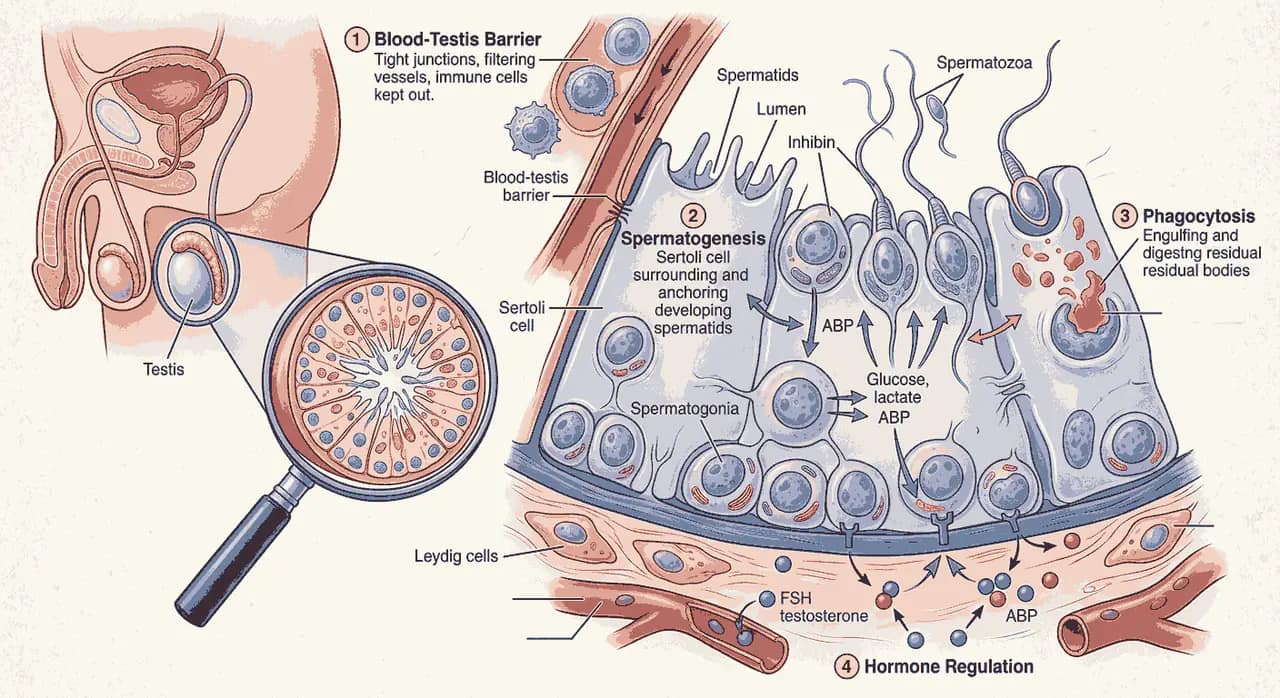
Master Sertoli Cells Location and Function MCQs With Answers for Class 12 Biology
Master Sertoli Cells Location and Function MCQs With Answers for Class 12 Biology with clear explanations, key concepts , and exam-focused preparation to boost,
Stop Losing Marks: Apomixis and polyembryony MCQs class 12 biology with answers pdf
Master concepts with Apomixis and polyembryony MCQs class 12 biology with answers pdf, boost exam preparation, improve accuracy, and score higher in board ,NEET