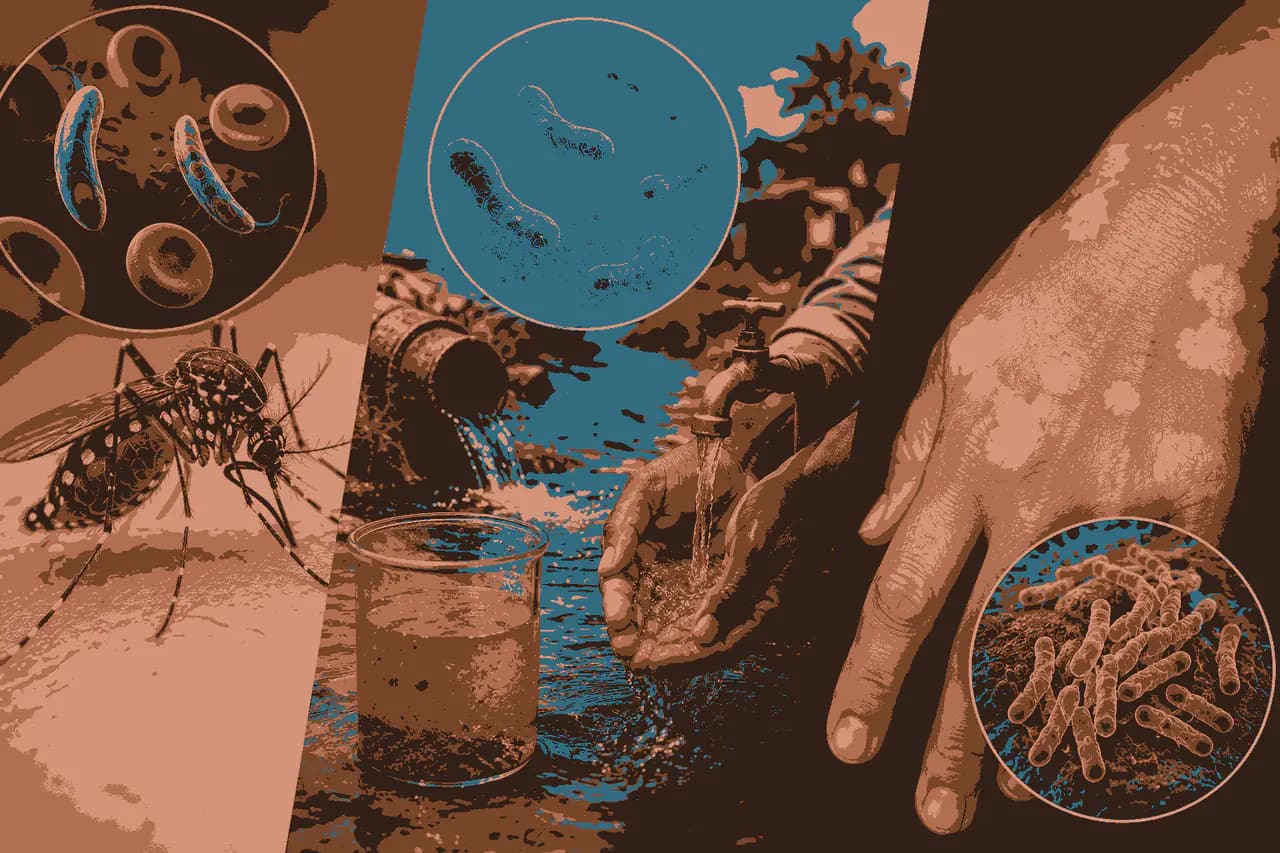
Malaria Cholera and Leprosy MCQs for Biology Exams is an important revision topic for aspirants who want to strengthen their understanding of infectious diseases in a clear, organised, and exam-focused way. Malaria Cholera and Leprosy MCQs for Biology Exams helps aspirants revise three major diseases that are often discussed in biology under human health, disease transmission, pathogens, symptoms, immunity, prevention, and control. These diseases are important because they represent different types of infections: malaria is a protozoan vector-borne disease, cholera is a bacterial water-borne disease, and leprosy is a chronic bacterial disease. Malaria Cholera and Leprosy MCQs for Biology Exams allows aspirants to compare these diseases based on causative agents, modes of spread, affected body systems, symptoms, diagnosis, and prevention. Malaria Cholera and Leprosy MCQs for Biology Exams becomes easier when aspirants first understand malaria. Malaria is caused by Plasmodium species and is transmitted by the bite of infected female Anopheles mosquitoes. In biology exams, aspirants often need to remember that Plasmodium vivax and Plasmodium falciparum are important malaria-causing parasites. Malaria Cholera and Leprosy MCQs for Biology Exams helps aspirants understand the role of sporozoites, merozoites, red blood cells, liver stages, fever cycles, chills, sweating, anaemia, and weakness. The release of toxic substances during the rupture of infected red blood cells is responsible for fever and chills in malaria. Malaria Cholera and Leprosy MCQs for Biology Exams also highlights the importance of mosquito control, use of bed nets, removal of stagnant water, insecticide spraying, and early treatment. Cholera is another key disease covered under Malaria Cholera and Leprosy MCQs for Biology Exams. Cholera is caused by the bacterium Vibrio cholerae and spreads mainly through contaminated food and water. Aspirants should remember that poor sanitation, unsafe drinking water, and unhygienic food handling increase the risk of cholera transmission. Malaria Cholera and Leprosy MCQs for Biology Exams helps aspirants revise symptoms such as severe watery diarrhoea, dehydration, weakness, vomiting, and electrolyte loss. The most important treatment for cholera is rehydration therapy because rapid fluid loss can become life-threatening if not treated quickly. Malaria Cholera and Leprosy MCQs for Biology Exams also teaches aspirants that clean water, proper sanitation, handwashing, safe food practices, and public health awareness are essential for cholera prevention. Leprosy is an important chronic infectious disease included in Malaria Cholera and Leprosy MCQs for Biology Exams. It is caused by Mycobacterium leprae and mainly affects the skin, peripheral nerves, mucous membranes, and eyes. Malaria Cholera and Leprosy MCQs for Biology Exams helps aspirants understand that leprosy may cause skin patches, loss of sensation, nerve damage, muscle weakness, and deformities if not diagnosed and treated early. Unlike fast-spreading diseases, leprosy usually develops slowly and has a long incubation period. Malaria Cholera and Leprosy MCQs for Biology Exams also helps aspirants understand that early diagnosis and multidrug therapy can prevent complications and reduce transmission. Aspirants preparing Malaria Cholera and Leprosy MCQs for Biology Exams should focus on comparison-based revision. Malaria spreads through a mosquito vector, cholera spreads through contaminated water and food, and leprosy spreads mainly through prolonged close contact with untreated infected individuals. Malaria Cholera and Leprosy MCQs for Biology Exams becomes more useful when aspirants prepare short tables for disease name, causative agent, transmission, symptoms, prevention, and treatment. This method improves memory and reduces confusion during exams. Malaria Cholera and Leprosy MCQs for Biology Exams also strengthens conceptual clarity by showing how different pathogens use different routes to infect humans. Another important advantage of Malaria Cholera and Leprosy MCQs for Biology Exams is that it helps aspirants connect textbook knowledge with real-life health practices. Malaria prevention requires vector control, cholera prevention requires sanitation and clean drinking water, and leprosy control requires early diagnosis, treatment, and awareness. Malaria Cholera and Leprosy MCQs for Biology Exams teaches aspirants that disease prevention is not limited to medicine alone; it also depends on hygiene, environment, nutrition, public health systems, and responsible behaviour. Aspirants should also understand the difference between protozoan, bacterial, vector-borne, water-borne, and chronic infectious diseases. For effective revision, aspirants should study Malaria Cholera and Leprosy MCQs for Biology Exams regularly through concise notes, diagrams, flowcharts, and disease comparison charts. Malaria Cholera and Leprosy MCQs for Biology Exams is especially helpful for board exams, NEET preparation, and other biology-based tests because these diseases are commonly used to test factual knowledge as well as application-based understanding. Aspirants should avoid rote learning and instead focus on why each disease spreads, how the pathogen affects the body, and which preventive measures break the chain of infection. Malaria Cholera and Leprosy MCQs for Biology Exams also builds awareness about public health challenges in tropical and developing regions.
Malaria Cholera and Leprosy MCQs for Biology Exams:
- Which pair of diseases is caused by a virus?
A. Typhoid, tetanus B. Rabies, mumps C. Cholera, tuberculosis D. AIDS, syphilis Answer: B. Rabies, mumps Explanation: Rabies and mumps are viral diseases.
- Which disease is correctly matched with its vector?
A. Body louse - Typhoid B. House fly - Yellow fever C. Anopheles - Malaria D. Aedes - Plague Answer: C. Anopheles - Malaria Explanation: Anopheles mosquito is correctly matched with the transmission of malaria.
- Sickle cell anaemia has not been eliminated from the African population because
A. It is controlled by recessive genes B. It is not a fatal disease C. It provides immunity against malaria D. It is controlled by dominant genes Answer: C. It provides immunity against malaria Explanation: Sickle cell anaemia has not been eliminated from the African population because the sickle cell trait gives protection against malaria.
- The only mammal, other than man, which suffers from leprosy is
A. Dasypus B. Desmodus C. Rhinolophus D. Mus Answer: A. Dasypus Explanation: Dasypus, especially the armadillo Dasypus novemcinctus, can suffer from leprosy caused by Mycobacterium leprae.
- Widal Test is a confirmation test for _______
A. Pneumonia B. Typhoid C. Jaundice D. Epilepsy Answer: B. Typhoid Explanation: Widal test is a serological test used for the diagnosis of typhoid fever. It detects antibodies against Salmonella typhi antigens.
- Where did an epidemic bone softening disease Itai-Itai occur first?
A. South Korea B. Japan C. China D. Burma Answer: B. Japan Explanation: Itai-Itai disease, involving osteomalacia and kidney damage, was first reported in Japan.
- Athlete’s foot is caused by
A. Tinea pedis B. Tinea capitis C. Candida albicans D. Rickettsia Answer: A. Tinea pedis Explanation: Athlete’s foot is caused by a fungal infection known as Tinea pedis. It commonly affects the spaces between the toes.
- Hepatitis-B virus is a
A. Hepadnavirus B. Variolavirus C. Retrovirus D. Picornavirus Answer: A. Hepadnavirus Explanation: Hepatitis B virus belongs to the group of hepadnaviruses.
- What is the cause of Diphtheria?
A. Viruses B. Eukaryotes C. Mycoplasma D. Bacteria Answer: D. Bacteria Explanation: Diphtheria is caused by the bacterium Corynebacterium diphtheriae.
- What is the effect of cigarette smoking and radon in combination on lungs?
A. Fatal B. Synergistic C. Mutualistic D. Antagonistic Answer: B. Synergistic Explanation: The combined effect of cigarette smoking and radon exposure on lungs is synergistic, meaning their combined harmful effect is greater than either alone.
- Which response is responsible for tissue injury causing redness, swelling, pain, and production of heat and fever?
A. Physiological B. Anatomical C. Inflammatory D. Cellular Answer: C. Inflammatory Explanation: Redness, swelling, pain, heat, and fever are signs of an inflammatory response to infection or injury.
- What is used for external application in the cure of leprosy?
A. Rice bran oil B. Neem seed oil C. Cotton seed oil D. Groundnut seed oil Answer: B. Neem seed oil Explanation: Neem seed oil is used externally in traditional treatment practices for leprosy.
- From which plant is Quinine, used for the treatment of malarial fever, extracted?
A. Atropa belladonna B. Cinchona officinalis C. Aconitum napellus D. Rauwolfia serpentina Answer: B. Cinchona officinalis Explanation: Quinine, used for the treatment of malarial fever, is extracted from the bark of Cinchona officinalis.
- One of the protozoan diseases is
A. Polio B. AIDS C. Taeniasis D. Malaria Answer: D. Malaria Explanation: Malaria is a protozoan disease caused by Plasmodium species.
- Which one is not transmitted by houseflies?
A. Cholera B. Typhoid C. Dysentery D. Yellow fever Answer: D. Yellow fever Explanation: Yellow fever is not transmitted by houseflies. It is transmitted by Aedes mosquitoes.
- Which one of the following is a pandemic disease?
A. Amoebic dysentery B. Hepatitis C. Filariasis D. Influenza Answer: D. Influenza Explanation: Influenza can become a pandemic disease when a new influenza virus spreads widely across countries or continents.
- Find the odd one.
A. Guinea worm B. Hookworm C. Ringworm D. Tapeworm Answer: C. Ringworm Explanation: Ringworm is a fungal skin infection, while guinea worm, hookworm, and tapeworm are parasitic worms.
- Which insect spreads yellow fever?
A. Aedes B. Psorophora C. Glossina D. Phlebotomus Answer: A. Aedes Explanation: Yellow fever is mainly spread by Aedes mosquitoes.
- What causes malignant malaria?
A. Plasmodium falciparum B. Plasmodium ovale C. Plasmodium vivax D. Plasmodium malariae Answer: A. Plasmodium falciparum Explanation: Malignant malaria is caused by Plasmodium falciparum.
- Which disease is caused by a helminth parasite with a gastropoda member as an intermediate host?
A. Ascariasis B. Bilharziasis C. Taeniasis D. Enterobiasis Answer: B. Bilharziasis Explanation: Bilharziasis, also called schistosomiasis, is caused by a helminth parasite that uses a gastropod, usually a snail, as an intermediate host.
- Why does sprinkling oil on stagnant water help control malaria?
A. Mosquito larvae get asphyxiated B. Water becomes impure for mosquito C. Specific gravity of water increases D. Oils kill malarial parasite in mosquitoes Answer: A. Mosquito larvae get asphyxiated Explanation: Sprinkling oil on stagnant water blocks air supply to mosquito larvae, causing them to get asphyxiated and die.
- Where would you look for E. coli?
A. Milk B. Water C. Human intestine D. Soil Answer: C. Human intestine Explanation: Escherichia coli is commonly found in the intestines of humans and animals.
- Where is the signet ring stage of Plasmodium found?
A. RBC of man B. RBC of Anopheles C. Liver of man D. Salivary gland Answer: A. RBC of man Explanation: The signet ring stage of Plasmodium is found inside the red blood cells of humans.
- What disorder is characterized by outbursts of emotions, quarrelsome behavior, and conflicts with others?
A. Schizophrenia B. Borderline personality disorder C. Addictive disorder D. Mood disorders Answer: B. Borderline personality disorder Explanation: Borderline personality disorder may involve emotional instability, quarrelsome behaviour, and conflicts with others.
- Which condition is a potential savior from a mosquito-borne infectious disease?
A. Pernicious anaemia B. Leukaemia C. Thalassaemia D. Sickle cell anaemia Answer: D. Sickle cell anaemia Explanation: Sickle cell trait gives some protection against malaria, a mosquito-borne infectious disease.
- From which plant is a medicine for respiratory disorders obtained?
A. Ephedra B. Eucalyptus C. Cannabis D. Saccharum Answer: A. Ephedra Explanation: Medicine used for respiratory disorders is obtained from Ephedra.
- Which of the following is a water-borne disease?
A. Tuberculosis B. Chickenpox C. Malaria D. Cholera Answer: D. Cholera Explanation: Cholera is a water-borne disease transmitted through contaminated water or food.
- What is the most important treatment for cholera?
A. Rehydration therapy B. Chemotherapy C. Immunotherapy D. Radiation therapy Answer: A. Rehydration therapy Explanation: Rehydration therapy is the most important treatment for cholera because it replaces the fluids and salts lost due to severe diarrhoea.
- In 1990, what kind of therapy was given to a four-year-old girl with Adenosine Deaminase, ADA, deficiency?
A. Gene therapy B. Chemotherapy C. Immunotherapy D. Radiation therapy Answer: A. Gene therapy Explanation: In 1990, gene therapy was given to a four-year-old girl with Adenosine Deaminase deficiency.
- What caused the oriental sore?
A. Trypanosoma gambiense
B. Leishmania brasiliensis
C. Leishmania cruzi
D. Leishmania tropica
Answer: D. Leishmania tropica
Explanation: Oriental sore is caused by Leishmania tropica.
Conclusion on Malaria Cholera and Leprosy MCQs for Biology Exams
In conclusion, Malaria Cholera and Leprosy MCQs for Biology Exams is a valuable study topic for aspirants who want to master infectious diseases in a structured and exam-ready manner. It improves understanding of malaria, cholera, and leprosy through their causes, transmission routes, symptoms, prevention, and treatment. Malaria Cholera and Leprosy MCQs for Biology Exams also helps aspirants improve accuracy, confidence, and speed while answering disease-based biology questions. With consistent revision, Malaria Cholera and Leprosy MCQs for Biology Exams can make human health and disease concepts easier, clearer, and more meaningful for aspirants.
Related reading

Essential Vaccines and Drug Abuse MCQs Class 12 Biology - Powerful Exam Practice Questions
Revise Vaccines and Drug Abuse MCQs Class 12 Biology with key facts on immunity, vaccines, addiction, drug source, and health risks for aspirants prep for exams

High - Risk Oncogenes and Cancer MCQs for Class 12 Biology - Avoid Costly Mistakes
Explore Oncogenes and Cancer MCQs for Class 12 Biology with insights on tumours, metastasis, causes, diagnosis, treatment for aspirants preparing biology exams.