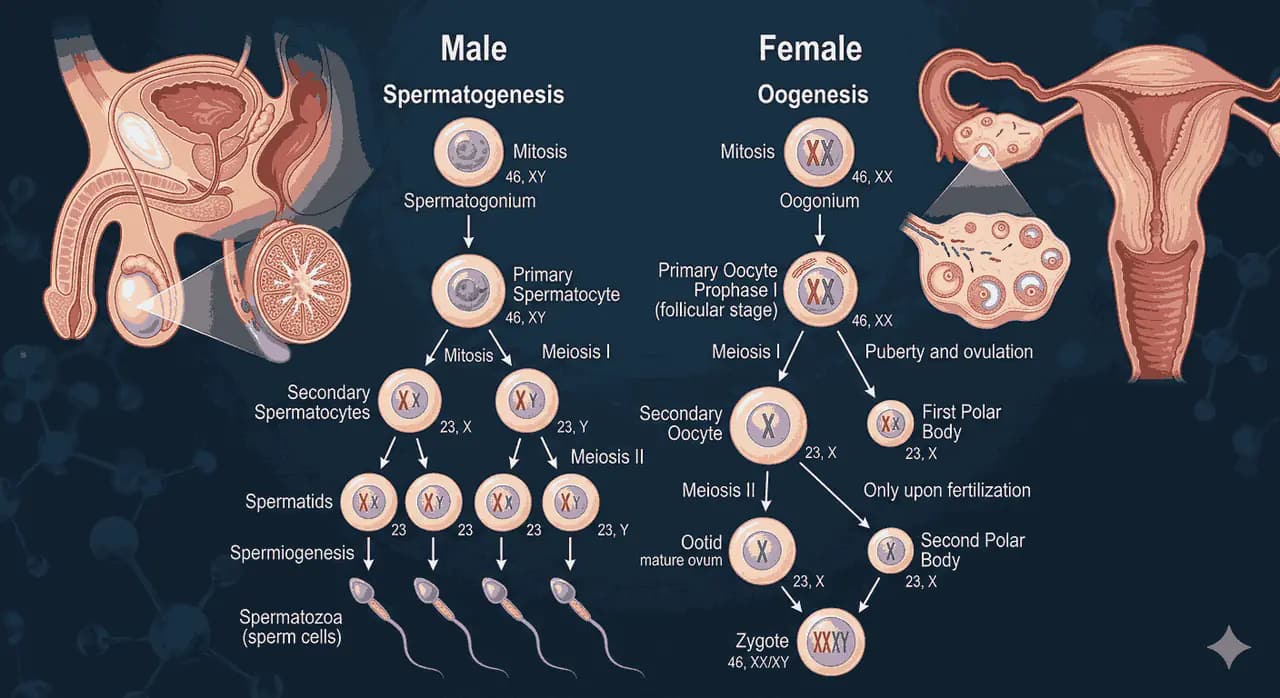
Human biology is a fascinating subject, especially when it comes to understanding reproduction and the formation of gametes. The topic Human Gametogenesis and Reproductive Structures MCQs Class 12 plays a crucial role in helping aspirants grasp these concepts clearly and effectively. A strong understanding of this area not only helps in exams but also builds a solid foundation for advanced studies in biology.
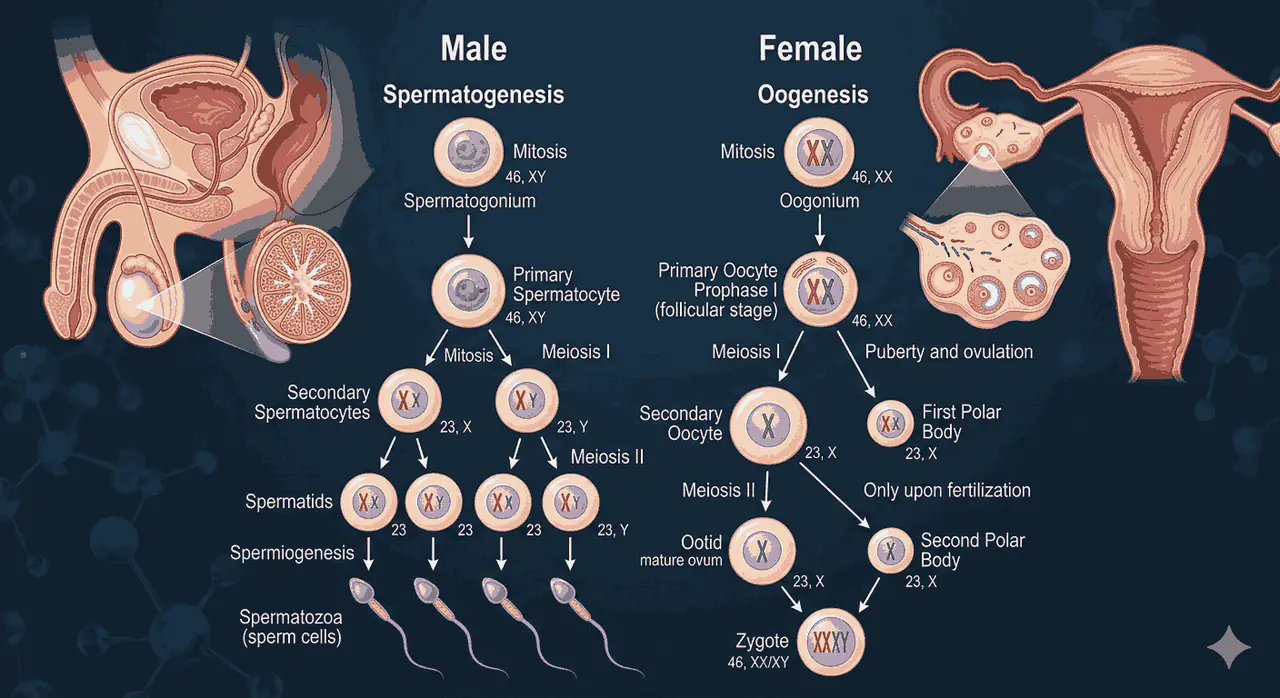
The concept of gametogenesis refers to the process by which male and female gametes are formed. When aspirants explore Human Gametogenesis and Reproductive Structures MCQs Class 12, they begin to understand the differences between spermatogenesis and oogenesis. Spermatogenesis occurs in the testes and leads to the formation of sperm, while oogenesis takes place in the ovaries and results in the formation of ova. Practicing Human Gametogenesis and Reproductive Structures MCQs Class 12 helps reinforce these processes through application-based learning.
Reproductive structures are equally important in this topic. The male reproductive system includes organs like testes, epididymis, vas deferens, and accessory glands. Similarly, the female reproductive system includes ovaries, fallopian tubes, uterus, and vagina. Through Human Gametogenesis and Reproductive Structures MCQs Class 12, aspirants can test their understanding of the structure and function of each organ in a systematic manner.
One of the key benefits of studying Human Gametogenesis and Reproductive Structures MCQs Class 12 is that it promotes conceptual clarity. Instead of memorizing facts, aspirants learn to apply their knowledge to different scenarios. For example, questions may focus on hormonal regulation, such as the role of FSH and LH in gamete formation. By practicing Human Gametogenesis and Reproductive Structures MCQs Class 12, aspirants can better understand how hormones control reproductive processes.
Another important aspect covered under Human Gametogenesis and Reproductive Structures MCQs Class 12 is the role of cells involved in reproduction. Sertoli cells, Leydig cells, and follicular cells all have specific functions. Understanding these through Human Gametogenesis and Reproductive Structures MCQs Class 12 ensures that students are well-prepared for both theoretical and application-based questions.
Additionally, the topic includes important processes such as fertilization, implantation, and early embryonic development. By working through Human Gametogenesis and Reproductive Structures MCQs Class 12, aspirants can connect these processes logically. This not only improves retention but also enhances analytical thinking skills, which are essential for competitive exams.
The importance of revision cannot be ignored, and this is where Human Gametogenesis and Reproductive Structures MCQs Class 12 becomes highly useful. Regular practice helps students identify weak areas and improve accuracy. Moreover, solving Human Gametogenesis and Reproductive Structures MCQs Class 12 under timed conditions can boost confidence and exam performance.
Another advantage of focusing on Human Gametogenesis and Reproductive Structures MCQs Class 12 is that it aligns closely with exam patterns. Most board and competitive exams include multiple-choice questions that test both basic and advanced understanding. By consistently practicing Human Gametogenesis and Reproductive Structures MCQs Class 12, aspirants become familiar with the type of questions they are likely to encounter.
Furthermore, learning through Human Gametogenesis and Reproductive Structures MCQs Class 12 encourages active learning. Instead of passively reading textbooks, students engage with the material, analyze options, and make informed choices. This active involvement significantly enhances learning outcomes.
It is also important to note that Human Gametogenesis and Reproductive Structures MCQs Class 12 helps in building problem-solving skills. Many questions require logical reasoning and elimination of incorrect options. Practicing Human Gametogenesis and Reproductive Structures MCQs Class 12 regularly sharpens these skills over time.
Human Gametogenesis and Reproductive Structures MCQs Class 12:
1. Which statement regarding the viability of mammalian sperm is incorrect?
a) Sperm is viable only up to 24 h
b) Survival of sperm depends on pH of medium
c) Viability is determined by its motility
d) Sperm must be concentrated in a thick suspension
Answer: d
Explanation: The statement “sperm is viable only up to 24 hours” is incorrect. Mammalian sperm can survive up to 72 hours in the female reproductive tract under suitable conditions.
2. Fertilizin is produced from which part?
a) Mature eggs (ovum)
b) Acrosome
c) Polar bodies
d) Middle piece of sperm
Answer: a
Explanation: Fertilizin is produced by the ovum and helps in sperm attraction during fertilization.
3. Gametes from 100 secondary oocytes and 100 secondary spermatocytes?
a) 200 ova, 200 sperms
b) 50 ova, 100 sperms
c) 100 ova, 200 sperms
d) 100 ova, 100 sperms
Answer: c
Explanation: Each secondary oocyte → 1 ovum; each secondary spermatocyte → 2 sperms.
4. Hyaluronidase is synthesized in?
a) Tail
b) Head
c) Golgi body of acrosome
d) Mitochondria
Answer: c
Explanation: Acrosome enzymes are formed from Golgi apparatus.
5. Leydig cells secrete?
a) Glucagon
b) Androgens
c) Progesterone
d) Intestinal mucus
Answer: b
Explanation: Leydig cells produce testosterone.
6. Middle piece of sperm contains?
a) Mitochondria, Golgi bodies, centriole
b) Axial filament, centriole, Golgi bodies
c) Mitochondria, centriole, axial filament
d) Golgi bodies, axial filament, centriole
Answer: c
Explanation: Middle piece has mitochondria for energy and axial filament.
7. Polar bodies form during?
a) Oviposition
b) Oogenesis
c) Fertilization
d) Spermatogenesis
Answer: b
Explanation: Polar bodies form during unequal divisions in oogenesis.
8. Chromosomes in secondary oocyte?
a) 22
b) 44
c) 46
d) 23
Answer: d
Explanation: Secondary oocyte is haploid (23 chromosomes).
9. Prostate contributes what % of semen?
a) 60%
b) 30%
c) 80%
d) 10%
Answer: b
Explanation: Prostate contributes ~30% of seminal fluid.
10. Genetic material of sperm is in?
a) Tail
b) Head
c) Whole body
d) Middle piece
Answer: b
Explanation: Nucleus in head carries DNA.
11. Proximal centriole destruction affects?
a) Motility
b) Fertilization
c) Cleavage
d) None
Answer: c
Explanation: Centriole helps in spindle formation → affects cleavage.
12. Release of spermatids is called?
a) Spermatogenesis
b) Spermiogenesis
c) Spermiation
d) Spermatogonium
Answer: c
Explanation: Spermiation = release into lumen.
13. Middle piece contains?
a) Acrosome
b) Mitochondria
c) Nucleus
d) Centriole
Answer: b
Explanation: Mitochondria provide ATP.
14. Ovum layers (outside → inside)?
a) Corona radiata → zona pellucida → vitelline membrane
b) Zona → corona → vitelline
c) Vitelline → zona → corona
d) Zona → vitelline → corona
Answer: a
Explanation: Correct structural order.
15. Cytoplasm around mitochondria?
a) Manchette
b) Centroplasm
c) Microplasm
d) Acrosome
Answer: c
Explanation: Microplasm surrounds mitochondria.
16. Largest oogenesis cell?
a) Secondary oocyte
b) 1st polar body
c) Primordial cell
d) Oogonium
Answer: a
Explanation: Secondary oocyte is largest functional cell.
17. Corona radiata is made of?
a) Granulosa cells
b) Cortical cells
c) Theca externa
d) Theca interna
Answer: a
Explanation: Derived from granulosa cells.
18. Correct sperm transport sequence?
a) Vasa efferentia → rete testis
b) Rete testis → epididymis → vasa efferentia
c) Rete testis → vasa efferentia → epididymis → vas deferens
d) Vas deferens → rete testis
Answer: c
Explanation: Standard sperm pathway.
19. Gamete contains?
a) Many alleles
b) All alleles
c) Two alleles
d) One allele
Answer: d
Explanation: Haploid cells carry one allele.
20. Given below are two statements:
Statement I: The release of sperms into the seminiferous tubules is called spermiation.
Statement II: Spermiogenesis is the process of formation of sperms from spermatogonia.
Choose the correct option:
a) Statement I is incorrect but Statement II is correct
b) Both Statement I and Statement II are correct
c) Both Statement I and Statement II are incorrect
d) Statement I is correct but Statement II is incorrect
Answer: d
Explanation:
Statement I is correct because spermiation refers to the release of mature spermatozoa from Sertoli cells into the lumen of seminiferous tubules.
Statement II is incorrect because spermiogenesis is the transformation of spermatids into spermatozoa, not from spermatogonia (that process is spermatogenesis).
21. Which of the following statements are true for spermatogenesis but do NOT hold true for oogenesis?
(A) It results in the formation of haploid gametes
(B) Differentiation of gamete occurs after completion of meiosis
(C) Meiosis occurs continuously in a mitotically dividing stem cell population
(D) It is controlled by LH and FSH
(E) It is initiated at puberty
Choose the correct answer:
a) (B), (C) and (E) only
b) (C) and (E) only
c) (B) and (C) only
d) (B), (D) and (E) only
Answer: a
Explanation:
- (A) is true for both spermatogenesis and oogenesis → not unique
- (B) is true only for spermatogenesis (post-meiotic differentiation occurs)
- (C) spermatogenesis is continuous → not true for oogenesis
- (D) both processes are hormonally controlled → not unique
- (E) spermatogenesis begins at puberty → oogenesis begins before birth
Thus, (B), (C), and (E) are correct.
22. Formation of gametes affected by?
a) LH
b) MH
c) TSH
d) FSH
Answer: d
Explanation: FSH stimulates gamete formation.
23. Secondary spermatocytes are?
a) Haploid
b) Diploid
c) Triploid
d) None
Answer: a
Explanation: After meiosis I → haploid.
24. Reproduction starts at?
a) Puberty
b) Embryonic stage
c) Adulthood
d) Childhood
Answer: a
Explanation: Hormonal maturity begins at puberty.
25. . Match the following columns and select the correct option:
Column I
A. Ovary
B. Placenta
C. Corpus luteum
D. Leydig cells
Column II
i. Human chorionic gonadotropin (hCG)
ii. Estrogen & Progesterone
iii. Androgens
iv. Progesterone only
Options:
a) A-(ii), B-(i), C-(iv), D-(iii)
b) A-(iv), B-(iii), C-(ii), D-(i)
c) A-(i), B-(ii), C-(iii), D-(iv)
d) A-(i), B-(iii), C-(ii), D-(iv)
Answer: a
Explanation:
- Ovary → Estrogen & Progesterone (ii)
- Placenta → hCG (i)
- Corpus luteum → Progesterone (iv)
- Leydig cells → Androgens (iii)
So the correct matching is A-(ii), B-(i), C-(iv), D-(iii).
26. Haploid cells?
a) Primary spermatocyte
b) Primary oocyte
c) Secondary spermatocyte, ovum
d) Spermatogonia
Answer: c
Explanation: Haploid after meiosis.
27. Second polar body extrusion?
a) After fertilization
b) Before sperm entry
c) During cleavage
d) After sperm entry before fusion
Answer: d
Explanation: Triggered by sperm entry.
28. Correct sperm formation sequence?
a) Spermatogonia → spermatocyte → spermatid → sperm
b) Reverse
c) Mixed
d) Incorrect
Answer: a
Explanation: Standard spermatogenesis flow.
29. Correct sperm enzyme function?
a) Fertilizin penetrates
b) Hyaluronidase penetrates egg layers
c) Acrosin dissolves corona radiata
d) Capacitation in penis
Answer: b
Explanation: Hyaluronidase helps penetration.
30. Chromosomes in spermatogonium?
a) 46
b) 23
c) 48
d) 43
Answer: a
Explanation: Spermatogonia are diploid (2n = 46).
Conclusion on Human Gametogenesis and Reproductives Structure MCQs Class 12
In conclusion, mastering the topic of reproduction becomes much easier with consistent practice of Human Gametogenesis and Reproductive Structures MCQs Class 12. It not only strengthens conceptual understanding but also improves speed and accuracy in exams. Aspirants who dedicate time to solving Human Gametogenesis and Reproductive Structures MCQs Class 12 are more likely to perform well and develop a deeper appreciation for biology as a subject.
Related reading
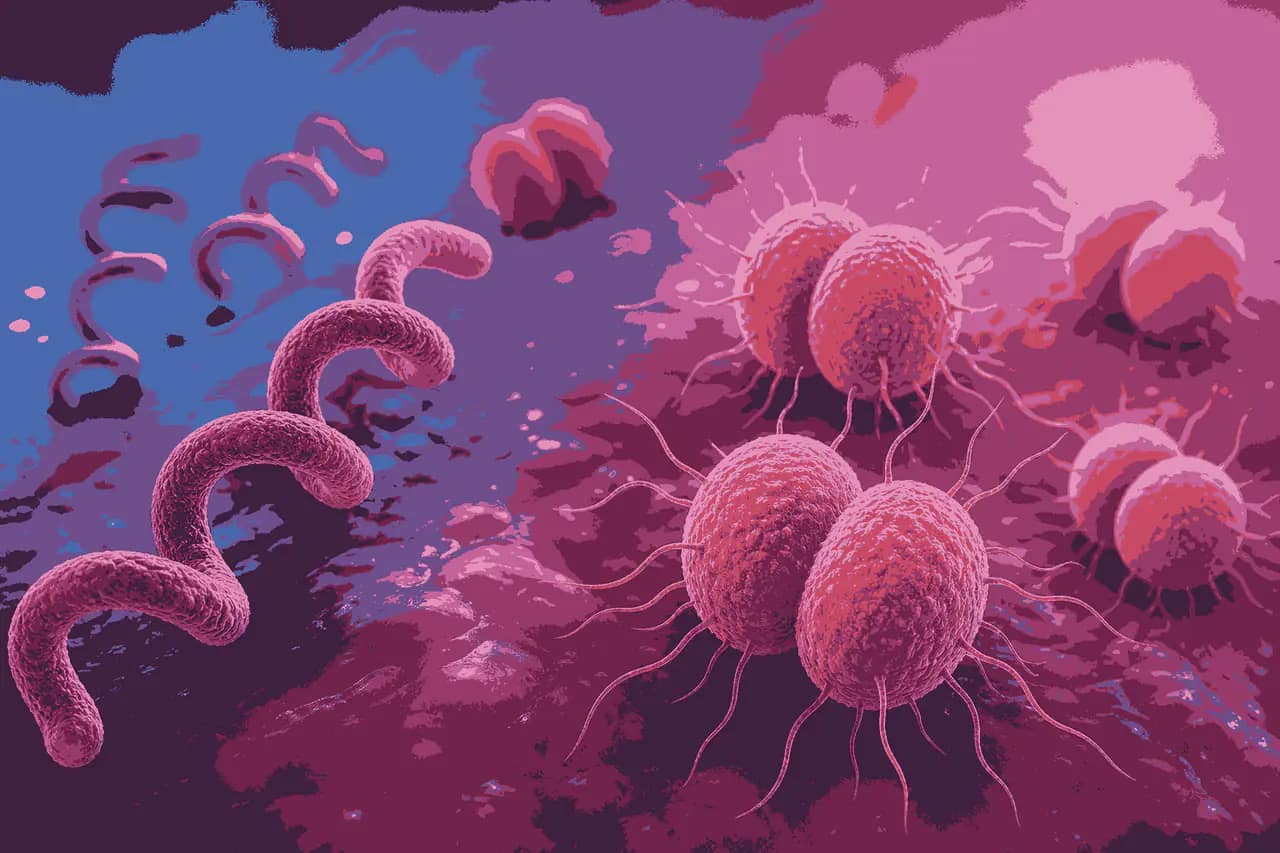
Boost Your Score with Syphills Gonorrhea Bacterial STD MCQs Class 12 Biology for Competitive Exams
Master Syphills Gonorrhea Bacterial STD MCQs Class 12 Biology with clear concepts , symptoms, causes, treatments to boost exam preparation and improve accuracy.
Master These Essential Vasectomy and Tubectomy MCQs for Class 12 Biology Exams
Practice Vasectomy and Tubectomy mcqs for class 12 Biology exams. Boost your preparation with important questions answers and explanations for NEET,JEE and CUET