
Homeostasis and Adaptation MCQs Biology is an important ecology and physiology topic for aspirants who want to understand how organisms survive in changing environmental conditions. Homeostasis and Adaptation MCQs Biology helps aspirants revise the ability of living systems to maintain internal stability even when external surroundings change. In biology, homeostasis refers to the self-regulating tendency of an organism to keep its internal environment balanced, while adaptation refers to structural, physiological, or behavioral features that help organisms survive in their habitats. Homeostasis and Adaptation MCQs Biology is useful for Class 12 Biology, NEET, nursing entrance exams, ecology revision, and life science preparation. Homeostasis and Adaptation MCQs Biology becomes easier when aspirants first understand why internal balance is necessary. Organisms must maintain suitable body temperature, water balance, salt concentration, blood glucose level, pH, and metabolic conditions. Homeostasis and Adaptation MCQs Biology explains that even small disturbances in internal conditions can affect enzyme activity, cellular function, and survival. Mammals and birds are good examples of organisms that regulate body temperature. They are called homeothermic animals because they maintain a relatively constant internal temperature despite changes in the external environment. Homeostasis and Adaptation MCQs Biology is closely connected with regulators and conformers. Regulators maintain internal conditions within narrow limits by using physiological mechanisms, while conformers allow their internal conditions to change with the external environment. Homeostasis and Adaptation MCQs Biology helps aspirants understand that regulation requires energy, but it allows organisms to remain active in different environmental conditions. For example, humans sweat when body temperature rises and shiver when body temperature falls. These responses help restore normal temperature and maintain equilibrium. Homeostasis and Adaptation MCQs Biology also includes partial regulators, which show limited ability to regulate internal conditions. Some organisms regulate only within a certain range and conform outside that range. Homeostasis and Adaptation MCQs Biology teaches aspirants that survival strategies differ across habitats. Aquatic organisms may face changes in salinity, desert animals face water scarcity, and high-altitude organisms face low oxygen availability. Each environmental challenge requires a suitable response for survival. Homeostasis and Adaptation MCQs Biology is important for understanding desert adaptations. Desert animals such as kangaroo rats conserve water by producing highly concentrated urine and dry feces. Homeostasis and Adaptation MCQs Biology helps aspirants remember that kangaroo rats can meet much of their water requirement through metabolic oxidation of food. They avoid daytime heat by living in burrows and becoming active at night. These adaptations reduce water loss and help maintain internal balance in dry environments. Homeostasis and Adaptation MCQs Biology also explains temperature adaptations. Animals living in cold regions may have thick fur, fat layers, reduced surface area, or hibernation behavior. Homeostasis and Adaptation MCQs Biology is linked with bears, which avoid winter by hibernation. During hibernation, metabolic rate, body temperature, heartbeat, and breathing rate decrease, allowing the animal to conserve energy. Some animals migrate to favorable habitats, while others enter diapause or aestivation depending on environmental stress. Homeostasis and Adaptation MCQs Biology should also include plant adaptations. Xerophytes survive dry habitats with reduced leaves, thick cuticles, sunken stomata, stunted stems, and well-developed vascular tissues. Hydrophytes have air spaces for buoyancy and gas exchange, while halophytes tolerate saline soils. Homeostasis and Adaptation MCQs Biology helps aspirants connect plant structure with habitat conditions. These adaptations show how morphology and physiology work together to improve survival. Homeostasis and Adaptation MCQs Biology becomes stronger when aspirants connect it with Van’t Hoff’s rule. This rule states that metabolic activity usually increases with rising temperature, often doubling with every 10°C rise within a suitable range. Homeostasis and Adaptation MCQs Biology reminds aspirants that temperature strongly affects enzyme activity, respiration, photosynthesis, and growth. However, extreme temperatures can damage proteins and disturb cellular balance, so organisms need protective mechanisms. Homeostasis and Adaptation MCQs Biology is also useful for understanding acclimatization. Humans living at high altitudes gradually adapt to low oxygen by increasing breathing rate, red blood cell production, and oxygen-carrying capacity. Homeostasis and Adaptation MCQs Biology explains that short-term responses and long-term adaptations both help organisms survive stress. Adaptation may occur over generations through natural selection, while acclimatization occurs within an individual’s lifetime.
Homeostasis and Adaptation MCQs Biology:
- How are thylakoids in chloroplast arranged?
A. Interconnected discs B. Interconnected sacs C. Stacked discs D. None of the above Answer: C. Stacked discs Explanation: Thylakoids in chloroplasts are arranged as stacked discs known as grana. These grana are present in the stroma of the chloroplast.
- What does the term Taiga refer to?
A. Temperate deciduous forest of the Northern Hemisphere B. Temperate semi-deciduous forest of the Northern Hemisphere C. Temperate tall grasslands of the Northern Hemisphere D. Temperate coniferous forest of the Northern Hemisphere Answer: D. Temperate coniferous forest of the Northern Hemisphere Explanation: Taiga forest, also known as boreal forest, is a cold-climate forest dominated by coniferous trees such as spruce, pine, and fir.
- Select the correct sequence regarding the levels of ecological organization.
a. Community b. Organism c. Tissue d. Ecosystem e. Organ f. Landscape g. Cell h. Population i. Biosphere j. Organ-system k. Biome Options: A. g → c → e → j → b → a → h → f → d → k → i B. g → c → e → j → b → h → a → f → d → k → i C. g → c → e → j → b → h → a → d → f → k → i D. g → c → b → j → e → h → a → f → d → k → i Answer: C. g → c → e → j → b → h → a → d → f → k → i Explanation: The correct sequence from least to most inclusive is cell, tissue, organ, organ-system, organism, population, community, ecosystem, landscape, biome, and biosphere.
- Is bioenergy always eco-friendly, cheap, non-polluting, or both eco-friendly and cheap?
A. Eco-friendly B. Cheap C. Non-polluting D. Both A and B Answer: D. Both A and B Explanation: Bioenergy is derived from renewable organic materials. It is often considered eco-friendly and can also be cost-effective compared to fossil fuels.
- Which element has the highest percentage weight in both the earth's crust and the human body?
A. Hydrogen B. Carbon C. Oxygen D. Calcium Answer: C. Oxygen Explanation: Oxygen has the highest percentage by weight in both the earth's crust and the human body.
- Which pair is incorrect?
A. Cenchrus - Savanna B. Abies - Coniferous forest C. Quercus - Broadleaf forest D. Tectona - Temperate forest Answer: D. Tectona - Temperate forest Explanation: Tectona, commonly known as teak, is found in tropical moist deciduous forests, not temperate forests.
- Which of the following biomes is the richest source of biodiversity including both plants and animals?
A. Tropical evergreen forest B. Tropical savannah forest C. Northern coniferous forest D. Temperate deciduous forest Answer: A. Tropical evergreen forest Explanation: Tropical evergreen forests receive high rainfall and have warm temperatures throughout the year, supporting very rich biodiversity.
- In summer, in lakes, the upper warm water is separated from the bottom cool water by middle water. This is called
A. Thermocline B. Thermodynamics C. Thermal stratification D. Epilimnion Answer: C. Thermal stratification Explanation: Thermal stratification occurs when a lake forms distinct temperature layers, with warm water at the top and cooler water at the bottom.
- 5th June is celebrated as
A. World Forest Day B. World Environment Day C. World Red Cross Day D. World Food Day Answer: B. World Environment Day Explanation: World Environment Day is celebrated every year on 5th June to raise awareness about environmental protection.
- Which one of the following pairs is mismatched?
A. Savanna - Acacia trees B. Prairie - Epiphytes C. Tundra - Permafrost D. Coniferous forest - Evergreen trees Answer: B. Prairie - Epiphytes Explanation: Prairies are grasslands and are not associated with epiphytes. Savanna is associated with Acacia trees, tundra with permafrost, and coniferous forests with evergreen trees.
- The logistic population growth is expressed by the equation
A. NKdN/dt rN N B. KN dt/dN Nr K C. KNdN/dt rN K D. dN/dt = rN Answer: C. KNdN/dt rN K Explanation: Logistic growth is represented by an S-shaped curve and occurs when resources are limited. The standard logistic equation is dN/dt = rN(K-N)/K.
- What type of human population is represented by a stable age pyramid?
A. Expanding population B. Vanishing population C. Stable population D. Declining population Answer: C. Stable population Explanation: A stable population has a balanced proportion of pre-reproductive, reproductive, and post-reproductive individuals.
- What do A, B, and C represent in the diagrammatic representation of the response of an organism to abiotic factors?
A. Conformer, Regulator, Partial B. Regulator, Partial, Conformer C. Partial, Regulator, Conformer D. Regulator, Conformer, Partial Answer: D. Regulator, Conformer, Partial Explanation: In response to abiotic factors, organisms may behave as regulators, conformers, or partial regulators.
- Soil particles determine its
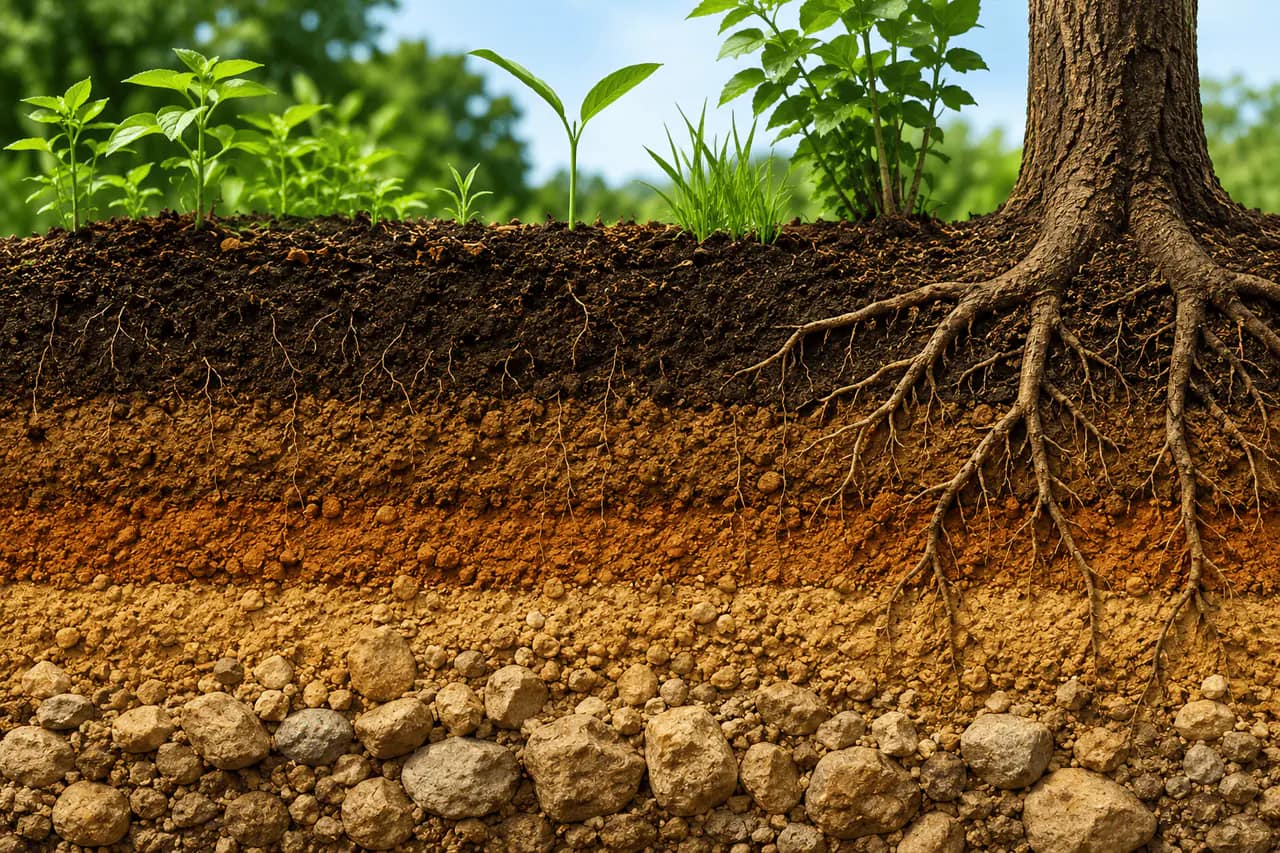
A. Texture B. Field capacity C. Water holding capacity D. Soil flora Answer: A. Texture Explanation: Soil texture is determined by the relative proportion of sand, silt, and clay particles.
- Soil is a mixture of
A. Sand and humus B. Sand and clay C. Sand, clay and humus D. Clay and humus Answer: C. Sand, clay and humus Explanation: Soil is composed of mineral particles such as sand and clay, along with organic matter such as humus.
- Nature and properties of soil depend upon
A. Weathering and climate B. Soil erosion never depends C. Never affected by climate D. Never affected by weathering Answer: A. Weathering and climate Explanation: Soil properties depend on climate, weathering processes, parent material, organic matter, and soil development.
- The soil which is transported by wind is known as
A. Colluvial B. Eolian C. Alluvial D. Glacial soil Answer: B. Eolian Explanation: Eolian soil is transported and deposited by wind.
- If b = 65, d = 45, and N = 100, find dN/dt in a population.
A. 200 B. 2000 C. 100 D. 1000 Answer: B. 2000 Explanation: dN/dt = (b - d)N. Therefore, dN/dt = (65 - 45) × 100 = 20 × 100 = 2000.
- Van't Hoff's rule states that
A. With the increase of every 10°C temperature, the rate of metabolic activities becomes half B. With the decrease of every 10°C temperature, the rate of metabolic activities doubles C. With the increase of every 10°C temperature, the rate of metabolic activities doubles D. With the increase or decrease of temperature, there is no change in metabolic activities Answer: C. With the increase of every 10°C temperature, the rate of metabolic activities doubles Explanation: Van't Hoff's rule states that the rate of metabolic activity generally doubles with every 10°C rise in temperature within a suitable range.
- Which soil type and composition is considered best for growth and development of common vegetation?
A. Loamy and clay soil B. Loamy soil, a mixture of clay and sand C. Black and clay soil D. Both loamy soil and sandy soil Answer: B. Loamy soil, a mixture of clay and sand Explanation: Loamy soil contains a balanced mixture of sand, silt, clay, and humus. It has good aeration and water-holding capacity, making it suitable for common vegetation.
- The soil with the poorest water-holding capacity is
A. Clay B. Loam C. Sandy D. None of these Answer: C. Sandy Explanation: Sandy soil has large particles and large pore spaces, so it drains quickly and has poor water-holding capacity.
- Doubling of metabolic activity with every increase in temperature by 10°C is called
A. Van't Hoff's rule B. Allen's rule C. Bergmann's rule D. Jordan’s rule Answer: A. Van't Hoff's rule Explanation: Van't Hoff's rule states that biological and chemical reaction rates generally increase with a rise in temperature, often doubling with every 10°C increase.
- Which of the following soil is transported by air?
A. Alluvial B. Aerial C. Eolian D. Glacial Answer: C. Eolian Explanation: Eolian soil is transported by wind or air. Alluvial soil is transported by running water, and glacial soil by glaciers.
- What is the study of soil especially with respect to plant growth known as?
A. Study of snakes B. Study of amphibians C. Study of elephants D. None of these Answer: D. None of these Explanation: The study of soil especially with respect to plant growth is called edaphology. Since edaphology is not listed, the correct answer is none of these.
- Where is more than 70% of the world's freshwater contained?
A. Antarctica B. Glaciers and mountains C. Greenland D. Polar ice Answer: D. Polar ice Explanation: A major portion of the world's freshwater is stored in polar ice caps and glaciers.
- Which of the following statements is incorrect with reference to kangaroo rat?
A. Eliminates dilute urine B. Found in North American desert C. Meets its water requirements through internal fat oxidation D. Uses minimal water to remove excretory products Answer: A. Eliminates dilute urine Explanation: Kangaroo rats conserve water by producing highly concentrated urine. They do not eliminate dilute urine.
- How do bears avoid winter?
A. Migration B. Diapause C. Hibernation D. Aestivation Answer: C. Hibernation Explanation: Bears avoid winter by hibernation, a state of reduced metabolic activity that helps conserve energy during cold months.
- What is the term used to describe animals that have a built-in thermostat to maintain a constant body temperature?
A. Biothermic B. Poikilothermic C. Oligothermic D. Homoeothermic Answer: D. Homoeothermic Explanation: Homoeothermic animals maintain a relatively constant internal body temperature. Birds and mammals are examples.
- What does homeostasis describe in biological systems?
A. Tendency of the biological system to change with the slightest change in the environment B. Disturbance of the self-regulatory system C. Tendency of the biological system to resist change D. None of the above Answer: C. Tendency of the biological system to resist change Explanation: Homeostasis is the ability of a biological system to maintain internal stability and resist changes in the external environment.
- Which of the following is a correct match between an animal and a certain phenomenon it exhibits?
A. Pheretima - Sexual dimorphism
B. Musca - Complete metamorphosis
C. Chameleon - Mimicry
D. Taenia - Polymorphism
Answer: B. Musca - Complete metamorphosis
Explanation: Musca shows complete metamorphosis with egg, larva, pupa, and adult stages. Pheretima is hermaphrodite, chameleon shows camouflage, and polymorphism is seen in organisms such as Obelia.

Conclusion on Homeostasis and Adaptation MCQs Biology
Homeostasis and Adaptation MCQs Biology should be revised with keywords such as homeostasis, adaptation, regulator, conformer, partial regulator, homeothermic, poikilothermic, hibernation, aestivation, migration, diapause, xerophyte, hydrophyte, halophyte, osmoregulation, thermoregulation, and metabolic water. Homeostasis and Adaptation MCQs Biology helps aspirants understand that survival depends on both internal regulation and external adaptation. In conclusion, this topic is a high-value area for aspirants preparing ecology and physiology.
Related reading

Master Birth Rate and Death Rate Population MCQs Class 12 Biology: Powerful Practice Questions for Exam Success
Revise Birth Rate and Death Rate Population MCQs Class 12 Biology with natality, mortality, population growth, carrying capacity, and ecology exam preparations.
Comprehensive Edaphology and Soil Ecology Biology MCQs with Answers: Achieve Brilliant Results
Revise Edaphology and Soil Ecology Biology MCQs with Answers covering soil texture,, water-holding capacity, soil organisms, plant growth, and ecology exam prep