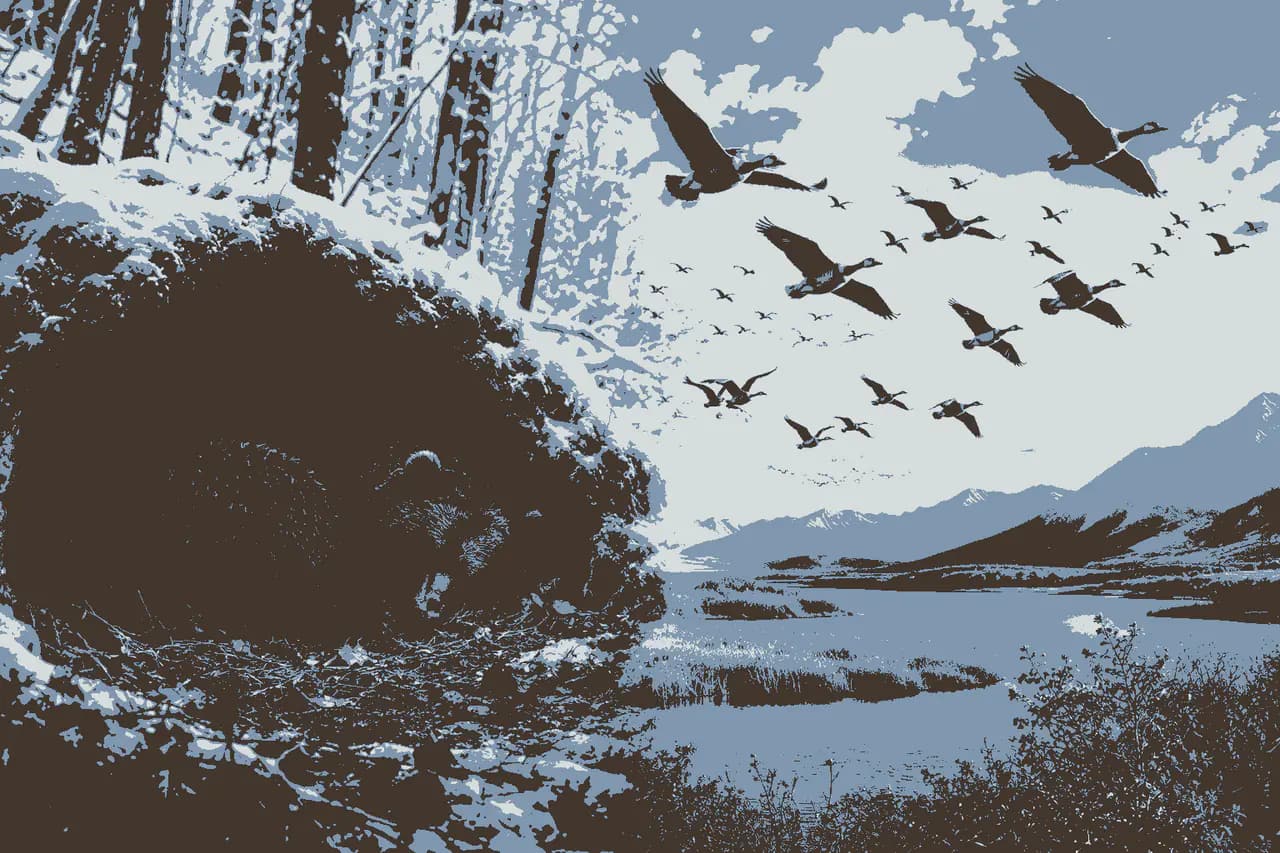
Hibernation and Migration MCQs Solved Answers is an important ecology and adaptation topic for aspirants who want to understand how animals survive unfavorable environmental conditions. Hibernation and Migration MCQs Solved Answers helps aspirants revise the biological strategies used by organisms to escape cold, food shortage, extreme temperatures, and seasonal stress. These survival responses are not random behaviors but well-regulated adaptations controlled by physiology, hormones, biological clocks, metabolism, and environmental signals. Hibernation and Migration MCQs Solved Answers becomes easier when aspirants first understand hibernation. Hibernation is a winter dormancy seen in many animals during cold seasons when food becomes scarce and temperatures drop. Hibernation and Migration MCQs Solved Answers explains that during hibernation, animals reduce their metabolic rate, body temperature, heartbeat, and breathing rate to conserve energy. Bears, bats, ground squirrels, and some rodents are commonly associated with hibernation-like survival strategies. Hibernation and Migration MCQs Solved Answers also helps aspirants understand that hibernation is different from ordinary sleep. In normal sleep, body functions remain relatively active, but during hibernation, physiological activities become extremely slow. Hibernation and Migration MCQs Solved Answers teaches that stored body fat becomes the main energy source during this inactive phase. This allows animals to survive for long periods without regular feeding, movement, or external food intake. Hibernation and Migration MCQs Solved Answers is closely related to the concept of homeostasis. Homeostasis means maintaining a stable internal environment despite external changes. Hibernation and Migration MCQs Solved Answers shows how animals regulate internal conditions when the outer environment becomes unfavorable. For example, animals living in cold regions must avoid excessive heat loss, maintain essential body functions, and survive when plants, insects, or prey are unavailable. Hibernation and Migration MCQs Solved Answers also covers migration, another major survival strategy. Migration is the seasonal movement of animals from one region to another in search of food, breeding grounds, favorable climate, or safety. Hibernation and Migration MCQs Solved Answers helps aspirants remember that birds, fishes, insects, mammals, and some marine animals show migration. Examples include migratory birds, salmon, whales, monarch butterflies, and certain grazing mammals. Hibernation and Migration MCQs Solved Answers becomes strong when aspirants compare hibernation and migration clearly. In hibernation, animals stay in one place and reduce activity to survive harsh conditions. In migration, animals move to a different place where conditions are better. Hibernation and Migration MCQs Solved Answers explains that both strategies help organisms avoid environmental stress, but the method is different. One depends on inactivity and energy conservation, while the other depends on movement. Hibernation and Migration MCQs Solved Answers is also linked with biological rhythms. Many seasonal behaviors are controlled by internal biological clocks and environmental cues such as temperature, day length, rainfall, and food availability. Hibernation and Migration MCQs Solved Answers helps aspirants understand circadian, circannual, and seasonal rhythms. These rhythms guide animals to begin migration, prepare for hibernation, store fat, reproduce, or change activity patterns at the right time. Hibernation and Migration MCQs Solved Answers should also include other dormancy-related terms such as aestivation and diapause. Aestivation is summer dormancy, usually seen during hot and dry conditions. Diapause is a period of suspended development commonly seen in insects. Hibernation and Migration MCQs Solved Answers helps aspirants distinguish winter sleep, summer sleep, and inactive developmental stages. These concepts are important in ecology, animal physiology, and adaptation-based exam preparation. Hibernation and Migration MCQs Solved Answers helps aspirants revise examples from nature. Bears use hibernation to avoid winter food scarcity. Birds migrate across long distances to reach warmer regions or breeding grounds. Fish such as salmon migrate for reproduction. Monarch butterflies migrate seasonally across large distances. Hibernation and Migration MCQs Solved Answers also connects these examples with energy conservation, reproduction, survival, navigation, and environmental response. Hibernation and Migration MCQs Solved Answers is useful for understanding animal adaptations in changing climates. Climate change can disturb migration timing, food availability, breeding cycles, and hibernation patterns. Hibernation and Migration MCQs Solved Answers helps aspirants connect textbook biology with real-world ecological problems. If winters become shorter or warmer, some hibernating animals may wake earlier. If seasonal cues change, migratory animals may reach destinations at the wrong time.
Hibernation and Migration MCQs Solved Answers:
- During adverse season, how do therophytes survive?
A. Rhizomes B. Seeds C. Bulbs D. Corms Answer: B. Seeds Explanation: Therophytes survive unfavourable conditions in the form of seeds. When favourable conditions return, the seeds germinate and develop into new plants.
- Match the following correctly.
List I: A. Diapause B. Cyclomorphosis C. Thermal stratification D. Bioluminescence List II: i. Temperature variations with seasonal changes ii. Light produced by living organisms iii. Inactiveness iv. Seasonal morphological variations Options: A. A-iii, B-iv, C-i, D-ii B. A-iii, B-iv, C-i, D-ii C. A-i, B-iv, C-iii, D-ii D. A-iii, B-iv, C-i, D-ii Answer: B. A-iii, B-iv, C-i, D-ii Explanation: Diapause is a period of reduced metabolic activity or inactiveness. Cyclomorphosis refers to seasonal morphological variations. Thermal stratification is related to temperature variations in water bodies with seasonal changes. Bioluminescence is light produced by living organisms.
- Match the following correctly.
List I: A. Fig tree B. Ophrys C. Sea anemone D. Camouflage E. Monarch butterfly List II: i. Highly distasteful special chemical ii. Cryptically coloured iii. Wasp iv. Sexual deceit v. Stinging cells List III: P. Developing seeds Q. Special chemical present R. Clown fish S. Pollination by wasp T. Insects and frogs Options: A. A-iv-P, B-iii-T, C-v-R, D-ii-Q, E-i-S B. A-i-Q, B-iii-S, C-v-R, D-ii-T, E-iv-P C. A-ii-S, B-iv-P, C-v-R, D-ii-T, E-i-Q D. A-iii-S, B-iv-P, C-v-R, D-ii-T, E-i-Q Answer: D. A-iii-S, B-iv-P, C-v-R, D-ii-T, E-i-Q Explanation: Fig tree and wasp show mutualism. Ophrys uses sexual deceit for pollination. Sea anemone provides protection to clown fish with its stinging cells. Camouflage is seen in insects and frogs. Monarch butterfly has distasteful chemicals that protect it from predators.
- Match the following correctly.
List I: i. Calotropis ii. Cactus iii. Pisaster iv. Monarch butterfly v. Camouflage List II: A. Predator of American Pacific coast B. Insects and frogs cryptically coloured C. Distasteful glycosides D. Cardiac glycosides E. Predator is moth Options: A. i-C, ii-E, iii-A, iv-D, v-B B. i-D, ii-E, iii-A, iv-C, v-B C. i-A, ii-D, iii-E, iv-C, v-B D. i-E, ii-D, iii-C, iv-A, v-B Answer: B. i-D, ii-E, iii-A, iv-C, v-B Explanation: Calotropis produces poisonous cardiac glycosides. Cactus is eaten by moth larvae in certain biological control examples. Pisaster is a predator on the Pacific coast. Monarch butterfly is protected by distasteful glycosides. Camouflage is seen in cryptically coloured insects and frogs.
- Which of the following features of plants is not helpful in adapting to desert life?
A. Presence of thick cuticle on the leaf surface B. Leaves modified into spines C. Presence of sunken stomata D. Absence of trichomes on leaf surface Answer: D. Absence of trichomes on leaf surface Explanation: Thick cuticle, spines, and sunken stomata help desert plants reduce water loss. Absence of trichomes is not helpful because trichomes can reduce transpiration.
- Which term describes organisms that are able to generate heat energy within the body and also retain it?
A. Endothermic B. Exothermic C. Photothermic D. Geothermic Answer: A. Endothermic Explanation: Endothermic organisms generate heat within their bodies and can retain it to maintain body temperature.
- What is the term for the inactive stage that animals undergo during winter, also known as winter sleep?
A. Aestivation B. Hibernation C. Adaptation D. Acclimatization Answer: B. Hibernation Explanation: Hibernation is a winter dormancy or inactive stage in which animals reduce metabolic activity to survive cold conditions.
- What is the term for the maintenance of relatively constant internal conditions different from the surrounding environment?
A. Haemostasis B. Osmoregulation C. Homeostasis D. Biogenesis Answer: C. Homeostasis Explanation: Homeostasis is the maintenance of relatively constant internal conditions despite changes in the external environment.
- Why is it easier for a small animal to run uphill than for a large animal?
A. The efficiency of muscles in large animals is less than in small animals B. It is easier to carry a small body weight C. Smaller animals have a higher metabolic rate D. Small animals have a lower oxygen requirement Answer: C. Smaller animals have a higher metabolic rate Explanation: Small animals generally have a higher metabolic rate, which allows quicker energy release and helps them move rapidly, including running uphill.
- Which two changes usually tend to occur in plain dwellers when they move to high altitudes of 3,500 m or more?
A. Increase in red blood cell size and increased breathing rate B. Increased breathing rate and increase in thrombocyte count C. Increase in red blood cell size and increase in thrombocyte count D. Increase in red blood cell production and increased breathing rate Answer: A. Increase in red blood cell size and increased breathing rate Explanation: At high altitudes, oxygen availability decreases. The body responds by increasing breathing rate and improving oxygen-carrying capacity through changes in red blood cells.
- What is the reason for the increase in red blood cells when there is little oxygen in the body?
A. To compensate for the lack of oxygen B. To decrease breathing depth and rate C. To decrease heart rate D. To increase oxygen levels in the body Answer: A. To compensate for the lack of oxygen Explanation: When oxygen is low, the body produces more red blood cells to increase oxygen transport.
- What term is used to describe the property shown by reptiles and amphibians to change their body temperature according to the external environment?
A. Regulators B. Conformers C. Partial regulators D. Thermophiles Answer: B. Conformers Explanation: Conformers are organisms whose internal body temperature changes according to the external environment. Reptiles and amphibians are examples.
- What is the force opposite to the ability to reproduce at a given rate in the growth and development of every population?
A. Fecundity B. Environmental resistance C. Biotic control D. Mortality Answer: B. Environmental resistance Explanation: Environmental resistance includes limiting factors such as food shortage, predation, competition, disease, and space limitation that oppose population growth.
- What will happen if the number of organisms increases at a place?
A. Interspecies competition B. Intraspecies competition C. No competition will occur D. The organisms will migrate to a different location Answer: B. Intraspecies competition Explanation: When the number of organisms of the same species increases in one place, competition among members of the same species increases.
- What is the evolutionary force that reduces genetic variation by removing low-frequency alleles?
A. Adaptive radiation B. Gene flow C. Genetic drift D. Reproductive isolation Answer: C. Genetic drift Explanation: Genetic drift causes random changes in allele frequencies and can remove low-frequency alleles from a population, reducing genetic variation.
- Which of the following statements about populations and communities are correct?
I. Population is a group of organisms belonging to a species living in a particular area. II. Populations of different species in a given habitat, interacting with one another, constitute a community. III. Population is a group of organisms belonging to different species. Options: A. I and III only B. I and II only C. II and III only D. I, II and III Answer: B. I and II only Explanation: A population consists of organisms of the same species living in a particular area. A community consists of populations of different species interacting in a habitat.
- If there are 250 snails in a pond, and within a year their number increases to 2500 by reproduction, what should be their birth rate per snail per year?
A. 25 B. 15 C. 10 D. 9 Answer: D. 9 Explanation: Birth rate = Change in population / Initial population. Here, birth rate = (2500 - 250) / 250 = 2250 / 250 = 9 per snail per year.
- According to the provided passage, what is the study of ecology of population called?
A. Autecology B. Synecology C. Ecotype D. Demecology Answer: D. Demecology Explanation: Demecology is the branch of ecology that deals with populations, including birth rate, death rate, population size, and growth.
- In a population, unrestricted reproductive capacity is called
A. Biotic potential B. Fertility C. Carrying capacity D. Birth rate Answer: A. Biotic potential Explanation: Biotic potential is the maximum reproductive capacity of a population under ideal environmental conditions.
- If 8 Drosophila in a laboratory population of 80 died during a week, the death rate in the population is ______ individuals per Drosophila per week.
A. 0 B. 0.1 C. 10 D. 1.0 Answer: B. 0.1 Explanation: Death rate = Number of deaths / Total population = 8 / 80 = 0.1 individuals per Drosophila per week.
- The following graph depicts changes in two populations, A and B, of herbivores in a grassy field. A possible reason for these changes is that
A. Population B competed more successfully for food than population A B. Population A produced more offspring than population B C. Population A consumed the members of population B D. Both plant populations in this habitat decreased Answer: A. Population B competed more successfully for food than population A Explanation: Population B increased while population A decreased, suggesting that population B competed more successfully for available resources.
- The species confined to a particular region and not found elsewhere is termed as
A. Rare B. Keystone C. Alien D. Endemic Answer: D. Endemic Explanation: Endemic species are restricted to a particular geographical region and are not naturally found elsewhere.
- Natality refers to
A. Death rate B. Birth rate C. Number of individuals entering a habitat D. Number of individuals leaving the habitat Answer: B. Birth rate Explanation: Natality refers to the birth rate of a population.
- Niche is
A. All the biological factors in the organism's environment B. The physical space where an organism lives C. The functional role played by the organism where it lives D. The range of temperature that the organism needs to live Answer: C. The functional role played by the organism where it lives Explanation: A niche is the functional role of an organism in its habitat, including how it uses resources and interacts with other organisms.
- A biologist studied the population of rats in a barn. He found that the average natality was 250, average mortality was 240, immigration was 20, and emigration was 30. The net increase in population is
A. Zero B. 10 C. 15 D. 5 Answer: A. Zero Explanation: Net increase = (Births + Immigration) - (Deaths + Emigration). Therefore, (250 + 20) - (240 + 30) = 270 - 270 = 0.
- The formula for exponential population growth is
A. dt/dN = rN B. dN/rN = dt C. rN/dN = dt D. dN/dt = rN Answer: D. dN/dt = rN Explanation: Exponential population growth is represented by the equation dN/dt = rN, where r is the intrinsic rate of natural increase.
- Which of the following is the correct sequence of stages of growth curve for bacteria?
A. Lag, Log, Stationary, Decline phase B. Lag, Log, Stationary phase C. Stationary, Lag, Log, Decline phase D. Decline, Lag, Log phase Answer: A. Lag, Log, Stationary, Decline phase Explanation: In a closed culture system, bacterial growth shows four phases: lag phase, log phase, stationary phase, and decline phase.
- An interaction in which one organism is benefited and the other is unaffected is known as
A. Predation B. Commensalism C. Mutualism D. Parasitism Answer: B. Commensalism Explanation: Commensalism is an interaction in which one organism benefits while the other is neither helped nor harmed.
- In an experiment with freshly hatched larvae of Khapra beetle reared on a basal diet with increasing amounts of cholesterol, what does the graph indicate?
A. Cholesterol is an essential dietary requirement of Khapra beetle B. Growth of Khapra beetle is directly proportional to cholesterol concentration C. Cholesterol concentration of 2 µg/g diet is the optimum level D. Growth of Khapra beetle is inhibited when cholesterol concentration exceeds 5 µg/g diet Answer: A. Cholesterol is an essential dietary requirement of Khapra beetle Explanation: The graph indicates that cholesterol is necessary for the growth and development of Khapra beetle larvae.
- What will be the shape of the growth curve of a bacterial population in a lab plotted against time?
A. Sigmoid
B. Hyperbolic
C. Ascending straight line
D. Descending straight line
Answer: B. Hyperbolic
Explanation: Under favourable laboratory conditions with sufficient food and space, a bacterial population may grow exponentially, showing a J-shaped or hyperbolic growth curve.
Conclusion on Hibernation and Migration MCQs Solved Answers
Hibernation and Migration MCQs Solved Answers should be revised with terms such as adaptation, dormancy, hibernation, migration, homeostasis, biological clock, metabolic rate, energy conservation, circannual rhythm, aestivation, diapause, thermoregulation, and survival strategy. Hibernation and Migration MCQs Solved Answers gives aspirants a clear understanding of how organisms respond to environmental challenges. With consistent revision, this topic helps aspirants build confidence in ecology, animal behavior, physiology, biodiversity, and environmental biology.
Related reading
Conquer Organisms Interactions MCQs Solved Answers for Competitive Exams
Revise Organisms Interactions MCQs Solved Answers covering mutualism, commensalism, predation, parasitism, competition, amensalis, ecology for competitive exams

Remarkable Taiga Forest and Temperature Region MCQs Solved Answers for Better Scores
Explore Taiga Forest and Temperature Region MCQs Solved Answers covering boreal forests, temperate zones, coniferous trees , rainfall, biomes, ecology revision.