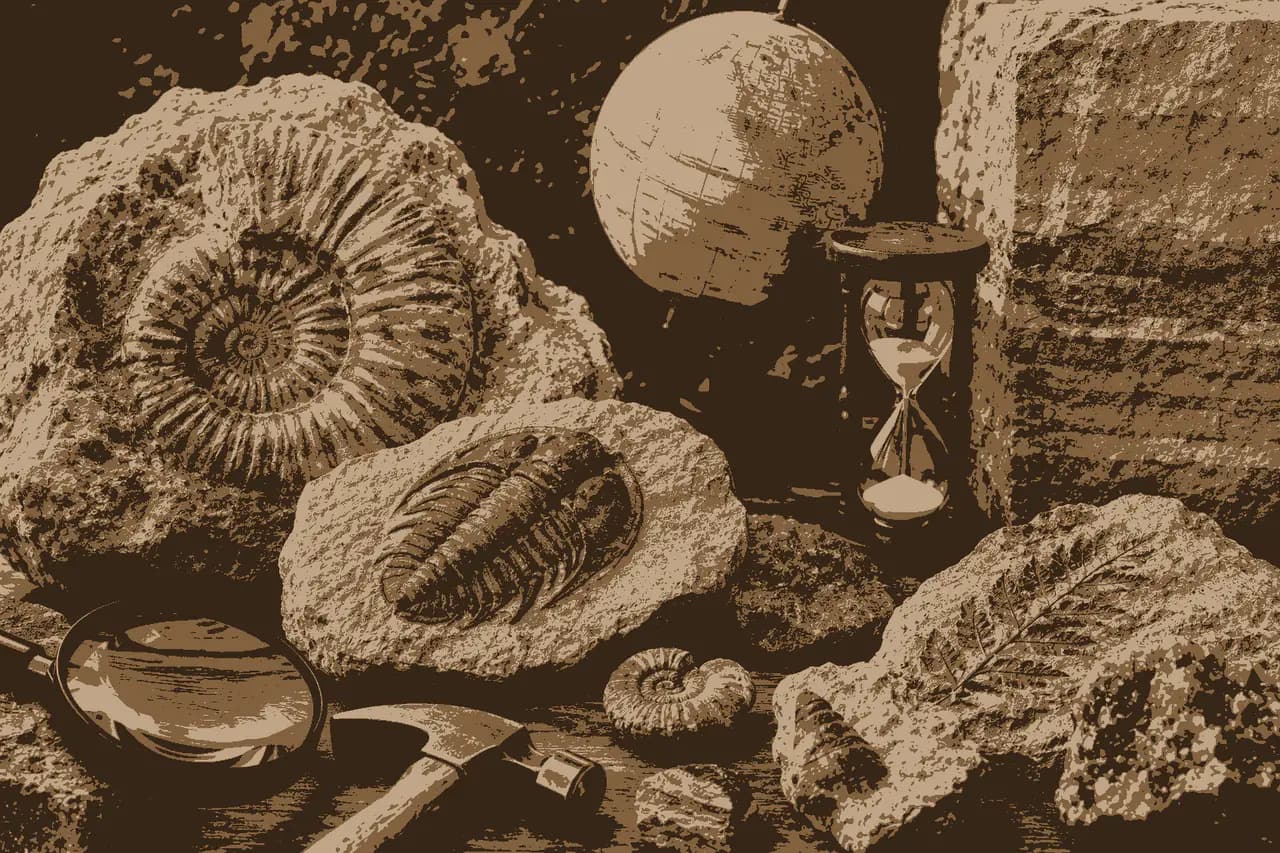
Fossils play a major role in understanding the history of life on Earth, and aspirants preparing for competitive biology examinations frequently search for Fossils and Dating Methods MCQs PDF to strengthen their preparation. Fossils provide direct evidence of ancient organisms and help scientists trace evolutionary relationships over millions of years. Since questions related to fossil records, geological eras, and dating techniques are common in NEET and Class 12 biology, Fossils and Dating Methods MCQs PDF has become an important resource for aspirants aiming to improve conceptual understanding and exam performance.
The study of fossils is known as paleontology, and aspirants revising through Fossils and Dating Methods MCQs PDF learn how preserved remains, impressions, footprints, and traces of organisms reveal information about extinct species. Fossils are generally found in sedimentary rocks where layers of sediments gradually preserve biological material over time. Through Fossils and Dating Methods MCQs PDF, aspirants understand how fossils provide evidence for organic evolution and support Darwin’s theory of descent with modification.
One of the most important concepts covered in Fossils and Dating Methods MCQs PDF is the classification of fossils. Fossils can exist as petrified fossils, molds, casts, impressions, or trace fossils. Petrified fossils form when minerals replace the organic matter of organisms. Trace fossils include footprints, tunnels, and trails left behind by ancient organisms. Aspirants often study these categories carefully because examination questions frequently ask about examples and fossil types in Fossils and Dating Methods MCQs PDF.
The fossil record also helps explain the evolutionary history of organisms. Aspirants using Fossils and Dating Methods MCQs PDF commonly study transitional fossils such as Archaeopteryx, which shows characteristics of both reptiles and birds. Such fossils serve as connecting links and provide strong evidence for evolution. Similarly, horse evolution from Eohippus to Equus is another frequently discussed example in Fossils and Dating Methods MCQs PDF, helping aspirants understand gradual evolutionary change.
Another important topic included in Fossils and Dating Methods MCQs PDF is geological dating. Fossils are useful only when scientists can determine their approximate age. Relative dating and absolute dating are two major approaches used in paleontology. Relative dating estimates the sequence of events by studying rock layers, while absolute dating provides an exact age using radioactive elements. Aspirants revising through Fossils and Dating Methods MCQs PDF often compare these methods because questions frequently test differences between relative and radioactive dating techniques.
Radioactive dating methods are among the most important sections of Fossils and Dating Methods MCQs PDF. Carbon-14 dating is commonly used for relatively recent fossils and archaeological remains. Potassium-argon dating and uranium-lead dating are used for much older rocks and fossils. Electron-spin resonance is considered highly accurate for fossil dating. Aspirants studying Fossils and Dating Methods MCQs PDF learn that radioactive isotopes decay at predictable rates, allowing scientists to estimate the age of fossils precisely.
Aspirants also learn through Fossils and Dating Methods MCQs PDF that fossils reveal changes in Earth’s atmosphere and environmental conditions. Fossilized cyanobacteria suggest that oxygen-producing organisms existed billions of years ago. This contributed to the transformation of Earth’s reducing atmosphere into the oxidizing atmosphere present today. Such concepts are repeatedly emphasized in Fossils and Dating Methods MCQs PDF because they connect evolution, geology, and environmental biology.
Another major topic covered in Fossils and Dating Methods MCQs PDF is living fossils. Living fossils are organisms that have remained relatively unchanged over millions of years. Examples include Limulus and Latimeria. Aspirants preparing with Fossils and Dating Methods MCQs PDF study these organisms because they demonstrate evolutionary stability and survival over geological periods.
Comparative anatomy and fossil studies together provide strong support for evolution. Through Fossils and Dating Methods MCQs PDF, aspirants learn the significance of homologous organs, analogous organs, and vestigial organs. Fossils help establish evolutionary relationships among organisms by revealing structural similarities between extinct and modern species. These concepts are important because many NEET questions combine fossil evidence with comparative anatomy.
The geological time scale is another essential section in Fossils and Dating Methods MCQs PDF. Aspirants study eras such as Precambrian, Paleozoic, Mesozoic, and Cenozoic, along with major evolutionary events associated with each period. Dinosaurs dominated the Mesozoic era, while mammals flourished during the Cenozoic era. Understanding these timelines through Fossils and Dating Methods MCQs PDF helps aspirants answer chronology-based biology questions accurately.
Fossils also help scientists understand extinction events and environmental catastrophes. Georges Cuvier’s theory of catastrophism explained sudden extinctions through floods, droughts, and geological disasters. Aspirants revising with Fossils and Dating Methods MCQs PDF often study how fossil evidence contributed to the development of modern evolutionary theories.
Regular practice using Fossils and Dating Methods MCQs PDF improves memory retention, conceptual clarity, and analytical skills. Since biology entrance examinations frequently include assertion-reason questions, matching questions, and evolutionary interpretations, aspirants benefit greatly from revising fossil evidence systematically. Practicing Fossils and Dating Methods MCQs PDF also helps aspirants quickly identify important scientists, dating techniques, fossil examples, and geological eras.
Fossils and Dating Methods MCQs PDF:
- For natural selection, the important factor is
A. Disuse
B. Variation
C. Catastrophe
D. Special creation
Answer: B. Variation
Explanation: Variation provides differences among organisms, helping natural selection act effectively.
- Which is most recent in human evolution?
A. Neolithic
B. Mesolithic
C. Upper Palaeolithic
D. Middle Palaeolithic
Answer: A. Neolithic
Explanation: The Neolithic age is the most recent stage listed in human evolution.
- According to Cuvier, differences in fossils from different strata were evidence for
A. Divine creation
B. Evolution by natural selection
C. Continental drift
D. Local catastrophic events
Answer: D. Local catastrophic events
Explanation: Cuvier’s catastrophism theory explained extinction due to disasters like floods and droughts.
- The oldest fossil record from India is of
A. Archaeo Spheroides
B. Archaeopteryx
C. Chlamydomonas
D. Stromatolites
Answer: A. Archaeo Spheroides
Explanation: Archaeo Spheroides is the oldest blue-green algal fossil from India.
- Which gases were present in the prebiotic atmosphere?
A. Ammonia
B. Methane
C. Oxygen
D. Both A and B
Answer: D. Both A and B
Explanation: Methane and ammonia existed in primitive Earth’s atmosphere, but oxygen was absent.
- Following are two statements regarding the origin of life:
(A) Earliest organisms were non-green and anaerobic.
(B) First autotrophs were chemoautotrophs that never released oxygen.
A. Both false
B. A correct but B false
C. B correct but A false
D. Both correct
Answer: D. Both correct
Explanation: Primitive organisms were anaerobic heterotrophs and later chemoautotrophs evolved.
- Wings of butterflies and birds look alike due to
A. Convergent evolution
B. Divergent evolution
C. Adaptive radiation
D. Parallel evolution
Answer: A. Convergent evolution
Explanation: Similar functions evolved independently in unrelated organisms.
- Origin of life from inorganic compounds is not possible today because of
A. Lack of raw materials
B. High concentration of oxygen
C. Low temperature
D. Pollution
Answer: B. High concentration of oxygen
Explanation: Oxygen prevents formation of primitive organic compounds.
- Who proposed the theory of continuity of germplasm?
A. Weismann
B. Pasteur
C. De Vries
D. Mendel
Answer: A. Weismann
Explanation: August Weismann proposed continuity of germplasm theory.
- Which process is NOT included in modern synthetic theory of evolution?
A. Gene mutation
B. Gene recombination
C. Natural selection
D. Increase in size
Answer: D. Increase in size
Explanation: Increase in size alone is not an evolutionary mechanism.
- One minute in the geological clock equals approximately
A. 187,500,000 years
B. 52,000 years
C. 3,125,000 years
D. 190,000 years
Answer: C. 3,125,000 years
Explanation: Geological time scales compress millions of years into minutes.
- Which organism transformed Earth’s reducing atmosphere into oxidizing atmosphere?
A. Cyanobacteria
B. Angiosperms
C. Photosynthetic bacteria
D. Eukaryotic algae
Answer: A. Cyanobacteria
Explanation: Cyanobacteria released oxygen during photosynthesis.
- Which statement about protobionts is incorrect?
A. Partially isolated from surroundings
B. Maintained internal environment
C. Able to reproduce
D. Could separate molecules from surroundings
Answer: D. Could separate molecules from surroundings
Explanation: Protobionts were primitive structures lacking advanced selective mechanisms.
- Transformation of Earth’s reducing atmosphere into oxidizing atmosphere occurred mainly due to
A. Aerobic photosynthesizers
B. Anaerobic heterotrophs
C. Anaerobic photosynthesizers
D. Anaerobic chemoheterotrophs
Answer: A. Aerobic photosynthesizers
Explanation: Oxygenic photosynthesis gradually increased atmospheric oxygen.
- Which is NOT proved by chemosynthetic theory of origin of life?
A. Formation of coacervates
B. Formation of true living cells
C. Formation of macromolecules
D. Formation of micromolecules
Answer: B. Formation of true living cells
Explanation: Chemosynthetic theory explains molecular evolution, not formation of actual living cells.
- Who experimentally proved Lamarck’s inheritance of acquired characters wrong?
A. Darwin
B. August Weismann
C. De Vries
D. Haeckel
Answer: B. August Weismann
Explanation: Weismann’s tail-cutting experiments disproved Lamarckism.
- The branch of botany helping understand plant evolution is
A. Palynology
B. Physiology
C. Phytogeography
D. Paleobotany
Answer: D. Paleobotany
Explanation: Paleobotany studies fossil plants and plant evolution.
- Match the following correctly:
(A) Georges Cuvier
(B) Claude Bernard
(C) Louis de Buffon
(D) Richard Owen
(I) Homeostasis
(II) Homology
(III) Comparative anatomy
(IV) System of nomenclature
(V) Natural history
A. I III II V
B. III I V II
C. II I III V
D. III II I IV
Answer: B. III I V II
Explanation:
- Cuvier → Comparative anatomy
- Claude Bernard → Homeostasis
- Buffon → Natural history
- Richard Owen → Homology
- Which is not vestigial in humans?
A. Tail vertebrae
B. Nails
C. Nictitating membrane
D. Vermiform appendix
Answer: B. Nails
Explanation: Nails are functional structures, not vestigial organs.
- The relatively most accurate fossil dating method is
A. Electron-spin resonance method
B. Uranium-lead method
C. Potassium-argon method
D. Radio-carbon method
Answer: A. Electron-spin resonance method
Explanation: ESR dating accurately estimates fossil ages using trapped electron analysis.
- Prototherians are connecting links between
A. Amphibians and aves
B. Reptiles and mammals
C. Fishes and amphibians
D. Reptiles and amphibians
Answer: B. Reptiles and mammals
Explanation: Prototherians possess reptilian and mammalian features.
- The pioneers of organic evolution are
A. Karl Landsteiner, Hugo de Vries, Malthus
B. Darwin, Hugo de Vries, Lamarck, Huxley
C. Lamarck, Karl Landsteiner, Malthus, Hugo de Vries
D. Darwin, Lamarck, Karl Landsteiner, Hugo de Vries
Answer: B. Darwin, Hugo de Vries, Lamarck, Huxley
Explanation: These scientists significantly contributed to evolutionary theory.
- Footprints and trails preserved in sediments are examples of
A. Petrified fossils
B. Impressions
C. Imprints
D. Coprolites
Answer: B. Impressions
Explanation: Impression fossils preserve marks left by organisms.
- Which set includes homologous organs?
A. Hind legs of dog, duck, kangaroo
B. Wings of bat, butterfly, bird
C. Sting of bee, scorpion, mosquito
D. Tail of rat, peacock, earthworm
Answer: A. Hind legs of dog, duck, kangaroo
Explanation: Homologous organs share origin but differ in function.
- Living fossils are
A. Primitive organisms
B. Extinct organisms
C. Organisms unchanged over time
D. Connecting links
Answer: C. Organisms unchanged over time
Explanation: Living fossils retain ancestral characteristics for millions of years.
- Which is a vestigial organ in humans?
A. Hair
B. Intestine
C. Wisdom teeth
D. Muscle of glottis
Answer: C. Wisdom teeth
Explanation: Wisdom teeth have lost much of their original function.
- Organs similar in function but different in structure are called
A. Homologous structures
B. Analogous structures
C. Adaptive structures
D. Variable structures
Answer: B. Analogous structures
Explanation: Analogous organs arise through convergent evolution.
- The earliest fossil form in horse evolution is
A. Merychippus
B. Mesohippus
C. Eohippus
D. Equus
Answer: C. Eohippus
Explanation: Eohippus is considered the earliest ancestor of the modern horse.
- Which statement is NOT true for Archaeopteryx?
A. Wings had three clawed digits
B. Hind feet had five digits
C. Long lizard-like tail
D. Thecodont teeth on jaws
Answer: B. Hind feet had five digits
Explanation: Archaeopteryx did not possess five digits on hind limbs.
- Archaeopteryx belonged to which period?
A. Jurassic
B. Cretaceous
C. Triassic
D. Permian
Answer: A. Jurassic
Explanation: Archaeopteryx lived during the Jurassic period.
Conclusion on Fossils and Dating Methods MCQs PDF
In conclusion, Fossils and Dating Methods MCQs PDF is an essential study resource for aspirants preparing for NEET and other biology examinations. The topic covers fossil formation, geological dating methods, transitional fossils, living fossils, evolutionary evidence, and geological eras in detail. Continuous revision through Fossils and Dating Methods MCQs PDF helps aspirants strengthen biology fundamentals, improve confidence, and achieve better examination performance.
Related reading
Ultimate Jean Baptiste Lamarck Evolution Theory MCQs with Answers for Smart NEET Prepraration
Master Jean Baptiste Lamarck Evolution Theory MCQs with Answers for NEET , Class 12 Biology. Learn Lamarckism, acquired characters, evolution concepts examples.
Powerful Common Ancestor of Apes and Humans MCQs with Answers for Competitive Exams
Learn Common Ancestor of Apes and Humans MCQs with Answers for NEET and Class 12 Biology. Explore fossils, evolution, primates, and human ancestry concepts exam