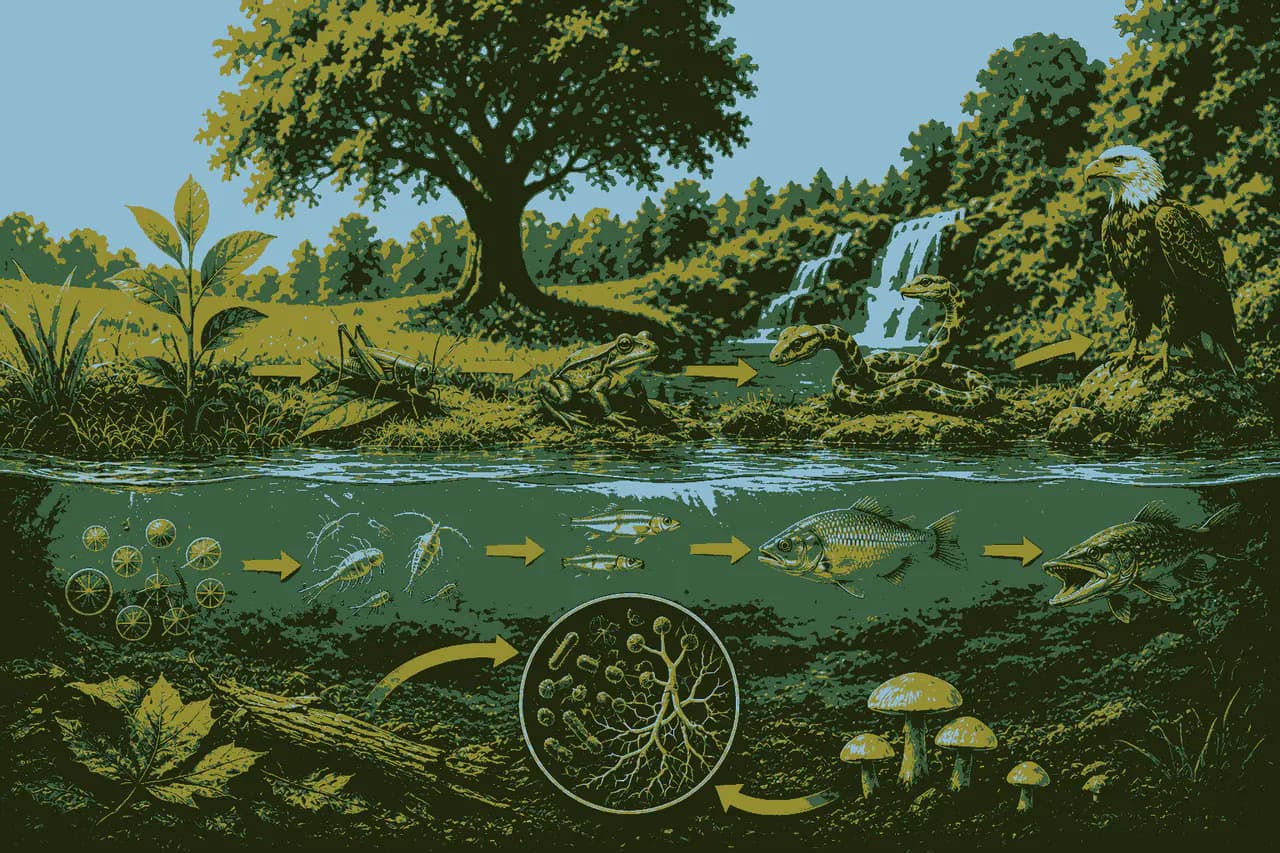
Energy Flow in Ecosystem MCQs PDF Class 12 is an important ecology topic for aspirants who want to understand how energy enters, moves, and decreases across different trophic levels in an ecosystem. Energy Flow in Ecosystem MCQs PDF Class 12 helps aspirants revise producers, consumers, decomposers, food chains, food webs, productivity, trophic levels, ecological pyramids, and the 10 percent law in a simple and exam-focused way. Energy Flow in Ecosystem MCQs PDF Class 12 becomes easier when aspirants first understand that the Sun is the primary source of energy for most ecosystems. Green plants, algae, and some bacteria capture solar energy through photosynthesis and convert it into chemical energy. Energy Flow in Ecosystem MCQs PDF Class 12 explains that producers form the first trophic level because they prepare organic food and support all other organisms directly or indirectly. Energy Flow in Ecosystem MCQs PDF Class 12 also helps aspirants understand that energy flow is unidirectional. Energy enters through producers, moves to herbivores, then to carnivores, and finally reaches decomposers through dead organic matter. Energy Flow in Ecosystem MCQs PDF Class 12 teaches that energy does not cycle like nutrients. Instead, energy is gradually lost as heat at each trophic level due to respiration and metabolic activities. Energy Flow in Ecosystem MCQs PDF Class 12 is closely related to the 10 percent law. According to this concept, only about 10 percent of energy is transferred from one trophic level to the next, while the remaining energy is lost mainly as heat. Energy Flow in Ecosystem MCQs PDF Class 12 helps aspirants understand why food chains are usually short. Since energy decreases at every step, very little energy remains available for higher trophic levels. Energy Flow in Ecosystem MCQs PDF Class 12 also covers primary productivity. Primary productivity refers to the rate at which producers form organic matter through photosynthesis. Energy Flow in Ecosystem MCQs PDF Class 12 explains the difference between gross primary productivity and net primary productivity. Gross primary productivity is the total organic matter produced by plants, while net primary productivity is the biomass left after respiratory losses. This stored biomass becomes available to herbivores and decomposers. Energy Flow in Ecosystem MCQs PDF Class 12 is useful for understanding secondary productivity as well. Secondary productivity is the rate at which consumers form new organic matter by using the food they consume. Energy Flow in Ecosystem MCQs PDF Class 12 helps aspirants remember that producers are linked with primary productivity, while consumers are linked with secondary productivity. This distinction is important for ecosystem-based questions. Energy Flow in Ecosystem MCQs PDF Class 12 also explains standing crop and biomass. Standing crop is the mass of living material present at a particular trophic level at a specific time. Energy Flow in Ecosystem MCQs PDF Class 12 teaches aspirants that biomass may be expressed as fresh weight or dry weight. Forest ecosystems usually have very high biomass because of large trees and dense vegetation, while aquatic ecosystems may show rapid productivity due to phytoplankton and algae. Energy Flow in Ecosystem MCQs PDF Class 12 becomes stronger when aspirants revise food chains. A grazing food chain begins with green plants and passes through herbivores and carnivores. A detritus food chain begins with dead organic matter and involves decomposers and detritivores. Energy Flow in Ecosystem MCQs PDF Class 12 helps aspirants understand that both types of food chains are important for ecosystem functioning and nutrient recycling. Energy Flow in Ecosystem MCQs PDF Class 12 also includes decomposers. Decomposers such as bacteria and fungi break down dead organisms and waste materials into simpler substances. Energy Flow in Ecosystem MCQs PDF Class 12 explains that decomposers do not return energy to the Sun, but they recycle minerals and nutrients back into the ecosystem. If decomposers are removed, nutrient cycling is disturbed and dead organic matter accumulates. Energy Flow in Ecosystem MCQs PDF Class 12 helps aspirants connect energy flow with ecological pyramids. The pyramid of energy is always upright because energy decreases at each successive trophic level. Energy Flow in Ecosystem MCQs PDF Class 12 also explains that pyramids of number and biomass may be upright or inverted depending on the ecosystem. However, energy flow always follows the same direction from producers to consumers.
Energy Flow in Ecosystem MCQs PDF Class 12
- What is the reason for the highest biomass in aquatic ecosystems?
A. Nanoplankton, blue-green algae, green algae B. Sea grass and slime molds C. Benthic and brown algae D. Diatoms Answer: C. Benthic and brown algae Explanation: The highest biomass in aquatic ecosystems is mainly contributed by benthic and brown algae. The benthic zone includes the bottom region of water bodies where many organisms and algae are found.
- In the food chain “Plant → Insect → Frog → A → Eagle”, what is A?
A. Cobra B. Parrot C. Rabbit D. Wolf Answer: A. Cobra Explanation: In the food chain Plant → Insect → Frog → Cobra → Eagle, cobra acts as the next consumer after frog and becomes prey for the eagle.
- Which animal may occupy more than one trophic level in the same ecosystem at the same time?
A. Frog B. Sparrow C. Lion D. Goat Answer: B. Sparrow Explanation: A sparrow can occupy more than one trophic level. It acts as a primary consumer when it feeds on seeds and fruits, and as a secondary consumer when it feeds on insects and worms.
- In a maize field ecosystem, which of the following is a primary consumer?
A. Lion B. Grasshopper C. Wolf D. Phytoplankton Answer: B. Grasshopper Explanation: Grasshopper is a primary consumer because it feeds directly on producers such as maize plants. Lion and wolf are carnivores, while phytoplankton are producers in aquatic ecosystems.
- Biotic and abiotic components form
A. Community B. Society C. Population D. Species Answer: A. Community Explanation: According to the given answer key, the answer is community. However, scientifically, biotic and abiotic components together form an ecosystem. A community includes only living organisms, while an ecosystem includes both living and non-living components.
- World Summit on Sustainable Development, 2002, was held in
A. Argentina B. South Africa C. Brazil D. Sweden Answer: B. South Africa Explanation: The World Summit on Sustainable Development was held in Johannesburg, South Africa, from 26 August to 4 September 2002.
- Match the following and select the correct option.
A. Earthworm - Pioneer species B. Succession - Detritivore C. Ecosystem service - Natality D. Population growth - Pollination Correct matching: A. Earthworm - Detritivore B. Succession - Pioneer species C. Ecosystem service - Pollination D. Population growth - Natality Options: A. i, ii, i, iv B. iv, i, iii, ii C. iii, ii, iv, i D. ii, i, iv, iii Answer: D. ii, i, iv, iii Explanation: Earthworm is a detritivore. Succession begins with pioneer species. Pollination is an ecosystem service. Natality is related to population growth.
- Choose the correct statements.
A. The total annual account of wet organic matter of the forest can be estimated with the annual net productivity amount of standing forest. B. Ecosystems also exert direct physical influence that helps to moderate regional and local weather. C. Decline in pollinator activity could mean rising cost of pollination-dependent fruits and vegetables. D. Costanza and his colleagues have tried to put a price tag on nature’s life-support services. Options: A. A, B, C B. B, C, D C. A, C, D D. A, B, D Answer: B. B, C, D Explanation: Ecosystems influence local and regional weather, pollinator decline can increase the cost of pollination-dependent crops, and Robert Costanza and colleagues estimated the economic value of ecosystem services. Statement A is incorrect.
- In a population, when the growth rate reaches its maximum, it is called
A. Carrying capacity B. Biotic potential C. Positive interactions D. Negative growth Answer: B. Biotic potential Explanation: Biotic potential is the maximum reproductive capacity or maximum possible growth rate of a population under ideal environmental conditions.
- Which of the following is expected to have the highest value in g/m²/year in an ecosystem?
A. Secondary production B. Tertiary production C. Gross production D. Net production Answer: C. Gross production Explanation: Gross production, or gross primary productivity, is the total organic matter produced by producers before respiratory losses. Therefore, it has the highest value.
- The amount of biomass or organic matter produced per unit area over a time period by plants during photosynthesis is called
A. Secondary production B. Primary production C. Gross primary production D. Net primary production Answer: B. Primary production Explanation: Primary production is the amount of biomass or organic matter produced by plants per unit area over a given time through photosynthesis.
- Match the items in List I with the corresponding items in List II.
List I: A. Carbon dissolved in oceans B. Annual fixation of carbon through photosynthesis C. PAR captured by plants D. Productivity of oceans List II: i. 55 billion tons ii. 71% iii. 4 × 10³ kg iv. 2 to 10% Options: A. ii, iv, iii, i B. iii, iv, ii, i C. ii, iii, iv, i D. iii, ii, i, iv Answer: C. ii, iii, iv, i Explanation: According to the given matching key, carbon dissolved in oceans is matched with 71%, annual fixation of carbon through photosynthesis with 4 × 10³ kg, PAR captured by plants with 2 to 10%, and productivity of oceans with 55 billion tons.
- In an ecosystem, the rate of production of organic matter during photosynthesis is termed as
A. Gross primary productivity B. Secondary productivity C. Net productivity D. Net primary productivity Answer: A. Gross primary productivity Explanation: Gross primary productivity is the rate at which producers capture solar energy and convert it into organic matter during photosynthesis.
- The mass of living material at a trophic level at a particular time is called
A. Standing state B. Net primary productivity C. Standing crop D. Gross primary productivity Answer: C. Standing crop Explanation: Standing crop is the mass of living organisms present at a trophic level at a particular time. It may be measured as biomass or number per unit area.
- In a growing population of a country,
A. Pre-reproductive individuals are more than reproductive individuals B. Reproductive individuals are less than post-reproductive individuals C. Pre-reproductive individuals are less than reproductive individuals D. Reproductive and pre-reproductive individuals are equal in number Answer: A. Pre-reproductive individuals are more than reproductive individuals Explanation: In a growing population, the number of young or pre-reproductive individuals is greater than the reproductive and post-reproductive groups.
- Secondary productivity is the rate of formation of new organic matter by
A. Decomposer B. Producer C. Parasite D. Consumer Answer: D. Consumer Explanation: Secondary productivity is the rate at which consumers convert food energy into new biomass.
- Which ecosystem has the maximum biomass?
A. Forest ecosystem B. Grassland ecosystem C. Pond ecosystem D. Lake ecosystem Answer: A. Forest ecosystem Explanation: Forest ecosystems have the maximum biomass among terrestrial ecosystems because of their large trees and dense vegetation.
- The rate of formation of new organic matter by a rabbit in a grassland is called
A. Net primary productivity B. Gross primary productivity C. Net productivity D. Secondary productivity Answer: D. Secondary productivity Explanation: Rabbit is a consumer. The formation of new organic matter by consumers is called secondary productivity.
- The energy present in the biomass of plants is known as
A. Gross primary productivity B. Net productivity C. Secondary productivity D. Net primary productivity Answer: D. Net primary productivity Explanation: Net primary productivity is the energy or biomass stored in plant tissues after respiratory losses. It is available to herbivores and decomposers.
- The biomass available for consumption by herbivores and decomposers is called
A. Net primary productivity B. Secondary productivity C. Standing crop D. Gross primary productivity Answer: A. Net primary productivity Explanation: Net primary productivity is the biomass left after plant respiration. It is available for consumption by herbivores and decomposers.
- Which ecosystem has the highest annual net primary productivity?
A. Tropical deciduous forest B. Temperate evergreen forest C. Desert D. Tropical rain forest Answer: D. Tropical rain forest Explanation: Tropical rainforests have the highest annual net primary productivity because of warm temperature, abundant rainfall, and high plant diversity.
- Which one of the following is not a functional unit of an ecosystem?
A. Productivity B. Stratification C. Energy flow D. Decomposition Answer: B. Stratification Explanation: Productivity, decomposition, energy flow, and nutrient cycling are major functional aspects of an ecosystem. Stratification is a structural feature, not a functional unit.
- Identify the incorrect statement regarding the flow of energy between various components of the food chain.
A. Each trophic level loses some energy as heat to the environment. B. The amount of energy available at each trophic level is 10% of the previous trophic level. C. Energy flow is unidirectional. D. Green plants capture about 10% of the solar energy that falls on leaves. Answer: D. Green plants capture about 10% of the solar energy that falls on leaves. Explanation: Energy flow in an ecosystem is unidirectional, and only about 10% of energy is transferred from one trophic level to the next. Green plants capture only a small fraction of incoming solar radiation, not 10% of the total solar energy falling on leaves.
- What is the term used for the increase in toxic concentration from one trophic level to another trophic level in an ecosystem?
A. Ecological succession B. Biomagnification C. Bioindicator D. Cytological effect Answer: B. Biomagnification Explanation: Biomagnification is the increase in concentration of toxic substances at successive trophic levels in a food chain.
- In a forest ecosystem, what is the role of fungi?
A. Producer B. Decomposer C. Top consumer D. Autotroph Answer: B. Decomposer Explanation: Fungi act as decomposers in forest ecosystems. They break down dead organic matter and recycle nutrients.
- How does energy enter a food chain in an ecosystem?
A. Producers B. Primary consumers C. Secondary consumers D. Tertiary consumers Answer: A. Producers Explanation: Energy enters a food chain through producers, mainly green plants, which capture solar energy through photosynthesis.
- A lake with nutrients is called
A. Trophic B. Euphoric C. Oligotrophic D. Eutrophic Answer: D. Eutrophic Explanation: A eutrophic lake is rich in nutrients such as nitrates and phosphates. It often supports abundant algae and aquatic plant growth.
- Energy transferred from one trophic level to another is
A. 5% B. 10% C. 15% D. 20% Answer: B. 10% Explanation: According to Lindeman’s 10% law, only about 10% of energy is transferred from one trophic level to the next.
- Decomposers are
A. Autotrophs B. Autoheterotrophs C. Organotrophs D. Heterotrophs Answer: D. Heterotrophs Explanation: Decomposers are heterotrophs that feed on dead and decaying organic matter. Examples include bacteria and fungi.
- If decomposers are removed, what will happen to the ecosystem?
A. Energy cycle is stopped
B. Mineral cycle is stopped
C. Consumers cannot absorb solar energy
D. Rate of decomposition of minerals increases
Answer: B. Mineral cycle is stopped
Explanation: Decomposers break down organic matter and release minerals back into the ecosystem. If decomposers are removed, mineral cycling will be disrupted.
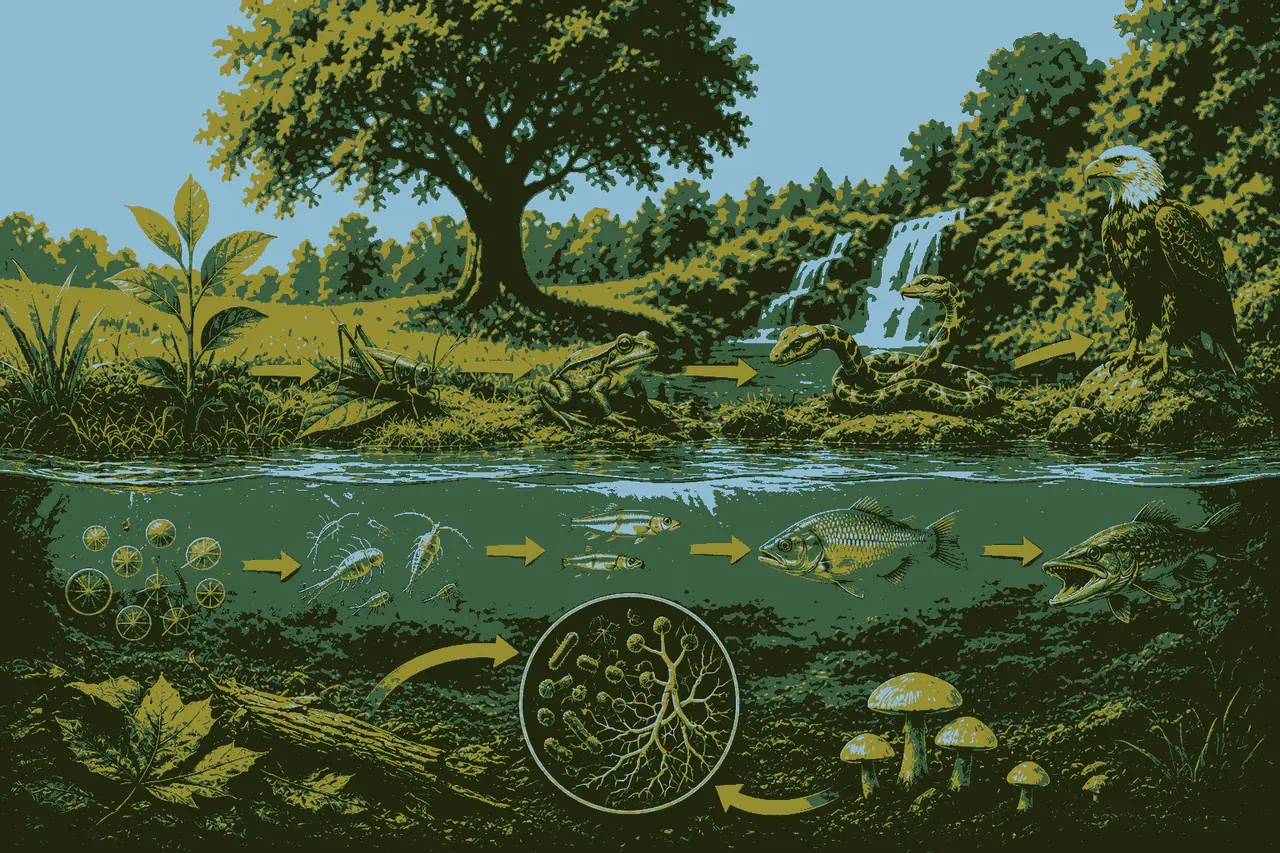
Conclusion on Energy Flow in Ecosystem MCQs PDF Class 12
Energy Flow in Ecosystem MCQs PDF Class 12 is important for Class 12 Biology, NEET, and ecology revision because many questions test productivity, trophic levels, energy transfer, decomposers, biomagnification, and ecosystem functions. In conclusion, Energy Flow in Ecosystem MCQs PDF Class 12 gives aspirants a clear understanding of how ecosystems remain functional through energy transfer, biomass production, nutrient recycling, and trophic relationships.
Related reading
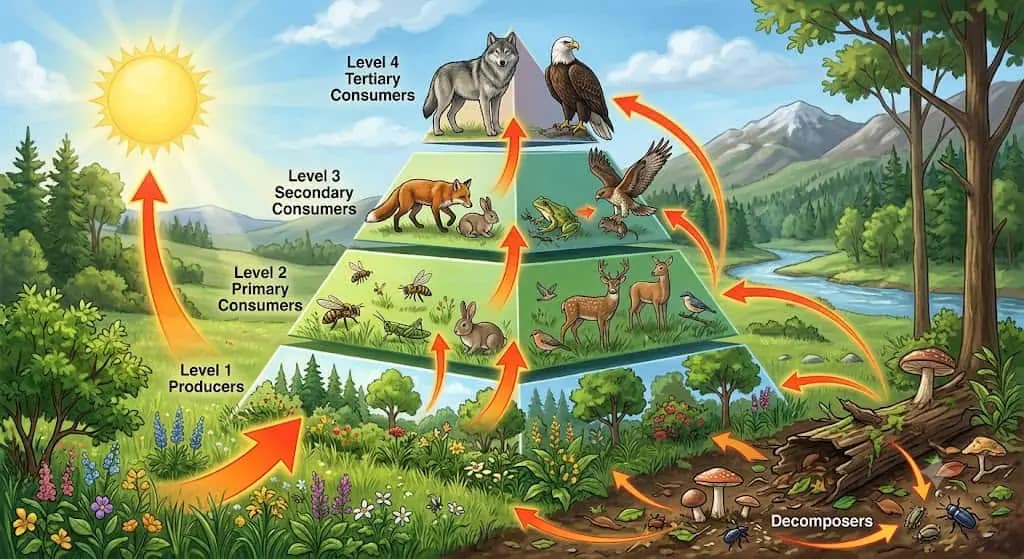
Avoid Common Mistakes in Energy Flow and Trophic Levels MCQs PDF Class 12 Biology
Revise Energy Flow and Trophic Levels MCQs PDF Class 12 Biology covering ecological pyramids, 10% law, NPP, food chains, succession and trophic levels for exams
Boost Your Score with Endemic Species and Biodiversity MCQs PDF Class 12 for NEET, JEE & CUET
Revise Endemic Species and Biodiversity MCQs PDF Class 12 covering biodiversity hotspots, endemic species, genetic diversity, alien invasion, biodiversity loss.