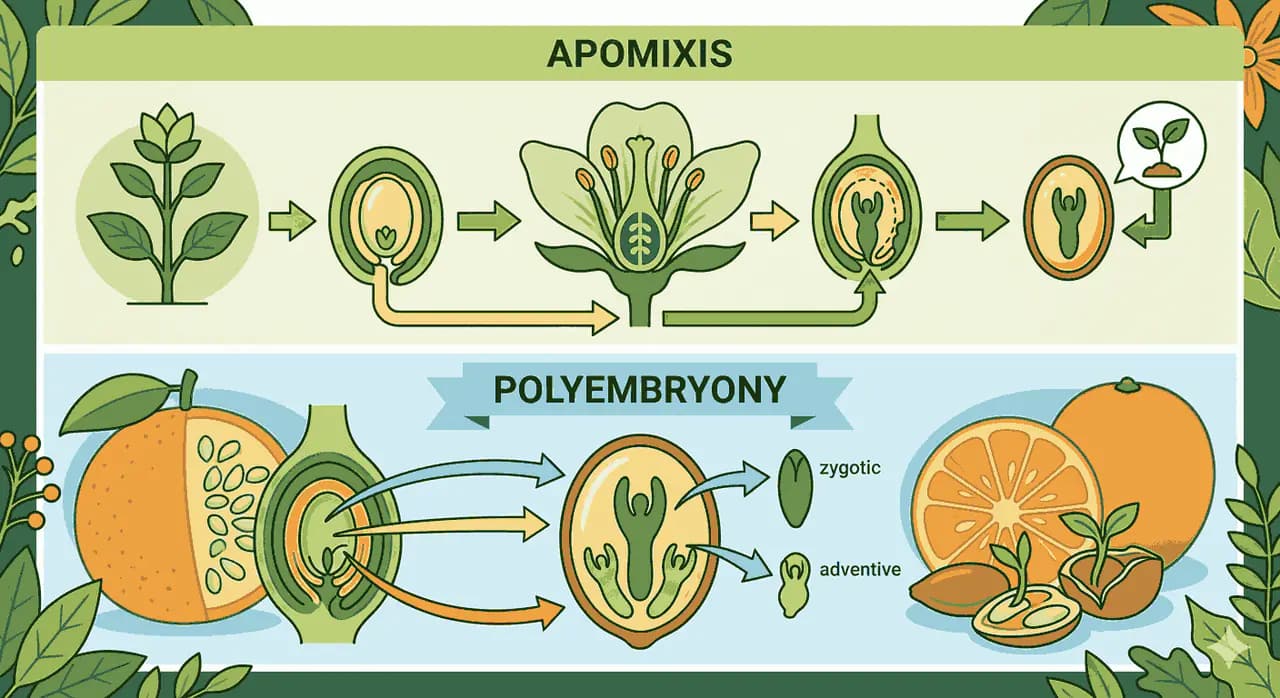
Understanding plant reproduction becomes much easier when aspirants regularly practice Apomixis and polyembryony MCQs class 12 biology with answers pdf. These topics are highly important in Class 12 Biology and are frequently asked in board exams as well as competitive exams like NEET. By solving Apomixis and polyembryony MCQs class 12 biology with answers pdf, aspirants can strengthen their conceptual clarity and improve accuracy in exams.
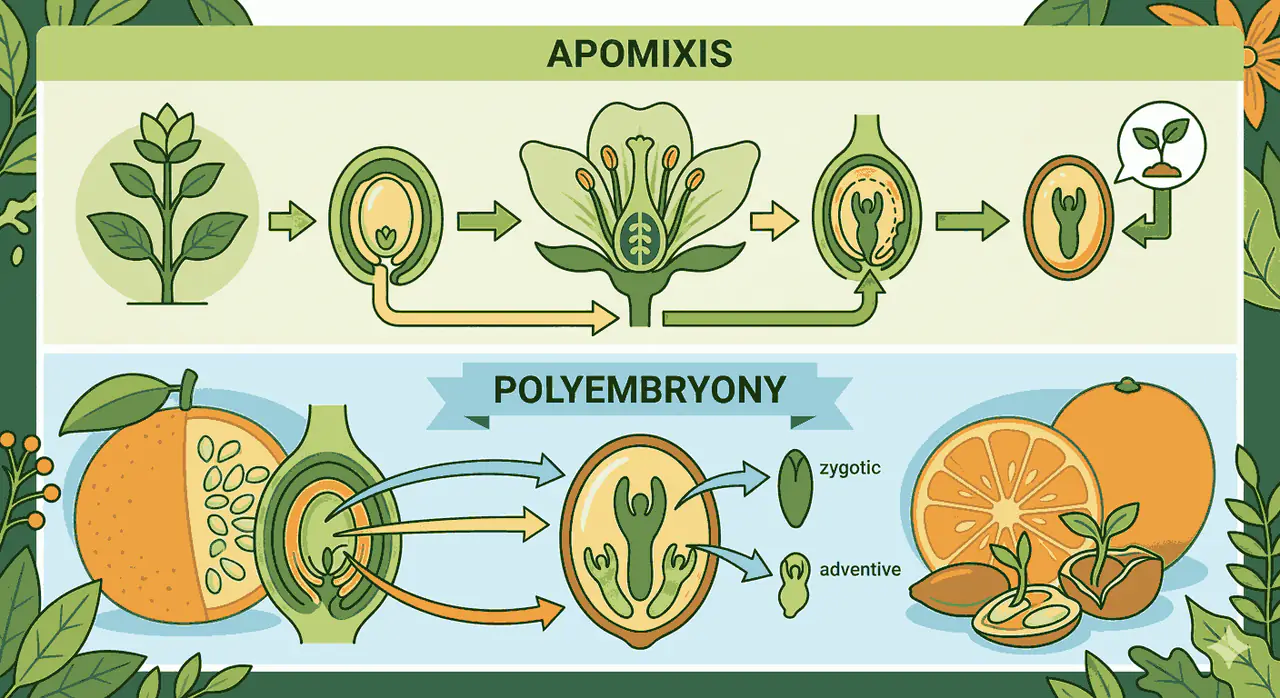
Apomixis is a special type of asexual reproduction where seeds are formed without fertilization. This concept is a key focus area in Apomixis and polyembryony MCQs class 12 biology with answers pdf because it helps aspirants understand how plants can produce genetically identical offspring. In apomixis, meiosis and fertilization are bypassed, which means the resulting plants are clones of the parent plant. Practicing Apomixis and polyembryony MCQs class 12 biology with answers pdf helps aspirants identify different types of apomixis such as recurrent and non-recurrent apomixis.
Polyembryony, on the other hand, refers to the development of more than one embryo within a single seed. This fascinating phenomenon is also widely covered in Apomixis and polyembryony MCQs class 12 biology with answers pdf. It is commonly observed in plants like citrus and mango, where multiple embryos can arise either from zygotic or nucellar origin. Through consistent practice of Apomixis and polyembryony MCQs class 12 biology with answers pdf, aspirants can easily differentiate between true polyembryony and adventive embryony.
Another important concept linked with apomixis is adventive embryony, where embryos develop from somatic tissues like nucellus or integuments. This concept is frequently included in Apomixis and polyembryony MCQs class 12 biology with answers pdf. Understanding this helps aspirants answer application-based questions that require deeper conceptual thinking. Regular revision using Apomixis and polyembryony MCQs class 12 biology with answers pdf ensures better retention of such complex topics.
The significance of apomixis in agriculture cannot be ignored. It has the potential to revolutionize hybrid seed production by maintaining desirable traits across generations. This real-world application is often highlighted in Apomixis and polyembryony MCQs class 12 biology with answers pdf, making it easier for aspirants to connect theory with practical use. Practicing Apomixis and polyembryony MCQs class 12 biology with answers pdf also helps in understanding how apomixis can reduce the cost of hybrid seeds.
Polyembryony also has practical importance, especially in horticulture. It helps in producing uniform and disease-resistant plants. These aspects are frequently tested through Apomixis and polyembryony MCQs class 12 biology with answers pdf, allowing aspirants to develop a well-rounded understanding of the topic. By solving Apomixis and polyembryony MCQs class 12 biology with answers pdf, aspirants can easily recognize examples and mechanisms of polyembryony.
In addition, aspirants must understand the differences between apomixis, parthenogenesis, and parthenocarpy. These distinctions are often confusing but are clearly addressed in Apomixis and polyembryony MCQs class 12 biology with answers pdf. Regular practice ensures that aspirants do not mix up these closely related concepts. Solving Apomixis and polyembryony MCQs class 12 biology with answers pdf helps in identifying key differences and avoiding common mistakes.
Consistency is the key to mastering biology concepts. By including Apomixis and polyembryony MCQs class 12 biology with answers pdf in daily study routines, aspirants can significantly improve their performance. These MCQs are designed to test both basic knowledge and higher-order thinking skills. Practicing Apomixis and polyembryony MCQs class 12 biology with answers pdf regularly enhances speed, accuracy, and confidence.
Moreover, revising concepts through Apomixis and polyembryony MCQs class 12 biology with answers pdf helps aspirants identify weak areas and focus on improvement. It also helps in time management during exams, which is crucial for scoring high marks. The more aspirants practice Apomixis and polyembryony MCQs class 12 biology with answers pdf, the better they perform under exam pressure.
Apomixis and polyembryony MCQs class 12 biology with answers pdf:
1.
During which of the following formations does free nuclear division occur?
a) Flower
b) Endosperm
c) Gametes
d) Fruit
Answer: b
Explanation: Free nuclear division occurs during endosperm formation where nuclear divisions are not followed by cytokinesis, forming a multinucleate structure (e.g., coconut water).
2.
What is the function of the micropyle of a seed?
a) Male gametophyte entry
b) Pollen tube
c) Water entry
d) Gas exchange
Answer: c
Explanation: Micropyle allows water to enter the seed during germination.
3.
How many seeds are produced from how many fruits of maize?
a) 200 seeds from 200 fruits
b) 100 seeds from 100 fruits
c) 50 seeds from 50 fruits
d) 5 seeds from 5 fruits
Answer: a
Explanation: Maize fruit (caryopsis) is single-seeded, so seeds = fruits.
4.
Parthenogenetic embryos are formed by:
a) Unfertilized eggs
b) Fertilized eggs
c) Sporophytic cells
d) Male gametophyte
Answer: a
Explanation: Parthenogenesis involves embryo development from an unfertilized egg.
5.
Which PGR induces parthenocarpy in tomatoes?
a) Auxin
b) Gibberellin
c) Cytokinin
d) Ethylene
Answer: a
Explanation: Auxin promotes fruit development without fertilization.
6.
Aleurone grains are rich in:
a) Fat
b) Protein
c) Carbohydrates
d) Auxins
Answer: b
Explanation: Aleurone layer is protein-rich and aids in seed germination.
7.
Parthenocarpy makes no sense in:
a) Banana
b) Orange
c) Lemon
d) Pomegranate
Answer: d
Explanation: In pomegranate, seeds are edible, so seedless fruits are not useful.
8.
Seed germination while attached to parent plant is:
a) Apomixis
b) Vivipary
c) Parthenocarpy
d) Parthenogenesis
Answer: b
Explanation: Vivipary occurs in plants like Rhizophora.
9.
Seed coat is derived from:
a) Pericarp
b) Epicarp
c) Integuments
d) Nucellus
Answer: c
Explanation: Integuments form testa and tegmen.
10.
Parthenogenesis is a form of:
a) Budding
b) Asexual reproduction
c) Sexual reproduction
d) Regeneration
Answer: b
Explanation: It is embryo formation without fertilization.
11.
Ovary developing into fruit without fertilization is:
a) Porogamy
b) Apospory
c) Apogamy
d) Parthenocarpy
Answer: d
Explanation: Parthenocarpy leads to seedless fruits.
12.
Endosperm in maize is covered by:
a) Aleurone layer
b) Embryo
c) Cotyledon
d) Plumule
Answer: a
Explanation: Aleurone is the outer protein layer of endosperm.
13.
Parachute mechanism of seed dispersal occurs in:
a) Cotton
b) Sunflower
c) Physalia
d) Calotropis
Answer: d
Explanation: Calotropis seeds have hairy structures aiding wind dispersal.
14.
Edible part of paddy is:
a) Mesocarp
b) Hull
c) Endosperm and embryo
d) Inflorescence
Answer: c
Explanation: Rice grain consists mainly of endosperm and embryo.
15.
Arrhenotoky is related to:
a) Parthenogenesis
b) Wax formation
c) Organogenesis
d) Both (a) and (b)
Answer: a
Explanation: Arrhenotoky is a type of parthenogenesis producing males.
16.
Flower divisible into two equal halves by one plane:
a) Zygomorphic
b) Hypogynous
c) Perigynous
d) Epigynous
Answer: a
Explanation: Zygomorphic flowers have bilateral symmetry.
17.
Seed formation without fertilization in flowering plants involves the process of:
a) Apomixis
b) Sporulation
c) Budding
d) Somatic hybridization
Answer: a
Explanation: Apomixis is a special mode of asexual reproduction in which seeds are formed without fertilization. In this process, meiosis and syngamy are bypassed, and the embryo develops directly from diploid cells. This leads to genetically identical offspring (clones), making it highly valuable in agriculture for maintaining hybrid traits across generations.
18.
Where do apomictic embryos in citrus arise from?
a) Synergids
b) Maternal sporophytic tissue in ovule
c) Antipodal cells
d) Diploid egg
Answer: b
Explanation: In citrus, apomictic embryos arise from the nucellar (sporophytic) tissue of the ovule. This process is known as adventive embryony. These embryos develop alongside the sexually produced embryo and are genetically identical to the mother plant, ensuring uniformity.
19.
Which strategy can be employed to overcome the expense of purchasing hybrid seeds every year?
a) Production of apomictic seeds
b) Parthenocarpy
c) Synthetic seeds
d) Conventional plant breeding
Answer: d
Explanation: Conventional plant breeding is commonly used to reduce dependency on hybrid seeds. However, apomixis (option a) has greater future potential because it can fix hybrid vigor permanently. Currently, conventional breeding remains the practical solution in agriculture.
20.
Where does nucellar polyembryony occur?
a) Corchorus
b) Citrus
c) Carthamus
d) Zea mays
Answer: b
Explanation: Nucellar polyembryony is commonly observed in Citrus species. Multiple embryos arise from nucellar cells, leading to several seedlings from a single seed. This is important for producing true-to-type plants.
21.
What is amphimixis?
a) Fusion of sperm with egg
b) Fusion of pronucleus of sperm with egg
c) No fusion
d) Fusion of diploid cells
Answer: b
Explanation: Amphimixis refers specifically to the fusion of male and female pronuclei during fertilization. It is the essential step in sexual reproduction that results in the formation of a diploid zygote.
22.
Another term for sexual reproduction in flowering plants is:
a) Apomixis
b) Amphimixis
c) Polyembryony
d) Apogamy
Answer: b
Explanation: Amphimixis is synonymous with sexual reproduction because it involves the fusion of male and female gametes, leading to genetic recombination.
23.
Which plants show adventive embryonic cells?
a) Citrus and Mango
b) Sunflower and Mango
c) Lemon and Maize
d) Lemon and Palms
Answer: a
Explanation: Citrus and mango exhibit adventive embryony where embryos develop from somatic cells (nucellus), not from gametes. This ensures clonal propagation.
24.
Why do apomictic seeds have huge potential in the hybrid seed industry?
a) Show segregation of characters
b) Produced with fertilization
c) Genetically diverse
d) Produced without fertilization
Answer: d
Explanation: Apomictic seeds do not undergo meiosis or fertilization, so they retain hybrid vigor across generations. This eliminates the need to buy hybrid seeds every year.
25.
Assertion: Polyembryony is observed in plants like mango.
Reason: Nucellar cells develop into embryos.
a) Both true and correct explanation
b) Both true but not explanation
c) Assertion true, Reason false
d) Assertion false, Reason true
Answer: a
Explanation: Polyembryony in mango occurs due to the formation of embryos from nucellar tissue. Thus, both the assertion and reason are correct, and the reason explains the assertion.
26.
Which of the following is NOT a type of endoscopy?
a) Colonoscopy
b) Laryngoscopy
c) Cryoscopy
d) Bronchoscopy
Answer: c
Explanation: Cryoscopy is a physical chemistry technique used to determine molecular weight by measuring freezing point depression. It is unrelated to medical endoscopy.
27.
Match the following:
a) 5, 2, 4, 1
b) 4, 1, 5, 3
c) 3, 5, 2, 4
d) 2, 3, 1, 5
Answer: b
Explanation:
- Coleorhiza → protects radicle
- Apogamy → sporophyte develops without gamete fusion
- Indusium → protects sorus
- Caudex → stem structure
Thus correct matching corresponds to option (b).
28.
In lichens, relationship between alga and fungus is:
a) Epiphytic
b) Parasitic
c) Symbiotic
d) Saprophytic
Answer: c
Explanation: Lichens show mutualistic symbiosis. Algae provide food via photosynthesis, while fungi offer protection and support.
29.
In adventive embryony, embryos develop from:
a) Synergids or antipodals
b) Nucellus or integuments
c) Zygote
d) Accessory embryo sacs
Answer: b
Explanation: Adventive embryony involves development of embryos from diploid somatic tissues like nucellus or integuments, bypassing fertilization.
30.
Viruses are not considered fully alive because:
a) Require DNA and RNA
b) Need food molecules
c) Require oxygen
d) Need host cell to replicate
Answer: d
Explanation: Viruses lack cellular machinery and cannot reproduce independently. They replicate only inside host cells, which is why they are considered at the boundary of living and non-living.
Conclusion on Apomixis and Polyembryony MCQs Class 12 Biology with Answers PDF
In conclusion, Apomixis and polyembryony MCQs class 12 biology with answers pdf are an essential resource for effective exam preparation. They provide a structured way to revise important topics, understand complex concepts, and improve problem-solving skills. Aspirants who consistently practice Apomixis and polyembryony MCQs class 12 biology with answers pdf are more likely to achieve excellent results in their exams.
Related reading
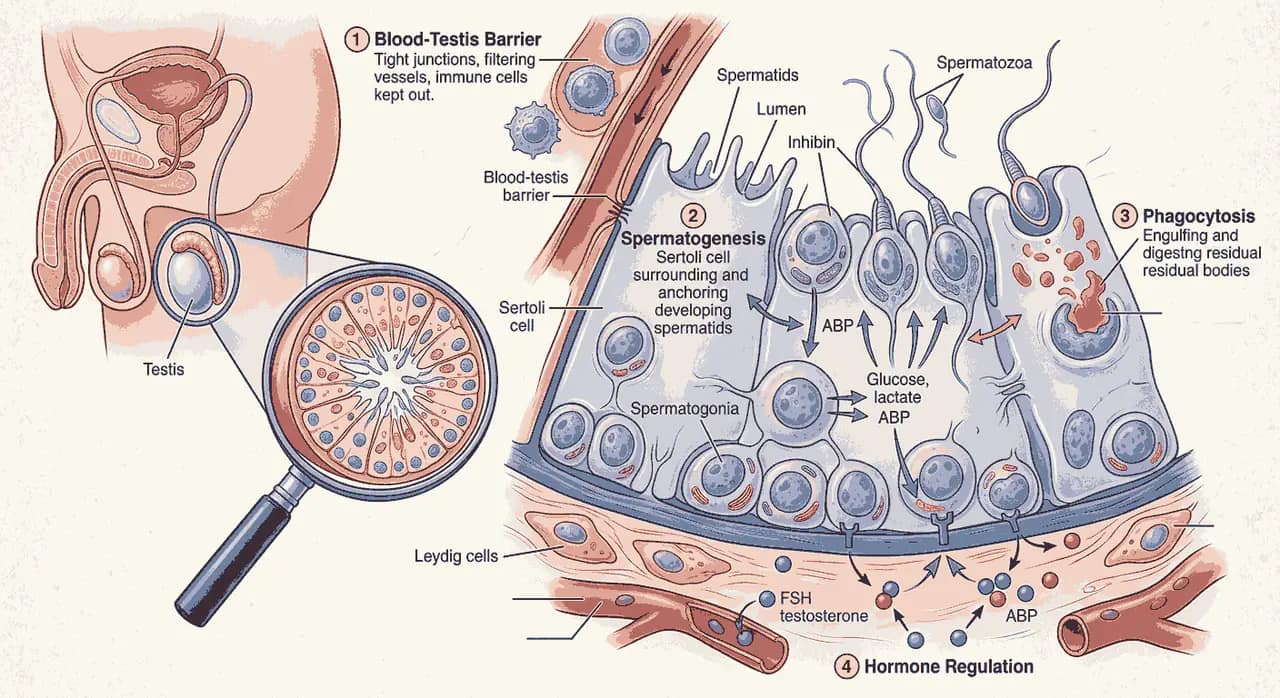
Master Sertoli Cells Location and Function MCQs With Answers for Class 12 Biology
Master Sertoli Cells Location and Function MCQs With Answers for Class 12 Biology with clear explanations, key concepts , and exam-focused preparation to boost,
Score Higher Now: Powerful Seed Development and Embryology MCQs Class 12 Biology with Answers
Practice Seed Development and Embryology MCQs Class 12 Biology with Answers. Boost exam preparation with important questions on embryos, seeds and fertilization