
- Keneitsino Lydia
- May 29, 2026
Ultimate Jean Baptiste Lamarck Evolution Theory MCQs with Answers for Smart NEET Prepraration
Jean Baptiste Lamarck Evolution Theory MCQs with Answers is an important part of the Evolution chapter in Class 12 Biology and is frequently asked in NEET and other competitive examinations. Understanding Lamarck’s contribution to evolutionary biology helps aspirants appreciate how scientific ideas about evolution developed before the modern understanding of genetics and natural selection emerged. For this reason, Jean Baptiste Lamarck Evolution Theory MCQs with Answers remains a valuable topic for examination preparation.
When studying Jean Baptiste Lamarck Evolution Theory MCQs with Answers, aspirants learn about Jean Baptiste Lamarck, a French biologist who proposed one of the earliest scientific theories of evolution. At a time when many people believed species were fixed and unchanging, Lamarck suggested that organisms could gradually change over time in response to their environment. This revolutionary idea laid the foundation for future evolutionary studies and makes Jean Baptiste Lamarck Evolution Theory MCQs with Answers highly relevant in biology curricula.
A key concept frequently associated with Jean Baptiste Lamarck Evolution Theory MCQs with Answers is the theory of inheritance of acquired characteristics. Lamarck proposed that traits acquired during an organism’s lifetime could be passed on to its offspring. According to his theory, organisms adapt to environmental challenges by modifying their bodies, and these modifications are inherited by future generations.
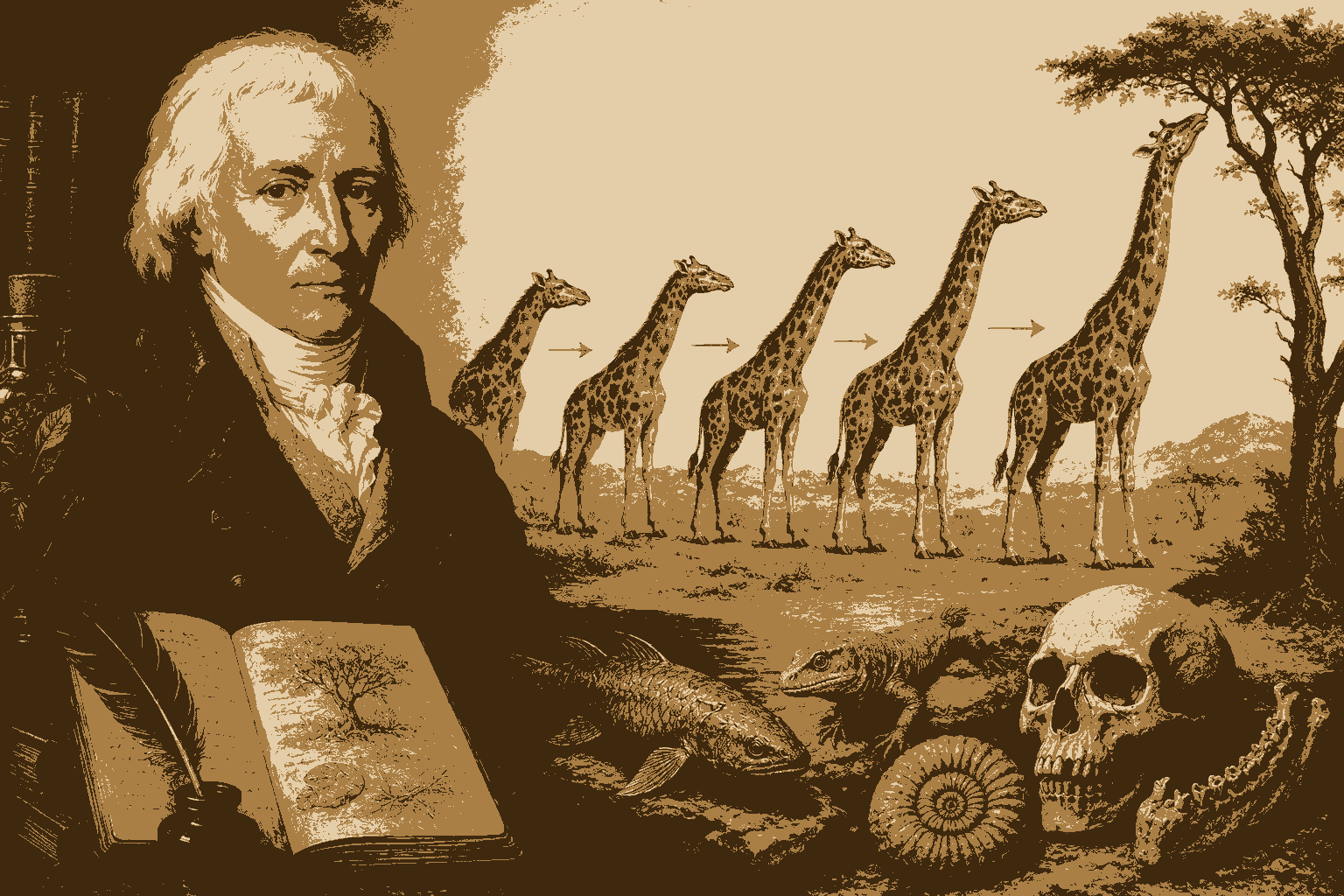
One of the most famous examples discussed while preparing Jean Baptiste Lamarck Evolution Theory MCQs with Answers is the evolution of the giraffe’s long neck. Lamarck suggested that ancestral giraffes had shorter necks and continuously stretched them to reach leaves on tall trees. Over many generations, this acquired characteristic was passed to offspring, eventually producing modern giraffes with long necks. Although modern science does not support this explanation, it remains an important historical example in Jean Baptiste Lamarck Evolution Theory MCQs with Answers.
Another essential aspect of Jean Baptiste Lamarck Evolution Theory MCQs with Answers is the concept of use and disuse of organs. Lamarck believed that organs used frequently became stronger and more developed, while organs that were rarely used gradually degenerated. According to this idea, environmental conditions directly influenced the physical characteristics of organisms.
While studying Jean Baptiste Lamarck Evolution Theory MCQs with Answers, aspirants often encounter examples such as webbed feet in aquatic birds, reduction of eyes in cave-dwelling animals, and limb reduction in snakes. Lamarck explained these features through repeated use or disuse over many generations. These examples formed the basis of his evolutionary explanations and are commonly discussed in Jean Baptiste Lamarck Evolution Theory MCQs with Answers.
The significance of Jean Baptiste Lamarck Evolution Theory MCQs with Answers extends beyond the theory itself because it highlights how scientific understanding evolves over time. Although many aspects of Lamarck’s theory were later disproved, his willingness to propose that species change through time represented a major advance in biological thought.
An important development related to Jean Baptiste Lamarck Evolution Theory MCQs with Answers was the work of August Weismann. Weismann conducted experiments in which he cut the tails of mice over several generations. Despite repeated tail removal, offspring continued to be born with normal tails. These findings demonstrated that acquired characteristics are not inherited, directly challenging Lamarck’s theory.
As aspirants continue exploring Jean Baptiste Lamarck Evolution Theory MCQs with Answers, they learn how Charles Darwin proposed a different mechanism known as natural selection. Darwin suggested that naturally occurring variations already exist within populations, and individuals possessing favorable traits are more likely to survive and reproduce. This explanation eventually replaced Lamarck’s theory as the dominant explanation for evolution.
Even though modern biology does not fully support Lamarck’s ideas, Jean Baptiste Lamarck Evolution Theory MCQs with Answers remains important because Lamarck was among the first scientists to propose that evolution occurs gradually over time. His ideas encouraged further research and discussion, ultimately contributing to the development of modern evolutionary theory.
Many Jean Baptiste Lamarck Evolution Theory MCQs with Answers focus on distinguishing Lamarckism from Darwinism. Aspirants should understand that Lamarck emphasized acquired characteristics, whereas Darwin emphasized natural selection acting on existing variations. Recognizing these differences is essential for success in biology examinations.
Another reason why Jean Baptiste Lamarck Evolution Theory MCQs with Answers is frequently tested is that it introduces the historical progression of scientific thought. Understanding how evolutionary theories developed helps aspirants appreciate the evidence-based nature of science and the process by which scientific ideas are refined.
The topic Jean Baptiste Lamarck Evolution Theory MCQs with Answers also reinforces important concepts related to adaptation. While Lamarck’s explanation of adaptation is no longer accepted, the concept itself remains central to evolutionary biology. Organisms continue to adapt to their environments through genetic variation and natural selection.
Aspirants preparing Jean Baptiste Lamarck Evolution Theory MCQs with Answers should pay attention to terminology such as acquired characters, inheritance, use and disuse, adaptation, and evolution. These terms frequently appear in examination questions and are closely linked to Lamarck’s contributions.
The continued appearance of Jean Baptiste Lamarck Evolution Theory MCQs with Answers in competitive examinations reflects the importance of understanding both historical and modern perspectives on evolution. Questions often assess conceptual understanding rather than simple memorization.
Regular revision of Jean Baptiste Lamarck Evolution Theory MCQs with Answers helps aspirants develop a clear understanding of evolutionary concepts and avoid confusion between Lamarck’s ideas and modern evolutionary theory. This distinction is particularly important in NEET and board examinations.
Jean Baptiste Lamarck Evolution Theory MCQs with Answers:
1. Alexander Von Humboldt described for the first time:
A. Ecological Biodiversity
B. Laws of limiting factor
C. Species area relationships
D. Population Growth equation
Answer: C. Species area relationships
Explanation: Alexander von Humboldt, a German naturalist, was the first scientist to describe the relationship between species richness and area. He observed that within a region, species richness increases with increasing explored area.
2. What did Weismann’s experiments cutting off tails of mice generation after generation demonstrate?
A. Tail is an essential organ
B. Darwinism was wrong
C. Lamarckism was wrong
D. Mutation theory was wrong
Answer: C. Lamarckism was wrong
Explanation: August Weismann repeatedly cut the tails of mice for many generations and found that offspring were always born with normal tails. This disproved Lamarck’s theory of inheritance of acquired characters.
3. Which of the following is not considered a living fossil?
A. King crab
B. Sphenodon
C. Archaeopteryx
D. Peripatus
Answer: C. Archaeopteryx
Explanation: Archaeopteryx is an extinct transitional fossil connecting reptiles and birds. Living fossils are organisms that still exist today with little evolutionary change.
4. On which organism did De Vries work while proposing his mutation theory?
A. Oenothera lamarckiana
B. Drosophila melanogaster
C. Pisum sativum
D. Althea rosea
Answer: A. Oenothera lamarckiana
Explanation: Hugo de Vries developed the Mutation Theory of Evolution after studying the Evening Primrose plant, Oenothera lamarckiana.
5. Which phenomenon supports Darwin’s concept of natural selection in organic evolution?
A. Production of Dolly the sheep by cloning
B. Development of organs from stem cells
C. Development of transgenic animals
D. Prevalence of pesticide-resistant insects
Answer: D. Prevalence of pesticide-resistant insects
Explanation: Resistant insects survive pesticide exposure and reproduce, demonstrating natural selection in action.
6. Radioactive C-dating and living fossils are used for:
A. Biological age
B. Geological age
C. Age of rock
D. Geographical distribution
Answer: A. Biological age
Explanation: Carbon dating determines the age of organic remains, while living fossils help estimate biological ages and evolutionary timelines.
7. Which of the following is the relatively most accurate method for dating fossils?
A. Potassium-argon method
B. Uranium-lead method
C. Electron spin resonance method
D. Radiocarbon method
Answer: C. Electron spin resonance method
Explanation: Electron Spin Resonance (ESR) dating can determine the age of fossilized remains and ancient biological materials with high accuracy.
8. Select the correct sequence of geological periods – Permian, Triassic, Jurassic
Options:
A. Permian → Triassic → Jurassic
B. Jurassic → Triassic → Permian
C. Triassic → Jurassic → Permian
D. Jurassic → Permian → Triassic
Answer: A. Permian → Triassic → Jurassic
Explanation:
The correct chronological sequence is:
Permian → Triassic → Jurassic
- Permian Period (299–252 million years ago) was the last period of the Paleozoic Era and ended with the largest mass extinction event in Earth’s history.
- Triassic Period (252–201 million years ago) was the first period of the Mesozoic Era and witnessed the origin of dinosaurs and early mammals.
- Jurassic Period (201–145 million years ago) was characterized by the dominance of dinosaurs and the appearance of the first birds.
Therefore, the correct order from oldest to youngest is:
Permian → Triassic → Jurassic.
9. Which evidence does not favour Lamarck’s inheritance of acquired characters?
A. Lack of pigment in cave animals
B. Melanisation in peppered moth
C. Absence of limbs in snakes
D. Webbed toes in aquatic birds
Answer: B. Melanisation in peppered moth
Explanation: Industrial melanism is explained by natural selection, not inheritance of acquired characteristics.
10. “Descent of Man and Selection in Relation to Sex” was written by:
A. Linnaeus
B. Copernicus
C. Darwin
D. Mendel
Answer: C. Darwin
Explanation: Charles Darwin published “The Descent of Man” in 1871, discussing human evolution and sexual selection.
11. The idea of natural selection as the fundamental process of evolution was reached:
A. Independently by Darwin and Wallace in 1900
B. By Darwin in 1866
C. By Wallace in 1901
D. Independently by Darwin and Wallace in 1859
Answer: D. Independently by Darwin and Wallace in 1859
Explanation: Both Darwin and Alfred Russel Wallace independently conceived natural selection and jointly presented the idea.
12. Which phenomenon supports Darwin’s concept of natural selection?
A. Development of transgenic animals
B. Dolly the sheep by cloning
C. Prevalence of pesticide-resistant insects
D. Stem-cell organ development
Answer: C. Prevalence of pesticide-resistant insects
Explanation: Resistant insects survive pesticide exposure and pass resistance genes to offspring.
13. Statement: Survival of the fittest is central to natural selection.
Reason: Individuals with advantageous adaptations survive better.
A. Only Statement true
B. Both true but Reason not explanation
C. Both true and Reason is correct explanation
D. Both false
Answer: C
Explanation: Individuals possessing favorable adaptations are more likely to survive and reproduce.
14. Lederberg’s replica plating experiment explains:
A. Lamarck’s theory
B. Mutation theory
C. Darwin’s theory
D. None of these
Answer: C. Darwin’s theory
Explanation: Antibiotic-resistant mutations existed before exposure, supporting natural selection.
15. Darwin’s book “Origin of Species by Natural Selection” was published in:
A. 1809
B. 1859
C. 1857
D. 1869
Answer: B. 1859
Explanation: Darwin published “On the Origin of Species” in 1859.
16. According to Darwin, evolution is:
A. A slow, gradual and continuous process
B. A sudden but discontinuous process
C. A slow and discontinuous process
D. A slow, sudden and discontinuous process
Answer: A
Explanation: Darwin believed evolution occurs gradually through accumulation of small variations.
17. The best description of natural selection is:
A. Reproductive success of organisms best adapted to the environment
B. Acts when resources are unlimited
C. Change in proportion of variations within a population
D. Follows Hardy-Weinberg principle
Answer: A
Explanation: Better-adapted organisms leave more offspring, causing favorable traits to spread.
18. Higher frequency of melanic British moths and DDT-resistant mosquitoes are examples of:
A. Arrival of the fittest
B. Genetic drift
C. Natural selection
D. Point mutation
Answer: C. Natural selection
Explanation: Environmental pressures favored advantageous traits, increasing their frequency.
19. Darwin’s finches represent:
A. Morphological variations
B. Geographical isolations
C. Climate variations
D. Reproductive isolation
Answer: B. Geographical isolations
Explanation: Different islands led to geographic isolation and adaptive radiation among finches.
20. Jean-Baptiste Lamarck explained evolution based on:
A. Natural selection
B. Survival of the fittest
C. Mutations
D. Inheritance of acquired characteristics
Answer: D
Explanation: Lamarck proposed that acquired traits can be inherited by offspring.
21. Broad palm with a single palmar crease is visible in a person suffering from:
A. Thalassemia
B. Down’s syndrome
C. Turner’s syndrome
D. Klinefelter’s syndrome
Answer: B. Down’s syndrome
Explanation: Down’s syndrome is a chromosomal disorder caused by trisomy 21. One characteristic feature is a broad palm with a single transverse palmar crease (simian crease).
22. The disease caused due to deposition of iron particles in tissues is:
A. Silicosis
B. Asbestosis
C. Emphysema
D. Siderosis
Answer: D. Siderosis
Explanation: Siderosis is an occupational lung disease caused by inhalation and accumulation of iron dust particles in body tissues, especially the lungs.
23. What are the dormant stages of Plasmodium in the liver cells of man called?
A. Hypnozoites
B. Sporozoites
C. Merozoites
D. Gametocytes
Answer: A. Hypnozoites
Explanation: Hypnozoites are dormant liver-stage forms of Plasmodium vivax and Plasmodium ovale that can cause relapses of malaria.
24. Tropical splenomegaly syndrome is a symptom of which disease?
A. Filaria
B. Malaria
C. Typhoid
D. Pneumonia
Answer: B. Malaria
Explanation: Tropical splenomegaly syndrome is characterized by an enlarged spleen and is commonly associated with chronic malaria infections.
25. Which disease among the following has existed in the past but is now showing incidence in new geographical areas?
A. Re-emerging disease: Tuberculosis
B. Emerging disease: Cholera
C. Super-emerging disease: SARS
D. Emerging disease: Dengue fever
Answer: A. Re-emerging disease: Tuberculosis
Explanation: Tuberculosis had been controlled in many regions but has reappeared due to factors such as drug resistance and weakened public health systems.
26. Phenylketonuria, Sickle Cell Anaemia, and Cystic Fibrosis are caused respectively due to mutations on:
A. Chromosome 7, Chromosome 11, Chromosome 12
B. Chromosome 12, Chromosome 11, Chromosome 7
C. Chromosome 11, Chromosome 18, Chromosome 9
D. Chromosome 18, Chromosome 11, Chromosome 9
Answer: B. Chromosome 12, Chromosome 11, Chromosome 7
Explanation:
- Phenylketonuria (PKU) → Chromosome 12
- Sickle Cell Anaemia → Chromosome 11
- Cystic Fibrosis → Chromosome 7
These are inherited genetic disorders caused by mutations in specific genes located on these chromosomes.
27. Kwashiorkor and Beri-Beri are categorized as:
A. Communicable diseases
B. Infectious diseases
C. Deficiency diseases
D. None of the above
Answer: C. Deficiency diseases
Explanation: Kwashiorkor results from protein deficiency, while Beri-Beri results from Vitamin B1 (Thiamine) deficiency.
28. Tay-Sachs disease is due to which type of gene?
A. Sex-linked recessive gene
B. Sex-linked dominant gene
C. Autosomal dominant gene
D. Autosomal recessive gene
Answer: D. Autosomal recessive gene
Explanation: Tay-Sachs disease is an inherited autosomal recessive disorder caused by deficiency of the enzyme Hexosaminidase A.
29. Leprosy is also called:
A. Hansen’s disease
B. Sarcoma
C. Slim disease
D. Leukemia
Answer: A. Hansen’s disease
Explanation: Leprosy, caused by Mycobacterium leprae, is commonly known as Hansen’s disease after the physician who identified the bacterium.
30. Which of the following is not correctly matched?
A. Glossina palpalis – Sleeping sickness
B. Culex – Filariasis
C. Aedes aegypti – Yellow fever
D. Anopheles culicifacies – Leishmaniasis
Answer: D. Anopheles culicifacies – Leishmaniasis
Explanation:
- Anopheles culicifacies is a vector of malaria, not leishmaniasis.
- Leishmaniasis (Kala-azar) is caused by Leishmania donovani and transmitted by sandflies (Phlebotomus).
Conclusion on Jean Baptiste Lamarck Evolution Theory MCQs with Answers
In conclusion, Jean Baptiste Lamarck Evolution Theory MCQs with Answers remains an essential topic in biology because it represents one of the earliest attempts to explain evolutionary change. Although many of Lamarck’s ideas have been replaced by modern scientific explanations, his contributions played a significant role in shaping evolutionary thought. By thoroughly understanding Jean Baptiste Lamarck Evolution Theory MCQs with Answers, aspirants can strengthen their knowledge of evolution, improve examination performance, and gain a deeper appreciation for the history of biological science