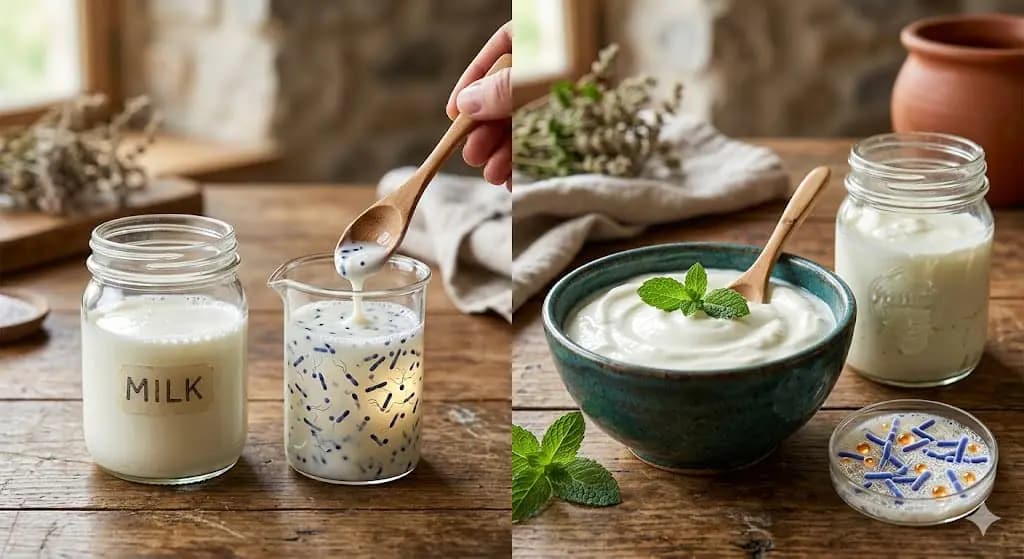
Lactobacillus and Curd Formation MCQs with Answers is an important biology topic for aspirants who want to understand microbes in household products, fermentation, lactic acid bacteria, and the conversion of milk into curd in a clear and exam-focused way. Lactobacillus and Curd Formation MCQs with Answers helps aspirants revise how useful microorganisms play a major role in food preparation and nutrition. In Class 12 Biology and competitive exams, questions related to Lactobacillus, lactic acid bacteria, curd formation, probiotics, fermentation, and vitamin enrichment are commonly asked. Lactobacillus and Curd Formation MCQs with Answers is useful because it connects microbiology with daily life examples that aspirants can easily remember. Lactobacillus and Curd Formation MCQs with Answers becomes easier when aspirants first understand what Lactobacillus is. Lactobacillus is a type of lactic acid bacterium that grows in milk and converts lactose, the milk sugar, into lactic acid. Lactobacillus and Curd Formation MCQs with Answers explains that the production of lactic acid lowers the pH of milk, causing milk proteins such as casein to coagulate. This process changes liquid milk into a semi-solid product called curd. Lactobacillus and Curd Formation MCQs with Answers helps aspirants remember that curd formation is not simply a physical change but a microbial fermentation process. Lactobacillus and Curd Formation MCQs with Answers also highlights the nutritional importance of curd. During curd formation, lactic acid bacteria partially digest milk proteins and improve the digestibility of milk. Lactobacillus and Curd Formation MCQs with Answers helps aspirants understand that curd is often easier to digest than milk for many people. Lactic acid bacteria also improve the nutritional quality of milk by increasing certain vitamins, especially vitamin B12. Lactobacillus and Curd Formation MCQs with Answers is important because exams often test the role of LAB in improving the nutritional value of curd. Aspirants preparing Lactobacillus and Curd Formation MCQs with Answers should focus on the role of fermentation. Fermentation is an anaerobic process in which microorganisms convert sugars into acids, gases, or alcohol. Lactobacillus and Curd Formation MCQs with Answers explains that in curd formation, lactose is converted into lactic acid. This acid gives curd its sour taste and helps preserve it for a short time by reducing the growth of harmful microbes. Lactobacillus and Curd Formation MCQs with Answers also helps aspirants connect curd formation with other fermented foods such as yogurt, cheese, bread, vinegar, and fermented soybean products. Lactobacillus and Curd Formation MCQs with Answers is also useful for understanding probiotics. Probiotics are live microbial food supplements that support beneficial bacteria in the digestive system. Lactobacillus and Curd Formation MCQs with Answers helps aspirants remember that Lactobacillus species are commonly associated with probiotic benefits. These bacteria may support digestion, improve gut microbial balance, and help maintain intestinal health. Lactobacillus and Curd Formation MCQs with Answers therefore teaches that microbes are not always harmful; many microorganisms are beneficial and essential for human health. Lactobacillus and Curd Formation MCQs with Answers should also be studied with related microbes used in food production. Saccharomyces cerevisiae is used in bread making, Aspergillus niger is used for citric acid production, Acetobacter aceti is used in vinegar formation, and Propionibacterium shermanii is associated with Swiss cheese. Lactobacillus and Curd Formation MCQs with Answers becomes more effective when aspirants compare these organisms with Lactobacillus. This comparison helps aspirants avoid confusion between curd, yogurt, cheese, vinegar, bread, and other microbial products. For effective revision, Lactobacillus and Curd Formation MCQs with Answers should be studied using short notes, flowcharts, and comparison tables. Aspirants can prepare a simple sequence: milk, Lactobacillus growth, lactose fermentation, lactic acid formation, pH reduction, casein coagulation, and curd formation. Lactobacillus and Curd Formation MCQs with Answers becomes easier when aspirants connect every step with a clear biological reason. They should also revise terms such as LAB, fermentation, lactose, lactic acid, casein, coagulation, probiotics, vitamin B12, curd, yogurt, and microbial food supplements.
Lactobacillus and Curd Formation MCQs with Answers:
- What is Streptococcus responsible for?
A. Conversion of alcohol from molasses B. Processing of leather C. Conversion of milk into curd D. None of these Answer: C. Conversion of milk into curd Explanation: Streptococcus helps in the conversion of milk into curd through fermentation.
- What are probiotics?
A. Cancer-inducing microbes B. Safe antibiotics C. Food allergens D. Live microbial food supplements Answer: D. Live microbial food supplements Explanation: Probiotics are live microbial food supplements that improve the population of beneficial bacteria in the body.
- Why does Lactobacillus-mediated conversion of milk to curd occur?
A. Coagulation and partial digestion of milk fats B. Coagulation and partial digestion of milk proteins C. Coagulation of milk protein and complete digestion of milk fats D. Coagulation of milk fats and complete digestion of milk protein Answer: B. Coagulation and partial digestion of milk proteins Explanation: Lactobacillus converts milk into curd by producing lactic acid, which coagulates and partially digests milk proteins.
- What is a microbial mutant requiring a growth factor in addition to a minimal medium called?
A. Auxotroph B. Heterotroph C. Autotroph D. Syntroph Answer: A. Auxotroph Explanation: An auxotroph is a mutant microorganism that requires an additional nutrient or growth factor to grow on minimal medium.
- Which microorganism is responsible for changing milk into curd?
A. Lactobacillus B. Acetobacter aceti C. Bacillus megaterium D. None of these Answer: A. Lactobacillus Explanation: Lactobacillus converts milk into curd by fermenting lactose into lactic acid.
- What vitamin does Lactic Acid Bacteria, LAB, increase in milk when converting it to curd?
A. Vitamin A B. Vitamin B12 C. Vitamin B1 D. Vitamin C Answer: B. Vitamin B12 Explanation: Lactic acid bacteria increase the nutritional value of curd by increasing vitamin B12 content.
- Which fermented food is produced by Mucor?
A. Tempe kedel B. Tofu C. Tempe kedel D. Sufu Answer: D. Sufu Explanation: Sufu is a fermented soybean food produced with the help of Mucor through solid-state fermentation of tofu.
- What are cheese and yogurt products of?
A. Dehydration B. Fermentation C. Pasteurization D. Distillation Answer: B. Fermentation Explanation: Cheese and yogurt are fermented products made with the help of microorganisms such as bacteria and fungi.
- Which combination of microbes is responsible for the formation and flavor of yogurt?
A. Lactobacillus casei and Streptococcus thermophilus B. Rhizobium meliloti and Azotobacter species C. Bacillus megaterium and Acetobacter aceti D. None of these Answer: A. Lactobacillus casei and Streptococcus thermophilus Explanation: Lactobacillus casei and Streptococcus thermophilus help in yogurt formation and contribute to its flavor.
- The presence of diversity at the junction of territories of two different habitats is known as
A. Bottle neck effect B. Edge effect C. Junction effect D. Pasteur effect Answer: B. Edge effect Explanation: The increased diversity found at the junction of two different habitats is called the edge effect. Such a transition zone is known as an ecotone.
- Autoecology refers to
A. Ecological study of individual species B. Animal ecology C. Plant ecology D. Population study Answer: A. Ecological study of individual species Explanation: Autoecology is the ecological study of an individual species and its relationship with the environment.
- Identify the characters related to xerophytes from the following: A. Stunted stems B. Reduced leaves C. Single layered epidermis D. Well developed vascular bundles E. More air cavities
Options: A. A, B, E only B. A, B, D only C. B, C, E only D. A, C, E only Answer: B. A, B, D only Explanation: Xerophytes are plants adapted to dry habitats. They commonly show stunted stems, reduced leaves, and well-developed vascular bundles.
- Organisms living in constant environmental conditions get
A. Species extinction B. Niche specialization C. Organizational protection D. Ex-situ conservation Answer: B. Niche specialization Explanation: Organisms living in constant environmental conditions may become highly adapted to a specific habitat, leading to niche specialization.
- The term niche was first used by
A. Clements B. Grinnell C. Warming D. Odum Answer: B. Grinnell Explanation: The term niche was first used by Grinnell in 1917 to describe the role of a species in its ecosystem.
- Plants growing in dry and saline soil are called
A. Xerophyte B. Hydrophyte C. Halophyte D. Heliophyte Answer: C. Halophyte Explanation: Halophytes are plants that grow in saline soils. Xerophytes grow in dry habitats, while hydrophytes grow in water.
- Which one of the following is one of the characteristics of a biological community?
A. Stratification B. Natality C. Mortality D. Sex-ratio Answer: A. Stratification Explanation: Stratification is a characteristic of a biological community and refers to vertical layering in vegetation or habitat structure.
- The species of plants that play a vital role in controlling the relative abundance of other species in a community are called
A. Edge species B. Keystone species C. Pioneer species D. Seral species Answer: B. Keystone species Explanation: Keystone species have a major effect on community structure and control the relative abundance of other species.
- Recapitulation theory was proposed by
A. E. Haeckel B. Mendel C. Hugo de Vries D. Von Baer Answer: A. E. Haeckel Explanation: Recapitulation theory, also called biogenetic law, was proposed by Ernst Haeckel.
- What theory suggested a connection between embryonic development and evolutionary history, stating that the stages of development recapitulate the evolutionary history of a species?
A. Haeckel's Theory B. Darwin's Theory C. Lamarck's Theory D. Mendel's Theory Answer: A. Haeckel's Theory Explanation: Haeckel's theory suggested that embryonic development, or ontogeny, recapitulates evolutionary history, or phylogeny.
- What is the system of rotating crops with legume or grass pasture to improve soil structure and fertility called?
A. Shifting agriculture B. Ley farming C. Contour farming D. Strip farming Answer: B. Ley farming Explanation: Ley farming involves rotating crops with legume or grass pasture to improve soil fertility and structure.
- What is the interspecies relationship in which one organism is harmed while the other remains unaffected?
A. Commensalism B. Parasitism C. Predation D. Amensalism Answer: D. Amensalism Explanation: Amensalism is an interaction in which one organism is harmed while the other remains unaffected.
- Nitrates and phosphates flowing from agricultural farms into water bodies are a significant cause of what mechanism?
A. Mineralisation B. Stratification C. Eutrophication D. Humification Answer: C. Eutrophication Explanation: Eutrophication occurs when water bodies receive excess nutrients such as nitrates and phosphates, leading to excessive growth of algae and aquatic plants.
- What is the species of plants that plays a vital role in controlling the relative abundance of other species in a community called?
A. Exotic species B. Keystone species C. Alien species D. Endemic species Answer: B. Keystone species Explanation: A keystone species has a strong effect on community structure and controls the relative abundance of other species.
- Lactic acid formation is a two-step anaerobic process. Both steps are carried out by which bacteria?
A. Streptococcus B. Rhizopus C. Lactobacillus D. Aspergillus Answer: C. Lactobacillus Explanation: Lactobacillus carries out lactic acid fermentation by converting lactose into lactic acid under anaerobic conditions.
- Match the following organisms with the products they produce.
A. Lactobacillus B. Saccharomyces cerevisiae C. Aspergillus niger D. Acetobacter aceti Products: i. Cheese ii. Curd iii. Citric acid iv. Bread v. Acetic acid Options: A. A-ii, B-iv, C-iii, D-v B. A-iii, B-iv, C-v, D-i C. A-ii, B-i, C-iii, D-v D. A-ii, B-iv, C-v, D-iii Answer: A. A-ii, B-iv, C-iii, D-v Explanation: Lactobacillus produces curd, Saccharomyces cerevisiae is used in bread making, Aspergillus niger produces citric acid, and Acetobacter aceti produces acetic acid.
- Which one of the following pairs is wrongly matched?
A. Coliforms - Vinegar B. Methanogens - Gobar gas C. Yeast - Ethanol D. Streptomycetes - Antibiotic Answer: A. Coliforms - Vinegar Explanation: Coliforms are indicators of fecal contamination in water. Vinegar is produced by Acetobacter aceti, not coliforms.
- Microbes not used in household products are: I. Trichoderma polysporum II. Rhizobium III. Clostridium IV. Propionibacterium shermanii
Options: A. I, IV B. I, II, III C. II, IV D. I, IV Answer: B. I, II, III Explanation: Trichoderma polysporum produces cyclosporin A, Rhizobium is used as a biofertilizer, and Clostridium is used industrially. Propionibacterium shermanii is used in cheese production, which is a food product.
- The bacteria that converts milk to curd is:
A. Propionibacterium shermanii B. Lactic Acid Bacteria, LAB C. Pseudomonas D. Xanthomonas Answer: B. Lactic Acid Bacteria, LAB Explanation: Lactic acid bacteria such as Lactobacillus grow in milk and convert lactose into lactic acid, forming curd.
- Roquefort cheese is ripened by which microorganism?
A. Yeast B. Bacterium C. Fungi D. Virus Answer: C. Fungi Explanation: Roquefort cheese is ripened by the fungus Penicillium roqueforti, which gives it its characteristic flavor.
- Commercial broiler strains used in India are:
A. Hyline
B. BV-300
C. Poona pearls
D. Hubbard
Answer: D. Hubbard
Explanation: Hubbard is one of the commercial broiler strains used in India.

Conclusion on Lactobacillus and Curd Formation MCQs with Answers
In conclusion, Lactobacillus and Curd Formation MCQs with Answers is a valuable topic for aspirants preparing for Class 12 Biology, NEET, nursing entrance exams, and other biology-based competitive tests. Lactobacillus and Curd Formation MCQs with Answers improves understanding of useful microbes, curd formation, fermentation, nutritional improvement, and probiotics. Lactobacillus and Curd Formation MCQs with Answers also helps aspirants connect textbook knowledge with everyday food preparation.
Related reading
Ultimate Vam Mycorrhiza MCQs with Answers Class 12 Biology - Powerful Practice for Exam Success
Revise Vam Mycorrhiza MCQs with Answers Class 12 Biology covering VAM, endomycorrhiza, phosphate absorption, biofertilizers, plant roots, and exam preparations.
Amazing Saccharomyces Cerevisiae MCQs with Answers from Microbes in Human Welfare
Revise Saccharomyces Cerevisiae MCQs with Answers covering yeast, fermentation, bread making, ethanol production , zymase , and biology exam prep for aspirants.