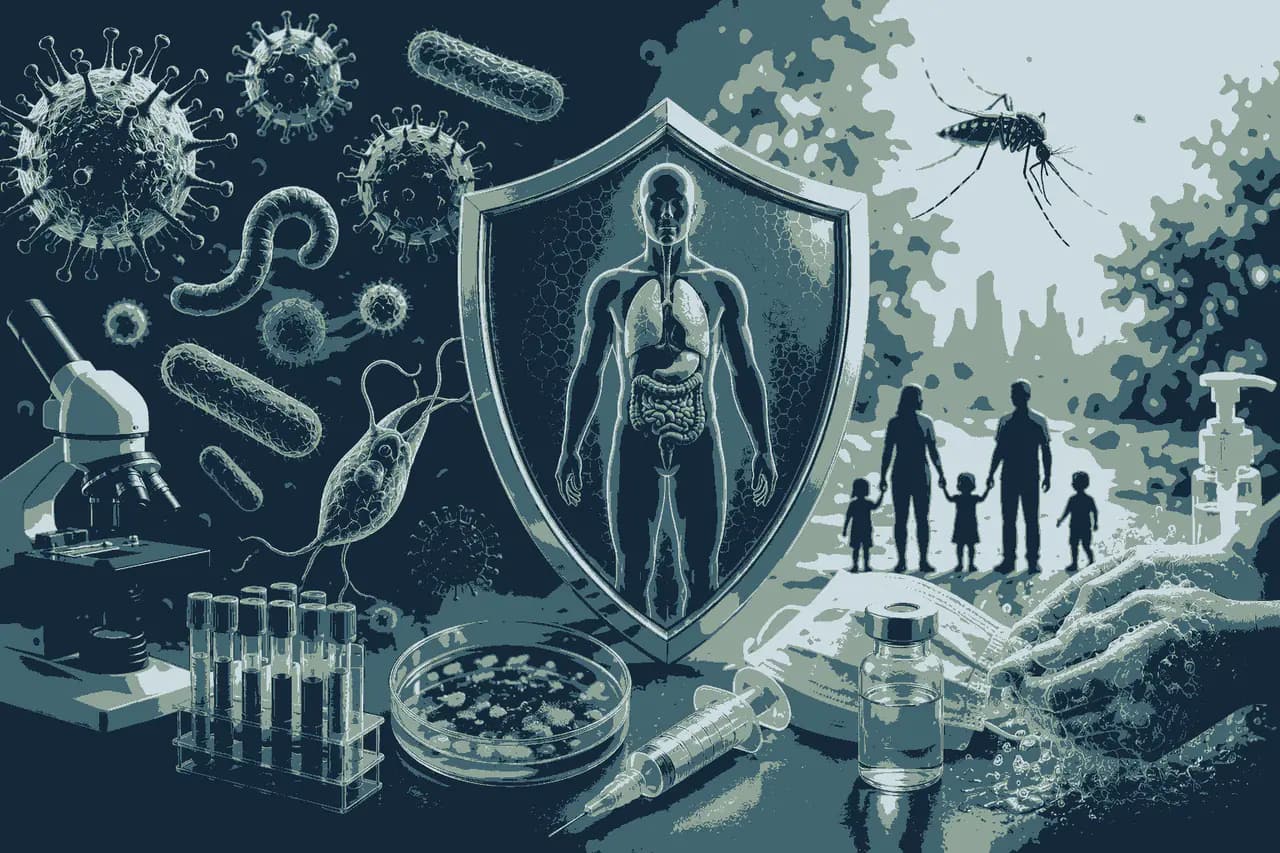
Epidemiology and Infectious Disease MCQs Biology is an important revision topic for aspirants who want to understand how infections spread, how outbreaks are studied, and how public health systems control disease. Epidemiology and Infectious Disease MCQs Biology connects basic biology with real health situations by explaining the link between pathogen, host, environment, immunity, transmission, prevention, and surveillance. For Class 12 Biology, NEET, and other competitive exams, Epidemiology and Infectious Disease MCQs Biology helps aspirants revise human health and disease in a focused and organised way. It encourages aspirants to study not only disease names but also causative agents, symptoms, vectors, diagnostic methods, prevention strategies, and the reasons behind disease control measures. Epidemiology and Infectious Disease MCQs Biology becomes easier when aspirants first understand the meaning of epidemiology. Epidemiology is the study of how diseases occur in populations, how frequently they appear, where they spread, and which groups are most affected. Epidemiology and Infectious Disease MCQs Biology includes important terms such as epidemic, pandemic, endemic disease, outbreak, incidence, prevalence, reservoir, carrier, vector, quarantine, isolation, contact tracing, incubation period, and herd immunity. These terms help aspirants understand how a disease moves from one person to another and how health authorities try to stop it. This topic also explains that infection spreads only when there is a source of pathogen, a mode of transmission, and a susceptible host. Aspirants preparing Epidemiology and Infectious Disease MCQs Biology should focus on the major types of infectious agents. Bacteria cause diseases such as typhoid, cholera, tuberculosis, pneumonia, and diphtheria. Viruses cause diseases such as influenza, measles, dengue, AIDS, hepatitis, and rabies. Protozoans cause diseases such as malaria and amoebiasis, while fungi may cause infections such as ringworm. Epidemiology and Infectious Disease MCQs Biology becomes more memorable when aspirants group diseases according to pathogen type. This method reduces confusion and helps aspirants revise quickly before examinations. Epidemiology and Infectious Disease MCQs Biology also improves understanding of disease transmission through air, water, food, body fluids, direct contact, contaminated objects, and insect vectors. Vector-borne diseases are an essential part of Epidemiology and Infectious Disease MCQs Biology because many important infections are spread by insects. Malaria is transmitted by the female Anopheles mosquito, dengue by the Aedes mosquito, filariasis by Culex mosquito, and kala-azar by the sandfly. Epidemiology and Infectious Disease MCQs Biology teaches aspirants that controlling vectors can reduce disease transmission at the community level. Simple measures such as preventing water stagnation, using mosquito nets, maintaining sanitation, spraying insecticides, and improving waste management are important public health actions. Epidemiology and Infectious Disease MCQs Biology also highlights the importance of safe drinking water, handwashing, proper food handling, vaccination, and early diagnosis. Immunity is another key area in Epidemiology and Infectious Disease MCQs Biology. The human body protects itself through skin, mucous membranes, white blood cells, antibodies, antigens, interferons, inflammation, memory cells, and immune responses. Vaccination is important because it prepares the immune system before the actual infection occurs. Epidemiology and Infectious Disease MCQs Biology helps aspirants understand why vaccines are used to prevent diseases such as polio, diphtheria, tetanus, pertussis, measles, tuberculosis, and hepatitis B. It also teaches that antibiotics mainly work against bacterial infections and should not be misused for viral diseases. Epidemiology and Infectious Disease MCQs Biology therefore builds both exam knowledge and responsible health awareness. A short revision strategy can make Epidemiology and Infectious Disease MCQs Biology more effective. Aspirants can prepare tables with columns for disease, pathogen, mode of transmission, symptoms, vector, and prevention. Epidemiology and Infectious Disease MCQs Biology should be revised through repeated reading, diagram-based notes, flowcharts, and comparison charts. Aspirants should pay special attention to confusing pairs such as epidemic and pandemic, carrier and vector, bacterial and viral diseases, isolation and quarantine, and active and passive immunity. Epidemiology and Infectious Disease MCQs Biology becomes stronger when aspirants connect every disease with its cause, spread, symptoms, and control method. Another important benefit of Epidemiology and Infectious Disease MCQs Biology is that it develops scientific thinking. During an outbreak, epidemiologists study who is affected, where cases are increasing, when the spread began, and how transmission is happening. Epidemiology and Infectious Disease MCQs Biology helps aspirants understand that disease prevention is not based on fear but on evidence, observation, diagnosis, reporting, and timely action. It also reminds aspirants that public health depends on both individual behaviour and community responsibility. Epidemiology and Infectious Disease MCQs Biology is useful because it links textbook learning with daily practices such as hygiene, vaccination, safe food habits, and medical awareness.
Epidemiology and Infectious Disease MCQs Biology:
- Anthrax is caused by:
A. Virus B. Bacteria C. Fungus D. Chemical compounds Answer: B. Bacteria Explanation: Anthrax is a serious infectious disease caused by gram-positive, rod-shaped bacteria known as Bacillus anthracis. Anthrax occurs naturally around the world in wild and domestic hoofed animals, especially cattle, sheep, goats, camels, and antelopes.
- An autoimmune disease is
A. B-lymphocytes induced B. Haemophilia C. Myasthenia gravis D. None of the above Answer: C. Myasthenia gravis Explanation: Myasthenia gravis is an autoimmune disease. It is an antibody-mediated autoimmune disorder in which antibodies affect acetylcholine receptors, leading to muscle weakness.
- Which one is matched correctly?
A. Arsenic – Black foot disease B. Fluoride – Itai-itai C. Mercury – Skeletal fluorosis D. Cadmium – Minamata disease Answer: A. Arsenic – Black foot disease Explanation: Black foot disease is a vascular disease caused by long-term exposure to arsenic. It is an endemic peripheral vascular disease reported among inhabitants of certain regions, including the southwest coast of Taiwan.
- Which of the following is non-pathogenic bacteria of colon?
A. Escherichia coli B. Balantidium coli C. Entamoeba coli D. Enterobius vermicularis Answer: A. Escherichia coli Explanation: Escherichia coli is a non-pathogenic bacterium normally found in the colon. Some strains may be harmful, but many strains are part of the normal intestinal flora.
- Viral diseases have no cure because
A. Viruses have no cell wall B. Viruses can multiply repeatedly within the host cell C. Presence of capsid D. Virus possesses no cytoplasm Answer: B. Viruses can multiply repeatedly within the host cell Explanation: Viral diseases are difficult to cure because viruses multiply inside host cells and use the host’s cellular machinery for reproduction.
- Which one of the following is correctly matched regarding an institute and its location?
A. National Institute of Virology - Pune B. National Institute of Communicable Diseases - Lucknow C. Central Drug Research Institute - Kasauli D. National Institute of Nutrition - Mumbai Answer: A. National Institute of Virology - Pune Explanation: The National Institute of Virology is located in Pune. It is one of the major institutes of the Indian Council of Medical Research.
- Which of the following is a non-communicable disease?
A. Tuberculosis B. Arthritis C. Rabies D. Diphtheria Answer: B. Arthritis Explanation: Arthritis is a non-communicable disease. It does not spread from one person to another like infectious diseases.
- The infectious and contagious bacterial disease that affects cattle, buffaloes, horses, sheep, and goats is
A. Anthrax B. Rinderpest C. Tick fever D. Necrosis Answer: A. Anthrax Explanation: Anthrax is an infectious bacterial disease that affects animals such as cattle, buffaloes, horses, sheep, and goats. It is caused by Bacillus anthracis.
- Pellagra is caused due to deficiency of
A. Niacin B. Pantothenic acid C. Tocopherol D. Cyanocobalamine Answer: A. Niacin Explanation: Pellagra is caused by deficiency of niacin, also known as vitamin B3. It is commonly associated with dermatitis, diarrhoea, and dementia.
- Black foot disease occurs due to
A. Cadmium B. Mercury C. Arsenic D. Copper Answer: C. Arsenic Explanation: Black foot disease is associated with long-term exposure to inorganic arsenic.
- Who discovered oocysts in the stomach of female Anopheles?
A. Ronald Ross B. Charles Laveran C. Golgi D. Lamble Answer: A. Ronald Ross Explanation: Sir Ronald Ross discovered the oocyst stage of the malaria parasite in the stomach wall of female Anopheles mosquito on 20 August 1897.
- Toxin produced by tetanus affects
A. Jaw bones B. Voluntary muscles C. Involuntary muscles D. Both A and B Answer: B. Voluntary muscles Explanation: Tetanus toxin affects voluntary muscles by causing painful muscle spasms and interfering with normal muscle contraction.
- A certain patient is suspected to be suffering from Acquired Immuno Deficiency Syndrome. Which diagnostic technique will you recommend for its detection?
A. WIDAL B. ELISA C. MRI D. Ultra Sound Answer: B. ELISA Explanation: ELISA is commonly used for detecting HIV infection because it can identify specific antibodies produced against HIV.
- At which stage of HIV infection does one usually show symptoms of AIDS?
A. Within 15 days of sexual contact with an infected person B. When the infecting retrovirus enters host cells C. When viral DNA is produced by reverse transcriptase D. When HIV replicates rapidly in helper T-lymphocytes and damages a large number of these cells Answer: D. When HIV replicates rapidly in helper T-lymphocytes and damages a large number of these cells Explanation: Symptoms of AIDS appear when HIV multiplies rapidly in helper T-lymphocytes and destroys many of these cells, severely weakening the immune system.
- The infectious diseases which are emerging include:
I. Severe Acute Respiratory Syndrome II. Dengue Fever III. Mad Cow Disease IV. Tuberculosis Options: A. I and IV B. I and III C. II and IV D. III and II Answer: B. I and III Explanation: Severe Acute Respiratory Syndrome and Mad Cow Disease are considered emerging infectious diseases. Emerging infectious diseases are diseases that have newly appeared in a population or are rapidly increasing in occurrence or geographic range.
- Match the following: List-I and List-II
List-I A. Nocturnal periodicity B. Extraintestinal migration C. Schuffner’s dots D. Tetranucleate cyst List-II i. Entamoeba histolytica ii. Plasmodium vivax iii. Wuchereria bancrofti iv. Ascaris lumbricoides Options: A. A-iii, B-ii, C-iv, D-i B. A-iv, B-iii, C-i, D-ii C. A-iii, B-iv, C-ii, D-i D. A-iii, B-v, C-ii, D-i Answer: C. A-iii, B-iv, C-ii, D-i Explanation: Nocturnal periodicity is shown by Wuchereria bancrofti. Extraintestinal migration is associated with Ascaris lumbricoides. Schuffner’s dots are seen in Plasmodium vivax infection. Tetranucleate cyst is the infective stage of Entamoeba histolytica.
- Which of the following statement is correct?
A. Female carrier for haemophilia may transmit the disease to sons. B. Thalassemia is a qualitative problem. C. Change in whole set of chromosomes is called aneuploidy. D. Sickle cell anaemia is quantitative problem. Answer: A. Female carrier for haemophilia may transmit the disease to sons. Explanation: A female carrier for haemophilia has one affected X chromosome and can transmit the disease to her sons.
- Find out correct match.
A. Dysentery - Protozoa - Liver B. Ringworm - Fungus - Skin C. Typhoid - Bacteria - Lungs D. Filariasis - Common round worm - Small intestine Answer: B. Ringworm - Fungus - Skin Explanation: Ringworm is caused by fungi such as Trichophyton, Microsporum, and Epidermophyton. It mainly affects the skin, hair, and nails.
- The toxic substance haemozoin, responsible for high fever and chill, is released in which of the following diseases?
A. Typhoid B. Dengue C. Pneumonia D. Malaria Answer: D. Malaria Explanation: In malaria, the toxic substance haemozoin is released when red blood cells rupture. It is responsible for high fever and chills.
- Identify the symptoms of pneumonia.
A. High fever, weakness, stomach pain, loss of appetite B. Difficulty in breathing, fever, chills, cough, headache C. Nasal congestion and discharge, cough, sore throat, headache D. Constipation, abdominal pain, cramps, blood clots Answer: B. Difficulty in breathing, fever, chills, cough, headache Explanation: Pneumonia is an inflammatory lung condition. Its symptoms include difficulty in breathing, fever, chills, cough, and headache.
- Widal test is the confirmatory test for
A. Malaria B. Pneumonia C. Cholera D. Typhoid Answer: D. Typhoid Explanation: The Widal test is used to detect antibodies produced against Salmonella typhi, the bacterium that causes typhoid fever.
- World Malaria Day is celebrated on
A. 25th March B. 25th April C. 20th August D. 20th September Answer: B. 25th April Explanation: World Malaria Day is observed every year on 25th April to raise awareness about malaria prevention and control.
- Inhalation of iron particles causes
A. Pneumoconiosis B. Pneumonia C. Emphysema D. Black lung disease Answer: A. Pneumoconiosis Explanation: Inhalation of iron particles can cause a type of pneumoconiosis known as siderosis or welder’s lung.
- Assertion (A): Dengue fever is caused due to failure of clot reaction. Reason (R): The patient of dengue may require transfusion of blood platelets.
A. Both A and R are true and R is the correct explanation of A B. Both A and R are true but R is not the correct explanation of A C. A is true and R is false D. A is wrong and R is true Answer: B. Both A and R are true but R is not the correct explanation of A Explanation: Dengue is caused by dengue virus transmitted by Aedes mosquitoes. Dengue patients may require platelet transfusion because the disease can reduce platelet count.
- Identify the fungal disease among the following.
A. Common cold B. Pneumonia C. Ringworm D. Typhoid Answer: C. Ringworm Explanation: Ringworm is a fungal infection that can affect the skin, hair, and nails. It spreads through direct contact with an infected person or contaminated objects.
- Among the following, nocturnal periodicity is exhibited by
A. Sausage shaped larva B. Microfilaria C. Ookinete D. Rhabditiform larva Answer: B. Microfilaria Explanation: Nocturnal periodicity is shown by microfilariae, the larval stage of certain filarial worms responsible for lymphatic filariasis.
- Which of the following diseases is correctly matched with its causative agent?
A. Typhoid - Salmonella B. Elephantiasis - Aschelminthes C. Ringworm - Microsporum D. Malaria - Protozoan Answer: A. Typhoid - Salmonella Explanation: Typhoid is caused by the bacterium Salmonella typhi.
- Match the disease with its causative agent: Ringworm, Filariasis, Malaria, Pneumonia
A. Ringworm - Trichophyton, Filariasis - Wuchereria bancrofti, Malaria - Plasmodium vivax, Pneumonia - Haemophilus influenzae B. Ringworm - Haemophilus influenzae, Filariasis - Trichophyton, Malaria - Wuchereria bancrofti, Pneumonia - Plasmodium vivax C. Ringworm - Trichophyton, Filariasis - Wuchereria bancrofti, Malaria - Plasmodium vivax, Pneumonia - Haemophilus influenzae D. Ringworm - Plasmodium vivax, Filariasis - Wuchereria bancrofti, Malaria - Trichophyton, Pneumonia - Haemophilus influenzae Answer: C. Ringworm - Trichophyton, Filariasis - Wuchereria bancrofti, Malaria - Plasmodium vivax, Pneumonia - Haemophilus influenzae Explanation: Ringworm is caused by Trichophyton, filariasis by Wuchereria bancrofti, malaria by Plasmodium vivax, and pneumonia may be caused by Haemophilus influenzae.
- Which bacterial disease is found in chickens?
A. Rickets B. Ranikhet C. Fowl pox D. Fowl cholera Answer: D. Fowl cholera Explanation: Fowl cholera is a bacterial disease found in chickens. It is caused by Pasteurella multocida.
- Which disease is not immunized by triple antigen?
A. Typhoid
B. Tetanus
C. Diphtheria
D. Whooping cough
Answer: A. Typhoid
Explanation: Triple antigen vaccine protects against diphtheria, pertussis or whooping cough, and tetanus. It does not immunize against typhoid.
Conclusion on Epidemiology and Infectious Disease MCQs Biology
In conclusion, Epidemiology and Infectious Disease MCQs Biology is a highly useful topic for aspirants who want to master infectious diseases, epidemiological terms, immunity, vectors, transmission, diagnosis, vaccination, and prevention. This Epidemiology and Infectious Disease MCQs Biology supports better exam preparation by turning a large chapter into clear and manageable concepts. It helps aspirants improve accuracy, speed, and confidence while also building awareness about public health. With consistent revision, Epidemiology and Infectious Disease MCQs Biology can help aspirants understand how biology protects human life and how disease control begins with knowledge, prevention, and responsible action.
Related reading
Proven Vector Borne Disease MCQs Class 12 Biology for Exam Excellence
Revise Vector Borne Disease MCQs Class 12 Biology with key facts on vectors, pathogens, symptoms, transmission, and prevention for exam-ready aspirants for NEET
Ultimate Communicable Disease MCQs Class 12 Biology - Master Exam Success Fast
Explore Communicable Disease MCQs Class 12 Biology with key concepts on pathogens, vectors, immunity, symptoms, and prevention for aspirants preparing for exams