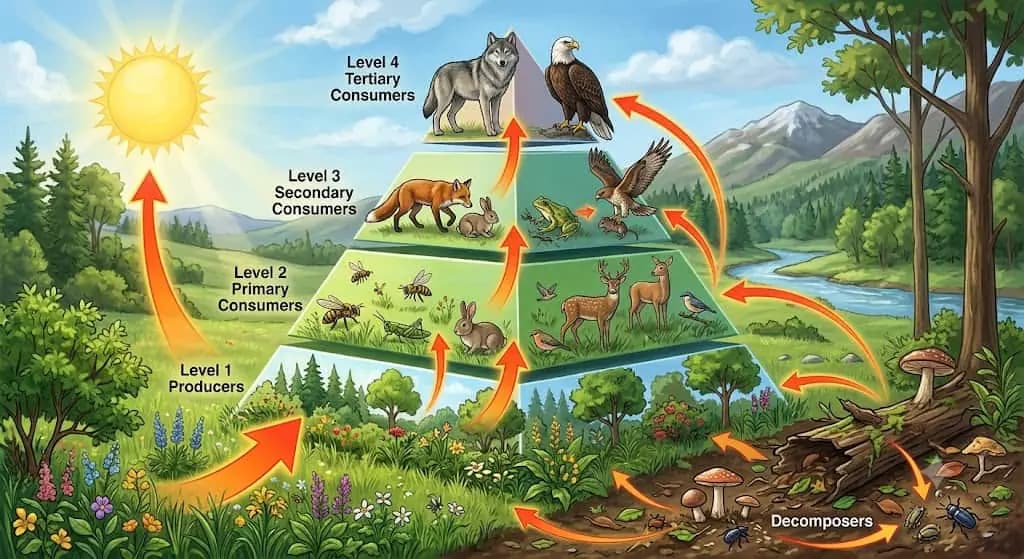
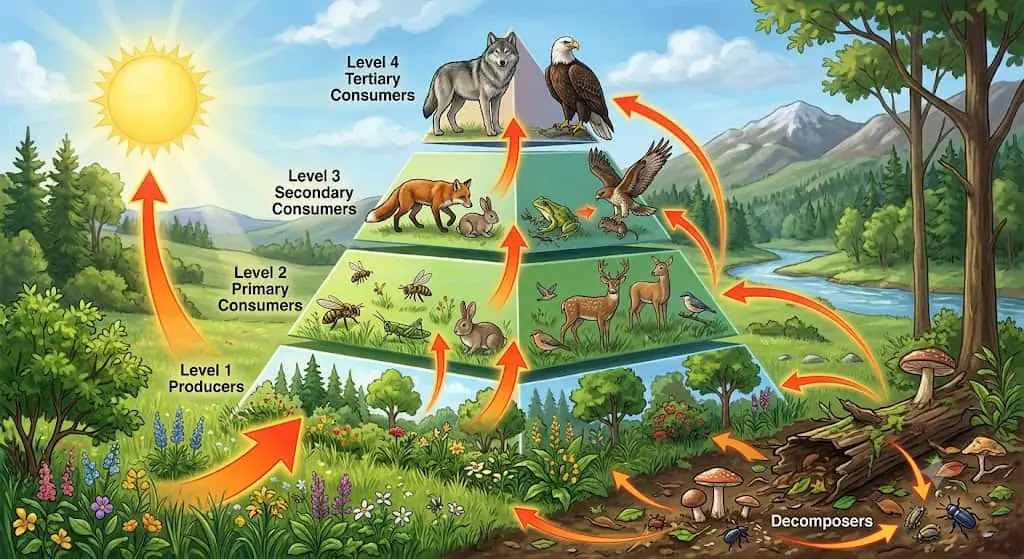
Energy Flow and Trophic Levels MCQs PDF Class 12 Biology is an important ecology topic for aspirants who want to understand how energy moves through an ecosystem. Energy Flow and Trophic Levels MCQs PDF Class 12 Biology helps aspirants revise producers, consumers, decomposers, food chains, food webs, ecological pyramids, productivity, and the 10% law in a clear and exam-focused way. In ecology, energy flow explains how solar energy captured by green plants is transferred to herbivores, carnivores, and decomposers. Energy Flow and Trophic Levels MCQs PDF Class 12 Biology becomes easier when aspirants first understand producers. Producers, also called autotrophs, form the first trophic level because they capture solar energy and convert it into chemical energy through photosynthesis. Energy Flow and Trophic Levels MCQs PDF Class 12 Biology explains that green plants, algae, phytoplankton, and some chemosynthetic bacteria act as producers. Since all other organisms depend directly or indirectly on producers, they form the foundation of every ecosystem. Energy Flow and Trophic Levels MCQs PDF Class 12 Biology also helps aspirants understand trophic levels. A trophic level is the feeding position of an organism in a food chain. Energy Flow and Trophic Levels MCQs PDF Class 12 Biology teaches that producers occupy T1, herbivores occupy T2, secondary consumers occupy T3, and tertiary consumers occupy T4. For example, in a food chain like grass → grasshopper → frog → snake → eagle, each organism represents a different feeding level. Energy Flow and Trophic Levels MCQs PDF Class 12 Biology is strongly connected with the 10% law of energy transfer. According to Lindeman’s 10% law, only about 10% of energy is transferred from one trophic level to the next, while the remaining energy is lost as heat, used in respiration, movement, digestion, and other metabolic activities. Energy Flow and Trophic Levels MCQs PDF Class 12 Biology helps aspirants understand why food chains are usually short and rarely exceed four or five trophic levels. Energy Flow and Trophic Levels MCQs PDF Class 12 Biology also explains why the pyramid of energy is always upright. At the producer level, the amount of energy is maximum because producers directly trap solar energy. Energy Flow and Trophic Levels MCQs PDF Class 12 Biology shows that as energy moves upward from producers to consumers, the available energy decreases at every step. Therefore, carnivores receive less energy than herbivores, and top consumers receive the least energy. Energy Flow and Trophic Levels MCQs PDF Class 12 Biology is useful for understanding ecological pyramids. Ecological pyramids may represent numbers, biomass, or energy. Energy Flow and Trophic Levels MCQs PDF Class 12 Biology teaches that the pyramid of energy is always upright, while the pyramid of biomass and pyramid of numbers may be upright or inverted depending on the ecosystem. In aquatic ecosystems, the biomass pyramid may be inverted because phytoplankton have low standing biomass but high turnover. Energy Flow and Trophic Levels MCQs PDF Class 12 Biology also includes productivity concepts. Gross primary productivity is the total rate of organic matter production by producers during photosynthesis. Net primary productivity is the organic matter left after respiratory losses. Energy Flow and Trophic Levels MCQs PDF Class 12 Biology helps aspirants remember that NPP is available to herbivores and decomposers. Secondary productivity is the rate of formation of new organic matter by consumers. Energy Flow and Trophic Levels MCQs PDF Class 12 Biology should also be revised with food chains and food webs. A food chain is a linear pathway of energy transfer, while a food web is a network of interconnected food chains. Energy Flow and Trophic Levels MCQs PDF Class 12 Biology explains that food webs provide greater stability because organisms have multiple feeding connections. If one food source decreases, an organism may depend on another available source. Energy Flow and Trophic Levels MCQs PDF Class 12 Biology helps aspirants understand decomposers and detritus food chains. Decomposers such as bacteria and fungi break down dead organic matter and recycle nutrients back into the soil. Energy Flow and Trophic Levels MCQs PDF Class 12 Biology also explains that detritus food chains begin with dead organic matter and are especially important in forests, soil ecosystems, and deep ocean environments. Without decomposers, mineral cycling would stop. Energy Flow and Trophic Levels MCQs PDF Class 12 Biology is also related to biomagnification. Biomagnification is the increase in concentration of toxic substances at successive trophic levels. Energy Flow and Trophic Levels MCQs PDF Class 12 Biology helps aspirants understand how chemicals like DDT can accumulate from water to plankton, small fish, large fish, and fish-eating birds. This concept shows how energy flow and food chains are connected with pollution and environmental health.
Energy Flow and Trophic Levels MCQs PDF Class 12 Biology:
- Which one of the following is most appropriately defined?
A. Parasite is an organism which always lives inside the body of another organism and may kill it B. Host is an organism which provides food to another organism C. Amensalism is a relationship in which one species is benefited whereas the other is unaffected D. Predator is an organism that catches and kills another organism for food Answer: D. Predator Explanation: A predator is an organism that captures, kills, and consumes another organism for food.
- Which one of the following types of organisms occupy more than one trophic level in a pond ecosystem?
A. Frog B. Phytoplankton C. Fish D. Zooplankton Answer: C. Fish Explanation: In a pond ecosystem, fish can occupy more than one trophic level. A fish feeding on phytoplankton may act as a primary consumer, while a fish feeding on smaller fish may act as a secondary consumer.
- In a terrestrial ecosystem such as a forest, where is the maximum energy found in terms of trophic levels?
A. T1 B. T2 C. T3 D. T4 Answer: A. T1 Explanation: The maximum energy is found at the first trophic level, T1, which consists of primary producers. Producers trap solar energy, and only about 10% of energy is transferred to the next trophic level.
- At which latitude does heat gain through insolation approximately equal heat loss through terrestrial radiation?
A. 66° North and South B. 122° North and South C. 40° North and South D. 142° North and South Answer: C. 40° North and South Explanation: At about 40° North and South latitudes, heat gain through insolation approximately equals heat loss through terrestrial radiation.
- When a man eats fish that feeds on zooplankton which have eaten small plants, who is the producer in the chain?
A. Zooplankton B. Small plants C. Fish D. Man Answer: B. Small plants Explanation: Small plants, such as phytoplankton, are the producers in this food chain because they prepare food by photosynthesis and occupy the first trophic level.
- Which of the following experiments suggests that the simplest living organisms could not have originated spontaneously from nonliving matter?
A. Larvae count appearing in decaying organic matter B. Meat not being spoiled when heated and kept sealed in a vessel C. Microbes not appearing in stored meat D. Microbes appearing from unsterilized organic matter Answer: B. Meat not being spoiled when heated and kept sealed in a vessel Explanation: When meat is heated and sealed, microbes are killed and no new microbes enter. This shows that living organisms do not arise spontaneously from nonliving matter.
- Match the trophic levels with their correct species examples in a grassland ecosystem.
A. Fourth trophic level B. Second trophic level C. First trophic level D. Third trophic level Examples: i. Crow ii. Vulture iii. Rabbit iv. Grass Options: A. A - i, B - ii, C - i, D - iv B. A - iv, B - i, C - iii, D - ii C. A - iii, B - ii, C - iv, D - i D. A - ii, B - iii, C - iv, D - i Answer: D. A - ii, B - iii, C - iv, D - i Explanation: Grass belongs to the first trophic level, rabbit to the second trophic level, crow to the third trophic level, and vulture to the fourth trophic level.
- Which of the following statements is incorrect?
A. Energy content gradually decreases from first to fourth trophic level B. Biomass decreases from first to fourth trophic level C. Energy content gradually increases from first to fourth trophic level D. Number of individuals decreases from first trophic level to fourth trophic level Answer: C. Energy content gradually increases from first to fourth trophic level Explanation: Energy content decreases at each successive trophic level because only about 10% of energy is transferred to the next level, while the rest is lost as heat or used in metabolic activities.
- Which of the following statements is not correct?
A. Pyramid of numbers in a grassland ecosystem is upright B. Pyramid of biomass in sea is generally inverted C. Pyramid of biomass in sea is generally upright D. Pyramid of energy is always upright Answer: C. Pyramid of biomass in sea is generally upright Explanation: The pyramid of biomass in the sea is generally inverted because the biomass of phytoplankton is lower than the biomass of consumers at a given time.
- Certain characteristic demographic features of developing countries are
A. High fertility, high density, rapidly rising mortality rate and very young age distribution B. High infant mortality, low fertility, uneven population growth and very young age distribution C. High mortality, high density, uneven population growth and very old age distribution D. High fertility, low or rapidly falling mortality rate, rapid population growth and very young age distribution Answer: D. High fertility, low or rapidly falling mortality rate, rapid population growth and very young age distribution Explanation: Developing countries generally show high fertility, low or falling mortality, rapid population growth, and a large proportion of young individuals.
- Which one of the following is not used for construction of ecological pyramids?
A. Dry weight B. Number of individuals C. Rate of energy flow D. Fresh weight Answer: D. Fresh weight Explanation: Ecological pyramids are constructed using number of individuals, dry biomass, or energy flow. Fresh weight is generally not used because it varies with water content.
- Given below is one of the types of ecological pyramids. This type represents
A. Pyramid of numbers in a grassland B. Pyramid of biomass in a fallow land C. Pyramid of biomass in a lake D. Energy pyramid in a spring Answer: C. Pyramid of biomass in a lake Explanation: A lake ecosystem may show an inverted or spindle-shaped pyramid of biomass because phytoplankton have low standing biomass but high turnover.
- In a food chain where Mr. X is eating curd or yogurt, at which trophic level should he be considered as occupying?
A. First trophic level B. Second trophic level C. Third trophic level D. Fourth trophic level Answer: C. Third trophic level Explanation: Milk products such as curd come from herbivorous animals that feed on plants. Humans consuming curd are therefore considered to occupy the third trophic level in this context.
- In a pyramid of numbers representing an ecosystem of a large freshwater pond, what can be said about the number of primary consumers compared to secondary consumers?
A. More than the producers B. More than the secondary consumers C. Less than the tertiary consumers D. Less than the secondary consumers Answer: B. More than the secondary consumers Explanation: In a freshwater pond, primary consumers such as zooplankton are usually more numerous than secondary consumers such as fish.
- Why is the pyramid of energy always upright for any ecosystem?
A. Carnivores have a better energy conversion efficiency than herbivores B. Producers have the lowest energy conversion efficiency C. Herbivores have a better energy conversion efficiency than carnivores D. Energy conversion efficiency is the same in all trophic levels Answer: C. Herbivores have a better energy conversion efficiency than carnivores Explanation: According to the given answer key, option C is correct. Scientifically, the pyramid of energy is always upright because energy is lost as heat at each trophic transfer, so higher trophic levels receive less energy.
- Identify the type of age pyramid represented below for the human population.
A. Ascending B. Expanding C. Stable D. Declining Answer: D. Declining Explanation: A declining age pyramid has a narrower base and a relatively larger proportion of older individuals, indicating low birth rate and slow or negative population growth.
- What is the formula for Net Primary Productivity (NPP) in an ecosystem?
A. GPP - R = NPP B. GPP + R = NPP C. GPP - NPP = R D. R - NPP = GPP Answer: A. GPP - R = NPP Explanation: Net Primary Productivity is calculated by subtracting respiratory loss from Gross Primary Productivity. Therefore, NPP = GPP - R.
- In a parasitic food chain, what is the characteristic of the pyramid of number?
A. Always upright B. Inverted C. Neither upright nor inverted D. Either upright or inverted Answer: B. Inverted Explanation: In a parasitic food chain, one host may support many parasites, and each parasite may support more hyperparasites, resulting in an inverted pyramid of numbers.
- Which of the following pyramids is always upright and can never be inverted?
A. Pyramid of biomass B. Pyramid of number C. Pyramid of energy D. Both A and C Answer: C. Pyramid of energy Explanation: Pyramid of energy is always upright because energy decreases at each successive trophic level due to loss as heat and metabolic use.
- The rate of formation of new organic matter by deer in a forest ecosystem is called
A. Primary productivity B. Secondary productivity C. Standing crop D. Net primary productivity Answer: B. Secondary productivity Explanation: Deer are consumers. The rate of formation of new organic matter by consumers is called secondary productivity.
- Pyramid of energy is always
A. Upright B. Downward C. Upright in pond and downward in forest D. Upright in forest and downward in pond Answer: A. Upright Explanation: The pyramid of energy is always upright because energy decreases from producers to consumers at each trophic level.
- Which of the following representations shows the pyramid of number in a forest ecosystem?
A. C B. D C. A D. B Answer: A. C Explanation: In a forest ecosystem, one large tree may support many herbivores, and these herbivores may support fewer carnivores. Therefore, the pyramid of numbers may be spindle-shaped.
- The upright pyramid of number is absent in
A. Lake B. Grassland C. Pond D. Forest Answer: D. Forest Explanation: In forests, the pyramid of numbers may not be upright because a single large tree can support many herbivores, which are then eaten by fewer carnivores.
- The age pyramid with broad base indicates
A. High percentage of young individuals B. High percentage of old individuals C. Low percentage of young individuals D. A stable population Answer: A. High percentage of young individuals Explanation: A broad-based age pyramid indicates a large number of young individuals and usually represents a growing population.
- Which one of the following statements for pyramid of energy is incorrect, whereas the remaining three are correct?
A. It is upright in shape B. Its base is broad C. It shows energy content of different trophic level organisms D. It is inverted in shape Answer: D. It is inverted in shape Explanation: The pyramid of energy is always upright because energy decreases at each successive trophic level.
- Correct statements among the following are:
I. Montreal Protocol is aimed at the safe disposal of radioactive wastes. II. The association of honey bee and orchid flower is commensalism. III. At high altitude, red blood cell production increases in man to compensate for low oxygen availability. IV. The pyramid of biomass in sea is inverted. A. I, III B. III, IV C. II, III D. I, IV Answer: B. III, IV Explanation: Red blood cell production increases at high altitudes to compensate for low oxygen availability. The pyramid of biomass in the sea is inverted because phytoplankton biomass is lower than consumer biomass at a given time.
- Which of the following statements is correct?
A. Algal bloom decreases fish mortality B. Eutrophication refers to increase in domestic sewage and wastewater in lakes C. Biomagnification refers to increase in concentration of the toxicant at successive trophic levels D. Presence of large amount of nutrients in water restricts algal bloom Answer: C. Biomagnification refers to increase in concentration of the toxicant at successive trophic levels Explanation: Biomagnification is the increase in concentration of non-biodegradable toxic substances at successive trophic levels in a food chain.
- The pioneer species in a hydrarch succession are
A. Free-floating angiosperms B. Submerged rooted plants C. Phytoplanktons D. Filamentous algae Answer: C. Phytoplanktons Explanation: Hydrarch succession begins in water bodies such as ponds and lakes. The pioneer species are usually phytoplanktons.
- Secondary succession takes place on or in
A. Degraded forest B. Newly created pond C. Newly cooled lava D. Bare rock Answer: A. Degraded forest Explanation: Secondary succession occurs in areas where a community previously existed but was disturbed, such as degraded forests, burned areas, or abandoned fields.
- The region of Biosphere Reserve which is legally protected and where no human activity is allowed is known as
A. Core zone
B. Buffer zone
C. Transition zone
D. Restoration zone
Answer: A. Core zone
Explanation: The core zone of a biosphere reserve is legally protected and free from human interference. Buffer and transition zones allow limited or regulated human activities.
Conclusion on Energy Flow and Trophic Levels MCQs PDF Class 12 Biology
Energy Flow and Trophic Levels MCQs PDF Class 12 Biology is a high-value topic because many Class 12 Biology exams test energy transfer, trophic levels, productivity, ecological pyramids, food chains, decomposers, and biomagnification. Energy Flow and Trophic Levels MCQs PDF Class 12 Biology gives aspirants a strong foundation for solving ecology-based questions with confidence. By revising this topic regularly, aspirants can understand ecosystem functioning, energy loss, producer-consumer relationships, nutrient cycling, and ecological balance more clearly.
Related reading
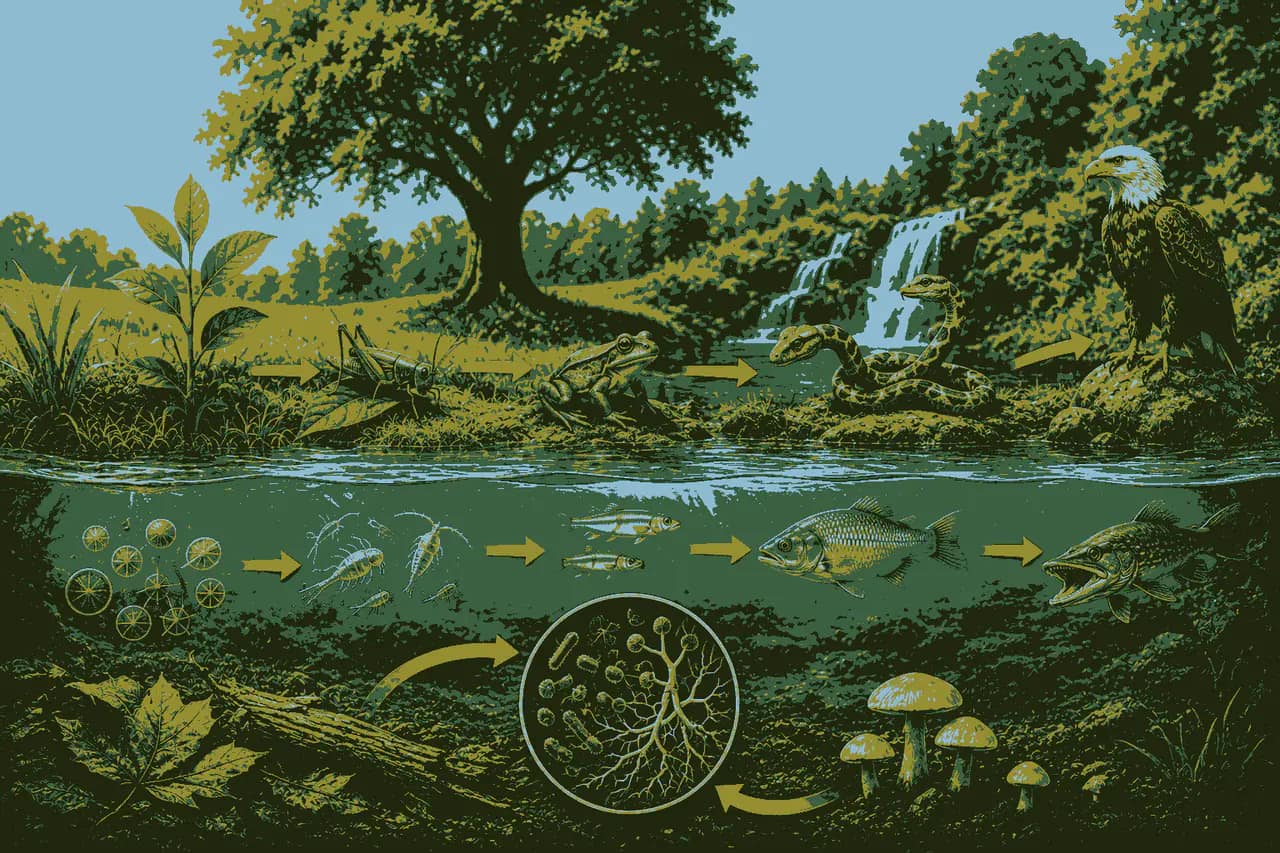
Power-Packed Energy Flow in Ecosystem MCQs PDF Class 12 for Quick Revision
Practice Energy Flow in Ecosystem MCQs PDF Class 12 with solved answers on food chains , trophic levels , 10% energy transfer , productivity , and decomposers.
Boost Your Score with Endemic Species and Biodiversity MCQs PDF Class 12 for NEET, JEE & CUET
Revise Endemic Species and Biodiversity MCQs PDF Class 12 covering biodiversity hotspots, endemic species, genetic diversity, alien invasion, biodiversity loss.