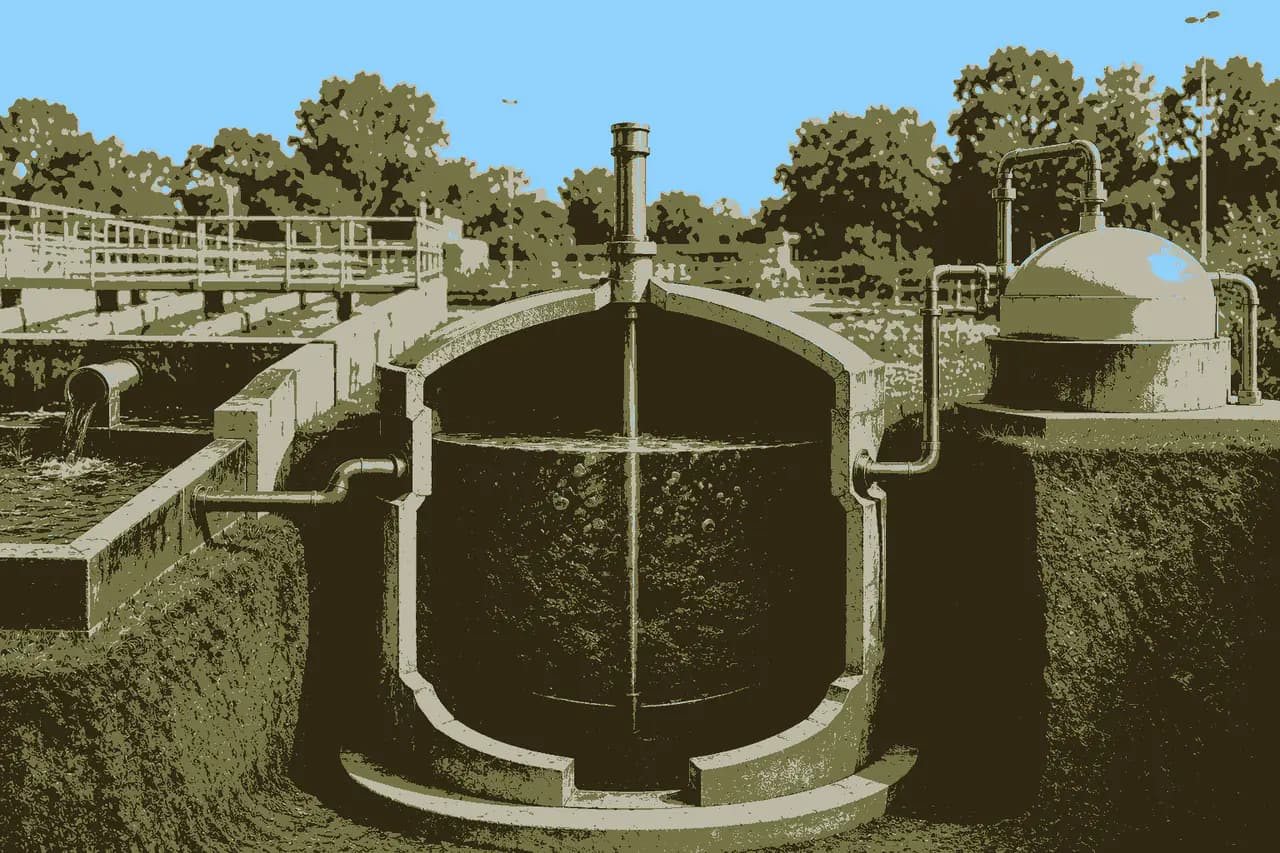
Anaerobic Sludge Digester MCQs Class 12 Biology is an important topic for aspirants who want to understand sewage treatment, microbial decomposition, biogas production, methanogens, activated sludge, and environmental biotechnology in a clear and exam-focused way. Anaerobic Sludge Digester MCQs Class 12 Biology helps aspirants revise one of the most important parts of microbes in human welfare, especially the role of microorganisms in the treatment of wastewater. Sewage contains organic matter, suspended particles, dissolved impurities, and harmful microbes, so it must be treated before being released into natural water bodies. Anaerobic Sludge Digester MCQs Class 12 Biology is useful for Class 12 board exams, NEET, nursing entrance exams, agriculture exams, and other biology-based competitive tests. Anaerobic Sludge Digester MCQs Class 12 Biology becomes easier when aspirants first understand the basic stages of sewage treatment. Primary treatment is a physical process in which large and small particles are removed by filtration and sedimentation. Secondary treatment is a biological process in which microorganisms decompose organic matter present in sewage. Anaerobic Sludge Digester MCQs Class 12 Biology explains that during secondary treatment, aerobic microbes are first used to reduce the biological oxygen demand, or BOD, of sewage. After this, the sludge containing microbial biomass is transferred to anaerobic sludge digesters, where anaerobic bacteria further break down organic matter. Anaerobic Sludge Digester MCQs Class 12 Biology teaches that an anaerobic sludge digester is a closed tank where decomposition takes place in the absence of oxygen. In this environment, anaerobic microbes digest organic matter and produce gases such as methane, carbon dioxide, and hydrogen sulphide. Anaerobic Sludge Digester MCQs Class 12 Biology helps aspirants remember that these gases together form biogas. Methane is the major useful component of biogas and can be used as a source of energy. Carbon dioxide and hydrogen sulphide are also produced during anaerobic digestion, but methane is the most important fuel gas. Anaerobic Sludge Digester MCQs Class 12 Biology also connects strongly with methanogenic bacteria. Methanobacterium is one of the important methanogens found in anaerobic sludge, cattle dung, and the rumen of cattle. Anaerobic Sludge Digester MCQs Class 12 Biology explains that methanogens grow in oxygen-free conditions and convert organic waste into methane-rich biogas. These microbes play a major role in waste management and renewable energy production. Anaerobic Sludge Digester MCQs Class 12 Biology becomes more meaningful when aspirants connect sewage treatment plants with gobar gas plants, because both involve anaerobic digestion and methane production. Anaerobic Sludge Digester MCQs Class 12 Biology is closely related to activated sludge treatment. During secondary treatment, sewage is aerated so that aerobic microbes grow and form flocs. These flocs consume organic matter and reduce BOD. Anaerobic Sludge Digester MCQs Class 12 Biology helps aspirants understand that the sediment formed after this process is called activated sludge. A part of activated sludge is recycled back into the aeration tank, while the remaining sludge is sent to anaerobic sludge digesters. This step is important because it reduces the volume of sludge and produces useful biogas. Anaerobic Sludge Digester MCQs Class 12 Biology should also cover BOD because it is a key indicator of water pollution. BOD refers to the amount of oxygen required by microorganisms to decompose organic matter in water. Anaerobic Sludge Digester MCQs Class 12 Biology helps aspirants remember that high BOD indicates high organic pollution, while low BOD indicates cleaner water. Secondary treatment is significant because it reduces BOD before treated water is released into rivers, lakes, or other water bodies. Proper sewage treatment prevents oxygen depletion, foul smell, spread of disease, and damage to aquatic life. Anaerobic Sludge Digester MCQs Class 12 Biology becomes easier when aspirants revise the difference between aerobic and anaerobic processes. Aerobic treatment requires oxygen and mainly reduces BOD through microbial oxidation. Anaerobic treatment occurs without oxygen and produces gases such as methane, carbon dioxide, and hydrogen sulphide. Anaerobic Sludge Digester MCQs Class 12 Biology is valuable because many exam questions test the role of aerobic microbes, anaerobic microbes, activated sludge, methanogens, and biogas separately. Understanding these differences helps aspirants avoid confusion during exams. Anaerobic Sludge Digester MCQs Class 12 Biology should be studied using flowcharts that show the complete path of sewage treatment. The flow may be remembered as screening, sedimentation, aeration, activated sludge formation, anaerobic digestion, biogas production, and final safe discharge. Anaerobic Sludge Digester MCQs Class 12 Biology becomes easier when aspirants connect each stage with its purpose. Screening removes large particles, sedimentation removes settleable solids, aeration supports aerobic microbes, and anaerobic digestion converts sludge into gases and stabilized waste.
Anaerobic Sludge Digester MCQs Class 12 Biology:
- In a population, unrestricted reproductive capacity is called
A. Biotic potential B. Fertility C. Carrying capacity D. Birth rate Answer: A. Biotic potential Explanation: Unrestricted reproductive capacity of a population is called biotic potential. It represents the maximum possible reproductive ability of a species under ideal conditions.
- If 8 Drosophila in a laboratory population of 80 died during a week, the death rate in the population is ______ individuals per Drosophila per week.
A. 0 B. 0.1 C. 10 D. 1.0 Answer: B. 0.1 Explanation: Death rate = Number of deaths / Total population = 8 / 80 = 0.1 individuals per Drosophila per week.
- The following graph depicts changes in two populations, A and B, of herbivores in a grassy field. A possible reason for these changes is that:
A. Population B competed more successfully for food than population A B. Population A produced more offspring than population B C. Population A consumed the members of population B D. Both plant populations in this habitat decreased Answer: A. Population B competed more successfully for food than population A Explanation: Population B increased because it adapted better to the environment and competed more successfully for food than population A.
- The species confined to a particular region and not found elsewhere is termed as:
A. Rare B. Keystone C. Alien D. Endemic Answer: D. Endemic Explanation: Endemic species are restricted to a specific geographical area and are not naturally found in any other part of the world.
- Natality refers to
A. Death rate B. Birth rate C. Number of individuals entering a habitat D. Number of individuals leaving the habitat Answer: B. Birth rate Explanation: Natality refers to the birth rate, which is the number of new individuals added to a population through reproduction.
- Niche is
A. All the biological factors in the organism's environment B. The physical space where an organism lives C. The functional role played by the organism where it lives D. The range of temperature that the organism needs to live Answer: C. The functional role played by the organism where it lives Explanation: A niche refers to the functional role of an organism in its habitat, including how it obtains food, interacts with others, and uses resources.
- A biologist studied the population of rats in a barn. He found that the average natality was 250, average mortality was 240, immigration was 20, and emigration was 30. The net increase in population is
A. Zero B. 10 C. 15 D. 5 Answer: A. Zero Explanation: Net increase = Birth rate + Immigration - Death rate - Emigration = 250 + 20 - 240 - 30 = 0. Therefore, there is no net increase in population.
- The formula for exponential population growth is
A. dt/dN = rN B. dN/rN = dt C. rN/dN = dt D. dN/dt = rN Answer: D. dN/dt = rN Explanation: Exponential population growth is represented by the equation dN/dt = rN, where r is the intrinsic rate of natural increase.
- What gases are produced in anaerobic sludge digesters?
A. Methane and CO₂ only B. Methane, hydrogen sulphide and CO₂ C. Methane, hydrogen sulphide and O₂ D. Hydrogen sulphide and CO₂ Answer: B. Methane, hydrogen sulphide and CO₂ Explanation: Anaerobic microbes digest organic matter in sludge digesters and produce gases such as methane, carbon dioxide, and hydrogen sulphide.
- During sewage treatment, biogases are produced which include:
A. Hydrogen sulphide, nitrogen, methane B. Methane, hydrogen sulphide, carbon dioxide C. Methane, oxygen, hydrogen sulphide D. Hydrogen sulphide, methane, sulphur dioxide Answer: B. Methane, hydrogen sulphide, carbon dioxide Explanation: Biogas is produced by anaerobic digestion of organic matter and mainly contains methane, carbon dioxide, and hydrogen sulphide.
- The domestic sewage in large cities:
A. Has high BOD as it contains both aerobic and anaerobic bacteria B. Is processed by aerobic and then anaerobic bacteria in the secondary treatment in Sewage Treatment Plants C. When treated in STPs does not really require the aeration step as the sewage contains adequate oxygen D. Has very high amounts of suspended solids and dissolved salts Answer: B. Is processed by aerobic and then anaerobic bacteria in the secondary treatment in Sewage Treatment Plants Explanation: In sewage treatment plants, secondary treatment involves microbial action. Aerobic microbes first reduce organic matter, followed by anaerobic digestion of sludge.
- Study the following statements and select the incorrect ones.
i. Physical removal of large and small particles through filtration and sedimentation is called primary sewage treatment. ii. Secondary sewage treatment is mainly a mechanical process. iii. Activated sludge sediment in sewage treatment plant is a rich source of aerobic bacteria. iv. Biogas, commonly called gobar gas, is pure methane. Options: A. i and ii only B. ii and iv only C. ii and iii only D. iii and iv only Answer: B. ii and iv only Explanation: Secondary sewage treatment is a biological process involving microbial activity, not mainly mechanical. Biogas is not pure methane; it is a mixture of methane, carbon dioxide, hydrogen sulphide, and other gases.
- In sewage treatment, secondary treatment is considered highly significant because
A. It helps to remove debris from the sewage B. It reduces the BOD level of sewage C. It helps in production of biogas D. It increases the organic content of sewage Answer: B. It reduces the BOD level of sewage Explanation: Secondary treatment reduces Biological Oxygen Demand, or BOD, by decomposing organic matter with the help of microbes.
- Sewage water can be purified by
A. Penicillin B. Fishes C. Aquatic plants D. Microorganisms Answer: D. Microorganisms Explanation: Sewage water is purified mainly by heterotrophic microorganisms that decompose organic matter present in sewage.
- Which of the following is the correct sequence of stages of growth curve for bacteria?
A. Lag, log, stationary, decline phase B. Lag, log, stationary phase C. Stationary, lag, log, decline phase D. Decline, lag, log phase Answer: A. Lag, log, stationary, decline phase Explanation: In a closed or batch culture, bacterial growth usually shows four phases: lag phase, log phase, stationary phase, and decline phase.
- An interaction in which one organism is benefited and the other is unaffected is known as:
A. Predation B. Commensalism C. Mutualism D. Parasitism Answer: B. Commensalism Explanation: Commensalism is an interaction in which one organism benefits while the other organism is neither harmed nor benefited.
- In an experiment with freshly hatched larvae of an insect, Khapra beetle, reared on a basal diet with increasing amounts of cholesterol, what does the graph indicate?
A. Cholesterol is an essential dietary requirement of Khapra beetle B. Growth of Khapra beetle is directly proportional to cholesterol concentration C. Cholesterol concentration of 2 µg/g diet is the optimum level D. Growth of Khapra beetle is inhibited when cholesterol concentration exceeds 5 µg/g diet Answer: A. Cholesterol is an essential dietary requirement of Khapra beetle Explanation: The graph indicates that cholesterol is necessary for the normal growth and development of Khapra beetle larvae.
- What will be the shape of the growth curve of a bacterial population in a lab plotted against time?
A. Sigmoid B. Hyperbolic C. Ascending straight line D. Descending straight line Answer: B. Hyperbolic Explanation: Under continuous availability of food and space in laboratory conditions, bacterial population may show exponential growth, represented by a J-shaped or hyperbolic curve.
- In an area with a population of large size individuals having long life span, more parental care, and slow development, what type of population growth curve will be observed?
A. S-shaped B. J-shaped C. Z-shaped D. All of these Answer: A. S-shaped Explanation: Large organisms with long life span, slow development, and more parental care usually show logistic or S-shaped growth.
- Which of the following statements is true regarding age pyramids?
A. A - Expanding, B - Stable, C - Declining B. A - Stable, B - Expanding, C - Declining C. A - Stable, B - Declining, C - Expanding D. A - Declining, B - Stable, C - Expanding Answer: A. A - Expanding, B - Stable, C - Declining Explanation: An expanding pyramid has more pre-reproductive individuals, a stable pyramid has nearly equal proportions, and a declining pyramid has fewer young individuals.
- July 11 is observed as:
A. World Population Day B. Tobacco Day C. World Environment Day D. World Health Day Answer: A. World Population Day Explanation: World Population Day is observed every year on July 11. It was established by the United Nations Development Programme in 1989.
- Match the following correctly.
Column I: i. Logistic growth ii. Exponential growth iii. Age pyramids iv. Pacific salmon fish Column II: A. dN/dt = rN B. Breeds only once in lifetime C. Expanding, stable and declining types D. Growth limited by carrying capacity E. Unlimited resource-based rapid growth Options: A. i-E, ii-A, iii-D, iv-B B. i-D, ii-A, iii-E, iv-C C. i-D, ii-C, iii-E, iv-B D. i-E, ii-A, iii-D, iv-C Answer: B. i-D, ii-A, iii-E, iv-C Explanation: Logistic growth is limited by carrying capacity, exponential growth is represented by dN/dt = rN, age pyramids may be expanding, stable, or declining, and Pacific salmon breed only once in their lifetime.
- At a given time in a forest, 900 deer are found. If 100 more deer can be accommodated, then 1000 is
A. Population carrying capacity of deer B. Mortality of deer C. Maximum natality D. Realised natality Answer: A. Population carrying capacity of deer Explanation: Carrying capacity is the maximum number of individuals that an environment can support. Here, the forest can support 1000 deer.
- Based on the statement “India is a country of youngsters,” what type of age pyramid would be formed?
A. Triangular shape B. Bell shape C. Urn shape D. Spindle shape Answer: A. Triangular shape Explanation: A population with a high proportion of young individuals forms a triangular age pyramid, indicating an expanding population.
- The bacterium that is commonly found in the anaerobic sludge during sewage treatment is called
A. Methanobacterium B. Staphylococcus C. Acetobacter aceti D. Clostridium butylicum Answer: A. Methanobacterium Explanation: Methanobacterium is a methanogenic bacterium found in anaerobic sludge. It helps produce methane during anaerobic digestion.
- The primary treatment of sewage water involves
A. Sludge digestion B. Aerobic bacterial activity C. Anaerobic bacterial activity D. Filtration and sedimentation Answer: D. Filtration and sedimentation Explanation: Primary treatment is a physical process that removes large and small particles from sewage through filtration and sedimentation.
- Stirred-tank bioreactors have been designed for
A. Addition of preservatives to the product B. Purification of the product C. Ensuring anaerobic conditions in the culture D. Availability of oxygen throughout the process Answer: D. Availability of oxygen throughout the process Explanation: Stirred-tank bioreactors are designed to ensure proper mixing and oxygen availability throughout the process.
- Select the correct statement from the following:
A. Biogas is produced by the activity of aerobic bacteria on animal waste B. Methanobacterium is an aerobic bacterium found in rumen of cattle C. Biogas commonly called gobar gas is pure methane D. Activated sludge sediment in settlement tanks of sewage treatment plant is a rich source of aerobic bacteria Answer: D. Activated sludge sediment in settlement tanks of sewage treatment plant is a rich source of aerobic bacteria Explanation: Activated sludge contains aerobic bacteria and other microbes that help decompose organic matter during sewage treatment.
- Biogas produced by fermentation of manure, sewage, cattle dung, etc. predominantly comprises
A. Methane, nitrogen and hydrogen B. Methane and carbon dioxide C. Methane and carbon monoxide D. Methane and nitric oxide Answer: B. Methane and carbon dioxide Explanation: Biogas mainly contains methane and carbon dioxide, along with small amounts of hydrogen sulphide, nitrogen, and hydrogen.
- In the Verhulst-Pearl logistic growth equation, the letter r denotes what?
A. Extrinsic rate of natural increase
B. Intrinsic rate of natural increase
C. Carrying capacity
D. Population density
Answer: B. Intrinsic rate of natural increase
Explanation: In the Verhulst-Pearl logistic growth equation, r denotes the intrinsic rate of natural increase.
Conclusion on Anaerobic Sludge Digester MCQs Class 12 Biology
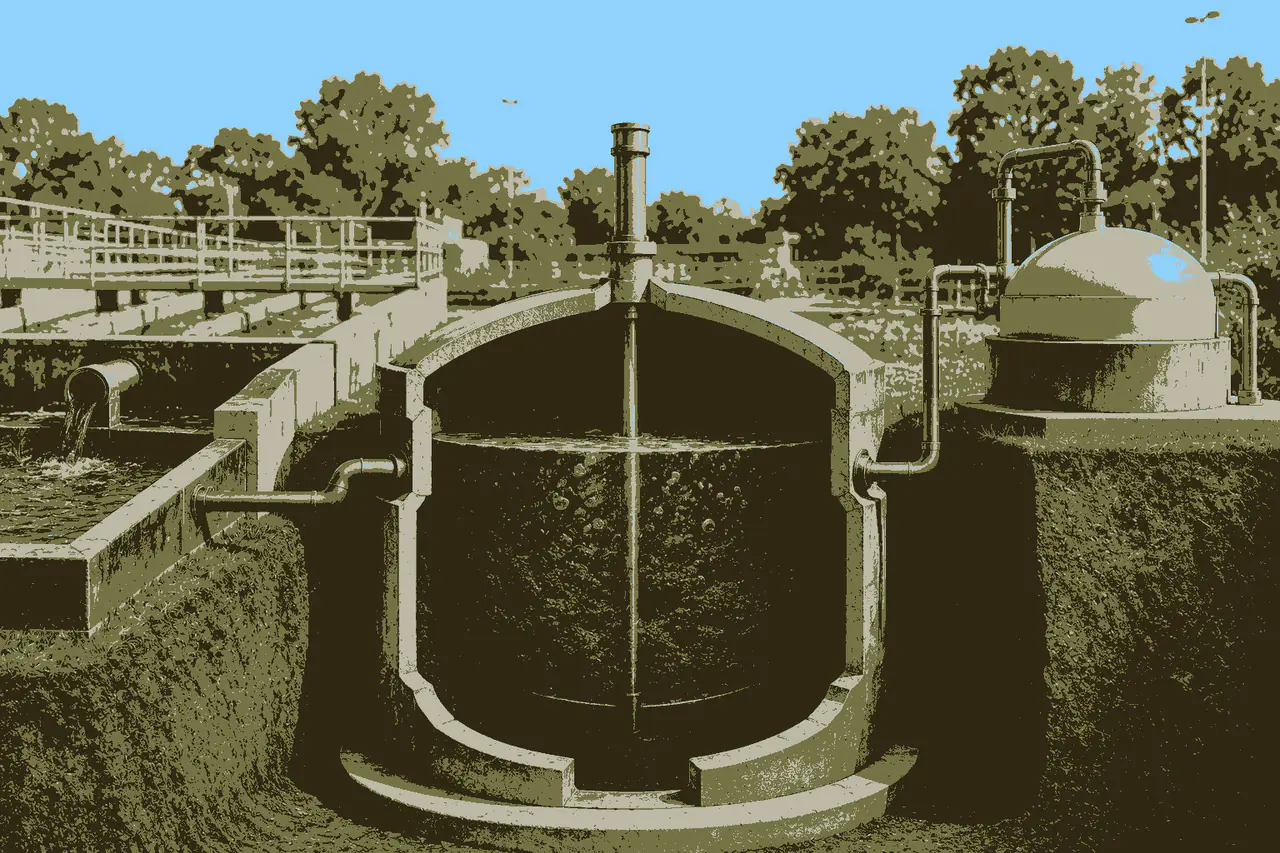
Anaerobic Sludge Digester MCQs Class 12 Biology helps aspirants understand the environmental importance of microorganisms. Microbes are not only disease-causing organisms; they also help recycle nutrients, treat sewage, produce biogas, and reduce pollution. Anaerobic Sludge Digester MCQs Class 12 Biology is important because it links microbiology with ecology, biotechnology, public health, and renewable energy. In conclusion, Anaerobic Sludge Digester MCQs Class 12 Biology improves understanding of sewage treatment, activated sludge, methanogens, BOD reduction, anaerobic digestion, and biogas production.
Related reading

Master Essential Cyanobacteria Biofertilizer MCQs Class 12 Biology: Proven Questions for Exam Success
Explore Cyanobacteria Biofertilizer MCQs Class 12 Biology with key facts on blue-green algae, Azolla, Anabaena, nitrogen fixation, paddy fields , and exam prep.
Ultimate Vam Mycorrhiza MCQs with Answers Class 12 Biology - Powerful Practice for Exam Success
Revise Vam Mycorrhiza MCQs with Answers Class 12 Biology covering VAM, endomycorrhiza, phosphate absorption, biofertilizers, plant roots, and exam preparations.