
- Keneitsino Lydia
- June 20, 2026
Unlock High-Scoring Hydrosere Succession and Nutrient Cycles MCQs with Answers
Hydrosere Succession and Nutrient Cycles MCQs with Answers is an important ecology topic for aspirants who want to understand how ecosystems gradually develop and how essential elements move through living and non-living components. Hydrosere Succession and Nutrient Cycles MCQs with Answers helps aspirants revise two connected concepts: ecological succession in aquatic habitats and biogeochemical cycling of nutrients such as carbon, nitrogen, phosphorus, and sulphur. Together, these Hydrosere Succession and Nutrient Cycles MCQs with Answers explain how life begins, changes, stabilizes, and sustains itself in nature.
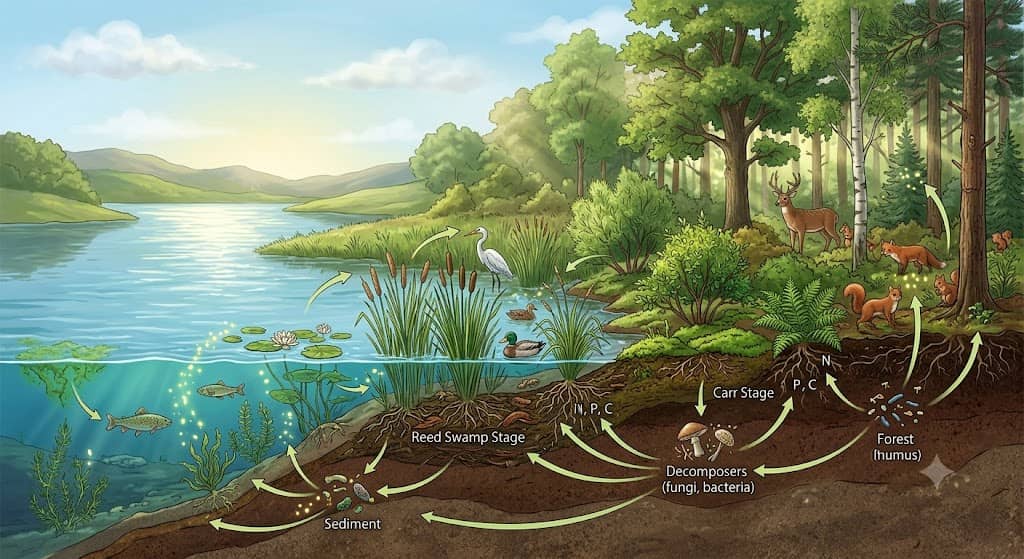
Hydrosere Succession and Nutrient Cycles MCQs with Answers becomes easier when aspirants first understand hydrosere. Hydrosere is a type of ecological succession that begins in a water body such as a pond, lake, or shallow aquatic habitat and gradually progresses toward a terrestrial climax community. Hydrosere Succession and Nutrient Cycles MCQs with Answers explains that this process starts with aquatic pioneer organisms and slowly converts the water body into marsh, meadow, and eventually forest-like conditions over a long period.
Hydrosere Succession and Nutrient Cycles MCQs with Answers is useful for remembering the stages of hydroseric succession. The sequence usually begins with phytoplankton, followed by rooted submerged plants, floating plants, reed swamp stage, sedge meadow stage, woodland stage, and climax forest stage. Hydrosere Succession and Nutrient Cycles MCQs with Answers helps aspirants understand that each stage modifies the habitat and makes it suitable for the next community. Dead organic matter accumulates, water depth decreases, and soil formation slowly begins.
Hydrosere Succession and Nutrient Cycles MCQs with Answers also explains the importance of pioneer species. In hydrosere, phytoplankton are usually the pioneer organisms because they are the first to colonize aquatic habitats. Hydrosere Succession and Nutrient Cycles MCQs with Answers teaches aspirants that pioneer organisms create conditions for later species by contributing organic matter, increasing nutrient availability, and changing the physical nature of the habitat. This gradual change is the foundation of ecological succession.
Hydrosere Succession and Nutrient Cycles MCQs with Answers should also be studied with the idea of sere and seral communities. A sere is the complete sequence of communities that appear during succession, while each intermediate stage is called a seral community. Hydrosere Succession and Nutrient Cycles MCQs with Answers helps aspirants understand that succession is not random. It follows a predictable pattern in which species composition changes until a relatively stable climax community is reached.
Hydrosere Succession and Nutrient Cycles MCQs with Answers is closely linked with nutrient cycles because succession depends on nutrient availability. Nutrient cycles, also called biogeochemical cycles, describe the movement of elements between organisms and the environment. Hydrosere Succession and Nutrient Cycles MCQs with Answers explains that nutrients are absorbed by producers, passed through food chains, returned by decomposers, and reused by plants. Without nutrient cycling, ecosystems cannot maintain productivity or support long-term growth.
Hydrosere Succession and Nutrient Cycles MCQs with Answers includes the carbon cycle, which is one of the most important cycles in nature. Carbon moves between the atmosphere, plants, animals, microbes, oceans, and soil. Hydrosere Succession and Nutrient Cycles MCQs with Answers helps aspirants remember that photosynthesis removes carbon dioxide from the atmosphere, while respiration, decomposition, and combustion release carbon dioxide back. Carbon cycling supports food production, energy transfer, and ecosystem balance.
Hydrosere Succession and Nutrient Cycles MCQs with Answers also covers the phosphorus cycle. Phosphorus is mainly a sedimentary cycle because its major reservoir is rocks and minerals, not the atmosphere. Hydrosere Succession and Nutrient Cycles MCQs with Answers explains that weathering of rocks releases phosphates into soil and water. Plants absorb phosphates, animals obtain phosphorus from plants or other animals, and decomposers return phosphorus to the soil through decomposition of organic matter.
Hydrosere Succession and Nutrient Cycles MCQs with Answers helps aspirants compare gaseous and sedimentary cycles. Carbon and nitrogen cycles are generally considered gaseous cycles because their major reservoirs include the atmosphere. Phosphorus and sulphur cycles are commonly studied as sedimentary cycles because their reservoirs are mainly rocks and soil. Hydrosere Succession and Nutrient Cycles MCQs with Answers becomes clearer when aspirants remember the reservoir of each nutrient and the role of microbes in nutrient recycling.
Hydrosere Succession and Nutrient Cycles MCQs with Answers is also connected with eutrophication. Eutrophication occurs when lakes or ponds become enriched with nutrients such as nitrogen and phosphorus, causing excessive growth of algae and aquatic plants. Hydrosere Succession and Nutrient Cycles MCQs with Answers teaches aspirants that eutrophication can reduce dissolved oxygen and cause fish death. This makes nutrient balance important for maintaining healthy aquatic ecosystems.
Hydrosere Succession and Nutrient Cycles MCQs with Answers:
- Niche overlap indicates
A. Active cooperation between two species
B. Two different parasites on the same host
C. Sharing of one or more resources between the two species
D. Mutualism between two species
Answer: C. Sharing of one or more resources between the two species
Explanation: Niche overlap describes the sharing of niche space by one or more species. It indicates similarity in the resource use of two species.
- According to IUCN Red List, what is the status of Red Panda, Ailurus fulgens?
A. Critically endangered species
B. Vulnerable species
C. Extinct species
D. Endangered species
Answer: D. Endangered species
Explanation: According to the IUCN Red List, the Red Panda, Ailurus fulgens, is classified as an endangered species.
- Two opposite forces operate in the growth and development of every population. One of them relates to the ability to reproduce at a given rate. The force opposing it is called
A. Morbidity
B. Fecundity
C. Biotic potential
D. Environmental resistance
Answer: D. Environmental resistance
Explanation: Environmental resistance is the force that opposes biotic potential. It includes limiting factors such as food shortage, space limitation, predation, disease, and climatic stress.
- Intermediate community between pioneer and climax communities is called
A. Seral community
B. Biotic community
C. Temporary community
D. Ecosere
Answer: A. Seral community
Explanation: A seral community is an intermediate community that appears during ecological succession between the pioneer stage and the climax stage.
- The vegetation of Rajasthan is
A. Xerophytic
B. Deciduous
C. Hydrophytic
D. Arctic
Answer: A. Xerophytic
Explanation: Rajasthan has desert conditions, so its vegetation is xerophytic. Xerophytic plants are adapted to dry habitats and show features that reduce water loss.
- Plants which behave as mesophytes in rainy season and as xerophytes in summers are called
A. Xerophytes
B. Mesophytes
C. Trophophytes
D. Phreatophytes
Answer: C. Trophophytes
Explanation: Trophophytes behave as mesophytes during the rainy season and as xerophytes during dry summers. They are adapted to alternating wet and dry conditions.
- Ephemerals are xerophytes that are
A. Drought resisting
B. Drought enduring
C. Drought escaping
D. None of these
Answer: C. Drought escaping
Explanation: Ephemerals are drought-escaping xerophytes. They complete their life cycle quickly before severe drought conditions begin.
- A place was rocky and barren but now there is a green forest. The sequence of origin is
A. Lichen, moss, herbs, shrubs
B. Moss, lichen, herbs, shrubs
C. Lichen, moss, shrubs, herbs
D. Shrubs, herbs, moss, lichen
Answer: A. Lichen, moss, herbs, shrubs
Explanation: In xerarch succession on bare rock, lichens appear first, followed by mosses, herbs, shrubs, and finally a forest community.
- Match the following.
Column I:
A. Predictable change in species composition
B. Climax community
C. Entire sequence community
D. Transitional community
Column II:
i. Equilibrium
ii. Seral stages
iii. Ecological succession
iv. Sere
Options:
A. i, v, iii, ii
B. iii, i, iv, ii
C. ii, iii, v, iv
D. iv, v, ii, i
Answer: B. iii, i, iv, ii
Explanation: Predictable change in species composition is ecological succession. Climax community represents equilibrium. The entire sequence is called a sere, and transitional communities are called seral stages.
- In hydroseric succession, which stage comes just before sedge meadow stage?
A. Rooted submerged stage
B. Phytoplankton stage
C. Reed swamp stage
D. Climax stage
Answer: C. Reed swamp stage
Explanation: In hydroseric succession, the reed swamp stage comes just before the sedge meadow stage.
- Which of the following is the correct trend of succession in hydroseric succession?
A. Phytoplankton → Reed swamp → Rooted submerged → Sedge meadow
B. Phytoplankton → Rooted submerged → Reed swamp → Sedge meadow
C. Phytoplankton → Sedge meadow → Reed swamp → Rooted submerged
D. Rooted submerged → Phytoplankton → Reed swamp → Sedge meadow
Answer: B. Phytoplankton → Rooted submerged → Reed swamp → Sedge meadow
Explanation: The correct sequence in hydroseric succession begins with phytoplankton, followed by rooted submerged plants, reed swamp, and sedge meadow stages.
- The organisms which invade a bare area to initiate an ecological succession are known as
A. Keystone species
B. Climatic species
C. Endemic species
D. Pioneer species
Answer: D. Pioneer species
Explanation: Pioneer species are the first organisms to colonize a bare area and initiate ecological succession.
- Assertion and Reason:
Assertion (A): A primary succession is more common than secondary succession.
Reason (R): Biogeochemical cycling is absent in secondary succession.
A. Both A and R are correct and R is the correct explanation for A
B. Both A and R are correct and R is not the correct explanation for A
C. A is correct but R is wrong
D. Both A and R are not correct
Answer: D. Both A and R are not correct
Explanation: Primary succession is generally less common and slower than secondary succession. Biogeochemical cycling is not absent in secondary succession.
- Which of the following would appear as the pioneer organisms on bare rocks?
A. Green algae
B. Lichens
C. Liverworts
D. Mosses
Answer: B. Lichens
Explanation: Lichens are the pioneer organisms on bare rocks. They secrete acids that help break down rocks and begin soil formation.
- The correct sequence of plants in hydrosere is
A. Oak → Lantana → Volvox → Hydrilla → Pistia → Scirpus
B. Oak → Lantana → Scirpus → Pistia → Hydrilla → Volvox
C. Volvox → Hydrilla → Pistia → Scirpus → Lantana → Oak
D. Pistia → Volvox → Scirpus → Hydrilla → Oak → Lantana
Answer: C. Volvox → Hydrilla → Pistia → Scirpus → Lantana → Oak
Explanation: Hydrosere begins with aquatic pioneer organisms such as Volvox and gradually proceeds through submerged, floating, reed swamp, shrub, and forest stages.
- Which one of the following statements is correct for secondary succession?
A. It is similar to primary succession except that it has a relatively fast pace
B. It begins on a bare rock
C. It occurs on deforested site
D. It follows primary succession
Answer: C. It occurs on deforested site
Explanation: Secondary succession occurs in areas where a previous community existed but was disturbed, such as deforested land, burned forests, or abandoned fields.
- Which of the following statements is incorrect based on the provided passage?
A. In mesophytes, unless the habitat is specialized, no adaptation is necessary
B. Warming, a British botanist, classified plant communities as three ecological groups based on dependence on water
C. Due to flooding-destroyed areas, secondary succession occurs much faster
D. In hydrophytes, the multilayered epidermis is useful in absorbing only water from surroundings
Answer: B and D
Explanation: The incorrect statements are B and D. Warming was a Danish botanist, not British. Also, hydrophytes generally do not need a multilayered epidermis for absorbing only water from surroundings.
- The role of bacteria in carbon cycle is
A. Photosynthesis
B. Chemosynthesis
C. Decomposition of organic compounds
D. Evolution of O₂
Answer: C. Decomposition of organic compounds
Explanation: Bacteria play an important role in the carbon cycle by decomposing organic matter and releasing carbon back into the environment.
- Which of the following statements is incorrect regarding the phosphorus cycle?
A. It is a sedimentary cycle
B. Phosphates are the major form of phosphorus reservoir
C. Phosphorus-solubilising bacteria facilitate the release of phosphorus from organic remains
D. There is appreciable respiratory release of phosphorus into atmosphere
Answer: D. There is appreciable respiratory release of phosphorus into atmosphere
Explanation: The phosphorus cycle does not have a significant atmospheric phase. There is no appreciable respiratory release of phosphorus into the atmosphere.
- The simplest of all nutrient cycles operating in an ecosystem is the ______ cycle.
A. Carbon
B. Phosphorus
C. Nitrogen
D. Sulphur
Answer: B. Phosphorus
Explanation: The phosphorus cycle is considered one of the simplest nutrient cycles because it is mainly sedimentary and lacks a significant gaseous phase.
- Which one of the following will accelerate the phosphorus cycle?
A. Rainfall and storms
B. Burning of fossil fuels
C. Volcanic activity
D. Weathering of rocks
Answer: D. Weathering of rocks
Explanation: Weathering of rocks releases phosphates into soil and water, accelerating the phosphorus cycle.
- The natural cycling of carbon between organisms and their environment is directly accomplished through
A. Radiations of solar energy
B. Photosynthesis and respiration
C. Nutrition and excretion
D. All of the above
Answer: B. Photosynthesis and respiration
Explanation: Carbon cycles directly between organisms and the environment mainly through photosynthesis and respiration.
- Which of the following are reservoirs for phosphorus and nitrogen cycles respectively?
A. Atmosphere and bedrocks
B. Bedrocks and atmosphere
C. Consumers
D. Atmosphere and producers
Answer: B. Bedrocks and atmosphere
Explanation: The main reservoir of phosphorus is sedimentary rocks, while the main reservoir of nitrogen is the atmosphere.
- In which of the following do both pairs have the correct combination?
A. Gaseous nutrient cycle: Sulphur and Phosphorus; Sedimentary nutrient cycle: Carbon and Nitrogen
B. Gaseous nutrient cycle: Carbon and Nitrogen; Sedimentary nutrient cycle: Sulphur and Phosphorus
C. Gaseous nutrient cycle: Carbon and Sulphur; Sedimentary nutrient cycle: Nitrogen and Phosphorus
D. Gaseous nutrient cycle: Nitrogen and Sulphur; Sedimentary nutrient cycle: Carbon and Phosphorus
Answer: B. Gaseous nutrient cycle: Carbon and Nitrogen; Sedimentary nutrient cycle: Sulphur and Phosphorus
Explanation: Carbon and nitrogen cycles are gaseous nutrient cycles, while phosphorus and sulphur cycles are mainly sedimentary nutrient cycles.
- Given below is a simplified model of phosphorus cycling in a terrestrial ecosystem with four blanks A-D. Identify the blanks.
A. Rock minerals, Detritus, Litter fall, Producers
B. Litter fall, Producers, Rock minerals, Detritus
C. Detritus, Rock mineral, Producer, Litter fall
D. Producers, Litter fall, Rock minerals, Detritus
Answer: B. Litter fall, Producers, Rock minerals, Detritus
Explanation: According to the given model of phosphorus cycling, the correct order of blanks is litter fall, producers, rock minerals, and detritus.
- Select the matched ones.
A. A, B and D only
B. A and C only
C. B and C only
D. B and D only
Answer: C. B and C only
Explanation: According to the given answer key, the correct matched statements are B and C only. The explanation relates to pioneer species, secondary succession, sedimentary cycles, and inverted biomass pyramid in the sea.
- Eutrophication is seen in
A. Saline soil
B. Agricultural land near thermal plant
C. Lake
D. Mountain
Answer: C. Lake
Explanation: Eutrophication is the nutrient enrichment of a water body, especially lakes, due to an increase in nitrogen and phosphorus.
- Biogeochemical cycle of which element has an atmospheric phase?
A. Carbon
B. Sodium
C. Phosphorus
D. Magnesium
Answer: A. Carbon
Explanation: The carbon cycle has an atmospheric phase because carbon dioxide is present in the atmosphere and is exchanged through photosynthesis and respiration.
- Fishes in eutrophic lake die due to
A. Lack of oxygen
B. Nutrient enrichment
C. CO₂
D. None
Answer: A. Lack of oxygen
Explanation: In eutrophic lakes, algal blooms increase and later decompose, reducing dissolved oxygen. This oxygen depletion causes fish death.
- Animals take phosphorus from
A. Water
B. Plants
C. Rock
D. Soil
Answer: B. Plants
Explanation: Plants absorb phosphorus from soil in the form of phosphates. Animals obtain phosphorus by eating plants or other animals that have consumed plants.
Conclusion on Hydrosere Succession and Nutrient Cycles MCQs with Answers
Hydrosere Succession and Nutrient Cycles MCQs with Answers is a high-value topic for Class 12 Biology, NEET ecology, and environmental science revision. Aspirants should revise terms such as hydrosere, phytoplankton, reed swamp, sedge meadow, climax community, sere, seral stage, carbon cycle, phosphorus cycle, nitrogen cycle, sedimentary cycle, gaseous cycle, eutrophication, and decomposition. Hydrosere Succession and Nutrient Cycles MCQs with Answers gives aspirants strong conceptual clarity about ecosystem development, nutrient recycling, succession patterns, and ecological stability.