
- Keneitsino Lydia
- June 19, 2026
Master Detritus Decomposition Ecology MCQs Solved Answers with Confidence
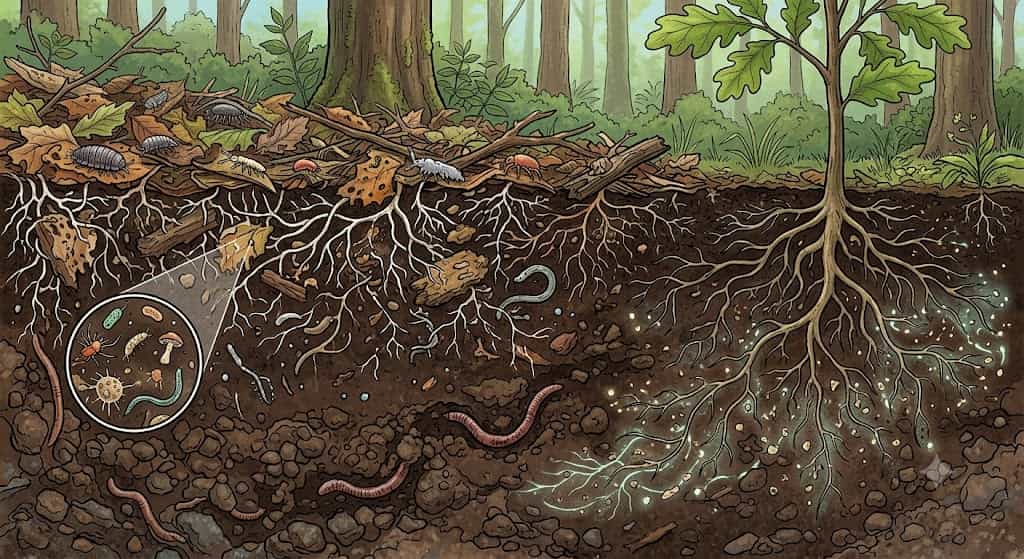
Detritus Decomposition Ecology MCQs Solved Answers is an important ecology topic for aspirants who want to understand how dead organic matter is broken down and recycled in ecosystems. Detritus Decomposition Ecology MCQs Solved Answers helps aspirants revise the role of detritus, decomposers, detritivores, fungi, bacteria, earthworms, humus formation, mineral cycling, and energy flow. This topic is highly useful for Class 12 Biology, NEET preparation, and environmental science revision because decomposition connects living organisms with soil fertility and nutrient recycling.
Detritus Decomposition Ecology MCQs Solved Answers becomes easier when aspirants first understand the meaning of detritus. Detritus refers to dead remains of plants, animals, fallen leaves, animal waste, and other organic debris present in an ecosystem. Detritus Decomposition Ecology MCQs Solved Answers explains that detritus is not useless waste; instead, it is the starting material for nutrient recycling. Without detritus breakdown, ecosystems would be filled with dead organic matter and essential minerals would remain locked.
Detritus Decomposition Ecology MCQs Solved Answers is closely related to decomposers and detritivores. Decomposers are mainly bacteria and fungi that chemically break down organic matter into simpler substances. Detritus Decomposition Ecology MCQs Solved Answers also includes detritivores such as earthworms, termites, mites, and some insects, which physically break detritus into smaller particles. These organisms support soil structure, fertility, aeration, and nutrient availability.
Detritus Decomposition Ecology MCQs Solved Answers helps aspirants understand the major steps of decomposition. The process includes fragmentation, leaching, catabolism, humification, and mineralization. Detritus Decomposition Ecology MCQs Solved Answers explains that fragmentation is the breakdown of detritus into smaller pieces by detritivores. Leaching removes water-soluble nutrients into the soil. Catabolism involves enzymatic breakdown of complex organic compounds by microbes. Humification produces humus, and mineralization releases inorganic nutrients.
Detritus Decomposition Ecology MCQs Solved Answers is important for understanding why decomposition rates differ in different ecosystems. Warm, moist, and oxygen-rich conditions increase decomposition. Detritus Decomposition Ecology MCQs Solved Answers teaches aspirants that detritus rich in sugars, nitrogen, and water-soluble compounds decomposes faster. However, detritus rich in lignin, chitin, tannins, and cellulose decomposes slowly because these materials are resistant to microbial action.
Detritus Decomposition Ecology MCQs Solved Answers also explains the importance of humus. Humus is a dark, amorphous, partially decomposed organic substance formed during humification. Detritus Decomposition Ecology MCQs Solved Answers helps aspirants remember that humus is resistant to microbial breakdown and decomposes very slowly. It improves soil texture, water-holding capacity, aeration, and fertility. Humus acts as a nutrient reservoir and supports the establishment of plant communities.
Detritus Decomposition Ecology MCQs Solved Answers is strongly connected with mineral cycling. Mineralization converts organic nutrients into inorganic forms that plants can absorb through their roots. Detritus Decomposition Ecology MCQs Solved Answers explains that nitrogen, phosphorus, potassium, calcium, and other minerals become available to producers through decomposition. If decomposers are removed from an ecosystem, the mineral cycle is disturbed, soil fertility decreases, and plant growth is affected.
Detritus Decomposition Ecology MCQs Solved Answers is also useful for understanding food chains. In grazing food chains, energy begins with green plants and moves to herbivores and carnivores. Detritus Decomposition Ecology MCQs Solved Answers explains that in detritus food chains, energy begins from dead organic matter and passes through detritivores and decomposers. This pathway is especially important in forests, deep oceans, soil ecosystems, and aquatic bottoms where dead organic matter supports many organisms.
Detritus Decomposition Ecology MCQs Solved Answers helps aspirants connect earthworms with decomposition and agriculture. Earthworms are economically important detritivores because they fragment organic matter, improve soil aeration, and produce nutrient-rich vermicompost. Detritus Decomposition Ecology MCQs Solved Answers also covers vermicomposting, where selected earthworm species convert organic waste into compost rich in nitrogen, potassium, and other nutrients. This makes decomposition important for organic farming and sustainable agriculture.
Detritus Decomposition Ecology MCQs Solved Answers also connects with pollution and biomagnification concepts. Decomposers can break down natural organic matter, but many toxic chemicals are non-biodegradable and accumulate in food chains. Detritus Decomposition Ecology MCQs Solved Answers helps aspirants understand why substances like DDT can increase in concentration at successive trophic levels. Decomposition works best for biodegradable organic material, not persistent pollutants.
Detritus Decomposition Ecology MCQs Solved Answers:
- The rate of decomposition is faster in the ecosystem due to the following factors EXCEPT:
A. Detritus richer in lignin and chitin
B. Detritus rich in sugars
C. Warm and moist environment
D. Presence of aerobic soil microbes
Answer: A. Detritus richer in lignin and chitin
Explanation: Decomposition is faster when detritus is rich in nitrogen and water-soluble substances such as sugars. It becomes slower when detritus contains lignin, chitin, tannins, and cellulose.
- The primary producers of the deep-sea hydrothermal vent ecosystem are
A. Green algae
B. Chemosynthetic bacteria
C. Blue-green algae
D. Coral reefs
Answer: B. Chemosynthetic bacteria
Explanation: Deep-sea hydrothermal vents do not receive sunlight. Chemosynthetic bacteria use chemicals such as hydrogen sulphide to produce organic matter and act as primary producers in this ecosystem.
- Bamboo plant is growing in a forest. What will be its trophic level?
A. First trophic level (T1)
B. Second trophic level (T2)
C. Third trophic level (T3)
D. Fourth trophic level (T4)
Answer: A. First trophic level (T1)
Explanation: Bamboo is a green plant and acts as a producer. All producers occupy the first trophic level in an ecosystem.
- Detritivores break down detritus into smaller particles. This process is called
A. Decomposition
B. Catabolism
C. Fragmentation
D. Humification
Answer: C. Fragmentation
Explanation: Fragmentation is the process in which detritivores such as earthworms break detritus into smaller particles during decomposition.
- If 20 J of energy is trapped at producer level, then how much energy will be available to peacock as food in the following chain?
Plant → Mice → Snake → Peacock
A. 0.02 J
B. 0.002 J
C. 0.2 J
D. 0.0002 J
Answer: A. 0.02 J
Explanation: According to the 10% law, only 10% of energy is transferred to the next trophic level. From 20 J at producer level, mice get 2 J, snake gets 0.2 J, and peacock gets 0.02 J.
- Which one of the following processes during decomposition is correctly described?
A. Leaching – Water-soluble inorganic nutrients rise to the top layers of soil
B. Fragmentation – Carried out by organisms such as earthworm
C. Humification – Leads to the accumulation of dark-coloured humus which undergoes microbial action at a very fast rate
D. Catabolism – Last step in decomposition under fully anaerobic condition
Answer: B. Fragmentation – Carried out by organisms such as earthworm
Explanation: Fragmentation is carried out by detritivores such as earthworms. Humus decomposes very slowly, and leaching refers to the movement of water-soluble nutrients downward in soil.
- Most animals that live in deep oceanic water are
A. Tertiary consumers
B. Detritivores
C. Primary consumers
D. Secondary consumers
Answer: B. Detritivores
Explanation: Most deep oceanic animals depend on dead organic matter falling from upper water layers. Therefore, many of them are detritivores or scavengers.
- The bacteria which attack dead animals are
A. First link of the food chain and are known as primary producers
B. Second link of the food chain and are herbivorous
C. Detritivores
D. Tertiary consumers
Answer: C. Detritivores
Explanation: Bacteria that act on dead animals help break down organic matter. They function as decomposers or detritus-feeding organisms in the ecosystem.
- What is the full form of GFC in the context of ecosystems?
A. Grazing food chain
B. Grazing fish chain
C. Gross food chain
D. Green forest conservation
Answer: A. Grazing food chain
Explanation: GFC stands for grazing food chain. It begins with producers such as green plants and continues through herbivores and carnivores.
- In which stage of the decomposition process do bacteria and fungi become active?
A. Fragmentation
B. Accumulation
C. Leaching
D. Catabolism
Answer: D. Catabolism
Explanation: During catabolism, bacteria and fungi secrete enzymes that break down complex organic compounds into simpler substances.
- What does biomagnification refer to in the context of ecosystems?
A. Breeding crops rich in minerals, vitamins, proteins, and healthier fats
B. Increase in concentration of toxicant at successive trophic levels
C. Exploring molecular, genetic, and species-level diversity for economic products
D. Decomposition of organic waste in water by microbes
Answer: B. Increase in concentration of toxicant at successive trophic levels
Explanation: Biomagnification is the progressive increase in concentration of non-biodegradable toxic substances at successive trophic levels in a food chain.
- Which of the following is called a detritivore in an ecosystem?
A. An animal feeding on a plant
B. An animal feeding on decaying organic matter
C. An animal feeding on another animal
D. A plant feeding on an animal
Answer: B. An animal feeding on decaying organic matter
Explanation: Detritivores feed on dead and decaying organic matter. Earthworms are common examples of detritivores.
- What is the average trophic efficiency of transfer of energy from one trophic level to the higher trophic level called?
A. Assimilation efficiency
B. Exploitation efficiency
C. Lindeman’s trophic efficiency rule
D. Gross primary production
Answer: C. Lindeman’s trophic efficiency rule
Explanation: Lindeman’s trophic efficiency rule states that only about 10% of energy is transferred from one trophic level to the next.
- In the given food chain, select the correct match for Column I and Column II based on the concentration of DDT in ppm.
Column I:
A. Zooplankton
B. Small fishes
C. Water
D. Fish-eating birds
E. Big fishes
Column II:
P. 0.003 ppb
Q. 2 ppm
R. 25 ppm
S. 0.04 ppm
T. 0.5 ppm
Options:
A. S, T, P, R, Q
B. S, T, P, Q, R
C. S, T, R, Q, P
D. Q, P, S, T, R
Answer: B. S, T, P, Q, R
Explanation: In an aquatic food chain, DDT concentration increases at higher trophic levels due to biomagnification. According to the given answer key, the correct sequence is S, T, P, Q, R.
- During the process of decomposition, in which stage does complex organic matter convert into inorganic ions and salts by fungi?
A. Mineralization
B. Catabolism
C. Fragmentation
D. All of the above
Answer: A. Mineralization
Explanation: Mineralization is the release of nutrients from organic matter into soluble inorganic forms. It is carried out by microorganisms such as saprophytic fungi and bacteria.
- Identify the possible link M in the following food chain.
Plant → Insect → M → Snake → Eagle
A. Rabbit
B. Wolf
C. Frog
D. Ichthyophis
Answer: C. Frog
Explanation: The correct food chain is Plant → Insect → Frog → Snake → Eagle. Frog feeds on insects and becomes prey for snake.
- Which one of the following species of earthworm is NOT recommended for vermicomposting?
A. Eisenia fetida
B. Eudrilus eugeniae
C. Pheretima posthuma
D. Perionyx excavatus
Answer: C. Pheretima posthuma
Explanation: Pheretima posthuma is generally not recommended for vermicomposting. Species such as Eisenia fetida, Eudrilus eugeniae, and Perionyx excavatus are commonly used.
- Consider the following statements concerning food chains.
i. Removal of 80% tigers from an area resulted in greatly increased growth of vegetation.
ii. Removal of most of the carnivores resulted in an increased population of deer.
iii. The length of food chains is generally limited to 3-4 trophic levels due to energy loss.
iv. The length of food chains may vary from 2 to 8 trophic levels.
A. i and iv
B. i and ii
C. ii and iii
D. iii and iv
Answer: C. ii and iii
Explanation: Removal of carnivores can increase herbivore populations such as deer. Food chains are generally limited to 3-4 trophic levels because energy is lost at each transfer.
- “Sun basket” is
A. The device to utilize sun rays directly to meet the requirement of heat energy
B. The sufficient amount of sunlight stored in a cell
C. A device of taking sunbath
D. All of the above
Answer: B. The sufficient amount of sunlight stored in a cell
Explanation: According to the given answer key, “sun basket” refers to sufficient sunlight stored in a cell.
- A detritivorous animal of economic importance is
A. Caterpillar larva
B. Leech
C. Earthworm
D. Giriraja fowl
Answer: C. Earthworm
Explanation: Earthworm is an economically important detritivore. It breaks down organic matter and helps in soil fertility and vermicomposting.
- Which one of them is considered as primary producers?
A. Flora found on land and water ecosystem
B. Flora found on land only
C. Amphibious and terrestrial plants only
D. Planktons only
Answer: A. Flora found on land and water ecosystem
Explanation: Primary producers include plants, algae, phytoplankton, and other photosynthetic organisms found in both land and aquatic ecosystems.
- Most diverse organisms of an ecosystem are
A. Producers
B. Consumers
C. Carnivores
D. Decomposers
Answer: D. Decomposers
Explanation: Decomposers include diverse organisms such as bacteria, fungi, and other microorganisms that break down dead organic matter.
- The highly degraded organic matter rich in nitrogen and potassium resulting from the activity of earthworms is called
A. Worm castings
B. Vermicompost
C. Compost bedding
D. Humus
Answer: B. Vermicompost
Explanation: Vermicompost is nutrient-rich organic matter produced by the activity of earthworms. It is commonly used as a biofertilizer.
- Increase in the concentration of a pollutant at successive trophic levels in an aquatic food chain is called
A. Biodegradation
B. Eutrophication
C. Bioremediation
D. Biomagnification
Answer: D. Biomagnification
Explanation: Biomagnification refers to the increase in concentration of pollutants such as DDT or mercury at successive trophic levels.
- Assertion and Reason:
Assertion (A): Soil is a major factor for the establishment of a biotic community with diverse organisms, and it takes several hundred to thousand years to produce fertile soil on bare rock.
Reason (R): Lichens secrete acids to dissolve rock for soil formation.
A. Both A and R are true, and R is the correct explanation of A
B. Both A and R are true, but R is not the correct explanation of A
C. A is true but R is false
D. A is false but R is true
Answer: A. Both A and R are true, and R is the correct explanation of A
Explanation: Lichens colonize bare rocks and secrete acids that help break down rock surfaces, gradually contributing to soil formation.
- The trophic level of a food chain having the greatest amount of energy is
A. Carnivores
B. Herbivores
C. Autotrophs
D. Omnivores
Answer: C. Autotrophs
Explanation: Autotrophs, or producers, form the first trophic level and contain the greatest amount of energy in a food chain.
- Peacock eats a snake, snake eats frog, frog eats insect, and insect eats green plant. What is the position of peacock in this food chain?
A. Primary producer
B. Secondary producer
C. Decomposer
D. Top at the apex of food pyramid
Answer: D. Top at the apex of food pyramid
Explanation: In the food chain Green plant → Insect → Frog → Snake → Peacock, the peacock is the top consumer and occupies the apex position.
- Which of the following organisms belong to the category of primary consumers in an ecosystem?
A. Eagle and snakes
B. Insects and cattle
C. Snakes and frogs
D. Water insects
Answer: B. Insects and cattle
Explanation: Primary consumers feed directly on producers. Insects and cattle are herbivores, so they are primary consumers.
- Which one of the following is a characteristic feature of cropland ecosystem?
A. Ecological succession
B. Absence of soil organisms
C. Least genetic diversity
D. Absence of weeds
Answer: C. Least genetic diversity
Explanation: Cropland ecosystems usually have low genetic diversity because humans cultivate selected crop varieties and control other organisms.
- Select the two correct statements from the given options.
A. A lion eating a deer and a sparrow feeding on grain are ecologically similar in being consumers.
B. Predator starfish Pisaster helps in maintaining species diversity of some invertebrates.
C. Predators ultimately lead to the extinction of prey species.
D. Production of chemicals such as nicotine and strychnine by plants are metabolic disorders.
Options:
A. A and D
B. A and B
C. B and C
D. C and D
Answer: B. A and B
Explanation: A lion and a sparrow are both consumers, though they may feed at different trophic levels. Pisaster is a predator that helps maintain species diversity in certain marine communities.
Conclusion on Detritus Decomposition Ecology MCQs Solved Answers
Detritus Decomposition Ecology MCQs Solved Answers should be revised with terms such as detritus, decomposers, detritivores, fragmentation, leaching, catabolism, humification, mineralization, humus, vermicompost, fungi, bacteria, earthworm, nutrient cycling, and mineral cycle. In conclusion, Detritus Decomposition Ecology MCQs Solved Answers gives aspirants a strong foundation in ecosystem functioning. Detritus Decomposition Ecology MCQs Solved Answers helps aspirants understand how dead matter returns to life-supporting nutrients, making decomposition essential for productivity, soil health, biodiversity, and ecological balance.