
- Keneitsino Lydia
- June 9, 2026
Amazing Pasteurization and Food Microbiology MCQs: Your Complete Success Guide
Pasteurization and Food Microbiology MCQs is an important biology topic for aspirants who want to understand food preservation, useful microbes, harmful microbes, fermentation, dairy processing, and safe food handling in a clear and exam-focused way. Pasteurization and Food Microbiology MCQs helps aspirants revise how microorganisms influence food quality, food safety, nutrition, spoilage, and preservation. Food microbiology deals with the study of microbes present in food, including bacteria, fungi, yeasts, and molds. Pasteurization and Food Microbiology MCQs is useful for Class 12 Biology, NEET, nursing entrance exams, agriculture-related exams, and other competitive tests because microbes in human welfare and food processing are frequently asked topics.
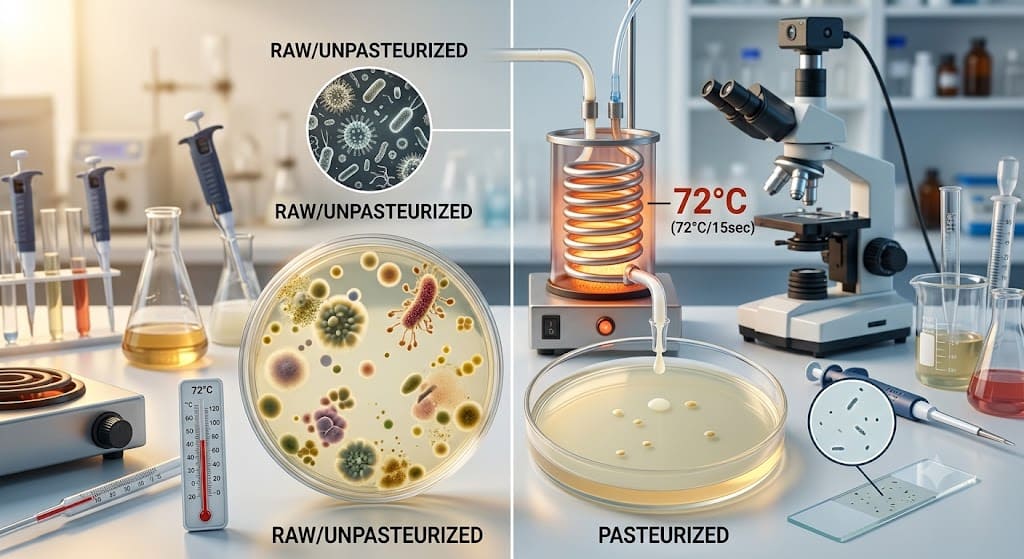
Pasteurization and Food Microbiology MCQs becomes easier when aspirants first understand pasteurization. Pasteurization is a process in which liquids such as milk are heated to a specific temperature for a definite time and then rapidly cooled. Pasteurization and Food Microbiology MCQs explains that this process reduces the number of harmful microorganisms and improves the keeping quality of milk and other beverages. Pasteurization does not usually sterilize milk completely, but it makes milk much safer for consumption by destroying many disease-causing microbes. Pasteurization and Food Microbiology MCQs helps aspirants remember that pasteurization was developed from the work of Louis Pasteur, whose experiments showed that heat treatment could reduce microbial contamination.
Pasteurization and Food Microbiology MCQs also connects pasteurization with public health. Milk can carry harmful microorganisms if it is not processed properly. Pasteurization and Food Microbiology MCQs is important because it explains why heating and rapid cooling help prevent food-borne infections. Aspirants should understand that pasteurization is different from boiling and sterilization. Boiling may use a higher temperature, while sterilization destroys nearly all forms of microbial life. Pasteurization and Food Microbiology MCQs helps aspirants understand that pasteurized milk still needs proper storage because some microbes may survive and multiply if the milk is kept in unsuitable conditions.
Pasteurization and Food Microbiology MCQs includes food fermentation as another major area. Fermentation is a process in which microorganisms convert sugars into useful products such as acids, alcohol, gases, and flavor compounds. Pasteurization and Food Microbiology MCQs helps aspirants compare pasteurization with fermentation because both involve microbes, but their purposes are different. Pasteurization reduces harmful microbes, while fermentation uses beneficial microbes to produce food products. Curd, yogurt, cheese, bread, vinegar, and alcoholic beverages are common examples of microbial food products. Pasteurization and Food Microbiology MCQs becomes stronger when aspirants connect Lactobacillus with curd, Saccharomyces cerevisiae with bread and alcohol, Acetobacter aceti with vinegar, and Aspergillus niger with citric acid.
Pasteurization and Food Microbiology MCQs should also cover food spoilage. Food spoilage occurs when microbes grow in food and change its taste, smell, texture, color, or safety. Pasteurization and Food Microbiology MCQs teaches aspirants that bacteria, yeasts, and molds can spoil food when temperature, moisture, nutrients, and time favor their growth. Refrigeration, drying, salting, sugaring, canning, pasteurization, and chemical preservation are methods used to reduce microbial growth. Pasteurization and Food Microbiology MCQs helps aspirants revise that not all microbes are harmful; some are useful in food production, while others cause spoilage and disease.
Pasteurization and Food Microbiology MCQs is valuable for understanding dairy microbiology. In curd formation, lactic acid bacteria convert lactose into lactic acid, causing milk proteins to coagulate. Pasteurization and Food Microbiology MCQs can be prepared by studying the role of lactic acid bacteria, vitamin enrichment, protein digestion, acidity, and probiotic benefits. Probiotics are live microbial food supplements that support beneficial gut bacteria. Pasteurization and Food Microbiology MCQs becomes easier when aspirants revise food microbes in a table format with columns for organism, product, process, and importance.
Aspirants preparing Pasteurization and Food Microbiology MCQs should also focus on industrial food microbiology. Many microbes are used commercially to produce enzymes, organic acids, vitamins, fermented foods, and beverages. Yeast produces carbon dioxide during bread making, making dough soft and porous. Acetobacter converts alcohol into acetic acid during vinegar production. Aspergillus niger produces citric acid on an industrial scale. Pasteurization and Food Microbiology MCQs helps aspirants connect these examples with real-life food industries and biotechnology applications.
Pasteurization and Food Microbiology MCQs:
- To speed up the malting process in the brewing industry, the growth hormone used is
A. Auxin
B. Gibberellic acid
C. Kinetin
D. Ethylene
Answer: B. Gibberellic acid
Explanation: Gibberellic acid is used as a growth hormone to speed up malting or seed germination in the brewing industry.
- Ethyl alcohol is commercially manufactured from:
A. Bajra
B. Grapes
C. Maize
D. Sugarcane
Answer: D. Sugarcane
Explanation: Ethyl alcohol, or ethanol, is commercially manufactured from sugarcane through fermentation.
- Industrial production of ethanol from starch is brought about by a certain species of
A. Azotobacter
B. Lactobacillus
C. Saccharomyces
D. Penicillium
Answer: C. Saccharomyces
Explanation: Industrial production of ethanol from starch is carried out by Saccharomyces, especially Saccharomyces cerevisiae.
- Malolactic fermentation during wine production is performed by
A. Lactobacillus
B. Leuconostoc
C. Saccharomyces
D. Aspergillus
Answer: A. Lactobacillus
Explanation: Malolactic fermentation during wine production is performed by lactic acid bacteria such as Lactobacillus.
- For the commercial and industrial production of citric acid, which of the following microbes is used?
A. Clostridium butylicum
B. Aspergillus niger
C. Lactobacillus sp.
D. Saccharomyces cerevisiae
Answer: B. Aspergillus niger
Explanation: Aspergillus niger is used for the commercial and industrial production of citric acid.
- Which of the following biome is the richest source of biodiversity including both plants and animals?
A. Tropical evergreen forest
B. Tropical savannah forest
C. Northern coniferous forest
D. Temperate deciduous forest
Answer: A. Tropical evergreen forest
Explanation: Tropical evergreen forests have high rainfall and warm temperatures, which support very rich biodiversity of plants and animals.
- In summer, in lakes, upper warm water is separated from bottom cool water by mid water called
A. Thermocline
B. Thermodynamics
C. Thermal stratification
D. Epilimnion
Answer: C. Thermal stratification
Explanation: Thermal stratification occurs when water bodies form layers of different temperatures. Warm water remains above and cooler, denser water stays below.
- 5th June is celebrated as
A. World Forest Day
B. World Environment Day
C. World Red Cross Day
D. World Food Day
Answer: B. World Environment Day
Explanation: World Environment Day is celebrated every year on 5th June.
- Which one of the following pairs is mismatched?
A. Savanna – Acacia trees
B. Prairie – Epiphytes
C. Tundra – Permafrost
D. Coniferous forest – Evergreen trees
Answer: B. Prairie – Epiphytes
Explanation: Prairie is a grassland biome, not typically associated with epiphytes. Savanna has Acacia trees, tundra has permafrost, and coniferous forests have evergreen trees.
- The logistic population growth is expressed by the equation
A. N/K dN/dt rN/(N-K)
B. K/N dt/dN Nr/(K-N)
C. K/N dN/dt rN/(K-N)
D. dN/dt = rN
Answer: C. K/N dN/dt rN/(K-N)
Explanation: Logistic growth gives an S-shaped curve and occurs when resources are limited and the population approaches carrying capacity, K.
- What type of human population is represented by the following age pyramid?
A. Expanding population
B. Vanishing population
C. Stable population
D. Declining population
Answer: C. Stable population
Explanation: A stable population has a relatively balanced distribution across age groups, showing a balance between birth and death rates.
- What do A, B, and C represent in the diagrammatic representation of the response of an organism to abiotic factors?
A. Conformer, Regulator, Partial
B. Regulator, Partial, Conformer
C. Partial, Regulator, Conformer
D. Regulator, Conformer, Partial
Answer: D. Regulator, Conformer, Partial
Explanation: In response to abiotic factors, organisms may be regulators, conformers, or partial regulators.
- During the formation of bread, it becomes porous due to the release of CO₂ by the action of:
A. Yeast
B. Bacteria
C. Virus
D. Protozoans
Answer: A. Yeast
Explanation: Bread dough is fermented by yeast, especially Saccharomyces cerevisiae. It releases carbon dioxide, making bread soft and porous.
- Dough kept overnight in warm weather becomes soft and spongy because of:
A. Fermentation
B. Cohesion
C. Osmosis
D. Absorption of carbon dioxide from the atmosphere
Answer: A. Fermentation
Explanation: During fermentation, yeast converts sugar into carbon dioxide and alcohol. The trapped carbon dioxide makes dough soft and spongy.
- A good producer of citric acid is:
A. Saccharomyces
B. Aspergillus
C. Pseudomonas
D. Clostridium
Answer: B. Aspergillus
Explanation: Aspergillus niger is a good producer of citric acid and is widely used in microbial fermentation industries.
- The puffed-up appearance of dough is due to fermentation by bacteria. Identify the gas liberated during the process.
A. Methane
B. Carbon dioxide
C. Hydrogen sulphide
D. Ammonia
Answer: B. Carbon dioxide
Explanation: The puffed-up appearance of dough is due to carbon dioxide gas released during fermentation.
- Idlies become puffy because
A. Bubbles of CO₂ trapped in gluten
B. Bubbles of O₂ trapped in gluten
C. Bubbles of H₂ trapped in gluten
D. Bubbles of NO₂ trapped in gluten
Answer: A. Bubbles of CO₂ trapped in gluten
Explanation: Fermentation of idli batter releases carbon dioxide, which gets trapped and makes idlies puffy and spongy.
- The process of making milk bacteria-less is called:
A. Immunization
B. Pasteurization
C. Vernalization
D. Purification
Answer: B. Pasteurization
Explanation: Pasteurization is the process of heating milk and then cooling it quickly to reduce harmful microorganisms.
- What is the process of pasteurization?
A. Heating of liquid at 65ºC
B. Heating of liquid between 65ºC to 80ºC followed by rapid cooling
C. Heating of solid at 65ºC
D. None of the above
Answer: B. Heating of liquid between 65ºC to 80ºC followed by rapid cooling
Explanation: Pasteurization involves heating liquids such as milk to a specific temperature and then rapidly cooling them to make them safer for consumption.
- What is heating milk at 65°C followed by sudden cooling known as?
A. Sterilization
B. Preservation
C. Pasteurization
D. Fermentation
Answer: C. Pasteurization
Explanation: Heating milk at about 65°C followed by sudden cooling is called pasteurization.
- What is the pasteurization temperature?
A. 72°C for 20 minutes
B. 63°C for 15 seconds
C. 70°C for 15 seconds
D. 65°C for 30 minutes
Answer: D. 65°C for 30 minutes
Explanation: Pasteurization may be done by heating milk around 65°C for about 30 minutes, followed by cooling.
- Soil particles determine its
A. Texture
B. Field capacity
C. Water holding capacity
D. Soil flora
Answer: A. Texture
Explanation: Soil texture is determined by the proportion of sand, silt, and clay particles in the soil.
- Soil is a mixture of:
A. Sand and humus
B. Sand and clay
C. Sand, clay and humus
D. Clay and humus
Answer: C. Sand, clay and humus
Explanation: Soil is a mixture of mineral particles such as sand and clay along with humus, water, and air.
- Nature and properties of soil depends upon _____.
A. Weathering and climate
B. Soil erosion never depends
C. Never affected by climate
D. Never affected by weathering
Answer: A. Weathering and climate
Explanation: The nature and properties of soil depend on weathering, climate, organic matter, and soil formation processes.
- The soil which is transported by wind is known as
A. Colluvial
B. Eolian
C. Alluvial
D. Glacial soil
Answer: B. Eolian
Explanation: Soil transported by wind is called eolian or aeolian soil.
- If b = 65 and d = 45; N = 100, find out dN/dt in a population.
A. 200
B. 2000
C. 100
D. 1000
Answer: B. 2000
Explanation: dN/dt = (b – d) × N = (65 – 45) × 100 = 20 × 100 = 2000.
- Van’t Hoff’s rule states that
A. With the increase of every 10°C temperature the rate of metabolic activities becomes half
B. With the decrease of every 10°C temperature the rate of metabolic activities doubles
C. With the increase of every 10°C temperature the rate of metabolic activities doubles
D. With the increase or decrease of temperature there is no change in metabolic activities
Answer: C. With the increase of every 10°C temperature the rate of metabolic activities doubles
Explanation: Van’t Hoff’s rule states that the rate of metabolic activity approximately doubles with every 10°C rise in temperature within a suitable range.
- Which one soil type and its composition is considered best for growth and development of common vegetation?
A. Loamy and clay soil
B. Loamy soil, 25–36% field capacity, a mixture of clay and sand
C. Black and clay soil
D. Both loamy soil and sandy soil
Answer: B. Loamy soil, 25–36% field capacity, a mixture of clay and sand
Explanation: Loamy soil is considered best for common vegetation because it has a balanced mixture of sand, silt, clay, and good water-holding capacity.
- The soil with poorest water holding capacity is
A. Clay
B. Loam
C. Sandy
D. None of these
Answer: C. Sandy
Explanation: Sandy soil has large particles and large pore spaces, so it has the poorest water holding capacity.
- Doubling of metabolic activity with every increase in temperature by 10°C is called
A. Van’t Hoff’s rule
B. Allen’s rule
C. Bergmann’s rule
D. Jordan’s rule
Answer: A. Van’t Hoff’s rule
Explanation: Van’t Hoff’s rule states that metabolic activity or reaction rate usually doubles with every 10°C rise in temperature within a tolerable range.

Conclusion on Pasteurization and Food Microbiology MCQs
In conclusion, Pasteurization and Food Microbiology MCQs is a highly useful topic for aspirants who want to master microbes in food processing and preservation. Pasteurization and Food Microbiology MCQs improves understanding of pasteurization, fermentation, food spoilage, dairy microbiology, probiotics, useful microbes, and safe food handling. Pasteurization and Food Microbiology MCQs also supports exam preparation by connecting theory with daily life examples such as milk, curd, yogurt, bread, vinegar, and cheese.