
- Keneitsino Lydia
- June 6, 2026
Tricky Xerophytes and Hydrophytes MCQs Class 12 Biology – Avoid These Common Exam Mistakes
Xerophytes and Hydrophytes MCQs Class 12 Biology is an important revision topic for aspirants who want to understand plant adaptations, ecological habitats, water availability, structural modifications, and survival strategies in different environments. Xerophytes and Hydrophytes MCQs Class 12 Biology helps aspirants compare two contrasting groups of plants: xerophytes, which grow in dry habitats, and hydrophytes, which grow in water or very wet conditions.
Xerophytes and Hydrophytes MCQs Class 12 Biology is useful for Class 12 board exams, NEET, and other biology-based competitive exams because questions from ecology often test plant features, habitat adaptations, root systems, leaves, cuticle, stomata, air spaces, and water conservation. Xerophytes and Hydrophytes MCQs Class 12 Biology also helps aspirants understand how plants modify their body structure according to environmental stress.
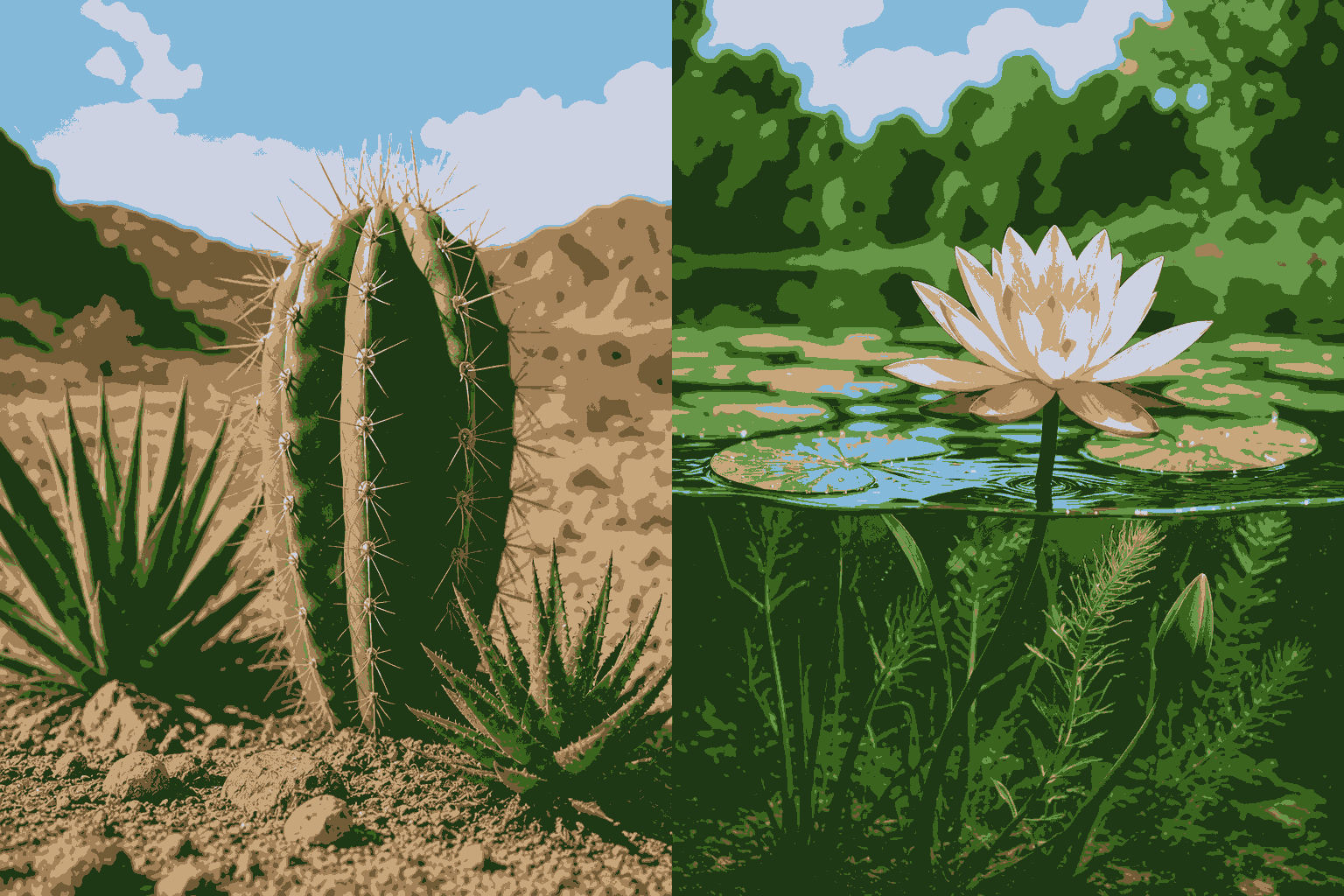
Xerophytes and Hydrophytes MCQs Class 12 Biology becomes easier when aspirants first understand xerophytes. Xerophytes are plants adapted to dry regions where water is limited. Xerophytes and Hydrophytes MCQs Class 12 Biology explains that xerophytes usually have well-developed roots, thick cuticle, reduced leaves, sunken stomata, fleshy stems, and water-storage tissues.
These adaptations reduce water loss and help plants survive in deserts or dry habitats. Xerophytes and Hydrophytes MCQs Class 12 Biology helps aspirants remember examples such as cactus, Opuntia, Aloe, and Euphorbia. Xerophytes and Hydrophytes MCQs Class 12 Biology also highlights that xerophytes may show leaf modification into spines, which reduces transpiration and protects the plant from grazing animals.
Xerophytes and Hydrophytes MCQs Class 12 Biology also includes hydrophytes, which are plants adapted to aquatic habitats. Hydrophytes may be free-floating, rooted floating, submerged, or partly submerged. Xerophytes and Hydrophytes MCQs Class 12 Biology explains that hydrophytes usually have poorly developed roots, thin cuticle, reduced mechanical tissue, large air spaces, and flexible stems. Air spaces help in buoyancy and gaseous exchange. Xerophytes and Hydrophytes MCQs Class 12 Biology helps aspirants remember examples such as Hydrilla, Vallisneria, Lotus, Eichhornia, and Pistia. Xerophytes and Hydrophytes MCQs Class 12 Biology becomes more meaningful when aspirants connect plant structure with water availability in the habitat.
Aspirants preparing Xerophytes and Hydrophytes MCQs Class 12 Biology should focus on the differences between xerophytes and hydrophytes. Xerophytes conserve water, while hydrophytes manage excess water. Xerophytes and Hydrophytes MCQs Class 12 Biology teaches that xerophytes have strong root systems for absorbing scarce water, whereas hydrophytes often have weak or reduced roots because water is freely available.
Xerophytes and Hydrophytes MCQs Class 12 Biology also helps aspirants compare leaves: xerophytes may have small, thick, leathery, or spiny leaves, while hydrophytes may have broad floating leaves or finely divided submerged leaves. This comparison-based approach makes Xerophytes and Hydrophytes MCQs Class 12 Biology easier to revise.
Xerophytes and Hydrophytes MCQs Class 12 Biology is also important for understanding stomatal adaptations. In xerophytes, stomata are often sunken or fewer in number to reduce transpiration. In floating hydrophytes, stomata are usually present on the upper surface of leaves, while submerged hydrophytes may lack stomata.
Xerophytes and Hydrophytes MCQs Class 12 Biology helps aspirants connect these details with practical survival strategies. Aspirants should also revise terms such as transpiration, cuticle, aerenchyma, succulence, root cap, mechanical tissue, buoyancy, and adaptation. Xerophytes and Hydrophytes MCQs Class 12 Biology becomes stronger when these terms are studied through diagrams and short comparison charts.
For effective exam preparation, Xerophytes and Hydrophytes MCQs Class 12 Biology should be revised using tables with columns for habitat, roots, stem, leaves, stomata, cuticle, tissues, examples, and special adaptations. Aspirants should avoid memorising isolated facts and instead understand why each feature is present. Xerophytes and Hydrophytes MCQs Class 12 Biology improves conceptual clarity because every adaptation has a purpose. Thick cuticle prevents water loss, fleshy stems store water, air chambers help floating, and flexible stems prevent damage in water currents.
Xerophytes and Hydrophytes MCQs Class 12 Biology:
- What is the Greek word for ecology?
A. Ethology
B. Oekologie
C. Synecology
D. Hexicology
Answer: B. Oekologie
Explanation: Ecology comes from the Greek words “oikos,” meaning house or dwelling, and “logos,” meaning study or discourse. Thus, ecology means the study of organisms in their home or environment.
- Two species occupying the same or overlapping area are called as
A. Sympatric
B. Allopatric
C. Parapatric
D. Ring species
Answer: A. Sympatric
Explanation: Sympatric species are species that occur in the same geographical region. Allopatric species occur in different geographical regions separated by barriers.
- Identify the wrong statements regarding hydrophytes and xerophytes.
Statements:
A. Hydrophytes possess well-developed root caps.
B. Hydrophytes have thin epidermis and poorly developed xylem.
C. Xerophytes have poorly developed roots and no root caps.
D. Xerophytes have well-developed roots and thick epidermis.
Options:
A. A and C
B. B and C
C. A and B
D. C and D
Answer: A. A and C
Explanation: Hydrophytes generally lack well-developed root caps and have thin epidermis with poorly developed xylem. Xerophytes usually have well-developed roots with root caps and thick epidermis.
- In which zone of the biosphere, no human activity is permitted?
A. Buffer zone
B. Core zone
C. Manipulation zone
D. All of these
Answer: B. Core zone
Explanation: The core zone is the most strictly protected part of a biosphere reserve. Human activities that may disturb the natural environment are not permitted there.
- The niche of a species is meant for
A. Habitat and specific functions of a species
B. Specific place where an organism lives
C. Specific species function and its competitive power
D. None of these
Answer: A. Habitat and specific functions of a species
Explanation: A niche includes the habitat, role, function, interactions, and resource use of a species within an ecosystem.
- Benthic animals are those which
A. Are submerged in an area
B. Float on the sea surface
C. Are deep dwellers in the sea
D. Are floating free organisms
Answer: C. Are deep dwellers in the sea
Explanation: Benthic animals live on or near the bottom of aquatic environments such as oceans, lakes, rivers, and ponds.
- The abundance of a species population within its habitat is called
A. Relative density
B. Regional density
C. Absolute density
D. Niche density
Answer: D. Niche density
Explanation: Niche density refers to the abundance of organisms occupying a specific ecological niche within an ecosystem.
- Which of the following correctly matches the substances in Column I with their corresponding substances in Column II?
Column I:
- Alkaloids
- Toxins
- Drugs
- Polymeric substances
Column II:
i. Vinblastine
ii. Morphine
iii. Ricin
iv. Rubber
Options:
A. 1-ii, 2-iii, 3-i, 4-iv
B. 1-iii, 2-iv, 3-ii, 4-i
C. 1-i, 2-iii, 3-v, 4-iv
D. 1-iv, 2-i, 3-iii, 4-v
Answer: A. 1-ii, 2-iii, 3-i, 4-iv
Explanation: Alkaloids are represented by morphine, toxins by ricin, drugs by vinblastine, and polymeric substances by rubber.
- What does AA stand for?
A. Abnormal Action
B. Anomalous Behaviour
C. Alcoholics Anonymous
D. Alcoholics Action
Answer: C. Alcoholics Anonymous
Explanation: AA stands for Alcoholics Anonymous, a support group for people recovering from alcohol addiction.
- Why is ethanol used to treat methanol toxicity?
A. It is a competitive inhibitor of alcohol dehydrogenase
B. It is a non-competitive inhibitor of alcohol dehydrogenase
C. It activates enzymes involved in methanol metabolism
D. It inhibits methanol uptake by cells
Answer: A. It is a competitive inhibitor of alcohol dehydrogenase
Explanation: Ethanol competes with methanol for alcohol dehydrogenase and helps prevent the conversion of methanol into toxic metabolites such as formaldehyde.
- Why is alcohol addiction harmful?
A. Protein depositions in liver
B. Deposition of extra fat in liver
C. Rise in blood sugar level
D. Cancer
Answer: B. Deposition of extra fat in liver
Explanation: Alcohol addiction may cause excessive fat deposition in the liver, leading to fatty liver and further liver damage.
- Assertion: Dope test is used to estimate the level of blood alcohol by analysing the breath of persons drinking alcohol.
Reason: A drunken person usually feels tense and less talkative.
A. Both Assertion and Reason are true and Reason is the correct explanation of Assertion
B. Both Assertion and Reason are true but Reason is not the correct explanation of Assertion
C. Assertion is true but Reason is false
D. Both Assertion and Reason are false
Answer: D. Both Assertion and Reason are false
Explanation: A dope test is not used to estimate blood alcohol through breath analysis. Also, alcohol generally reduces inhibition and may make a person more talkative rather than tense and less talkative.
- Why does fatty liver syndrome occur?
Assertion: Fatty liver syndrome occurs by alcoholism.
Reason: Alcoholics have a rate of carcinoma 10 times higher than that expected in the general population.
A. Both Assertion and Reason are true and Reason is the correct explanation of Assertion
B. Both Assertion and Reason are true but Reason is not the correct explanation of Assertion
C. Assertion is true but Reason is false
D. Both Assertion and Reason are false
Answer: B. Both Assertion and Reason are true but Reason is not the correct explanation of Assertion
Explanation: Fatty liver syndrome may occur due to alcoholism. Alcoholics may also have a higher cancer risk, but that is not the direct explanation for fatty liver syndrome.
- How does alcohol depress the nervous system?
A. Sedative agents
B. Analgesic agent
C. Anesthetic agents
D. All of these
Answer: D. All of these
Explanation: Alcohol depresses the nervous system and may act as a sedative, analgesic, and anesthetic-like agent.
- Which of the following disorder is associated with chronic alcoholism and malnutrition?
A. Hobnail liver
B. Amyloid liver
C. Laennec’s cirrhosis
D. All of the above
Answer: C. Laennec’s cirrhosis
Explanation: Laennec’s cirrhosis is associated with chronic alcoholism and malnutrition.
- In alcohol fermentation, what is the role of triose phosphate and acetaldehyde?
A. Triose phosphate is the electron donor while acetaldehyde is the electron acceptor
B. Triose phosphate is the electron donor while pyruvic acid is the electron acceptor
C. There is no electron donor
D. Oxygen is the electron acceptor
Answer: A. Triose phosphate is the electron donor while acetaldehyde is the electron acceptor
Explanation: In alcoholic fermentation, triose phosphate acts as an electron donor, while acetaldehyde acts as an electron acceptor.
- Which alcoholic beverage is formed by distillation?
A. Brandy
B. Wine
C. Beer
D. All
Answer: A. Brandy
Explanation: Brandy is produced by distillation, which separates alcohol from fermented liquids based on boiling point differences.
- Excessive consumption of alcohol leads to what condition?
A. Loss of memory
B. State of hallucination
C. Cirrhosis of liver
D. Suppression of brain functions
Answer: C. Cirrhosis of liver
Explanation: Excessive alcohol consumption can damage liver cells and lead to cirrhosis of the liver.
- What is the term for a temporary feeling of exaggerated joy, well-being, and optimism associated with drugs and alcohol?
A. Hallucination
B. Giddiness
C. Euphoria
D. Addiction
Answer: C. Euphoria
Explanation: Euphoria is a temporary feeling of exaggerated happiness, well-being, and optimism associated with certain drugs and alcohol.
- Which nutrient deficiency is responsible for Korsakoff’s syndrome due to alcohol abuse?
A. Vitamin B12
B. Fat
C. Protein
D. Vitamin B1
Answer: D. Vitamin B1
Explanation: Korsakoff’s syndrome is associated with deficiency of vitamin B1, also known as thiamine, often due to chronic alcohol abuse.
- Mechanical support, enzyme circulation, protein synthesis, and detoxification of drugs are functions of:
A. ER
B. Ribosomes
C. Dictyosome
D. Chloroplast
Answer: A. ER
Explanation: The endoplasmic reticulum provides mechanical support, helps in enzyme circulation, supports protein synthesis, and participates in detoxification.
- Which of the following statements are true related to ecology?
Statement I: Habitat is the specific place or environment where an organism lives, grows, and obtains resources for survival.
Statement II: Habitats may include forests, grasslands, deserts, wetlands, oceans, rivers, and lakes.
Statement III: A habitat contains only biotic factors.
Statement IV: A habitat includes both biotic and abiotic factors.
Statement V: The nine integrative levels of ecology include organelle, cell, tissue, organ, organ system, organism, population, community, ecosystem, and biosphere.
Options:
A. All statements are correct
B. Except Statement III, all are correct
C. Except Statement V, all are correct
D. Except Statements III and V, all are correct
Answer: D. Except Statements III and V, all are correct
Explanation: Statements I, II, and IV are correct. A habitat is the natural place where an organism lives and obtains resources, and it includes both biotic and abiotic factors. Statement III is incorrect because a habitat does not contain only biotic factors. Statement V is incorrect because the list given contains ten levels, not nine.
- Niche overlap indicates
A. Active co-operation between two species
B. Two different parasites on the same host
C. Sharing of one or more resources between the two species
D. Mutualism between two species
Answer: C. Sharing of one or more resources between the two species
Explanation: Niche overlap occurs when two or more species use one or more of the same resources in an ecosystem.
- Hydroponics is a
A. Airless culture
B. Waterless culture
C. Soilless culture
D. None of these
Answer: C. Soilless culture
Explanation: Hydroponics is a soilless cultivation method in which plants grow in nutrient-rich water solutions.
- The part of earth and atmosphere supporting life is
A. Biota
B. Biome
C. Ecotone
D. Biosphere
Answer: D. Biosphere
Explanation: The biosphere is the part of the Earth and its atmosphere that supports life.
- Earth has the maximum amount of oxygen in
A. Atmosphere
B. Hydrosphere
C. Lithosphere
D. Biosphere
Answer: C. Lithosphere
Explanation: The maximum amount of oxygen on Earth is present in the lithosphere, mainly bound in minerals and rocks such as silicates and oxides.
- The term Ecology was coined by
A. Lamarck
B. Bateson
C. Haeckel
D. Spencer
Answer: C. Haeckel
Explanation: Ernst Haeckel coined the term ecology in 1866 to describe the study of the relationship between organisms and their environment.
- Study of environment and animal relation is:
A. Ecosystem
B. Phytosociology
C. Biotic community
D. Ecology
Answer: D. Ecology
Explanation: Ecology is the study of interactions between organisms and their environment.
- Biological concept of species is mainly based on
A. Reproductive isolation
B. Morphological features only
C. Methods of reproduction only
D. Morphology and methods of reproduction
Answer: A. Reproductive isolation
Explanation: The biological species concept is mainly based on reproductive isolation, meaning members of a species can interbreed and produce fertile offspring.
- Which one of the following is not used in the production of yogurt?
A. Streptococcus lactis
B. Streptococcus thermophilus
C. Lactobacillus bulgaricus
D. Acetobacter aceti
Answer: D. Acetobacter aceti
Explanation: Acetobacter aceti is used in vinegar production, not yogurt production. Yogurt is commonly produced using Lactobacillus bulgaricus and Streptococcus thermophilus.
Conclusion on Xerophytes and Hydrophytes MCQs Class 12 Biology
In conclusion, Xerophytes and Hydrophytes MCQs Class 12 Biology is a valuable topic for aspirants who want to master ecology and plant adaptation in a simple and organised way. Xerophytes and Hydrophytes MCQs Class 12 Biology improves understanding of dry habitat plants, aquatic plants, structural differences, physiological adaptations, and survival mechanisms. Xerophytes and Hydrophytes MCQs Class 12 Biology also helps aspirants connect textbook biology with real environmental conditions.