- Keneitsino Lydia
- May 26, 2026
Explosive Stabilizing Directional Disruptive Selection Biology MCQs for NEET Success
Natural selection is one of the most important mechanisms of evolution, and understanding its different patterns is essential for aspirants preparing for NEET, Class 12 Biology examinations, and other competitive entrance tests. Among the most frequently studied topics in evolutionary biology are stabilizing selection, directional selection, and disruptive selection. As a result, Stabilizing Directional Disruptive Selection Biology MCQs has become a highly searched phrase among aspirants looking to strengthen their conceptual understanding of evolution and population genetics.
The topic of Stabilizing Directional Disruptive Selection Biology MCQs focuses on the three major modes of natural selection that influence the characteristics of populations over generations. These selection patterns explain how environmental pressures shape organisms and determine which traits become more common or less common within a population. Because these concepts are repeatedly tested in examinations, mastering Stabilizing Directional Disruptive Selection Biology MCQs is extremely important for aspirants.
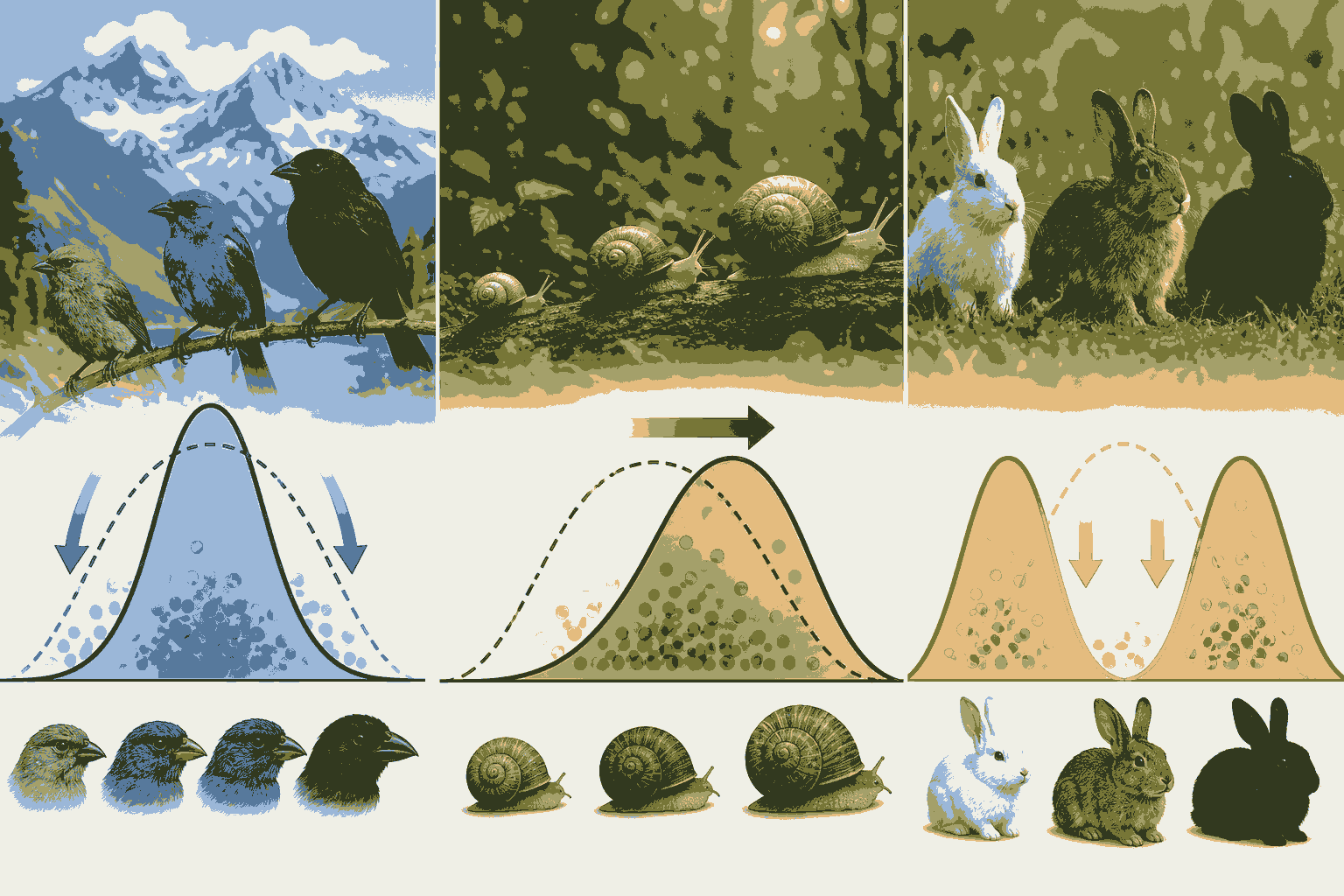
When studying Stabilizing Directional Disruptive Selection Biology MCQs, aspirants first encounter stabilizing selection. Stabilizing selection favors individuals with average characteristics while selecting against extreme variations. As a result, the population remains relatively stable over time. One of the classic examples discussed in Stabilizing Directional Disruptive Selection Biology MCQs is the birth weight of human babies. Babies with extremely low or extremely high birth weights have lower survival rates, while average-weight babies are more likely to survive and reproduce.
Another important concept covered in Stabilizing Directional Disruptive Selection Biology MCQs is directional selection. In this type of selection, one extreme phenotype is favored over the others. Consequently, the population shifts toward that particular trait over successive generations. A commonly cited example in Stabilizing Directional Disruptive Selection Biology MCQs is the development of antibiotic resistance in bacteria or pesticide resistance in insects. Individuals possessing advantageous traits survive better and gradually dominate the population.
The third major pattern explained through Stabilizing Directional Disruptive Selection Biology MCQs is disruptive selection. Unlike stabilizing selection, disruptive selection favors both extreme phenotypes while selecting against intermediate forms. This can result in the formation of two distinct groups within the same population. Many examples appearing in Stabilizing Directional Disruptive Selection Biology MCQs involve populations where both very small and very large individuals have survival advantages, while medium-sized individuals are disadvantaged.
One reason why Stabilizing Directional Disruptive Selection Biology MCQs is so important is that it helps aspirants understand how biodiversity develops. Natural selection is not always a simple process that favors a single trait. Different environmental conditions may produce different selective pressures, resulting in stabilizing, directional, or disruptive outcomes. Understanding these patterns is the foundation of Stabilizing Directional Disruptive Selection Biology MCQs.
The study of Stabilizing Directional Disruptive Selection Biology MCQs also helps explain evolutionary adaptation. Adaptation refers to inherited traits that improve an organism’s ability to survive and reproduce. Through stabilizing, directional, and disruptive selection, populations gradually become better suited to their environments. This evolutionary perspective makes Stabilizing Directional Disruptive Selection Biology MCQs highly relevant to modern biology.
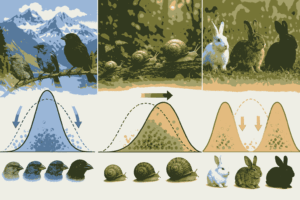
Aspirants often encounter graphical interpretations while preparing Stabilizing Directional Disruptive Selection Biology MCQs. Stabilizing selection produces a narrower bell-shaped curve centered around the average trait value. Directional selection shifts the entire curve toward one extreme. Disruptive selection creates two peaks because both extremes are favored. Recognizing these graphical patterns is a key skill developed through studying Stabilizing Directional Disruptive Selection Biology MCQs.
Another reason aspirants focus heavily on Stabilizing Directional Disruptive Selection Biology MCQs is its close connection with Darwin’s theory of natural selection. Darwin proposed that favorable variations increase an organism’s chances of survival and reproduction. The three selection patterns represent different ways in which favorable variations can spread through populations. Therefore, Stabilizing Directional Disruptive Selection Biology MCQs provides a practical understanding of Darwinian evolution.
Environmental change is another major theme associated with Stabilizing Directional Disruptive Selection Biology MCQs. When environments remain relatively constant, stabilizing selection often dominates. When conditions change, directional selection may favor a new advantageous trait. In highly variable environments, disruptive selection can occur, potentially leading to population divergence. These ecological relationships are frequently emphasized in Stabilizing Directional Disruptive Selection Biology MCQs.
The significance of Stabilizing Directional Disruptive Selection Biology MCQs extends beyond examination preparation. These concepts help scientists understand disease resistance, agricultural breeding programs, conservation biology, and species evolution. They provide a framework for analyzing how populations respond to changing environmental conditions and selective pressures.
For aspirants aiming for excellent scores in biology, regular practice of Stabilizing Directional Disruptive Selection Biology MCQs can greatly improve conceptual clarity. Since questions related to natural selection, adaptation, evolution, and population genetics frequently appear in NEET and Class 12 examinations, a thorough understanding of Stabilizing Directional Disruptive Selection Biology MCQs can provide a significant advantage.
Stabilizing Directional Disruptive Selection Biology MCQs:
1. In a population of 200 individuals, the frequency of an autosomal lethal gene is 0.4. What is the frequency of carriers in the population?
A. 72
B. 96
C. 104
D. 36
Answer: B. 96
Explanation: If q = 0.4, then p = 0.6. Heterozygous frequency = 2pq = 2 × 0.6 × 0.4 = 0.48. Therefore, carriers = 0.48 × 200 = 96 individuals.
2. What is the term used to describe the group of genes present in an ecosystem?
A. Genome
B. Gene Pool
C. Genotype
D. Phenotype
Answer: B. Gene Pool
Explanation: A gene pool is the total collection of genes and alleles present in a breeding population.
3. Who introduced the concept of genetic drift?
A. Sewall Wright
B. Hardy Weinberg
C. Julian Huxley
D. G.G. Simpson
Answer: A. Sewall Wright
Explanation: Sewall Wright proposed the concept of genetic drift, also known as the Sewall Wright Effect.
4. In a population in Hardy-Weinberg equilibrium for a gene with two alleles, if the gene frequency of allele ‘A’ is 0.7, what is the genotype frequency of ‘Aa’?
A. 0.21
B. 0.42
C. 0.36
D. 0.70
Answer: B. 0.42
Explanation: p = 0.7, q = 0.3. Therefore, heterozygous frequency = 2pq = 2 × 0.7 × 0.3 = 0.42.
5. To check the undue accumulation of deleterious mutations, Darwinian fitness is lowered from minimum to zero by which type of selection?
A. Directional selection
B. Normalizing selection
C. Cladogenesis
D. Phyletic change
Answer: B. Normalizing selection
Explanation: Normalizing (stabilizing) selection removes extreme phenotypes and maintains average individuals in a population.
6. For a gene with two alleles, if the gene frequency of the recessive gene is 0.2, what is the genotypic frequency of homozygous dominant individuals?
A. 0.064
B. 0.8
C. 0.64
D. 0.32
Answer: C. 0.64
Explanation: q = 0.2, therefore p = 0.8. Homozygous dominant frequency = p² = 0.8² = 0.64.
7. What is the important factor for natural selection?
A. Disuse
B. Variation
C. Catastrophic events
D. Special creation
Answer: B. Variation
Explanation: Variations provide the raw material upon which natural selection acts.
8. What would be the frequency of heterozygotes in a random mating population at equilibrium where the frequency of the ‘A’ allele is 0.6 and the frequency of the ‘a’ allele is 0.4?
A. 0.36
B. 0.16
C. 0.24
D. 0.48
Answer: D. 0.48
Explanation: Heterozygous frequency = 2pq = 2 × 0.6 × 0.4 = 0.48.
9. Random genetic drift in a population leads to:
A. Highly genetically variable individuals
B. Increased inbreeding within a population
C. Constant low mutation rate
D. Large population size
Answer: B. Increased inbreeding within a population
Explanation: Genetic drift reduces genetic variation and increases inbreeding, especially in small populations.
10. Which of the following theories was not given by Darwin?
A. Struggle for existence
B. Natural selection
C. Survival of the fittest
D. Genetic drift
Answer: D. Genetic drift
Explanation: Genetic drift was proposed later and is associated with Sewall Wright, not Darwin.
11. In Hardy-Weinberg equation, the frequency of heterozygous individual is represented by:
A. p²
B. 2pq
C. pq
D. q²
Answer: B. 2pq
Explanation: In the equation p² + 2pq + q² = 1, 2pq represents heterozygous individuals.
12. A population will not exist in Hardy-Weinberg equilibrium if:
A. There are no mutations
B. There is no migration
C. The population is large
D. Individuals mate selectively
Answer: D. Individuals mate selectively
Explanation: Hardy-Weinberg equilibrium requires random mating.
13. Artificial selection to obtain cows yielding higher milk output represents:
A. Stabilizing selection
B. Directional selection
C. Disruptive selection
D. Stabilizing followed by disruptive selection
Answer: B. Directional selection
Explanation: Selection favors one extreme trait, namely higher milk production.
14. Which of the following is not true for a species?
A. Members can interbreed
B. Variations occur among members
C. Gene flow does not occur between populations of a species
D. Species are reproductively isolated from other species
Answer: C. Gene flow does not occur between populations of a species
Explanation: Gene flow commonly occurs among populations belonging to the same species.
15. Which of the following statements regarding gene flow is incorrect?
A. Gene flow occurs between populations of a species
B. Gene flow involves movement of genes between populations
C. Gene flow does not occur between populations of a species
D. Gene flow may occur through migration and hybridization
Answer: C. Gene flow does not occur between populations of a species
Explanation: This statement is incorrect because gene flow is specifically the movement of genes among populations.
16. Which one of the following is a wrong statement regarding mutations?
A. UV and Gamma rays are mutagens
B. Change in a single base pair of DNA does not cause mutation
C. Deletion and insertion of base pairs cause frame-shift mutations
D. Cancer cells commonly show chromosomal aberrations
Answer: B. Change in a single base pair of DNA does not cause mutation
Explanation: A change in a single base pair can cause mutation. Such mutation is called point mutation.
17. In which condition does the gene ratio remain constant for any species?
A. Sexual selection
B. Random mating
C. Mutation
D. Gene flow
Answer: B. Random mating
Explanation: Hardy-Weinberg equilibrium requires random mating in a large population.
18. Hardy-Weinberg equilibrium is affected by which of the following factors?
A. Natural selection
B. New mutation
C. Genetic drift
D. All of the above
Answer: D. All of the above
Explanation: Natural selection, mutation, genetic drift, and gene flow can disturb Hardy-Weinberg equilibrium.
19. The natural selection that acts against change in form and keeps the population constant through time is:
A. Directional
B. Disruptive
C. Not acting
D. Stabilizing
Answer: D. Stabilizing
Explanation: Stabilizing selection favors average individuals and removes extreme variations.
20. Match the following sets correctly based on the provided information:
Set-I:
A. Disruptive selection
B. Directional selection
C. Stabilizing selection
D. Bottleneck effect
Set-II:
i. Lucky survivors after calamities
ii. Weight of newborn babies in England
iii. DDT resistance in mosquitoes
iv. Darwin’s finches with different beaks
A. ii iii iv i
B. iii iv ii i
C. iv iii ii i
D. i ii iii iv
Answer: C. iv iii ii i
Explanation: Disruptive selection is shown by Darwin’s finches, directional selection by DDT resistance, stabilizing selection by newborn baby weight, and bottleneck effect by lucky survivors after calamities.
21. Which of the following is also called the Sewall Wright Effect?
A. Gene Pool
B. Gene flow
C. Genetic Drift
D. Isolation
Answer: C. Genetic Drift
Explanation: Genetic drift is also called the Sewall Wright Effect.
22. What is another name for Genetic Drift?
A. Founder effect
B. Bottleneck effect
C. Sewall Wright Effect
D. Natural selection
Answer: C. Sewall Wright Effect
Explanation: Genetic drift was described by Sewall Wright, so it is called the Sewall Wright Effect.
23. Which of the following is a correct example of brief reduction in population size due to natural calamities leading to random genetic drift?
A. Human population of Pitcairn Island
B. Polydactylic dwarfs in Amish population
C. Long-necked giraffe
D. Industrial melanism
Answer: B. Polydactylic dwarfs in Amish population
Explanation: A sudden reduction in population size can cause bottleneck effect, a form of genetic drift.
24. In a population of plants where some were extremely tall and the remaining were extremely dwarf with no plants showing intermediate height, what type of natural selection is occurring?
A. Balancing
B. Directional
C. Stabilizing
D. Disruptive
Answer: D. Disruptive
Explanation: Disruptive selection favors both extreme forms and eliminates intermediate types.
25. According to the passage, which factor prevents the Hardy-Weinberg principle from operating?
A. The population is very large
B. Frequent mutations occur in the population
C. The population has no interaction with other populations
D. Free interbreeding occurs among all members
Answer: B. Frequent mutations occur in the population
Explanation: Frequent mutations change allele frequencies and disturb Hardy-Weinberg equilibrium.
26. When two species of different genealogy come to resemble each other as a result of adaptation, what is this phenomenon termed as?
A. Convergent evolution
B. Divergent evolution
C. Microevolution
D. Co-evolution
Answer: A. Convergent evolution
Explanation: Convergent evolution occurs when unrelated species develop similar adaptations.
27. Which factor affects Hardy-Weinberg equilibrium?
A. Evolution
B. Limiting factors
C. Saltation
D. Natural selection
Answer: D. Natural selection
Explanation: Natural selection changes allele frequencies and disturbs Hardy-Weinberg equilibrium.
28. What is the best definition of transfer of genetic material between populations?
A. Gene flow
B. Genetic drift
C. Genetic shift
D. Speciation
Answer: A. Gene flow
Explanation: Gene flow is the transfer of alleles from one population to another through migration or interbreeding.
29. If speciation takes place due to geographical isolation, what is it called?
A. Anagenesis
B. Directional evolution
C. Phyletic evolution
D. Allopatric speciation
Answer: D. Allopatric speciation
Explanation: Allopatric speciation occurs when geographical barriers separate populations and lead to new species formation.
30. Who proposed the theory of natural selection?
A. Inheritance of acquired characters
B. Natural selection
C. Recapitulation
D. Continuity of germplasm
Answer: B. Natural selection
Explanation: Charles Darwin proposed the theory of natural selection to explain adaptation and evolution.