
- Keneitsino Lydia
- April 23, 2026
Common Traps Revealed: Mitochondria in Sperm MCQs Class 12 Biology Questions
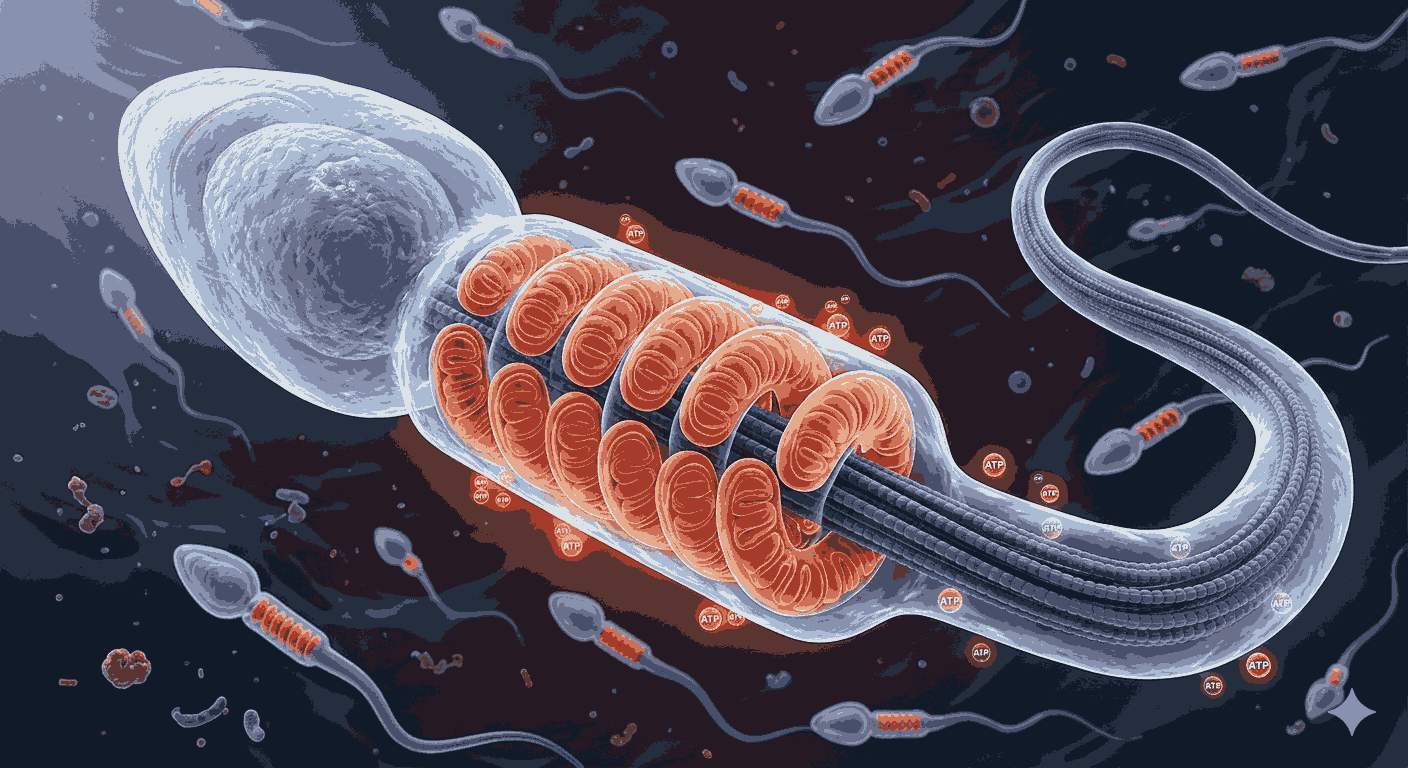
The sperm cell is highly specialized, and its structure is perfectly designed for motility and fertilization. The middle piece of the sperm contains numerous mitochondria arranged in a helical pattern. These mitochondria generate ATP, which powers the movement of the sperm tail. Through Mitochondria in Sperm MCQs Class 12 Biology Questions, aspirants can better understand how energy production is essential for sperm motility and successful fertilization.
When studying Mitochondria in Sperm MCQs Class 12 Biology Questions, learners also recognize that mitochondria are often referred to as the “powerhouse of the sperm.” Without sufficient ATP production, sperm would not be able to travel through the female reproductive tract. This highlights the direct link between structure and function, a key concept in biology that becomes clearer through Mitochondria in Sperm MCQs Class 12 Biology Questions.
Another important point covered under Mitochondria in Sperm MCQs Class 12 Biology Questions is the source of energy used by sperm. Fructose present in seminal fluid is metabolized by mitochondria to produce ATP. This biochemical process ensures that sperm remain active and capable of reaching the ovum. Practicing Mitochondria in Sperm MCQs Class 12 Biology Questions helps aspirants connect biochemical pathways with physiological functions.
The arrangement of mitochondria in the middle piece is also a common area of focus. In Mitochondria in Sperm MCQs Class 12 Biology Questions, questions often emphasize their helical arrangement around the axial filament. This structure ensures efficient energy transfer for continuous movement. Understanding such details through Mitochondria in Sperm MCQs Class 12 Biology Questions improves accuracy in exams.
In addition, Mitochondria in Sperm MCQs Class 12 Biology Questions often highlight the importance of cellular differentiation during spermiogenesis. During this stage, spermatids transform into mature spermatozoa, and mitochondria become densely packed in the middle piece. This transformation is crucial for acquiring motility, and repeated practice of Mitochondria in Sperm MCQs Class 12 Biology Questions reinforces this concept.
Aspirants also learn through Mitochondria in Sperm MCQs Class 12 Biology Questions that any defect in mitochondrial function can lead to reduced sperm motility, a condition known as asthenospermia. This real-world connection between biology and health makes the topic even more relevant and interesting. By engaging with Mitochondria in Sperm MCQs Class 12 Biology Questions, learners develop a deeper understanding of how cellular abnormalities can affect fertility.
Moreover, Mitochondria in Sperm MCQs Class 12 Biology Questions play a vital role in revision. Since many exam questions are concept-based, practicing these MCQs allows aspirants to test their knowledge effectively. It also helps in identifying weak areas and improving problem-solving skills. Regular exposure to Mitochondria in Sperm MCQs Class 12 Biology Questions builds confidence and enhances exam performance.
Another advantage of focusing on Mitochondria in Sperm MCQs Class 12 Biology Questions is that it integrates multiple topics such as cell biology, reproduction, and biochemistry. This interdisciplinary approach helps aspirants see the bigger picture and understand how different concepts are interconnected. As a result, learning becomes more meaningful and less dependent on rote memorization.
Mitochondria in Sperm MCQs Class 12 Biology Questions:
1. Which part of the sperm utilizes fructose as a source of energy?
a) Head
b) Tail
c) Acrosome
d) Middle piece
Answer: d
Explanation: The middle piece contains mitochondria (chondriosomes) that use fructose to generate ATP for sperm movement.
2. Where is the yolk found in a telolecithal egg?
a) All over the egg
b) On one side
c) Both sides
d) Centre
Answer: b
Explanation: Yolk is concentrated at the vegetal pole (one side).
3. In human beings, what type of eggs are present?
a) Mesolecithal
b) Alecithal
c) Microlecithal
d) Macrolecithal
Answer: b
Explanation: Human eggs lack yolk → alecithal.
4. Cross-section of middle piece shows?
a) Centriole + mitochondria + 9+2
b) Centriole + mitochondria
c) Mitochondria + 9+2 arrangement
d) Only 9+2
Answer: c
Explanation: Axoneme (9+2) + mitochondria present.
5. How many sperms are formed from a secondary spermatocyte?
a) 4
b) 8
c) 2
d) 1
Answer: c
Explanation: A secondary spermatocyte undergoes meiosis II to form two spermatids, which mature into two sperms.
6. Day 14 gamete released?
a) Secondary oocyte
b) Primary oocyte
c) Oogonium
d) Mature ovum
Answer: a
Explanation: Ovulation releases secondary oocyte.
7. End of oogenesis indicated by?
a) Secondary oocyte
b) First polar body
c) Second polar body
d) Perivitelline space
Answer: c
Explanation: Completion marked by second polar body formation.
8. Axial filament derived from?
a) Distal centriole
b) ER
c) Golgi
d) Proximal centriole
Answer: a
Explanation: Distal centriole forms flagellar axoneme.
9. Which statement is correct regarding spermiogenesis and Graafian follicle?
Statement I: During spermatogenesis, sperm heads embedded in Sertoli cells are released by spermiogenesis.
Statement II: The Graafian follicle contains a secondary oocyte.
a) Both Statement I and II are true
b) Both Statement I and II are false
c) Statement I is true but Statement II is false
d) Statement I is false but Statement II is true
Answer: d
Explanation:
- Statement I is incorrect → release is called spermiation, not spermiogenesis
- Statement II is correct → Graafian follicle contains secondary oocyte
10. Factor favoring spermatogenesis?
a) Testes in scrotum
b) Testes in abdomen
c) Mumps infection
d) High temperature
Answer: a
Explanation: Lower temperature (~2–3°C less) needed.
11. Mitochondria in sperm called?
a) Ring centriole
b) Lipochondria
c) Chondriosome
d) Microbodies
Answer: c
Explanation: Specialized mitochondria.
12. Why called chondriosomes?
a) Helical arrangement around axoneme
b) Tail location
c) Head location
d) Acrosome location
Answer: a
Explanation: Spiral arrangement provides energy.
13. Formation of ova is called?
a) RBC formation
b) Sperm formation
c) Oogenesis
d) Both
Answer: c
Explanation: Female gamete formation process.
14. Where do mitochondria occur in sperm?
a) Tail
b) Acrosome
c) Middle piece
d) Head
Answer: c
Explanation: Mitochondria are located in the middle piece and provide energy for movement.
15. During gametogenesis, Meiosis I occurs in?
a) Secondary spermatocytes
b) Primary spermatocytes and primary oocytes
c) Spermatogonia
d) Secondary oocytes
Answer: b
Explanation: Meiosis I occurs in primary cells, producing haploid secondary cells.
16. Correct sperm transport pathway?
a) Random sequence
b) Seminiferous tubules → Rete testis → Vasa efferentia → Epididymis → Vas deferens → Ejaculatory duct → Urethra
c) Incomplete
d) Incorrect
Answer: b
Explanation: This is the standard pathway of sperm transport.
17. Correct combination of cells and formation?
a) Spermatogonia – mitosis
b) Spermatid – meiosis I
c) Oogonia – meiosis
d) Secondary oocyte – meiosis I
Answer: d
Explanation: Secondary oocyte is formed after meiosis I.
18. Assertion–Reason Question
Assertion (A): Secondary spermatocytes are haploid.
Reason (R): They are formed from primary spermatocytes after meiosis I.
a) Both A and R are true and R is correct explanation
b) Both A and R are true but R is not explanation
c) A is true but R is false
d) A is false but R is true
Answer: a
Explanation: Meiosis I reduces chromosome number → secondary spermatocytes become haploid, so reason explains assertion.
19. Arrange the correct sequence of spermatogenesis
A. Spermatogonia
B. Secondary spermatocyte
C. Spermatogonial stem cells
D. Primary spermatocyte
E. Spermatid
a) C-D-B-A-E
b) C-A-D-B-E
c) A-B-C-D-E
d) C-D-A-B-E
Answer: b
Explanation:
Correct sequence:
Stem cells → Spermatogonia → Primary spermatocyte → Secondary spermatocyte → Spermatid
20. Which is a diploid cell?
a) Spermatid
b) Secondary spermatocyte
c) Spermatogonium
d) Spermatozoa
Answer: c
Explanation: Spermatogonium is diploid (2n).
21. Human egg contains?
a) Y chromosome
b) XX chromosomes
c) One X chromosome
d) XY chromosome
Answer: c
Explanation: Egg always carries X chromosome.
22. Small structure separated during oogenesis?
a) Polar bodies
b) Endosperm
c) Herring bodies
d) HeLa cells
Answer: a
Explanation: Unequal division forms polar bodies.
23. Process of sperm formation?
a) Oogenesis
b) Spermatogenesis
c) Spermiogenesis
d) None
Answer: b
Explanation: Complete sperm formation = spermatogenesis.
24. Gametogenesis refers to?
a) Fusion of gametes
b) Fusion of gametangia
c) Formation of gametes
d) Only male gametes
Answer: c
Explanation: Gametogenesis = formation of gametes.
25. Conversion of spermatid to sperm?
a) Early stage
b) Meiosis
c) Division
d) Spermiogenesis
Answer: d
Explanation: Final differentiation stage.
26. Middle piece contains?
a) Centriole
b) Nucleus
c) Protein
d) Mitochondria
Answer: d
Explanation: Energy-producing organelles.
27. Human gametes are?
a) Motile
b) Diploid
c) Haploid
d) No cell wall
Answer: c
Explanation: Gametes have n chromosomes.
28. Stage of full sperm maturity?
a) Spermiogenesis
b) Growth
c) Multiplication
d) Maturation
Answer: a
Explanation: Structural maturation happens here.
29. Reduction division occurs in?
a) Pollen grains
b) Tapetum
c) Megaspore
d) Megaspore mother cell
Answer: d
Explanation: Meiosis occurs in mother cell.
30. Enzyme-containing part of sperm?
a) Neck
b) Middle piece
c) Tail
d) Acrosome
Answer: d
Explanation: Acrosome contains enzymes for fertilization.
Conclusion on Mitochondria in Sperm MCQs Class 12 Biology Questions
In conclusion, mastering the concept of mitochondria in sperm is essential for a thorough understanding of human reproduction. Through consistent practice of Mitochondria in Sperm MCQs Class 12 Biology Questions, aspirants can strengthen their conceptual foundation, improve analytical skills, and perform better in exams. This topic not only enhances academic performance but also provides valuable insights into the functioning of living systems.