
- Keneitsino Lydia
- May 20, 2026
Powerful Miller Urey Experiment MCQs with Answers for NEET & CUET
The origin of life is one of the most fascinating topics in biology, and many aspirants preparing for NEET and board examinations regularly search for Miller Urey Experiment MCQs with Answers to strengthen their understanding of this chapter. The famous Miller-Urey experiment provided the first experimental support for the chemical origin of life theory proposed by Oparin and Haldane. Because this topic is frequently asked in competitive examinations, Miller Urey Experiment MCQs with Answers has become an essential study resource for aspirants who want to master evolution and origin-of-life concepts effectively.
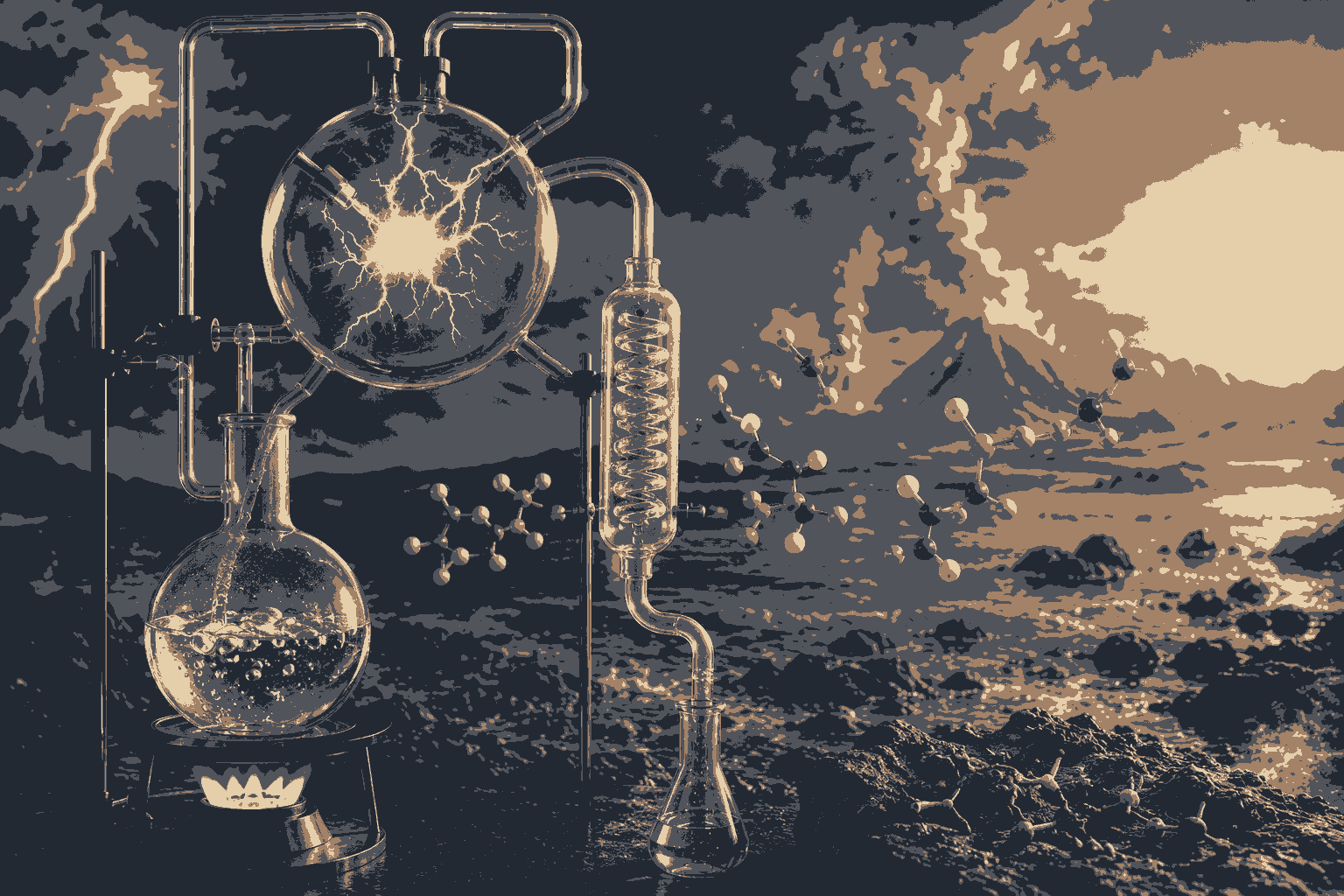
The Miller-Urey experiment was conducted in 1953 by Stanley Miller under the guidance of Harold Urey at the University of Chicago. Aspirants studying Miller Urey Experiment MCQs with Answers learn how primitive Earth conditions were recreated in a laboratory setup. The experiment used gases such as methane, ammonia, hydrogen, and water vapour to simulate the reducing atmosphere believed to exist on early Earth. By revising through Miller Urey Experiment MCQs with Answers, aspirants can easily remember the composition of the primitive atmosphere and the significance of each gas in chemical evolution.
One of the most important concepts covered in Miller Urey Experiment MCQs with Answers is the role of electrical discharge in the experiment. Miller passed electric sparks through the gas mixture to imitate lightning conditions present on primitive Earth. After continuous circulation for several days, organic compounds such as amino acids were formed. Aspirants frequently revise this concept using Miller Urey Experiment MCQs with Answers because questions related to amino acid formation are common in biology examinations.
The experiment strongly supported the theory of chemical evolution. According to this theory, life originated from non-living chemical substances under suitable environmental conditions. Aspirants using Miller Urey Experiment MCQs with Answers understand that the experiment did not create living organisms directly but demonstrated the formation of basic organic molecules required for life. This distinction is important because many objective questions are designed to confuse aspirants between “origin of life” and “origin of organic compounds.” Regular practice with Miller Urey Experiment MCQs with Answers helps avoid such mistakes.
Another major topic included in Miller Urey Experiment MCQs with Answers is the reducing atmosphere of primitive Earth. Oxygen was absent in free form during the early stages of Earth’s formation. Instead, gases like methane, ammonia, hydrogen, and water vapour dominated the atmosphere. Aspirants repeatedly revise these concepts using Miller Urey Experiment MCQs with Answers because exam questions often ask which gas was absent or present in Miller’s experimental setup.
The formation of amino acids during the experiment is considered one of the greatest achievements in experimental biology. Amino acids are the building blocks of proteins and are essential for life processes. Aspirants preparing through Miller Urey Experiment MCQs with Answers often study how amino acids such as glycine and alanine were synthesized in the apparatus. These details are important for understanding biochemical evolution and are frequently tested in objective examinations.
The topic of prebiotic evolution is also closely connected with Miller Urey Experiment MCQs with Answers. Prebiotic evolution refers to the formation of organic molecules before the origin of living organisms. Aspirants learn through Miller Urey Experiment MCQs with Answers that simple inorganic molecules gradually formed more complex organic compounds under primitive Earth conditions. This process eventually contributed to the emergence of the first primitive life forms.
Another important concept covered in Miller Urey Experiment MCQs with Answers is the significance of water in the origin of life. The experiment included boiling water to represent primitive oceans. Water vapour circulated within the apparatus and condensed continuously, simulating Earth’s natural water cycle. Aspirants often revise these details through Miller Urey Experiment MCQs with Answers because questions about primitive oceans and atmospheric conditions are common in Class 12 Biology examinations.
The Miller-Urey experiment also laid the foundation for future origin-of-life research. Modern biology and biochemistry continue to investigate how organic molecules formed naturally on primitive Earth. Aspirants using Miller Urey Experiment MCQs with Answers gain a broader understanding of evolutionary biology and scientific experimentation. This helps aspirants connect textbook concepts with real scientific discoveries.
For competitive examination preparation, Miller Urey Experiment MCQs with Answers is extremely useful because it simplifies a complicated topic into objective-based revision. Aspirants can improve memory retention, conceptual clarity, and question-solving accuracy by practicing Miller Urey Experiment MCQs with Answers regularly. Since evolution and origin-of-life chapters are highly scoring sections in biology, mastering this topic provides a strong advantage in examinations.
Miller Urey Experiment MCQs with Answers:
- Biological concept of species is mainly based on
A. Reproductive isolation
B. Morphological features only
C. Methods of reproduction only
D. Morphology and methods of reproduction
Answer: A. Reproductive isolation
Explanation:
Reproductive isolation prevents interbreeding between populations of different species.
- Which component was NOT part of the Urey-Miller experiment mixture?
A. Methane
B. CO₂
C. Hydrogen
D. Water vapour
Answer: B. CO₂
Explanation:
The Urey-Miller experiment used methane, hydrogen, ammonia, and water vapour.
- The evolution was termed as RNA world in the 1980s due to the discovery that
A. mRNA, tRNA, rRNA synthesize proteins
B. In some viruses RNA is genetic material
C. Some RNAs have enzymatic property
D. RNA is not found in all cells
Answer: C. Some RNAs have enzymatic property
Explanation:
Discovery of catalytic RNAs (ribozymes) led to the RNA world hypothesis.
- Similarities in organisms with different genotypes indicate
A. Microevolution
B. Macroevolution
C. Convergent evolution
D. Divergent evolution
Answer: C. Convergent evolution
Explanation:
Convergent evolution results in similar adaptations in unrelated organisms.
- The unit of evolution is now known to be the
A. Individual
B. Family
C. Population
D. Species
Answer: C. Population
Explanation:
Evolution occurs through changes in populations over generations.
- The concept of chemical evolution is based on
A. Crystallization of chemicals
B. Interaction of water, air and clay under intense heat
C. Effect of solar radiation on chemicals
D. Possible origin of life by combination of chemicals under suitable environmental conditions
Answer: D
Explanation:
Chemical evolution proposes that life originated from chemical reactions under primitive Earth conditions.
- Which compound has a very important role in prebiotic evolution?
A. SO₂
B. NO
C. CH₄
D. SO₃
Answer: C. CH₄
Explanation:
Methane was one of the important gases in Miller’s experiment.
- Who proposed the theory of pangenesis?
A. Darwin
B. Lamarck
C. Hugo de Vries
D. Oparin
Answer: A. Darwin
Explanation:
Charles Darwin proposed the theory of pangenesis in 1868.
- What are the basic elements of life?
A. C, H, O, N
B. C, P, H, S
C. H, O, N, S
D. P, C, O, N
Answer: A. C, H, O, N
Explanation:
Carbon, hydrogen, oxygen, and nitrogen are the major elements of life.
- Discovery of fossils of cyanobacteria indicates that life originated
A. Prior to 4600 million years ago
B. Between 4600 and 3600 million years ago
C. More than 3600 million years ago
D. During another period
Answer: C
Explanation:
Cyanobacterial fossils date back over 3.5 billion years.
- In which era did the origin of life occur?
A. Precambrian
B. Coenozoic
C. Palaeozoic
D. Mesozoic
Answer: A. Precambrian
Explanation:
Life originated during the Precambrian era.
- What gases were used by Miller and Urey in their experiment?
A. N₂ and H₂O
B. H₂O and CH₄
C. CH₄ and N₂
D. CO₂ and NH₃
Answer: B. H₂O and CH₄
Explanation:
Methane and water vapour were part of the experimental setup.
- What were the first organisms to evolve on Earth?
A. Saprotrophs
B. Photoautotrophs
C. Chemoautotrophs
D. Chemoheterotrophs
Answer: D. Chemoheterotrophs
Explanation:
The earliest organisms obtained energy from organic compounds.
- What was formed in S. Miller’s experiment?
A. Amino acids
B. Nucleic acids
C. UV radiations
D. Microspheres
Answer: A. Amino acids
Explanation:
Miller synthesized amino acids under primitive Earth conditions.
- Origin of first mammals occurred approximately
A. 500 million years ago
B. 220 million years ago
C. 1600 million years ago
D. Over 1600 million years ago
Answer: B. 220 million years ago
Explanation:
The first mammals evolved during the Triassic period.
- Chemical theory of origin was given by
A. Spallanzani
B. Louis Pasteur
C. Oparin and Haldane
D. Stanley Miller
Answer: C. Oparin and Haldane
Explanation:
Oparin and Haldane proposed the chemical evolution theory.
- Swan-necked flask experiment proved
A. Biogenesis
B. Abiogenesis
C. Gene therapy
D. Both (a) and (b)
Answer: A. Biogenesis
Explanation:
Pasteur proved life arises from pre-existing life.
- The long gap between origin of Earth and life was due to lack of
A. Oxygen
B. Water
C. DNA
D. Suitable temperature
Answer: D. Suitable temperature
Explanation:
Early Earth was too hot to support life.
- Life on Earth is estimated to have originated not earlier than
A. 4200 million years ago
B. 3500 million years ago
C. 1600 million years ago
D. 459 million years ago
Answer: B. 3500 million years ago
Explanation:
Scientific evidence suggests life began around 3.5 billion years ago.
- Which of the following is a mismatch?
A. Giraffe – Lamarck
B. Drosophila – Morgan
C. Galapagos island – Darwin’s finches
D. Origin of Species – Mendel
Answer: D
Explanation:
“Origin of Species” was written by Charles Darwin, not Mendel.
- According to abiogenesis, life originates from
A. Non-living matter
B. Pre-existing life
C. Chemicals
D. Extra-terrestrial matter
Answer: A. Non-living matter
Explanation:
Abiogenesis means origin of life from non-living substances.
- The most primitive cell-like aggregates capable of growth and division were
A. Chemoautotrophs
B. Eobionts
C. Prokaryotes
D. Microspheres
Answer: D. Microspheres
Explanation:
Microspheres resembled primitive cell-like structures.
- Which amino acid was not synthesized in Miller’s experiment?
A. Glycine
B. Aspartic acid
C. Glutamic acid
D. Alanine
Answer: C. Glutamic acid
Explanation:
Glutamic acid was absent among Miller’s synthesized products.
- Why is there no life on the Moon?
A. O₂
B. Water
C. Light
D. Temperature
Answer: B. Water
Explanation:
Absence of water makes the Moon unsuitable for life.
- Earth originated approximately
A. 4500 million years ago
B. 3600 million years ago
C. Between 1600–2600 million years ago
D. 2.5 million years ago
Answer: A. 4500 million years ago
Explanation:
Earth formed around 4.5 billion years ago.
- Who experimentally verified chemical origin of life?
A. Louis Pasteur
B. Charles Darwin
C. J.B.S. Haldane
D. Urey and Miller
Answer: D. Urey and Miller
Explanation:
They experimentally demonstrated formation of organic molecules.
- Origin of species from pre-existing species is called
A. Isolation
B. Speciation
C. Polyploidy
D. Mutation
Answer: B. Speciation
Explanation:
Speciation is the formation of new species.
- Who gave the theory of continuity of germplasm?
A. Hugo de Vries
B. Weismann
C. Darwin
D. Lamarck
Answer: B. Weismann
Explanation:
Weismann proposed continuity of germplasm theory.
- Fossil evidences of evolution are studied under
A. Embryology
B. Anatomy
C. Palaeontology
D. Biogeography
Answer: C. Palaeontology
Explanation:
Palaeontology deals with fossils and extinct organisms.
- Which factors play a positive role in evolution according to modern synthetic theory?
A. Natural selection and acquired characters
B. Natural selection and mutations
C. Acquired characters and artificial selection
D. Natural selection and mutations
Answer: B. Natural selection and mutations
Explanation:
Mutations and natural selection are key evolutionary forces.
Conclusion on Miller Urey Experiment MCQs with Answers
In conclusion, Miller Urey Experiment MCQs with Answers is an essential resource for aspirants preparing for NEET, board examinations, and other biology entrance tests. The topic explains primitive Earth conditions, chemical evolution, amino acid formation, and the experimental support for the origin of life theory. Regular revision through Miller Urey Experiment MCQs with Answers strengthens conceptual understanding and helps aspirants answer biology questions confidently and accurately.