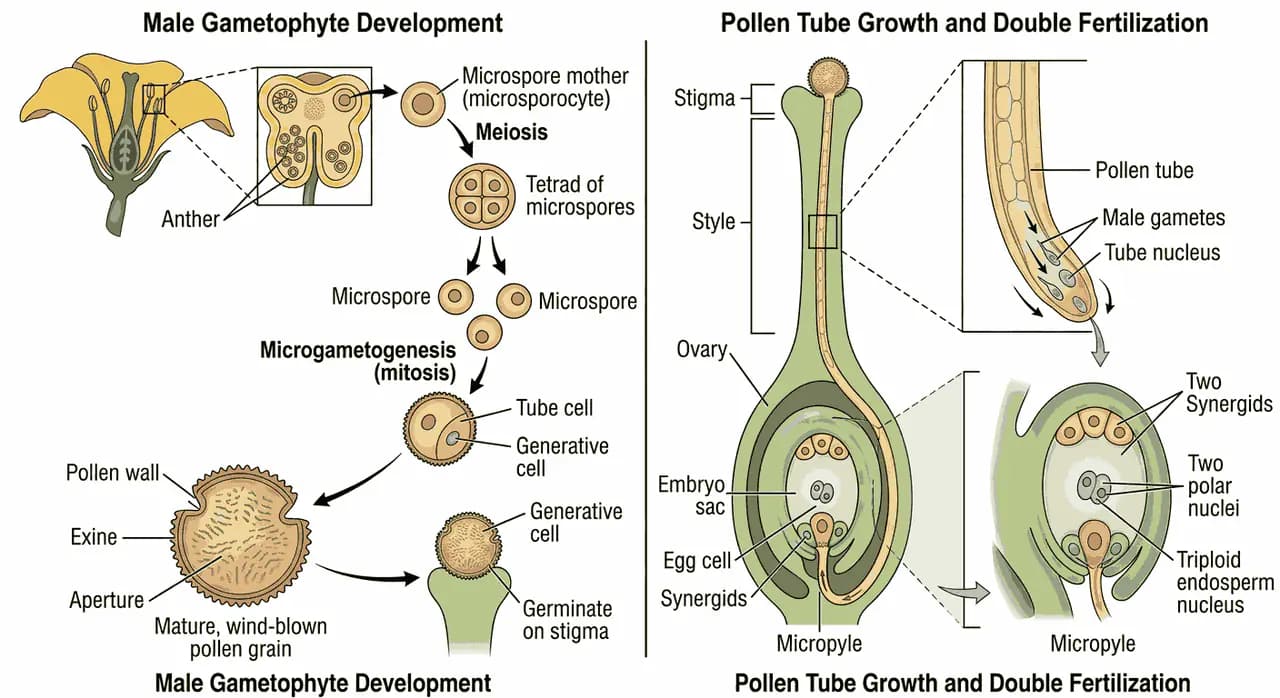
Understanding plant reproduction is a key part of Class 12 Biology, especially for aspirants preparing for competitive exams like NEET. One of the most important topics within this chapter is male gametophyte development and fertilization. That is why practicing Male Gametophyte Development And Fertilization MCQs Class 12 becomes essential for achieving conceptual clarity and exam success.
For many aspirants, the process of pollen grain formation and fertilization can initially seem complex. However, consistent practice with Male Gametophyte Development And Fertilization MCQs Class 12 simplifies these processes into clear and manageable concepts. The development of the male gametophyte begins with microsporogenesis, followed by the formation of pollen grains, which ultimately produce male gametes. By solving Male Gametophyte Development And Fertilization MCQs Class 12, aspirants can understand each stage in detail.
Another critical aspect is the structure of pollen grains and their role in fertilization. Aspirants often encounter questions about the vegetative cell and generative cell, and how they function during pollen tube formation. Practicing Male Gametophyte Development And Fertilization MCQs Class 12 helps aspirants remember these details more effectively and apply them accurately in exams.
Fertilization in flowering plants involves a unique process called double fertilization. This concept is frequently tested, and aspirants must clearly understand syngamy and triple fusion. Regular practice through Male Gametophyte Development And Fertilization MCQs Class 12 ensures that aspirants are well-prepared for such questions. It also strengthens their ability to differentiate between closely related terms.
Time management is another important benefit of solving Male Gametophyte Development And Fertilization MCQs Class 12. Since competitive exams require quick decision-making, aspirants who regularly practice Male Gametophyte Development And Fertilization MCQs Class 12 develop faster problem-solving skills. This ultimately improves their performance under exam conditions.
Moreover, Male Gametophyte Development And Fertilization MCQs Class 12 play a vital role in reinforcing theoretical knowledge. Instead of repeatedly reading long explanations, aspirants can revise key points efficiently through MCQ practice. This makes Male Gametophyte Development And Fertilization MCQs Class 12 a highly effective revision tool.
Aspirants also benefit from the analytical thinking required to solve Male Gametophyte Development And Fertilization MCQs Class 12. These questions often test conceptual understanding rather than memorization. By practicing Male Gametophyte Development And Fertilization MCQs Class 12, aspirants learn to analyze situations and choose the correct answer logically.
Another advantage is the improvement in accuracy. Regular exposure to Male Gametophyte Development And Fertilization MCQs Class 12 helps aspirants identify common mistakes and avoid them in exams. This leads to better scores and increased confidence. As aspirants continue practicing Male Gametophyte Development And Fertilization MCQs Class 12, they become more familiar with exam patterns.
Consistency is key in preparation, and aspirants who incorporate Male Gametophyte Development And Fertilization MCQs Class 12 into their daily routine are more likely to succeed. Even short practice sessions with Male Gametophyte Development And Fertilization MCQs Class 12 can significantly enhance understanding over time.
Furthermore, Male Gametophyte Development And Fertilization MCQs Class 12 help aspirants connect different concepts within the chapter. From pollen grain structure to fertilization mechanisms, all topics become interconnected through practice. This holistic understanding is crucial for solving higher-level questions.
Male Gametophyte Development And Fertilization MCQs Class 12:
1. Germination of pollen grain on the stigma is:
A. In situ germination
B. In vitro germination
C. In vivo germination
D. Autogamy
Answer: C
Explanation: When pollen germinates on the stigma of a living plant, it is called in vivo germination. In vitro occurs outside the plant in artificial medium.
2. In the anther wall:
A. Tapetum lies between endothecium and middle layers
B. Tapetum lies just inner to endothecium
C. Middle layer is between endothecium and tapetum
D. Endothecium lies inside middle layer
Answer: C
Explanation: The correct arrangement is:
Epidermis → Endothecium → Middle layer → Tapetum, where tapetum is innermost.
3. Which part contains sporogenous tissue?
A. Pollen
B. Microspores
C. Young anther
D. Stamen
Answer: C
Explanation: Sporogenous tissue develops inside the young anther and later forms microspore mother cells.
4. Developing pollen is nourished by:
A. Tapetum
B. Endothecium
C. Epidermis
D. Middle layer
Answer: A
Explanation: Tapetum provides nutrients, enzymes, and pollen wall materials.
5. Outer wall of pollen grain is made up of:
A. Cellulose
B. Sporopollenin
C. Pectocellulose
D. Lignin
Answer: B
Explanation: Exine is made of sporopollenin, a highly resistant substance.
6. Archesporium in ovule is:
A. Single celled, hypodermal
B. Central
C. Terminal
D. Multicellular
Answer: A
Explanation: It is usually single-celled and hypodermal, giving rise to sporogenous tissue.
7. Number of androcytes for 32 male gametes:
A. 4
B. 8
C. 10
D. 32
Answer: D
Explanation: Each androcyte produces one male gamete, so 32 needed.
8. Total pollen grains in Tamarindus:
A. 64500
B. 32250
C. 19350
D. 16125
Answer: C
Explanation: Based on number of flowers × anthers × pollen per anther.
9. Observation by Treub:
A. Micropylar entry
B. Chalazal entry
C. Integument entry
D. Multiple tubes
Answer: B
Explanation: Treub discovered chalazogamy (entry via chalaza).
10. Aleurone layer is rich in:
A. Vitamin A
B. Vitamin B
C. Vitamin C
D. Vitamin E
Answer: B
Explanation: Aleurone layer is rich in Vitamin B complex.
11. Wings of Pinus pollen arise from:
A. Exine
B. Intine
C. Both
D. Sporangium
Answer: A
Explanation: Wings are exine outgrowths aiding wind pollination.
12. Microspore mother cell forms:
A. Ovule
B. Pollen grains
C. Embryo sac
D. Pollen sac
Answer: B
Explanation: It undergoes meiosis → forms 4 microspores → pollen grains.
13. Function of germ pore:
A. Initiation of pollen tube
B. Water absorption
C. Radicle emergence
D. Gamete release
Answer: A
Explanation: Germ pore is the site for pollen tube emergence.
14. Self-pollination in Clerodendron prevented by:
A. Protogyny
B. Protandry
C. Herkogamy
D. Heterostyly
Answer: B
Explanation: Protandry = anther matures before stigma → prevents selfing.
15. Resistant material of exine:
A. Cutin
B. Lignin
C. Suberin
D. Sporopollenin
Answer: D
Explanation: Sporopollenin is most resistant biological substance.
16. Free nuclear divisions occur in:
A. Female gametophyte
B. Embryo
C. Male gametophyte
D. Endosperm
Answer: A
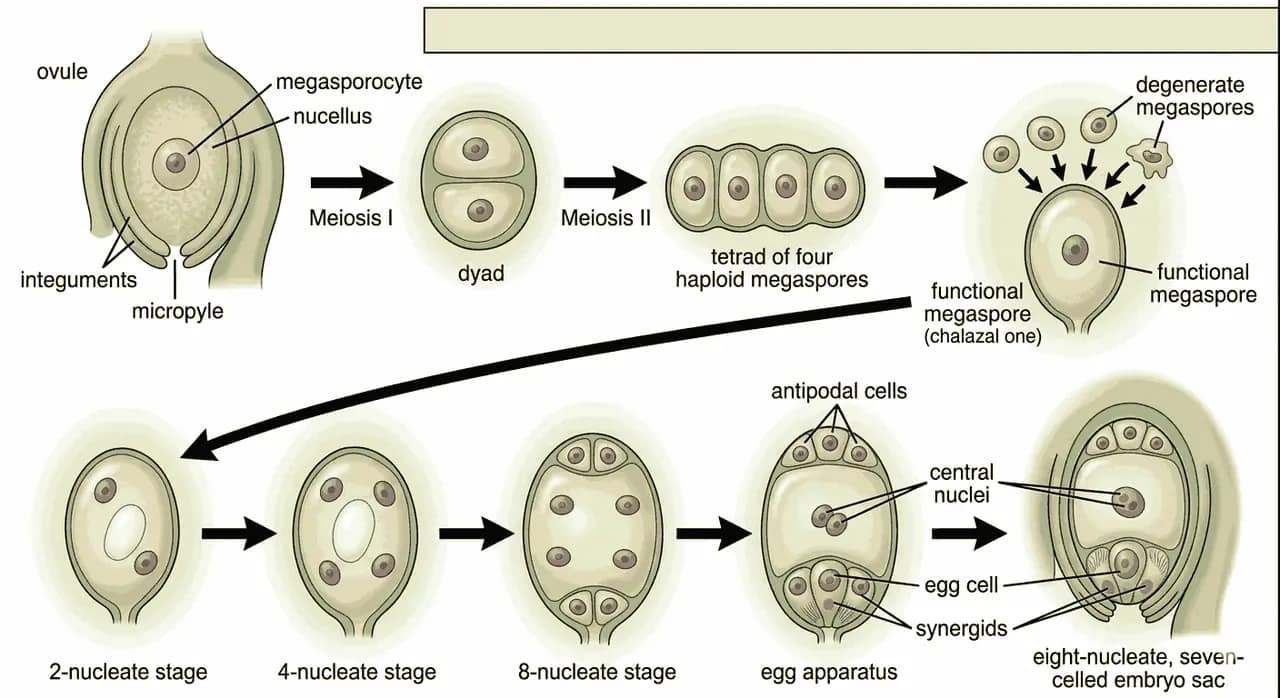
Explanation: Embryo sac formation involves 3 free nuclear mitotic divisions.
17. Growth of pollen tube is:
A. Geotropism
B. Chemotaxis
C. Thigmotaxis
D. Phototaxis
Answer: B
Explanation: Guided by chemical signals from ovule.
18. Chromosomes in callus from pollen (2n=28):
A. 28
B. 21
C. 14
D. 56
Answer: C
Explanation: Pollen is haploid → n = 14, callus retains haploid number.
19. Fibrous thickening found in:
A. Epidermis
B. Endothecium
C. Middle layer
D. Tapetum
Answer: B
Explanation: Endothecium helps in anther dehiscence.
20. Total pollen grains in Asteraceae:
A. 300
B. 500
C. 800
D. 1000
Answer: D
Explanation: 10 flowers × 5 anthers × 20 pollen = 1000
21. First sporophyte from pollen culture:
A. Hyacinthus
B. Datura
C. Drosera
D. Glycine
Answer: B
Explanation: Guha & Maheshwari developed it in Datura.
22. Diadelphous condition found in:
A. Rosaceae
B. Papilionaceae
C. Leguminosae
D. Cucurbitaceae
Answer: B
Explanation: 9+1 filament fusion is characteristic of Papilionaceae.
23. Pollen kit is secreted by:
A. Tapetum
B. Endothecium
C. Epidermis
D. Endodermis
Answer: A
Explanation: Tapetum secretes pollen kit for adhesion & protection.
24. Archesporium gives rise to:
A. Wall
B. Tapetum
C. Sporogenous tissue
D. Both wall and sporogenous
Answer: D
Explanation: Forms both anther wall and sporogenous cells.
25. Horse-shoe embryo sac occurs in:
A. Circinotropous
B. Anatropous
C. Amphitropous
D. Atropous
Answer: C
Explanation: Amphitropous ovule → curved embryo sac.
26. Pollen tube enters via:
A. Egg
B. Central cell
C. Persistent synergid
D. Degenerated synergid
Answer: D
Explanation: One synergid degenerates → allows entry.
27. Nuclear dimorphism seen in:
A. Amoeba
B. Trypanosoma
C. Plasmodium
D. Paramecium
Answer: D
Explanation: Paramecium has macronucleus & micronucleus.
28. Endosperm formed by:
A. Two polar nuclei + male gamete
B. One polar nucleus + male gamete
C. Egg + sperm
D. Two sperms
Answer: A
Explanation: Triple fusion → triploid endosperm.
29. Result of syngamy:
A. Ovum + sperm
B. Polar nuclei fusion
C. Zygote (2n)
D. Endosperm
Answer: C
Explanation: Syngamy forms diploid zygote.
30. Eight-nucleated embryo sac is:
A. Monosporic
B. Bisporic
C. Tetrasporic
D. Any of these
Answer: D
Explanation: All three types can form 8-nucleate embryo sac.
Conclusion on Male Gametophyte Development And Fertilization MCQs Class 12
In conclusion, the importance of Male Gametophyte Development And Fertilization MCQs Class 12 cannot be overstated. They provide conceptual clarity, improve speed, enhance accuracy, and build confidence among aspirants. By regularly practicing Male Gametophyte Development And Fertilization MCQs Class 12, aspirants can master this topic and perform exceptionally well in their exams.
Related reading
Score Higher Now: Powerful Seed Development and Embryology MCQs Class 12 Biology with Answers
Practice Seed Development and Embryology MCQs Class 12 Biology with Answers. Boost exam preparation with important questions on embryos, seeds and fertilization
Stop Losing Marks: Megaspore Development and Megasporogenesis MCQs Class 12
Revise Megaspore Development and Megasporogenesis MCQs Class 12 with answers. Practice key important questions, strengthen basics get exam-ready with confidence