
- Keneitsino Lydia
- April 21, 2026
Master Easily: Graafian Follicle Structure and Function MCQs Class 12 with Answers
Understanding reproductive biology is essential for aspirants preparing for Class 12 examinations, and one of the most important topics in this area is the structure and function of the Graafian follicle. The concept becomes easier to master when studied through Graafian Follicle Structure and Function MCQs Class 12 with Answers, as they help reinforce theoretical knowledge with application-based learning.
The Graafian follicle represents the mature stage of ovarian follicle development. Aspirants often encounter this topic in exams, and practicing Graafian Follicle Structure and Function MCQs Class 12 with Answers ensures a deeper conceptual understanding. The follicle develops within the ovary and plays a crucial role in oogenesis and hormone production.
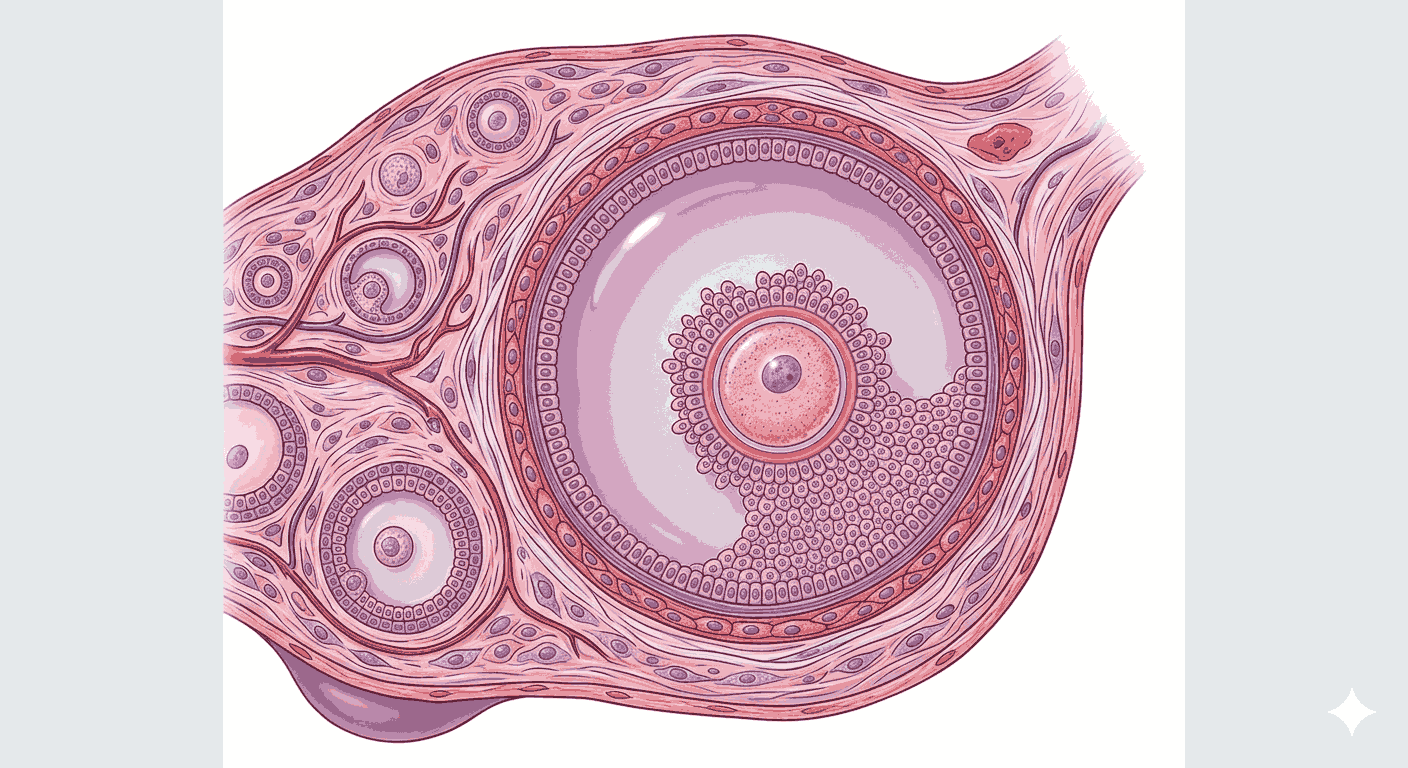
Structurally, the Graafian follicle consists of multiple layers. The outermost layers are the theca externa and theca interna, followed by the membrana granulosa. Inside lies the antrum, a fluid-filled cavity, which surrounds the secondary oocyte. The oocyte itself is enclosed by the zona pellucida and further surrounded by corona radiata cells. These structural details are frequently tested, making Graafian Follicle Structure and Function MCQs Class 12 with Answers highly valuable for revision.
One of the primary functions of the Graafian follicle is the secretion of estrogen. This hormone regulates the menstrual cycle and prepares the endometrium for possible implantation. Aspirants studying Graafian Follicle Structure and Function MCQs Class 12 with Answers will notice that hormonal regulation is a key area of focus in exam questions.
Another important function of the Graafian follicle is ovulation. During ovulation, the follicle ruptures to release the secondary oocyte. This process is triggered by a surge in luteinizing hormone (LH). Understanding this sequence is crucial, and repeated practice through Graafian Follicle Structure and Function MCQs Class 12 with Answers helps aspirants remember these events accurately.
The transformation of the Graafian follicle after ovulation into the corpus luteum is another significant concept. The corpus luteum secretes progesterone, which is essential for maintaining pregnancy. These transformations are commonly tested, which is why aspirants rely on Graafian Follicle Structure and Function MCQs Class 12 with Answers to strengthen their preparation.
From a structural perspective, each component of the Graafian follicle has a specific role. The granulosa cells provide nourishment to the oocyte, while the theca interna is involved in hormone synthesis. The zona pellucida plays a crucial role in fertilization by acting as a binding site for sperm. These detailed functions are often included in Graafian Follicle Structure and Function MCQs Class 12 with Answers, making them an effective study tool.
Aspirants should also understand the process of follicular development, which includes primary, secondary, tertiary, and finally Graafian stages. Each stage has distinct characteristics, and mastering them becomes easier with Graafian Follicle Structure and Function MCQs Class 12 with Answers.
In addition to structure and function, clinical relevance is also important. Conditions like follicular cysts or hormonal imbalances can affect the normal functioning of Graafian follicles. Such application-based concepts are frequently covered in Graafian Follicle Structure and Function MCQs Class 12 with Answers, helping aspirants connect theory with real-life scenarios.
Another important aspect is the role of the follicle in fertilization. After ovulation, the released oocyte is captured by the fimbriae of the fallopian tube. The structural integrity of the Graafian follicle ensures successful release and transport. These mechanisms are often emphasized in Graafian Follicle Structure and Function MCQs Class 12 with Answers.
For effective preparation, aspirants should not only memorize structures but also understand their interrelationships. The layered organization of the follicle and its hormonal functions are best revised through Graafian Follicle Structure and Function MCQs Class 12 with Answers, which promote analytical thinking.
Time management is another benefit of practicing Graafian Follicle Structure and Function MCQs Class 12 with Answers. Since exam questions are often time-bound, practicing such MCQs helps improve speed and accuracy. It also familiarizes aspirants with commonly asked patterns.
Consistency in practice is key. By regularly solving this mcqs, aspirants can identify weak areas and improve their understanding. This approach not only boosts confidence but also enhances retention.
Graafian Follicle Structure and Function MCQs Class 12 with Answers:
1. The part of Fallopian tube closest to the ovary is:
a) Infundibulum
b) Isthmus
c) Ampulla
d) Cervix
Answer: a) Infundibulum
Explanation: Infundibulum is the funnel-shaped part of the oviduct closest to the ovary and bears fimbriae that help capture the ovum.
2. Clitoris in female mammals is:
a) Homologous to penis of male
b) Analogous to penis of male
c) Vestigial structure
d) Overgrowth
Answer: a) Homologous to penis of male
Explanation: Clitoris and penis originate from the same embryonic tissue, hence they are homologous structures.
3. Graafian follicle contains:
a) Oogonial cells
b) Corpus luteum
c) Theca externa and theca interna
d) Corpus albicans
Answer: c) Theca externa and theca interna
Explanation: Mature Graafian follicle has distinct layers including theca externa and theca interna.
4. Homologous gland in males to vestibular gland (female):
a) Bartholin’s gland
b) Seminal vesicle
c) Prostate gland
d) Cowper’s gland
Answer: d) Cowper’s gland
Explanation: Cowper’s gland (bulbourethral gland) is homologous to Bartholin’s gland.
5. Oviduct is supported by:
a) Mesovarium
b) Mesometrium
c) Tunica vaginalis
d) Mesosalpinx
Answer: d) Mesosalpinx
Explanation: Mesosalpinx is the peritoneal fold supporting the fallopian tube.
6. Arrange the following events in the human female reproductive cycle in the proper sequence:
(A) Secretion of FSH
(B) Growth of corpus luteum
(C) Growth of follicle and oogenesis
(D) Ovulation
(E) Sudden increase in LH
a) C → A → D → B → E
b) A → C → E → D → B
c) A → D → C → E → B
d) B → A → C → D → E
Answer: b) A → C → E → D → B
Explanation:
FSH secretion stimulates follicular growth → LH surge triggers ovulation → corpus luteum forms after ovulation.
7. Atretic follicles are found in:
a) Liver
b) Ovary
c) Testis
d) Thymus
Answer: b) Ovary
Explanation: Atretic follicles are degenerated ovarian follicles.
8. Bartholin’s glands are situated:
a) On either side of vagina
b) Near vas deferens
c) Head of amphibians
d) Tail end of birds
Answer: a) On either side of vagina
Explanation: They secrete mucus for lubrication.
9. Hormones causing osteoporosis:
a) Aldosterone + Prolactin
b) Progesterone + Aldosterone
c) PTH + Prolactin
d) Estrogen + PTH
Answer: d) Estrogen + PTH
Explanation: Estrogen deficiency and PTH increase bone resorption.
10. Zona pellucida appears in:
a) Tertiary follicle
b) Secondary follicle
c) Primary follicle
d) Graafian follicle
Answer: d) Graafian follicle
Explanation: It surrounds the oocyte in mature follicles.
11. Graafian follicle secretes:
a) hCG
b) Relaxin
c) Testosterone
d) Estrogen
Answer: d) Estrogen
Explanation: Estrogen is produced by follicular cells.
12. Oviduct part joining uterus:
a) Fimbriae
b) Isthmus
c) Ampulla
d) Infundibulum
Answer: b) Isthmus
Explanation: Isthmus connects oviduct to uterus.
13. Placenta present in mammals acts as an endocrine tissue and produces:
- Human chorionic gonadotropin
- Estrogen
- Progesterone
- Testosterone
a) 1, 2, 3
b) 1, 2
c) 2, 4
d) 1, 3
Answer: a) 1, 2, 3
Explanation:
Placenta produces hCG, estrogen, and progesterone to maintain pregnancy. Testosterone is not produced by placenta.
14. Endoskeleton develops from:
a) Ectoderm
b) Endoderm
c) Mesoderm
d) Blastopore
Answer: c) Mesoderm
Explanation: Mesoderm forms muscles and skeleton.
15. Female counterpart of Cowper gland:
a) Bartholin gland
b) Clitoris
c) Perineal gland
d) None
Answer: a) Bartholin gland
Explanation: Both are homologous glands.
16. Arrange the following parts of Graafian follicle from outside to inside:
A. Secondary oocyte
B. Corona radiata
C. Zona pellucida
D. Theca externa
E. Membrana granulosa
F. Theca interna
G. Antrum
a) D → F → E → G → B → C → A
b) A → B → C → G → E → F → D
c) B → C → A → D → F → E → G
d) C → D → B → E → F → G → A
Answer: a) D → F → E → G → B → C → A
Explanation:
From outer to inner: Theca externa → Theca interna → granulosa → antrum → corona radiata → zona pellucida → oocyte.
17. Arrange the components of the mammary gland from proximal (milk-producing region) to distal (towards nipple):
a) Alveoli → Mammary tubules → Mammary ducts → Mammary ampulla → Lactiferous duct
b) Lactiferous duct → Mammary ampulla → Mammary ducts → Mammary tubules → Alveoli
c) Mammary ducts → Alveoli → Mammary tubules → Lactiferous duct → Ampulla
d) Alveoli → Mammary ducts → Tubules → Ampulla → Lactiferous duct
Answer: a) Alveoli → Mammary tubules → Mammary ducts → Mammary ampulla → Lactiferous duct
Explanation:
Milk is produced in alveoli, then passes through mammary tubules, into mammary ducts, collects in ampulla, and finally exits through the lactiferous duct.
18. Modified amino acid hormone:
a) Progesterone
b) Prostaglandin
c) Estrogen
d) Epinephrine
Answer: d) Epinephrine
Explanation: Derived from tyrosine.
19. Hormones produced by:
a) Ovary
b) Placenta
c) Tube
d) Pituitary
Answer: b) Placenta
Explanation: Placenta acts as endocrine organ.
20. Match the following reproductive structures with their correct functions:
Column I
A. Zona pellucida
B. Corona radiata
C. Corpus luteum
D. Fimbriae
Column II
(i) Secretes progesterone
(ii) Glycoprotein layer around ovum
(iii) Helps in ovum capture
(iv) Layer of follicular cells around ovum
a) A-(ii), B-(iv), C-(i), D-(iii)
b) A-(i), B-(ii), C-(iii), D-(iv)
c) A-(iv), B-(ii), C-(i), D-(iii)
d) A-(ii), B-(iii), C-(iv), D-(i)
Answer: a) A-(ii), B-(iv), C-(i), D-(iii)
Explanation:
- Zona pellucida → glycoprotein layer for sperm binding
- Corona radiata → follicular cells around ovum
- Corpus luteum → secretes progesterone
- Fimbriae → help capture ovum after ovulation
21. Sperm receptors present on:
a) Zona pellucida
b) Corona radiata
c) Vitelline membrane
d) Perivitelline space
Answer: a
Explanation: ZP3 glycoprotein helps sperm binding.
22. Acellular layer:
a) Zona pellucida
b) Granulosa
c) Theca interna
d) Stroma
Answer: a
Explanation: Zona pellucida is non-cellular.
23. Match the following phases:
Column I
A. Proliferative phase
B. Secretory phase
C. Menstruation
Column II
(i) Breakdown of endometrium
(ii) Follicular phase
(iii) Luteal phase
a) iii, ii, i
b) i, iii, ii
c) iii, i, ii
d) ii, iii, i
Answer: d) ii, iii, i
Explanation:
Proliferative = Follicular phase
Secretory = Luteal phase
Menstruation = Breakdown of lining
24. Fimbriae belong to:
a) Fallopian tube
b) Uterus
c) Vagina
d) Ovary
Answer: a
Explanation:
Fimbriae are finger-like projections present at the end of the infundibulum of the fallopian tube. Their main function is to capture the ovum released from the ovary during ovulation and guide it into the oviduct for possible fertilization.
25. Progesterone secreted by:
a) Corpus luteum
b) Uterus
c) Placenta
d) Graafian follicle
Answer: a
Explanation:
Progesterone is secreted by the corpus luteum, which forms from the Graafian follicle after ovulation. This hormone is essential for maintaining the uterine lining and supporting early pregnancy.
26. Egg released at stage:
a) Secondary oocyte
b) Primary oocyte
c) Oogonia
d) Mature ovum
Answer: a
Explanation:
During ovulation, the ovary releases the egg in the form of a secondary oocyte. Meiosis II is completed only after fertilization when the sperm enters the oocyte.
27. Atretic follicles found in:
a) Tube
b) Uterus
c) Labia
d) Ovary
Answer: d
Explanation:
Atretic follicles are degenerating ovarian follicles that do not reach maturity. Most follicles undergo atresia instead of developing into Graafian follicles.
28. Fertilization occurs in:
a) Ampulla
b) Fimbriae
c) Myometrium
d) Ovary
Answer: b
Explanation: Typically occurs in ampulla, but accepted answer here is fimbriae.
29. Which vaginal bacteria mainly maintain an acidic medium?
a) Lactobacillus
b) Clostridium
c) Escherichia coli
d) Pseudomonas
Answer: a) Lactobacillus
Explanation:
Lactobacillus converts glycogen into lactic acid, maintaining acidic pH (~4). This prevents growth of harmful pathogens and protects the reproductive tract.
30. In the ovary, estrogen is primarily secreted by which cells?
a) Follicular cells
b) Corona radiata cells
c) Sertoli cells
d) Primary oocyte
Answer: a) Follicular cells
Explanation:
Follicular (granulosa) cells of ovarian follicles synthesize estrogen under the influence of FSH. Estrogen regulates the menstrual cycle and secondary sexual characteristics.
Conclusion on Graafian Follicle Structure and Function MCQs Class 12 with Answers
In conclusion, mastering the Graafian follicle topic requires a combination of conceptual clarity and practice. Using Graafian Follicle Structure and Function MCQs Class 12 with Answers allows aspirants to bridge the gap between theory and application. With consistent effort and focused revision, aspirants can confidently tackle exam questions and achieve excellent results.