
- Keneitsino Lydia
- April 21, 2026
Common Traps Revealed: Acrosome Enzyme Function MCQs Biology Class 12 For Competitive Exams
When aspirants begin revising human reproduction, one topic that repeatedly appears in exams is Acrosome Enzyme Function MCQs Biology Class 12. This concept is both fundamental and highly scoring because it connects structure with function. A clear understanding of Acrosome Enzyme Function MCQs Biology Class 12 allows aspirants to confidently tackle conceptual, application-based, and diagram-based questions.
The acrosome is a cap-like structure present at the anterior part of the sperm head. In Acrosome Enzyme Function MCQs Biology Class 12, aspirants are often tested on its origin, structure, and role in fertilization. The acrosome is derived from the Golgi apparatus during spermiogenesis, which is an important point frequently asked in Acrosome Enzyme Function MCQs Biology Class 12. This developmental origin helps explain why the acrosome is rich in enzymes.
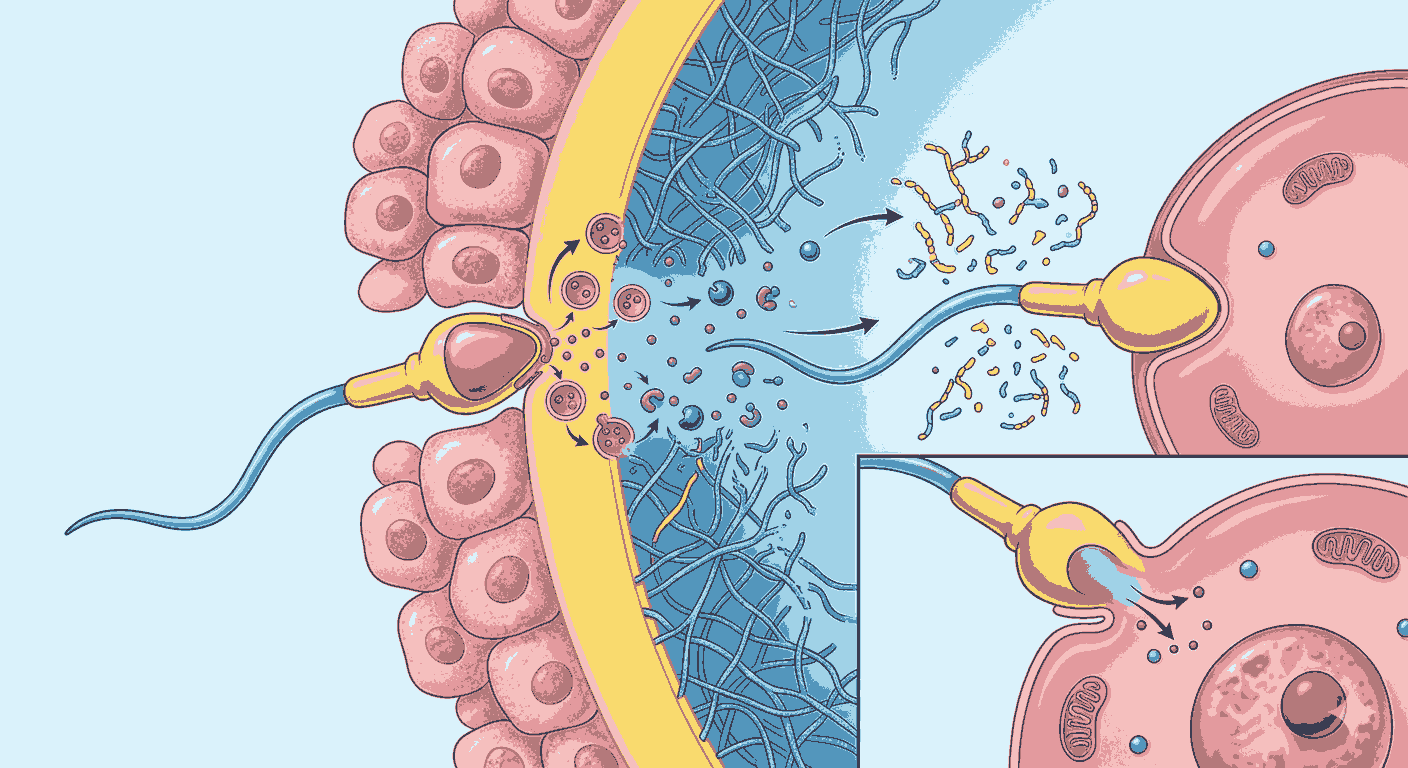
A key focus in Acrosome Enzyme Function MCQs Biology Class 12 is the enzymes contained within the acrosome. These include hyaluronidase, acrosin, and other hydrolytic enzymes. These enzymes are essential for breaking down the protective layers surrounding the ovum. Aspirants must remember this detail while solving Acrosome Enzyme Function MCQs Biology Class 12, as enzyme-related questions are very common.
During fertilization, the sperm undergoes a crucial event known as the acrosomal reaction. In Acrosome Enzyme Function MCQs Biology Class 12, this process is often highlighted as a key step in successful fertilization. When the sperm comes in contact with the zona pellucida of the ovum, the acrosome releases its enzymes. This allows the sperm to penetrate the outer layers of the egg, making this reaction central to Acrosome Enzyme Function MCQs Biology Class 12.
Another important aspect of Acrosome Enzyme Function MCQs Biology Class 12 is the role of hyaluronidase. This enzyme helps dissolve the matrix of follicular cells surrounding the ovum. Without this enzyme, sperm penetration would be extremely difficult. Therefore, questions related to enzyme function are frequently asked in Acrosome Enzyme Function MCQs Biology Class 12.
In addition to hyaluronidase, acrosin plays a major role in digesting the zona pellucida. Understanding this dual enzymatic action is critical for mastering Acrosome Enzyme Function MCQs Biology Class 12. Aspirants who clearly understand how these enzymes function can easily eliminate incorrect options in multiple-choice questions.
While preparing for Acrosome Enzyme Function MCQs Biology Class 12, aspirants should also focus on the structural relationship between the acrosome and nucleus. The acrosome sits just above the nucleus and works in coordination during fertilization. This structural arrangement is often tested in Acrosome Enzyme Function MCQs Biology Class 12, especially in diagram-based questions.
Another concept frequently asked in Acrosome Enzyme Function MCQs Biology Class 12 is the importance of the acrosomal reaction in species-specific fertilization. The enzymes ensure that only sperm of the same species can successfully fertilize the egg. This specificity is a key biological principle and is often included in Acrosome Enzyme Function MCQs Biology Class 12.
Aspirants should also understand that failure of acrosome function can lead to infertility. In Acrosome Enzyme Function MCQs Biology Class 12, such clinical correlations are sometimes included to test deeper understanding. If the acrosome does not release enzymes properly, sperm cannot penetrate the ovum, preventing fertilization.
Another important area in Acrosome Enzyme Function MCQs Biology Class 12 is the difference between acrosome and other sperm structures. While the tail is responsible for motility and the middle piece provides energy through mitochondria, the acrosome is specifically responsible for enzyme release. This functional differentiation is commonly asked in Acrosome Enzyme Function MCQs Biology Class 12.
In many exam questions related to Acrosome Enzyme Function MCQs Biology Class 12, aspirants are required to identify the correct enzyme or its function. These questions test both memory and conceptual clarity. Regular revision of enzyme roles can significantly improve performance in Acrosome Enzyme Function MCQs Biology Class 12.
Furthermore, Acrosome Enzyme Function MCQs Biology Class 12 often include sequence-based questions. For example, the rder of events from sperm contact to penetration of the ovum is a frequently tested concept. Understanding this sequence helps aspirants answer even tricky questions in Acrosome Enzyme Function MCQs Biology Class 12 with ease.
Acrosome Enzyme Function MCQs Biology Class 12:
1. Where does the vas deferens start from in the epididymis?
a) Cauda epididymis
b) Corpus epididymis
c) Caput epididymis
d) None of these options are correct
Answer: a
Explanation: The vas deferens begins from the cauda epididymis, which stores mature sperm.
2. What does the prostate gland secretion help in the formation of?
a) Larvae
b) Semen
c) Cocoon
d) Cartilage
Answer: b
Explanation: Prostate gland secretion contributes to semen formation.
3. What is the narrow passage connecting abdominal cavity with scrotal sacs?
a) Inguinal canal
b) Iter
c) Gubernaculum
d) Ejaculatory duct
Answer: a
Explanation: The inguinal canal connects the abdominal cavity to the scrotum.
4. Match the following glands
a) A-1 B-2 C-3 D-4
b) A-2 B-1 C-4 D-3
c) A-4 B-3 C-2 D-1
d) A-2 B-3 C-4 D-1
Answer: c
Explanation:
Seminal vesicles → alkaline fluid
Bartholin’s gland → lubrication
Prostate → acidic fluid
Bulbourethral → neutralizes urine
5. Tiny finger-like structure in female reproductive system
a) Vagina
b) Hymen
c) Mons pubis
d) Clitoris
Answer: d
Explanation: Clitoris is a sensitive erectile structure.
6.Match the components of human sperm correctly:
List-I
- Head
- Acrosome
- Middle piece
- Tail
List-II
p. Filled with enzymes
q. Contains mitochondria
r. Responsible for sperm motility
s. Contains haploid nucleus
Options:
a) 1–r, 2–q, 3–s, 4–p
b) 1–s, 2–p, 3–q, 4–r
c) 1–s, 2–r, 3–p, 4–q
d) 1–q, 2–s, 3–r, 4–p
Answer: b
Explanation:
- Head (1) contains the haploid nucleus → (s)
- Acrosome (2) is filled with enzymes → (p)
- Middle piece (3) contains mitochondria for energy → (q)
- Tail (4) helps in sperm motility → (r)
7. Human placenta is described as
a) Chorioallantoic
b) Haemochorial
c) Discoidal
d) Deciduate
Answer: b
Explanation: Maternal blood directly contacts fetal tissue.
8.Which of the following statements regarding oogenesis is correct?
Statement I: Primary follicles surrounded by multiple layers of granulosa cells, theca, and antrum are called secondary follicles.
Statement II: Graafian follicle ruptures during ovulation to release the secondary oocyte.
Options:
a) Both Statement I and Statement II are true
b) Both Statement I and Statement II are false
c) Statement I is correct but Statement II is false
d) Statement I is incorrect but Statement II is true
Answer: d
Explanation:
- Statement I is incorrect because follicles with multiple granulosa layers, theca, and antrum are called tertiary (Graafian) follicles, not secondary follicles.
- Statement II is correct because the Graafian follicle ruptures during ovulation, releasing the secondary oocyte.
9. Vas deferens and cervix statements
a) I incorrect, II correct
b) Both correct
c) Both incorrect
d) I correct only
Answer: b
Explanation: Both statements are biologically correct.
10. Mismatched pair
a) Corpus luteum – progesterone
b) Cowper’s gland – Prostaglandin
c) Acrosome – hyaluronidase
d) Placenta – hCG
Answer: b
Explanation: Cowper’s gland secretes mucus, not prostaglandins.
11. Closest part of fallopian tube to ovary
a) Isthmus
b) Infundibulum
c) Cervix
d) Ampulla
Answer: b
Explanation: Infundibulum with fimbriae collects ovum.
12. When is meiosis II completed in oocyte?
a) Copulation
b) After zygote
c) During fertilization
d) Before ovulation
Answer: c
Explanation: Completed after sperm entry.
13. Chromosome number in aleurone cells (2n = 42)
a) 21
b) 42
c) 63
d) 84
Answer: c
Explanation: Aleurone is triploid (3n = 63).
14. Correct diagram identification
a) Perimetrium, myometrium
b) Endometrium, fimbriae
c) Infundibulum, fimbriae, cervix
d) Funnel, uterus, cervix
Answer: c
Explanation: These are correctly identified parts.
15. Function of myometrium
a) Contractions during childbirth
b) Brain function
c) Heart contraction
d) Pain receptor
Answer: a
Explanation: Myometrium causes labor contractions.
16. Ovum movement blocked at ampulla
a) Isthmus → Infundibulum
b) Ovary → Ampulla
c) Isthmus → Uterus
d) Infundibulum → Isthmus
Answer: d
Explanation: Ovum cannot move forward.
17. Corpus luteum produces
a) Brain hormone
b) Progesterone
c) Heart enzyme
d) Skin receptor
Answer: b
Explanation: Maintains pregnancy.
18. NOT a function of vagina
a) Urine passage
b) Copulation
c) Birth canal
d) Menstrual flow
Answer: a
Explanation: Urine passes through urethra.
19. Odd one out
a) Infundibulum
b) Fimbriae
c) Isthmus
d) Labia minora
Answer: d
Explanation: External genital part.
20. Wrongly labelled part
a) Primary follicle
b) Ovum
c) Graafian follicle
d) Corpus luteum
Answer: c
Explanation: Mislabelled structure.
21. Corpus luteum develops from
a) Oocyte
b) Nephrostome
c) Graafian follicle
d) None
Answer: c
Explanation: After ovulation.
22. Meiotic arrest maintained by
a) Granulosa cells
b) Zona pellucida
c) Cumulus
d) Theca
Answer: a
Explanation: Granulosa cells maintain arrest.
23. Stretchable organ
a) Lungs
b) Stomach
c) Uterus
d) Eye
Answer: c
Explanation: Uterus expands during pregnancy.
24. Female secondary characters hormone
a) Relaxin
b) Progesterone
c) Estrogen
d) Gonadotropin
Answer: c
Explanation: Estrogen develops secondary traits.
25. Hormonal control correct combination
a) GnRH–TSH
b) GnRH–LH/FSH–Estrogen
c) GnRH–STH
d) GnRH–ACTH
Answer: b
Explanation: Standard hormonal pathway.
26. Endometrium lines
a) Bladder
b) Vagina
c) Uterus
d) Oviduct
Answer: c
Explanation: Inner uterine lining.
27. External genitalia includes
a) Clitoris
b) Vagina
c) Oviduct
d) Cervix
Answer: a
Explanation: External structure.
28. Discoverer of Graafian follicle
a) Fabricius
b) Hooke
c) Von Baer
d) De Graaf
Answer: d
Explanation: Named after De Graaf.
29. Graafian follicle contains
a) Theca externa
b) Granulosa
c) Theca interna
d) All
Answer: d
Explanation: All layers present.
30. Inner lining of uterus
a) Cervix
b) Oviduct
c) Endometrium
d) Fimbriae
Answer: c
Explanation: Endometrium prepares for implantation.
Acrosome Enzyme Function MCQs Biology Class 12
In conclusion, mastering Acrosome Enzyme Function MCQs Biology Class 12 requires a strong grasp of structure, enzyme function, and fertilization processes. Aspirants who focus on these core concepts and revise consistently will find Acrosome Enzyme Function MCQs Biology Class 12 much easier to solve. A thorough understanding not only boosts exam performance but also builds a solid foundation in human reproductive biology.