
- Keneitsino Lydia
- April 20, 2026
Master Sertoli Cells Location and Function MCQs With Answers for Class 12 Biology
Understanding human reproduction is essential for aspirants preparing for board exams and competitive tests, and one of the most important topics within this chapter is Sertoli Cells Location and Function MCQs With Answers for Class 12 Biology. This topic is frequently tested because it combines structure, function, and physiological importance in a concise yet concept-heavy manner. For aspirants aiming to master biology concepts, revising Sertoli Cells Location and Function MCQs With Answers for Class 12 Biology can significantly improve accuracy and confidence.
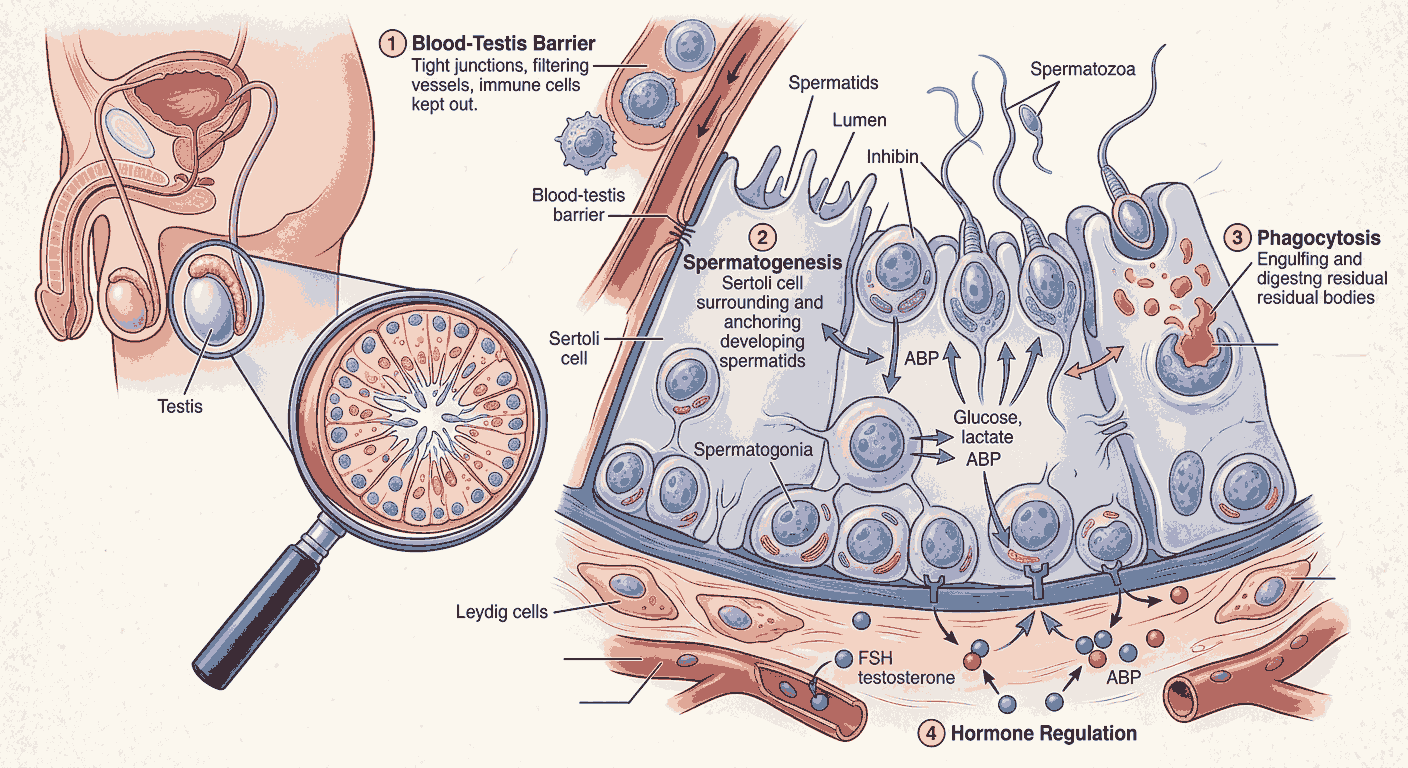
To begin with, Sertoli cells are specialized supporting cells found in the seminiferous tubules of the testes. These cells play a crucial role in spermatogenesis, making them a central concept in Sertoli Cells Location and Function MCQs With Answers for Class 12 Biology. Their strategic location within the seminiferous tubules allows them to directly interact with developing germ cells, ensuring proper nourishment and protection.
The phrase Sertoli Cells Location and Function MCQs With Answers for Class 12 Biology becomes highly relevant when discussing their primary function—supporting and nurturing spermatogenic cells. Sertoli cells provide essential nutrients and create a suitable microenvironment for sperm development. This nurturing role is often emphasized in exam-oriented questions related to Sertoli Cells Location and Function MCQs With Answers for Class 12 Biology.
Another key aspect covered under Sertoli Cells Location and Function MCQs With Answers for Class 12 Biology is the formation of the blood-testis barrier. Sertoli cells are connected by tight junctions, which create a protective barrier that prevents harmful substances from reaching developing sperms. This function is critical for maintaining the integrity of spermatogenesis and is a common conceptual question in Sertoli Cells Location and Function MCQs With Answers for Class 12 Biology.
In addition to providing structural and nutritional support, Sertoli cells also have an endocrine function. They secrete androgen-binding protein (ABP), which helps concentrate testosterone within the seminiferous tubules. This role is essential for the proper maturation of sperms and is frequently highlighted in Sertoli Cells Location and Function MCQs With Answers for Class 12 Biology.
Hormonal regulation is another important concept associated with Sertoli cells. Follicle-stimulating hormone (FSH) from the anterior pituitary gland stimulates Sertoli cells to carry out their functions effectively. This interaction between hormones and cells is a critical point of discussion in Sertoli Cells Location and Function MCQs With Answers for Class 12 Biology, especially in higher-order questions.
Moreover, Sertoli cells are involved in the process of phagocytosis. During spermatogenesis, many cells undergo degeneration, and Sertoli cells help remove these unwanted cell fragments. This cleaning function ensures a healthy environment for sperm development and is another frequently tested concept in Sertoli Cells Location and Function MCQs With Answers for Class 12 Biology.
The structural importance of Sertoli cells cannot be ignored. They extend from the basement membrane to the lumen of the seminiferous tubules, forming a supportive framework for developing sperms. This structural arrangement is often included in diagram-based questions in Sertoli Cells Location and Function MCQs With Answers for Class 12 Biology.
Aspirants should also note that Sertoli cells produce inhibin, a hormone that regulates FSH secretion through feedback mechanisms. This regulatory function ensures balanced sperm production and is an important detail in Sertoli Cells Location and Function MCQs With Answers for Class 12 Biology.
From an exam perspective, understanding both the location and multiple functions of Sertoli cells is crucial. Many questions are designed to test whether aspirants can distinguish between Sertoli cells and Leydig cells, which have entirely different roles. Such comparisons are commonly found in Sertoli Cells Location and Function MCQs With Answers for Class 12 Biology.
Consistency in revision plays a key role in mastering this topic. By repeatedly practicing concepts related to Sertoli Cells Location and Function MCQs With Answers for Class 12 Biology, aspirants can improve recall speed and reduce mistakes in exams. This topic may seem small, but it holds significant weight in scoring.
Sertoli Cells Location and Function MCQs With Answers for Class 12 Biology:
1. The Leydig cells as found in the human body are the secretory source of:
a) Glucagon
b) Androgens
c) Progesterone
d) Intestinal mucus
Answer: b
Explanation: Leydig (interstitial) cells present between seminiferous tubules secrete male sex hormones called androgens under LH control.
2. If vasa efferentia is blocked, gametes will not be transported from:
a) Vagina to uterus
b) Testes to epididymis
c) Epididymis to vas deferens
d) Ovary to uterus
Answer: b
Explanation: Vasa efferentia connect rete testis to epididymis, so blockage prevents sperm movement from testes to epididymis.
3. Which forms axial filament of human sperm?
a) Mitochondria
b) Proximal centriole
c) Distal centriole
d) Golgi body
Answer: c
Explanation: Distal centriole forms the axial filament (tail structure), responsible for sperm movement.
4. The four parts of sperm are:
a) Head, neck, body, tail
b) Head, nucleus, acrosome, tail
c) Centrioles, mitochondria, nucleus, acrosome
d) Axial filament, mitochondria, nucleus, acrosome
Answer: a
Explanation: A sperm consists of head (nucleus + acrosome), neck, middle piece (body), and tail.
5. Function of distal centriole is:
a) Forms axial filament
b) Provides energy
c) Contains nucleus
d) Helps cell division
Answer: a
Explanation: Distal centriole initiates formation of sperm tail (axial filament).
6. Energy for sperm movement is provided by:
a) Mitochondria
b) Golgi body
c) Centrioles
d) Nucleus
Answer: a
Explanation: Mitochondria in middle piece supply ATP for motility.
7. Function of Golgi body is:
a) Energy production
b) Axial filament formation
c) Protein processing
d) Cell division
Answer: c
Explanation: Golgi modifies and packages proteins from ER.
8. Sertoli cells function is:
a) Egg maturation
b) Sperm maturation
c) Enzyme production
d) Ovulation
Answer: b
Explanation: Sertoli cells nourish and support developing sperms.
9. Match the following:
Column I
A. Accessory duct
B. Accessory glands
C. Spermatids
D. Primary spermatocytes
Column II
- 23 chromosomes
- 46 chromosomes
- Seminal vesicles
- Vas deferens
Options:
a) A-4,3 B-5 C-2 D-1
b) A-4,5 B-2 C-1 D-3
c) A-2,1 B-3 C-5 D-4
d) A-4 B-3 C-1 D-2
Answer: d
Explanation:
Accessory duct → Vas deferens
Accessory glands → Seminal vesicles
Spermatids → Haploid (23)
Primary spermatocytes → Diploid (46)
10. Caput epididymis lies between:
a) Vasa efferentia & corpus epididymis
b) Rete testis & vasa efferentia
c) Vasa efferentia & rete testis
d) Cauda epididymis & vas deferens
Answer: a
Explanation: Caput is the head region connecting vasa efferentia to corpus.
11. Antifertilizin is present in:
a) Egg
b) Tail
c) Ovum
d) Spermatozoa
Answer: d
Explanation: Present on sperm surface, helps in recognition with egg.
12. Testes are outside abdomen to:
a) Maintain low temperature
b) Store sperm
c) Hormone regulation
d) Release sperm
Answer: a
Explanation: Spermatogenesis requires temperature lower than body temperature.
13. Stereocilia occur in:
a) Trachea
b) Stomach
c) Pharynx
d) Epididymis
Answer: d
Explanation: Help absorption and maturation of sperm.
14. Sertoli cells are found:
a) Between seminiferous tubules
b) Ovary
c) Fallopian tube
d) Inside seminiferous tubules
Answer: d
Explanation: Present inside seminiferous tubules supporting spermatogenesis.
15. Sertoli cells are:
a) In cortex
b) In medulla
c) In corpus luteum
d) In seminiferous tubules
Answer: d
Explanation: Located in seminiferous tubules along germ cells.
16. Sperm pathway in rabbit:
a) Rete testis → Vasa efferentia → Epididymis → Vas deferens
b) Wrong
c) Wrong
d) Wrong
Answer: a
Explanation: Correct anatomical sequence.
17. Membrane follicle is found in:
a) Cortex
b) Medulla
c) Corpus luteum
d) Graafian follicle
Answer: d
Explanation: Membrane follicle is part of Graafian follicle.
18. Mammalian testes contain:
a) Graafian follicles
b) Sertoli + seminiferous tubules
c) Sertoli + seminiferous tubules + Leydig
d) Graafian + Leydig
Answer: c
Explanation: All three structures are present.
19. Azoospermia treatment:
a) IVF
b) AI donor
c) AI homologous
d) GIFT
Answer: b
Explanation: Donor sperm is used.
20. Testis is characterized by:
a) Only proliferative cells
b) Tight junction compartmentalization
c) Few capillaries
d) Many capillaries
Answer: b
Explanation: Tight junctions form blood-testis barrier.
21. Orchidectomy is removal of:
a) Testes
b) Spleen
c) Ovaries
d) Liver
Answer: a
Explanation: Orchidectomy = surgical removal of testes.
22. Capacitation involves:
a) Size change
b) Acrosome reaction
c) Chromatin change
d) Mitochondrial alignment
Answer: b
Explanation: Capacitation prepares sperm for fertilization via acrosome reaction.
23. Bulbourethral gland is also called:
a) Lacrimal gland
b) Prostate gland
c) Cowper’s gland
d) Pineal gland
Answer: c
Explanation: Bulbourethral gland = Cowper’s gland.
24. Testes descend into scrotum for:
a) Organ development
b) Spermatogenesis
c) Fertilization
d) Hormone secretion
Answer: b
Explanation: Lower temperature is essential for sperm production.
25. Role of Sertoli cells:
a) Excretion
b) Nutrition of sperms
c) Respiration
d) All
Answer: b
Explanation: Sertoli cells nourish and support sperms.
26. Layers of testis (inner → outer):
a) Vaginalis → Albuginea → Vascularis
b) Vascularis → Albuginea → Vaginalis
c) Vaginalis → Vascularis → Albuginea
d) Albuginea → Vascularis → Vaginalis
Answer: b
Explanation: Inner: tunica vascularis → tunica albuginea → tunica vaginalis.
27. Fructose in semen is secreted by:
a) Seminal vesicles
b) Testis
c) Prostate
d) Cowper’s gland
Answer: a
Explanation: Seminal vesicles provide fructose for sperm energy.
28. Spermatids become spermatozoa by:
a) Spermatogenesis
b) Spermiogenesis
c) Meiosis
d) Spermiation
Answer: b
Explanation: Spermiogenesis = maturation of spermatids.
29. Androgen binding protein is produced by:
a) Leydig cells
b) Sertoli cells
c) Graafian cells
d) Corpus luteum
Answer: b
Explanation: Sertoli cells produce ABP to concentrate testosterone.
30. Failure of testis descent is:
a) Paedogenesis
b) Impotency
c) Cryptorchidism
d) Castration
Answer: c
Explanation: Cryptorchidism = undescended testes.
Conclusion on Sertoli Cells Location and Function MCQs With Answers for Class 12 Biology
In conclusion, the topic Sertoli Cells Location and Function MCQs With Answers for Class 12 Biology is fundamental for understanding male reproductive physiology. It combines structural, functional, and hormonal aspects, making it highly relevant for exams. With proper understanding and regular revision, aspirants can easily master Sertoli Cells Location and Function MCQs With Answers for Class 12 Biology and enhance their overall biology preparation.