
- Keneitsino Lydia
- April 7, 2026
Don’t Miss These 30 Free Radical Polymerization MCQs Practice Set with Answers – Avoid Costly Exam Mistakes
Free Radical Polymerization MCQs Practice Set with Answers is an essential resource for aspirants preparing for competitive exams and board-level chemistry assessments. Understanding polymerization mechanisms becomes much easier when learners repeatedly engage with Free Radical Polymerization MCQs Practice Set with Answers, as it helps reinforce both theoretical concepts and practical applications. Many aspirants rely on Free Radical Polymerization MCQs Practice Set with Answers to strengthen their problem-solving skills and improve accuracy.
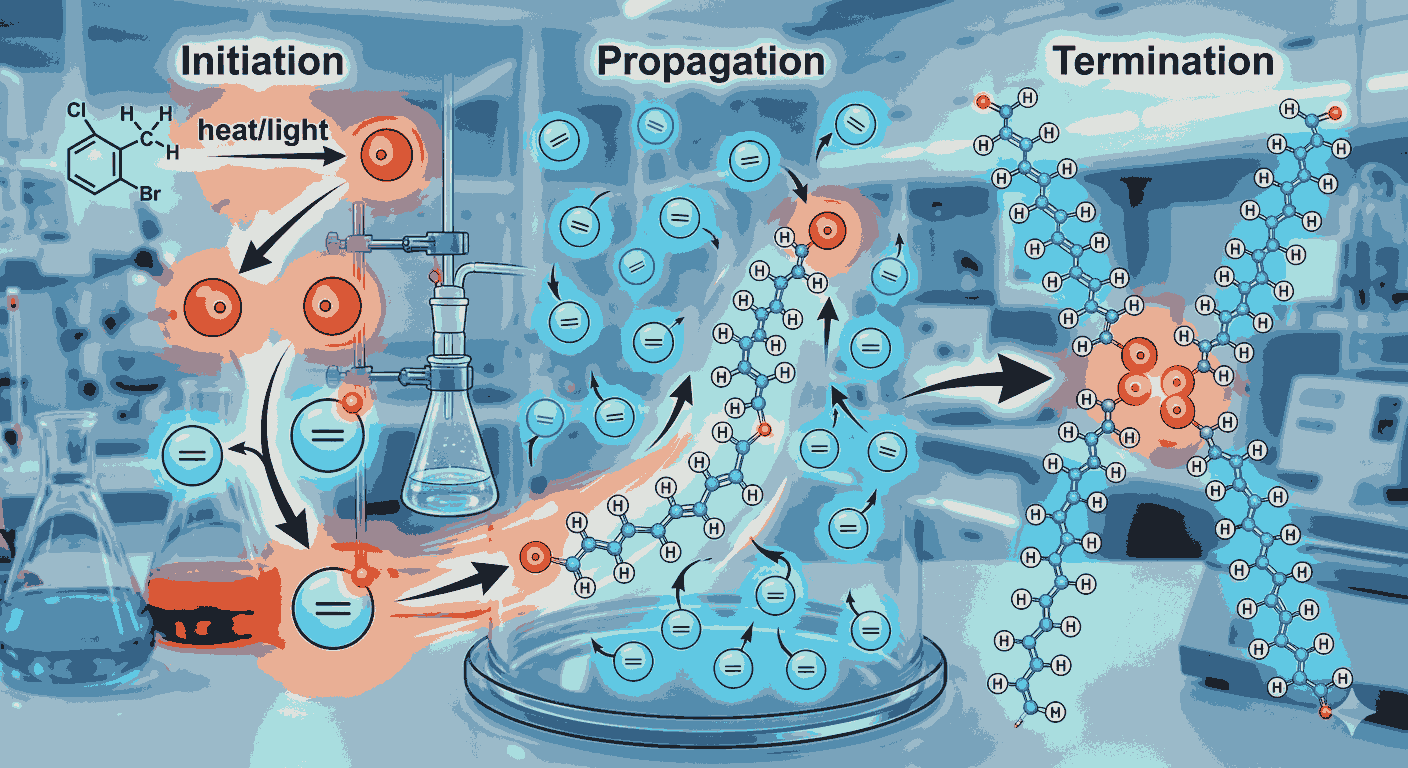
When studying polymer chemistry, Free Radical Polymerization MCQs Practice Set with Answers plays a crucial role in building conceptual clarity. Free radical polymerization involves three major steps: initiation, propagation, and termination. By practicing Free Radical Polymerization MCQs Practice Set with Answers, aspirants can clearly distinguish between these stages and understand how radicals are formed and consumed during the reaction. This repeated exposure through Free Radical Polymerization MCQs Practice Set with Answers ensures better retention of the mechanism.
Another important benefit of using Free Radical Polymerization MCQs Practice Set with Answers is that it helps aspirants identify common mistakes. Often, learners confuse chain-growth polymerization with condensation polymerization. However, consistent practice with Free Radical Polymerization MCQs Practice Set with Answers enables them to differentiate these concepts easily. In fact, Free Radical Polymerization MCQs Practice Set with Answers provides multiple perspectives on the same concept, making learning more comprehensive.
Time management is another area where Free Radical Polymerization MCQs Practice Set with Answers proves highly effective. In exams like NEET and JEE, speed and accuracy are equally important. Regular practice using Free Radical Polymerization MCQs Practice Set with Answers helps aspirants develop the ability to solve questions quickly without compromising accuracy. This is why many toppers recommend practicing Free Radical Polymerization MCQs Practice Set with Answers daily.
Additionally, Free Radical Polymerization MCQs Practice Set with Answers enhances analytical thinking. Instead of memorizing reactions, aspirants learn to analyze reaction conditions, catalysts, and intermediates. Free Radical Polymerization MCQs Practice Set with Answers encourages learners to think logically about how free radicals behave under different conditions. This analytical approach, developed through Free Radical Polymerization MCQs Practice Set with Answers, is extremely valuable in advanced chemistry studies.
Moreover, Free Radical Polymerization MCQs Practice Set with Answers is useful for revision purposes. Before exams, aspirants often look for quick and effective ways to revise important topics. Free Radical Polymerization MCQs Practice Set with Answers provides a compact yet comprehensive way to revisit key concepts. By solving Free Radical Polymerization MCQs Practice Set with Answers, aspirants can quickly identify weak areas and focus on improvement.
Another advantage of Free Radical Polymerization MCQs Practice Set with Answers is that it covers a wide range of question patterns. From conceptual questions to application-based problems, Free Radical Polymerization MCQs Practice Set with Answers prepares aspirants for all possible variations. This diversity in questions ensures that aspirants are well-prepared for any exam scenario, making Free Radical Polymerization MCQs Practice Set with Answers a reliable study tool.
Furthermore, Free Radical Polymerization MCQs Practice Set with Answers helps in understanding the role of initiators like benzoyl peroxide and AIBN. By practicing Free Radical Polymerization MCQs Practice Set with Answers, aspirants become familiar with how these initiators generate free radicals and start the polymerization process. This detailed understanding gained through Free Radical Polymerization MCQs Practice Set with Answers is essential for mastering polymer chemistry.
Consistency is key when it comes to exam preparation, and Free Radical Polymerization MCQs Practice Set with Answers supports this approach. Daily practice using Free Radical Polymerization MCQs Practice Set with Answers builds confidence and reduces exam anxiety. Aspirants who regularly solve Free Radical Polymerization MCQs Practice Set with Answers tend to perform better because they are already familiar with the question patterns.
Free Radical Polymerization MCQs Practice Set with Answers:
1. The polymer which is used in non-sticky kitchenware is
A. PVC
B. Teflon
C. Rayon
D. Isoprene
Answer: B
2. Terylene polymer is obtained by condensation of
A. Ethane-1,2-diol and Benzene-1,3-dicarboxylic acid
B. Propane-1,2-diol and Benzene-1,4-dicarboxylic acid
C. Ethane-1,2-diol and Benzene-1,4-dicarboxylic acid
D. Ethane-1,2-diol and Benzene-1,2-dicarboxylic acid
Answer: C
3. Match List I with List II
A → II (Phenol formaldehyde resin → Novolac)
B → III (Butadiene + styrene → Buna-S)
C → I (Polyester glycol + phthalic acid → Glyptal)
D → IV (Polyester glycol + terephthalic acid → Dacron)
Answer: A-II, B-III, C-I, D-IV
4. Vulcanization of rubber is carried out by heating a mixture of
A. Isoprene and styrene
B. Neoprene and sulphur
C. Isoprene and sulphur
D. Neoprene and styrene
Answer: C
5. The polymer manufactured by condensation polymerization is
A. Polyethylene
B. Polystyrene
C. Polypropylene
D. Polyvinyl chloride
Answer: A
6. The rearrangement used in Nylon-6 preparation is
A. Wolff rearrangement
B. Hofmann rearrangement
C. Curtius rearrangement
D. Beckmann rearrangement
Answer: D
7. Which of the following is called a polyamide?
A. Rayon
B. Nylon
C. Terylene
D. Orlon
Answer: B
8. The polymer obtained with methylene bridges is
A. PVC
B. Buna-S
C. Polyacrylonitrile
D. Bakelite
Answer: D
9. Polymer formed using caprolactam is
A. Nylon-6,6
B. Nylon-2-nylon-6
C. Melamine polymer
D. Nylon-6
Answer: D
10. Example of chain-growth polymer is
A. Bakelite
B. Teflon
C. Nylon
D. Terylene
Answer: B
11. Which is not a semi-synthetic polymer?
A. Cis-polyisoprene
B. Cellulose nitrate
C. Cellulose acetate
D. Vulcanised rubber
Answer: A
12. Assertion-Reason (Vulcanisation)
Answer: B
13. Nylon-66 is made from
A. HOOC(CH₂)₄COOH + H₂N(CH₂)₆NH₂
B. CH₂=CH-C(CH)=CH₂
C. CH₂=CH₂
D. None
Answer: A
14. Chain transfer reagent is
A. CCl₄
B. CH₄
C. O₂
D. H₂
Answer: A
15. Polymer with low degree of polymerization is
A. Higher polymer
B. Oligomer
C. Macromolecule
D. Copolymer
Answer: B
16. Conversion in free radical polymerization increases with
A. Temperature
B. Time
C. Monomer concentration
D. All of these
Answer: D
17. Buna-N is a copolymer of
A. Butadiene + styrene
B. Butadiene + acrylonitrile
C. Adipic acid + diamine
D. Ethylene glycol + terephthalic acid
Answer: B
18. PHBV is formed by
A. 3-hydroxybutanoic acid + 3-hydroxypentanoic acid
B. Only butanoic acid
C. Only pentanoic acid
D. Glycolic + lactic acid
Answer: A
19. Caprolactam gives
A. Nylon-6
B. Nylon-6,6
C. Nylon-60
D. Nylon-6,10
Answer: A
20. Synthetic wigs polymer is
A. PVC
B. PAN
C. Cellulose
D. Dynel
Answer: D
21. Not a chain growth polymer
A. Neoprene
B. Buna-S
C. PMMA
D. Glyptal
Answer: D
22. Dimethyl terephthalate + ethylene glycol gives
A. Nylon-6
B. Nylon-66
C. Dacron
D. Neoprene
Answer: C
23. Ziegler catalyst is
A. Titanium oxide
B. Titanium isopropoxide
C. TiCl₄ + Al(C₂H₅)₃
D. Lithium compound
Answer: C
24. Bakelite is formed from
A. Acetaldehyde
B. Acetal
C. Formaldehyde
D. Chlorobenzene
Answer: C
25. Terylene is made from
A. Benzoic acid
B. Phthalic acid
C. Salicylic acid
D. Terephthalic acid
Answer: D
26. Monomer of neoprene
A. CF₂=CF₂
B. CH₂=CHCl
C. CCl₂=CCl₂
D. Chloroprene
Answer: D
27. Polyethylene from 64.1 kg CaC₂ is
A. 7 kg
B. 14 kg
C. 21 kg
D. 28 kg
Answer: D
28. CF₂=CF₂ polymerization gives
A. PMMA
B. PAN
C. PVC
D. None
Answer: D
29. Another monomer giving neoprene
A. CH₂=CHCl
B. CCl₂=CCl₂
C. Chloroprene structure
D. CF₂=CF₂
Answer: C
30. Which is a biopolymer?
A. Dexton
B. PCTFE
C. Nylon-6,6
D. Neoprene
Answer: A
Conclusion on Free Radical Polymerization MCQs Practice Set with Answers
In conclusion, Free Radical Polymerization MCQs Practice Set with Answers is an indispensable tool for mastering polymer chemistry. It not only strengthens conceptual understanding but also improves speed, accuracy, and analytical thinking. By consistently practicing Free Radical Polymerization MCQs Practice Set with Answers, students can achieve better results and gain confidence in tackling complex chemistry problems.