
- Keneitsino Lydia
- March 23, 2026
30 Power-Packed Reaction Mechanism MCQs with Detailed Solutions for NEET, JEE and CUET
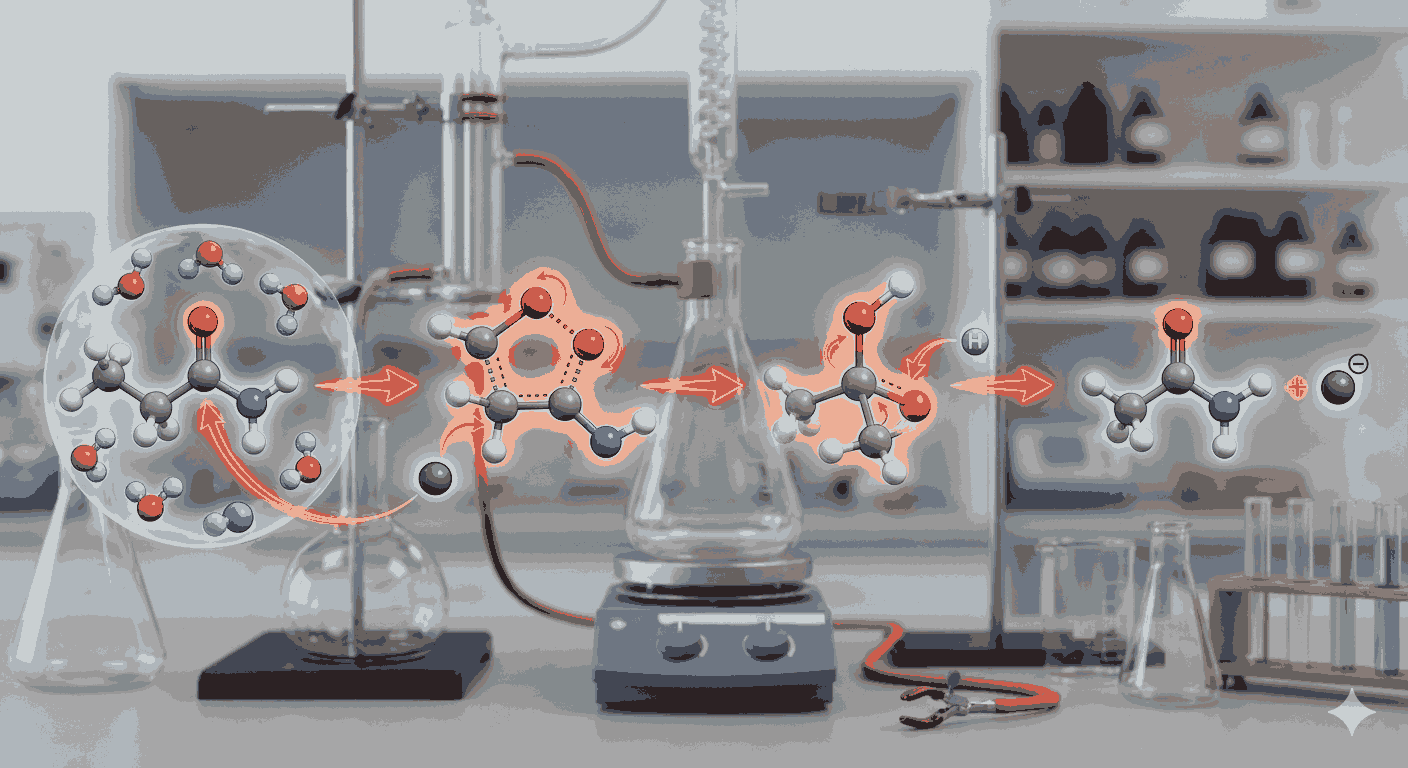
Reaction mechanisms form the backbone of organic chemistry and are extremely important for competitive exams like NEET, JEE, and CUET. Understanding how reactions proceed step by step allows aspirants to predict products, identify intermediates, and solve complex problems with confidence. One of the most effective ways to master this topic is through consistent practice of Reaction mechanism MCQs with detailed solutions for NEET, JEE and CUET, which helps in strengthening both conceptual clarity and analytical skills.
Organic chemistry is not about memorizing reactions; it is about understanding electron movement, bond formation, and bond breaking. By solving Reaction mechanism MCQs with detailed solutions for NEET, JEE and CUET,aspirants can visualize how nucleophiles and electrophiles interact during a reaction. This understanding is essential for topics like substitution, addition, elimination, and rearrangement reactions.
One of the key advantages of practicing Reaction mechanism MCQs with detailed solutions for NEET, JEE and CUET is that it helps aspirants understand reaction pathways in a structured way. Mechanisms such as SN1, SN2, E1, and E2 reactions are frequently tested, and these questions help learners differentiate between them based on factors like substrate structure, solvent, and reaction conditions.
Another important aspect of organic chemistry is electrophilic and nucleophilic reactions. Practicing Reaction mechanism MCQs with detailed solutions for NEET, JEE and CUET enables aspirants to identify the role of different reagents and predict the outcome of reactions accurately. This is particularly useful in understanding reactions of alkenes, alkynes, and aromatic compounds.
Carbocation stability is another crucial concept that influences reaction mechanisms. Rearrangements such as hydride shifts and methyl shifts often occur to form more stable intermediates. By solving Reaction mechanism MCQs with detailed solutions for NEET, JEE and CUET, aspirants can learn how these rearrangements take place and how they affect the final product.
In addition, reaction mechanisms involving functional groups like alcohols, aldehydes, ketones, and amines are commonly asked in exams. Practicing these MCQs helps aspirants understand how these functional groups behave under different conditions and how they can be transformed into other compounds.
Another major benefit of these MCQs is that they improve problem-solving speed. With regular practice, students develop the ability to quickly analyze a reaction and choose the correct answer without confusion. This is extremely important in time-bound exams.
Furthermore, it provide detailed explanations that help aspirants learn from their mistakes. Instead of just knowing the correct answer, learners understand why a particular option is correct and why others are incorrect. This leads to better retention of concepts.
Revision becomes much more effective with these mcqs, as aspirants can quickly go through important mechanisms and reinforce their understanding. This approach saves time and makes revision more engaging.
Another advantage of Reaction mechanism MCQs with detailed solutions for NEET, JEE and CUET is that they expose aspirants to a wide variety of question patterns, including assertion-reason and case-based questions. This ensures that aspirant are fully prepared for all types of questions that may appear in exams.
Consistency is key to mastering reaction mechanisms. Regular practice of Reaction mechanism MCQs with detailed solutions for NEET, JEE and CUET helps aspirants build confidence and improve accuracy over time. It also helps in identifying weak areas and focusing on topics that require more attention.
Moreover, Reaction mechanism MCQs with detailed solutions for NEET, JEE and CUET encourage logical thinking and application-based learning. Students learn to analyze reactions step by step and apply concepts rather than relying on memorization.
Reaction Mechanism MCQs with Detailed Solutions for NEET, JEE and CUET:
1. Aniline is prepared using Fe/HCl from:
a) Benzene
b) Nitrobenzene
c) Dinitrobenzene
d) None of these
Answer: b
2. Secondary nitroalkanes can be converted into ketones using:
a) Aqueous HCl
b) Aqueous NaOH
c) KMnO₄
d) CO
Answer: a
3. Alkyl cyanides on Stephen reduction give:
a) Aldehyde
b) Secondary amine
c) Primary amine
d) Amide
Answer: a
4. Hydrolysis of acetamide gives:
a) Acetic acid
b) Ethyl amine
c) Ethanol
d) Acetamide
Answer: a
5. Identify compound C:
a) CH₃CH₂CH=NNHCONH₂
b) [Image]
c) [Image]
d) None of these
Answer: a
6. The reaction ROOCH + N₃H → RNH₂ is called:
a) Lossen reaction
b) Curtius reaction
c) Schmidt reaction
d) Ullmann reaction
Answer: c
7. On reduction with LiAlH₄, which gives secondary amine?
a) Methyl isocyanide
b) Acetamide
c) Methyl cyanide
d) Nitroethane
Answer: a
8. Aniline is prepared using Fe/HCl from:
a) Benzene
b) Nitrobenzene
c) Dinitrobenzene
d) None
Answer: b
9. Product formed from hydroxylamine + carbonyl compound is:
a) Hydrazide
b) Oxime
c) Hydrazine
d) Hydrazone
Answer: b
10. Alkyl halide + alcoholic NH₃ gives:
a) Primary amine
b) Secondary amine
c) Tertiary amine
d) Mixture of all
Answer: d
11. Zwitter ion is formed by:
a) Aniline
b) Acetanilide
c) Benzoic acid
d) Glycine
Answer: d
12. Which dissolves in alkali after Hinsberg reaction?
a) CH₃NH₂
b) (C₂H₅)₂NH
c) (CH₃)₃N
d) None
Answer: a
13. Isopropyl amine + excess acetyl chloride gives:
a) (CH₃CO)₂N–CH(CH₃)₂
b) [Image]
c) (CH₃)₂CHN(COCH₃)₂
d) [Image]
Answer: c
14. Strongest base in aqueous solution:
a) Trimethylamine
b) Aniline
c) Dimethylamine
d) Methylamine
Answer: c
15. Reduction of alkyl nitrites gives:
a) Secondary amine
b) Primary amine
c) Tertiary amine
d) Amide
Answer: b
16. Amides are formed from acid chloride +:
a) NH₂NH₂
b) NH₃
c) NH₂OH
d) C₆H₅NHNH₂
Answer: b
17. C₃H₉N cannot represent:
a) 1° amine
b) 2° amine
c) 3° amine
d) Quaternary salt
Answer: d
18. Correct statement about metal nitrates:
a) All insoluble
b) Depends on temp
c) All soluble
d) Soluble in alcohol
Answer: c
19. Benzene nitrile obtained by dehydration of:
a) Benzoic acid
b) Benzamide
c) Benzophenone
d) Benzoyl chloride
Answer: b
20. Acetylation of aniline gives:
a) Paracetamol
b) N-acetyl aniline
c) o-amino acetophenone
d) p-amino acetophenone
Answer: b
21. Sulphur used in vulcanization of rubber:
a) 5%
b) 3%
c) 30%
d) 55%
Answer: a
22. Which will NOT give N₂ with HNO₂?
a) (CH₃)₂CHNH₂
b) CH₃NH₂
c) C₂H₅NH₂
d) All give N₂
Answer: d
23. Compound Y is:
a) Propanamine
b) N-methylpropanamine
c) N-ethylpropanamine
d) Propanamide
Answer: b
24. Carbylamine reaction is given by:
a) Primary amine
b) Secondary amine
c) Tertiary amine
d) Quaternary salt
Answer: a
25. Correct order of basic strength:
a) (CH₃)₂NH > CH₃NH₂ > (CH₃)₃N
b) (CH₃)₂NH > (CH₃)₃N > CH₃NH₂
c) CH₃NH₂ > (CH₃)₂NH > (CH₃)₃N
d) None
Answer: a
26. Boiling benzene diazonium chloride gives:
a) C₆H₅CH₂OH
b) C₆H₅N₂
c) C₆H₅COOH
d) C₆H₅OH
Answer: d
27. Acetamide + NaOBr gives:
a) Ethanamine
b) Methanamide
c) Methanamine
d) Ethanitrile
Answer: c
28. Amine not liberating nitrogen with HNO₂:
a) Trimethylamine
b) Ethylamine
c) sec-butylamine
d) Isopropylamine
Answer: a
29. Y in reaction C₂H₅Br → AgCN → X → reduction is:
a) n-propylamine
b) Isopropylamine
c) Ethylamine
d) Ethylmethylamine
Answer: d
30. Ethylamine on acetylation gives:
a) N-ethyl acetamide
b) Acetamide
c) Methyl acetamide
d) None
Answer: a
Conclusion on Reaction Mechanism MCQs with Detailed Solutions for NEET, JEE and CUET
In conclusion, mastering organic chemistry mechanisms requires a combination of understanding and practice. Reaction mechanism MCQs with detailed solutions for NEET, JEE and CUET serve as an excellent resource for achieving this goal. By regularly practicing Reaction mechanism MCQs with detailed solutions for NEET, JEE and CUET, aspirants can enhance their conceptual understanding, improve their problem-solving skills, and perform exceptionally well in competitive exams.