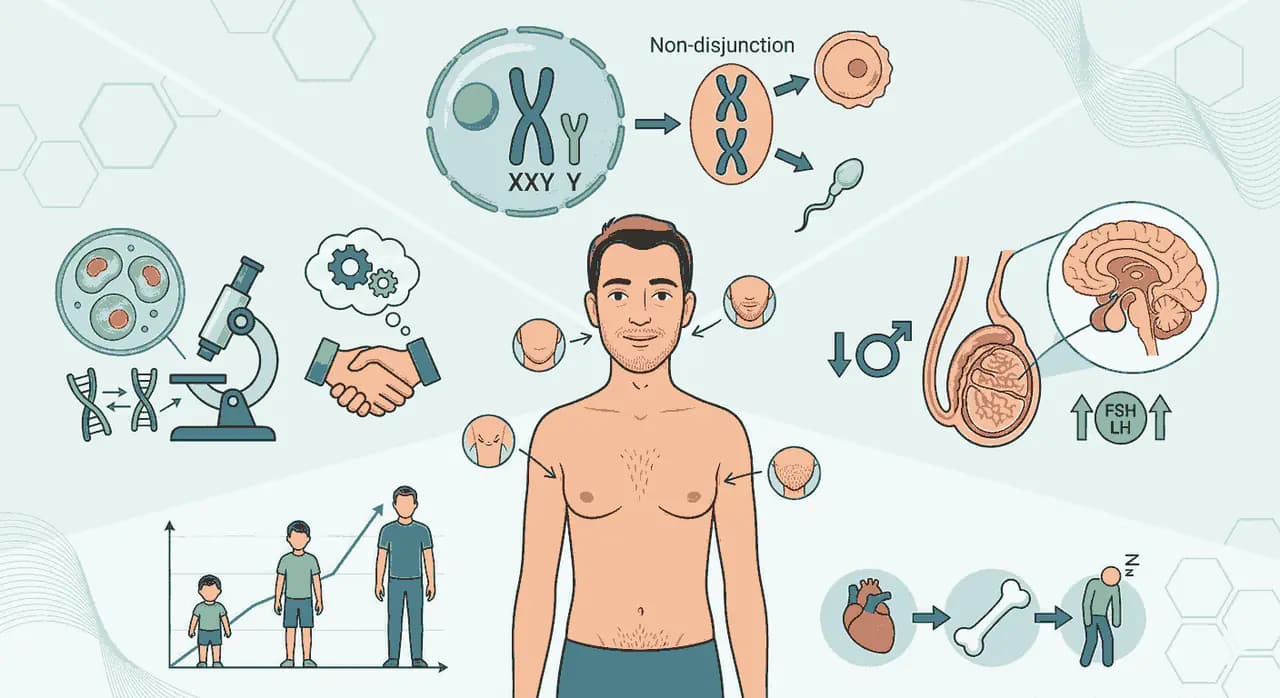
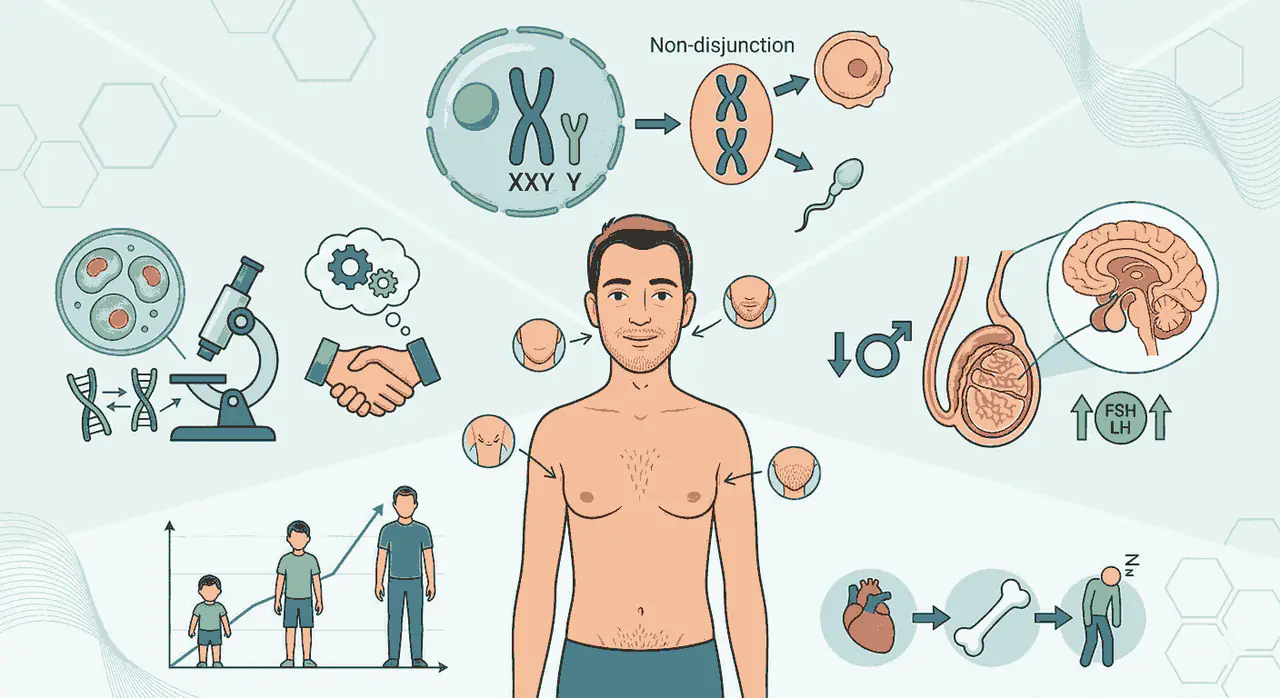
Klinefelter syndrome is one of the most important chromosomal disorders discussed in human genetics, and Klinefelter Syndrome MCQs Class 12 Biology help aspirants understand this topic in a simple and exam-oriented way. In Class 12 Biology, chromosomal abnormalities are an essential part of genetics, and practicing Klinefelter Syndrome MCQs Class 12 Biology improves conceptual understanding as well as problem-solving ability. Since this disorder is frequently asked in board exams and NEET examinations, aspirants should regularly revise Klinefelter Syndrome MCQs Class 12 Biology to strengthen their preparation.
The condition explained through Klinefelter Syndrome MCQs Class 12 Biology occurs due to the presence of an extra X chromosome in males, resulting in the chromosomal composition XXY. This additional chromosome affects physical and reproductive development in males. By solving Klinefelter Syndrome MCQs Class 12 Biology, students can easily remember the chromosomal formula and associated symptoms. The topic becomes easier when learners repeatedly practice Klinefelter Syndrome MCQs Class 12 Biology alongside NCERT concepts.
Another major advantage of studying Klinefelter Syndrome MCQs Class 12 Biology is that aspirants become familiar with terms like aneuploidy, Barr body, chromosomal mutation, and sex chromosome abnormalities. These concepts are interconnected in genetics, and regular revision using Klinefelter Syndrome MCQs Class 12 Biology helps students avoid confusion during examinations. Many biology questions combine different genetic disorders together, so solving Klinefelter Syndrome MCQs Class 12 Biology improves comparative understanding as well.
The topic of Klinefelter Syndrome MCQs Class 12 Biology is also important because it connects cytogenetics with human health. Aspirants learn how abnormalities in chromosome number can lead to developmental changes and infertility. Through continuous practice of Klinefelter Syndrome MCQs Class 12 Biology, aspirants understand how genetic imbalance affects hormone production and secondary sexual characteristics. Such understanding is valuable for both school-level and competitive examinations.
Aspirants often find human genetics difficult because of the large number of disorders and chromosomal combinations involved. However, practicing Klinefelter Syndrome MCQs Class 12 Biology repeatedly helps simplify these ideas. Questions related to XXY chromosomes, Barr bodies, and male infertility become much easier after regular exposure to Klinefelter Syndrome MCQs Class 12 Biology. This also improves retention and confidence while solving biology MCQs under time pressure.
Another important reason to study Klinefelter Syndrome MCQs Class 12 Biology is their relevance in medical entrance exams. NEET and other competitive examinations frequently include conceptual questions about chromosomal disorders. Aspirants who consistently revise Klinefelter Syndrome MCQs Class 12 Biology develop faster recall and stronger analytical skills. This ultimately improves exam performance and accuracy in genetics-based questions.
The chapter involving Klinefelter Syndrome MCQs Class 12 Biology also introduces aspirants to the broader concept of sex determination and sex-linked inheritance. By understanding how chromosomal imbalance occurs, students gain deeper knowledge of meiosis and nondisjunction. Practicing Klinefelter Syndrome MCQs Class 12 Biology therefore strengthens the overall foundation of genetics and inheritance patterns.
One of the best strategies for mastering human genetics is repeated revision. Solving Klinefelter Syndrome MCQs Class 12 Biology regularly allows aspirants to identify weak areas and improve conceptual clarity. These questions not only test memory but also evaluate understanding of chromosomal abnormalities and inheritance mechanisms. Continuous practice of Klinefelter Syndrome MCQs Class 12 Biology therefore supports long-term learning and better academic performance.
Furthermore, Klinefelter Syndrome MCQs Class 12 Biology help aspirants understand the importance of chromosome analysis in modern medicine. Scientists and doctors use chromosome studies to diagnose genetic disorders accurately. Through Klinefelter Syndrome MCQs Class 12 Biology, aspirants realize how biological concepts are applied in real-life medical diagnosis and treatment.
Klinefelter Syndrome MCQs Class 12 Biology:
1. If both parents are carriers for thalassemia, an autosomal recessive disorder, what are the chances of pregnancy resulting in an affected child?
A. 100%
B. No chance
C. 50%
D. 25%
Answer: D. 25%
Explanation: Thalassemia is an autosomal recessive disease, and if both parents are carriers, there is a 25% chance of the pregnancy resulting in an affected child.
2. If a diploid cell is treated with colchicine, what does it become?
A. Triploid
B. Tetraploid
C. Diploid
D. Monoploid
Answer: B. Tetraploid
Explanation: When a diploid cell is treated with colchicine, it becomes tetraploid as colchicine is commonly used to develop polyploid plants.
3. If a normal man and a normal woman, both having one albino parent, get married, what is the probability of their child being albino?
A. 20%
B. 25%
C. 75%
D. 80%
Answer: B. 25%
Explanation: If a normal man and a normal woman, both having one albino parent, get married, there is a 25% probability of their child being albino.
4. Of a normal couple, half the sons are haemophiliac while half the daughters are carriers. Where is the gene located?
A. X-chromosome of father
B. Y-chromosome of father
C. One X-chromosome of mother
D. Both the X-chromosomes of mother
Answer: C. One X-chromosome of mother
Explanation: The gene responsible for haemophilia is located on one X-chromosome of the mother, explaining why half the sons are haemophiliac and half the daughters are carriers.
5. If a color-blind mother and a normal father have children, what would be the outcome?
A. Color-blind sons and normal/carrier daughters
B. Color-blind sons and daughters
C. All color-blind
D. All normal
Answer: A. Color-blind sons and normal/carrier daughters
Explanation: A color-blind mother and normal father would have color-blind sons and normal/carrier daughters.
6. What are the chances (%) that a daughter inherits hypertrichosis if Kartarsingh has the trait?
A. 75
B. 100
C. 0
D. 50
Answer: C. 0
Explanation: Hypertrichosis is due to holandric genes on the Y-chromosome, so it is not expressed in females, making the chance of a daughter inheriting the trait 0%.
7. Select the CORRECT statement.
A. Sex-linked traits appear more frequently in females
B. Color blindness is caused due to proper formation of color-sensitive cells
C. Human females have a double dose of X chromosome
D. Drone bees produce sperms by meiosis
Answer: C. Human females have a double dose of X chromosome
Explanation: Human females have a double dose of the X chromosome, represented by XX chromosomes.
8. In a person suffering from sickle cell anemia, what becomes half-moon shaped?
A. RBC
B. Thrombocyte
C. Monocyte
D. Lymphocyte
Answer: A. RBC
Explanation: In sickle cell anemia, the RBC becomes half-moon shaped.
9. Which of the following is NOT an example of incomplete sex-linkage?
A. Total colour-blindness
B. Retinitis pigmentosa
C. Nephritis
D. Myopia
Answer: D. Myopia
Explanation: Myopia is not an example of incomplete sex-linkage. It is inherited in an X-linked recessive pattern.
10. Feminised males have ____ chromosomes.
A. 44
B. 45
C. 46
D. 47
Answer: D. 47
Explanation: Feminised males have 47 chromosomes in Klinefelter's syndrome.
11. Which of the following is a correct match?
A. Thalassemia - 42 AA
B. Down's syndrome - XY
C. Turner's syndrome - XXX
D. Klinefelter's syndrome - 44 AA + XXY
Answer: D. Klinefelter's syndrome - 44 AA + XXY
Explanation: Klinefelter's syndrome matches with 44 AA + XXY, characterized by tall thin eunuchoid individuals.
12. A couple, both carriers for the gene sickle cell anaemia planning to get married, want to know the chances of having anaemic progeny?
A. 100%
B. 75%
C. 50%
D. 25%
Answer: D. 25%
Explanation: When both partners are carriers, the chances of having anaemic progeny are 25%.
13. How many Barr bodies are present in the cells of Klinefelter Male (KM), Normal Male (M), and Normal Female (F) in humans?
A. 2(KM), 1(M), 2(F)
B. 1(KM), 0(M), 1(F)
C. 0(KM), 0(M), 1(F)
D. 3(KM), 1(M), 2(F)
Answer: B. 1(KM), 0(M), 1(F)
Explanation: In humans, Klinefelter Male has 1 Barr body, Normal Male has 0 Barr bodies, and Normal Female has 1 Barr body.
14. Replacement of which one of the following nucleotides in the HbA gene causes sickle cell anaemia?
A. A to T
B. T to A
C. U to A
D. C to G
Answer: B. T to A
Explanation: The replacement of T to A in the HbA gene causes sickle cell anaemia due to a point mutation converting a codon for glutamic acid to one for valine.
15. Which of the following is a correct match?
A. Downs syndrome - 21st chromosome
B. Sickle cell anaemia - X chromosome
C. Haemophilia - Y chromosome
D. Parkinson disease - X and Y chromosome
Answer: A. Downs syndrome - 21st chromosome
16. The gene of sickle cell anaemia is inherited by
A. blood cells
B. bone cells
C. sex chromosomes
D. autosomes
Answer: D. autosomes
17. 2n - 2 is known as:
A. monosomic
B. trisomic
C. nullisomy
D. polyploidy
Answer: C. nullisomy
Explanation: An organism that has lost a chromosome pair is called nullisomic. The result is usually lethal to diploids (2n - 2).
18. Which of the given statement(s) is/are incorrect?
I. Downs syndrome is a genetic disorder resulting from bisomy of chromosome 21.
II. Klinefelter syndrome is an abnormality in men who are always sterile because of an extra X-chromosome.
III. Huntington's disease is a sex-linked disorder more common in men because they have a single X-chromosome.
IV. Women generally do not suffer from haemophilia because its gene is borne on Y-chromosome.
A. Only I
B. II and IV
C. II and III
D. Only IV
Answer: B. II and IV
Explanation: Klinefelter syndrome males may show some female secondary sexual characteristics and are usually sterile. Haemophilia is an X-linked disease, not Y-linked.
19. The colour blind daughter is born in case of a
A. colour blind mother and normal father
B. carrier mother and colour blind father
C. normal mother and colour blind father
D. carrier mother and normal father
Answer: B. carrier mother and colour blind father
Explanation: The colour blind daughter is born in case of a carrier mother and colour blind father.
20. Read the following statements and choose correct option.
I. Colour blindness is autosomal recessive disorder
II. Gynaecomastia is enlargement of breasts in females.
III. Sickle-cell anaemia is an autosomal hereditary disorder.
IV. Haemophilia is sex linked disease.
A. I, II are correct, III, IV are incorrect
B. III, IV correct, but I, II are incorrect
C. III, V correct, but II, IV are incorrect
D. All are incorrect
Answer: B. III, IV correct, but I, II are incorrect
Explanation: Colour blindness is X-linked recessive inheritance. Gynaecomastia is enlargement of breasts in males.
21. A colourblind man marries the daughter of another colourblind man whose wife had a normal genotype for colour vision. In their progeny
A. All the children would colourblind
B. All their sons are colourblind
C. None of the daughters would be colourblind
D. Half of their sons and half of their daughter would be colourblind
Answer: D. Half of their sons and half of their daughter would be colourblind
Explanation: Half of their sons and half of their daughters would be colorblind.
22. Which of the following statements about genetic disorders are correct based on the provided passage?
(A) Phenylketonuria is caused by a mutation in the gene located on chromosome 12
(B) In Cooley's Anaemia the beta chain binds to RBC and damages them
(C) Cystic fibrosis causes increased resorption of Na and H2O from respiratory epithelium
(D) Individuals heterozygous to sickle cell trait always lead a healthy life
A. A, D
B. B, C
C. A, C
D. B, D
Answer: C. A, C
Explanation: Phenylketonuria is caused by mutation on chromosome 12. Cystic fibrosis affects chloride transport causing increased sodium and water resorption.
23. A couple whose sons are color blind with AB blood group, identify the parent from the following options.
A. Mother colorblind with blood group-A and father normal with blood group-B
B. Mother normal with blood group-A and father colorblind with blood group-B
C. Mother colorblind with blood group-B and father normal with blood group-B
D. Mother normal with blood group-A and father colorblind with blood group-B
Answer: B. Mother normal with blood group-A and father colorblind with blood group-B
Explanation: Color blindness is caused by a recessive sex-linked gene carried by the X-chromosome.
24. Which of the following can help in the diagnosis of genetic disorders?
A. ELISA
B. ABO blood group
C. PCR
D. NMR
Answer: C. PCR
Explanation: PCR is used to amplify DNA and diagnose genetic disorders caused by mutations.
25. Choose the correct statements regarding genetic disorders:
(I) Turner's female is a result of aneuploidy
(II) Tritanopia is a sex-linked recessive disorder
(III) Haemophilia C follows criss-cross pattern of inheritance
(IV) Sickle cell anemia is due to mutation of alleles in chromosome 11
A. I, IV
B. II, III
C. I, III
D. II, III
Answer: C. I, III
Explanation: Turner's syndrome results from aneuploidy. Haemophilia follows criss-cross inheritance.
26. If a color blind man marries a woman who is normal but carries this trait, what will be the progeny like?
A. all normal females but carriers of the trait
B. all males and 50% females color blind
C. all females and 50% males color blind
D. 50% males and 50% females color blind
Answer: D. 50% males and 50% females color blind
Explanation: Therefore, 50% males and 50% females will be color blind.
27. Gaucher's disease is a genetic disorder associated with the abnormal metabolism of which substance?
A. glucose
B. fat
C. protein
D. All of the above
Answer: B. fat
Explanation: Gaucher's disease is associated with the abnormal metabolism of fat.
28. Hurlers disease is caused by
A. presence of amino acid tyrosine
B. presence of lysosomes
C. absence of lysosomes
D. absence of amino acid tyrosine
Answer: C. absence of lysosomes
Explanation: Hurler’s disease is caused by deficiency of lysosomal enzymes required for breakdown of glycosaminoglycans.
29. The heterozygous individuals for sickle-cell anemia (HbA HbS) express disease phenotype and also carriers of the disease. HbA HbS genotype individuals are resistant to severe effects of malaria. The correct match is:
A. Both (S) and (R) are incorrect.
B. Both (S) and (R) are correct.
C. Both (S) and (R) are correct and (R) is a suitable explanation to (S).
D. (S) is incorrect but (R) is correct.
Answer: D. (S) is incorrect but (R) is correct.
Explanation: Individuals with HbA HbS genotype are carriers and show resistance to malaria, while HbS HbS individuals suffer from sickle-cell disease.
Conclusion on Klinefelter Syndrome MCQs Class 12 Biology
In conclusion, Klinefelter Syndrome MCQs Class 12 Biology are extremely useful for mastering concepts related to chromosomal disorders, aneuploidy, Barr bodies, and sex chromosome abnormalities. Regular practice of Klinefelter Syndrome MCQs Class 12 Biology improves conceptual clarity, analytical thinking, and exam confidence. Aspirants preparing for board exams and NEET should revise Klinefelter Syndrome MCQs Class 12 Biology consistently to achieve stronger results in genetics and human health topics.
Related reading
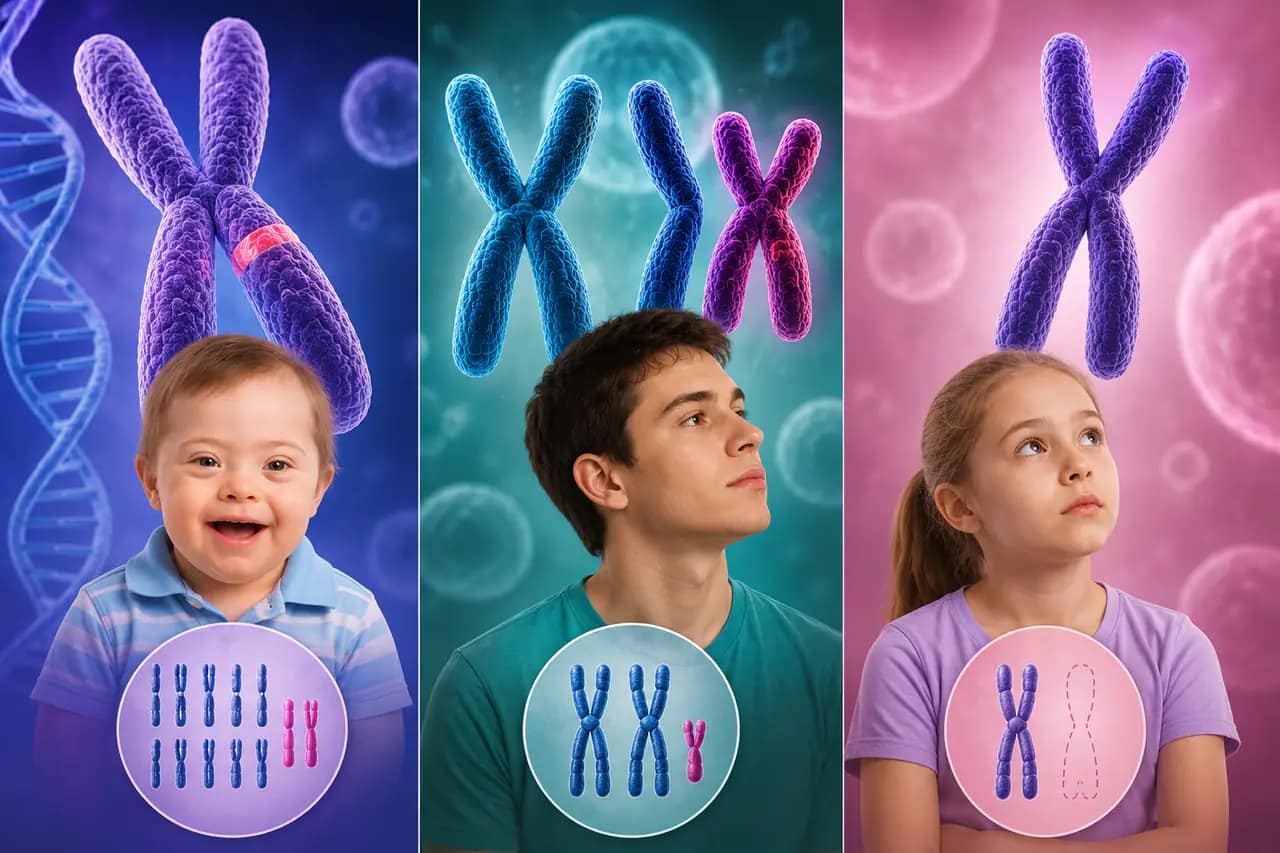
Exam-Winning Practice: Down Syndrome Klinefelter Turner Syndrome MCQs Class 12
Master Down Syndrome Klinefelter Turner Syndrome MCQs Class 12 with clear explanations on trisomy, monosomy, sex chromosomes, genetic disorders, and inheritance
Master Nondisjunction and Aneuploidy MCQs Class 12 Biology with Confidence for NEET, JEE & CUET
Master Nondisjunction and Aneuploidy MCQs Class 12 Biology with clear explanations on chromosomal disorders, trisomy, monosomy, meiosis, and genetic inheritance