Homologous organs, analogous organs, and vestigial organs are some of the most important concepts in evolutionary biology, and aspirants preparing for competitive examinations frequently search for Homologous Analogous Vestigial Organs MCQs with Answers to improve their understanding of these topics. The study of comparative anatomy provides strong evidence for organic evolution and helps explain how organisms are related through ancestry and adaptation. Because NEET and Class 12 Biology examinations regularly include conceptual questions from evolution, Homologous Analogous Vestigial Organs MCQs with Answers has become an essential revision resource for aspirants aiming for high scores.
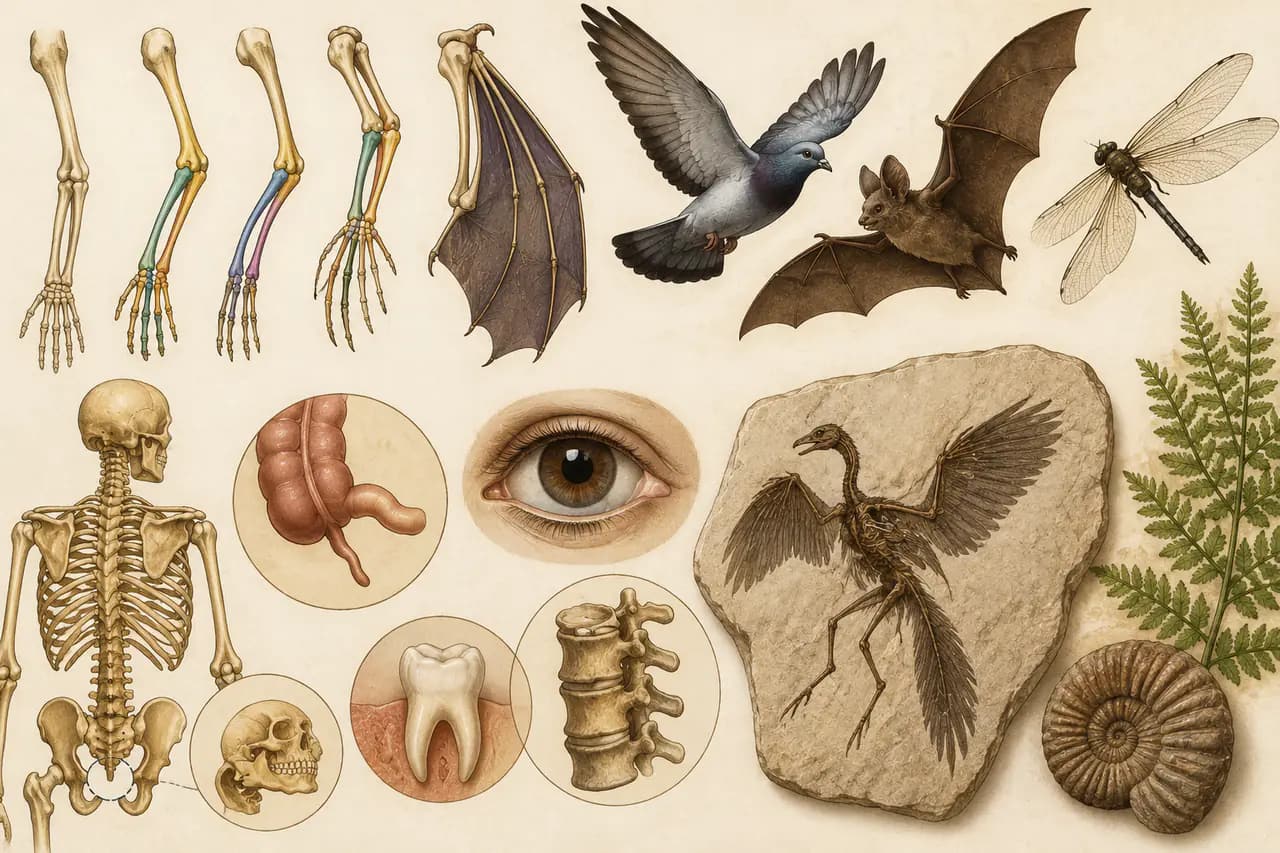
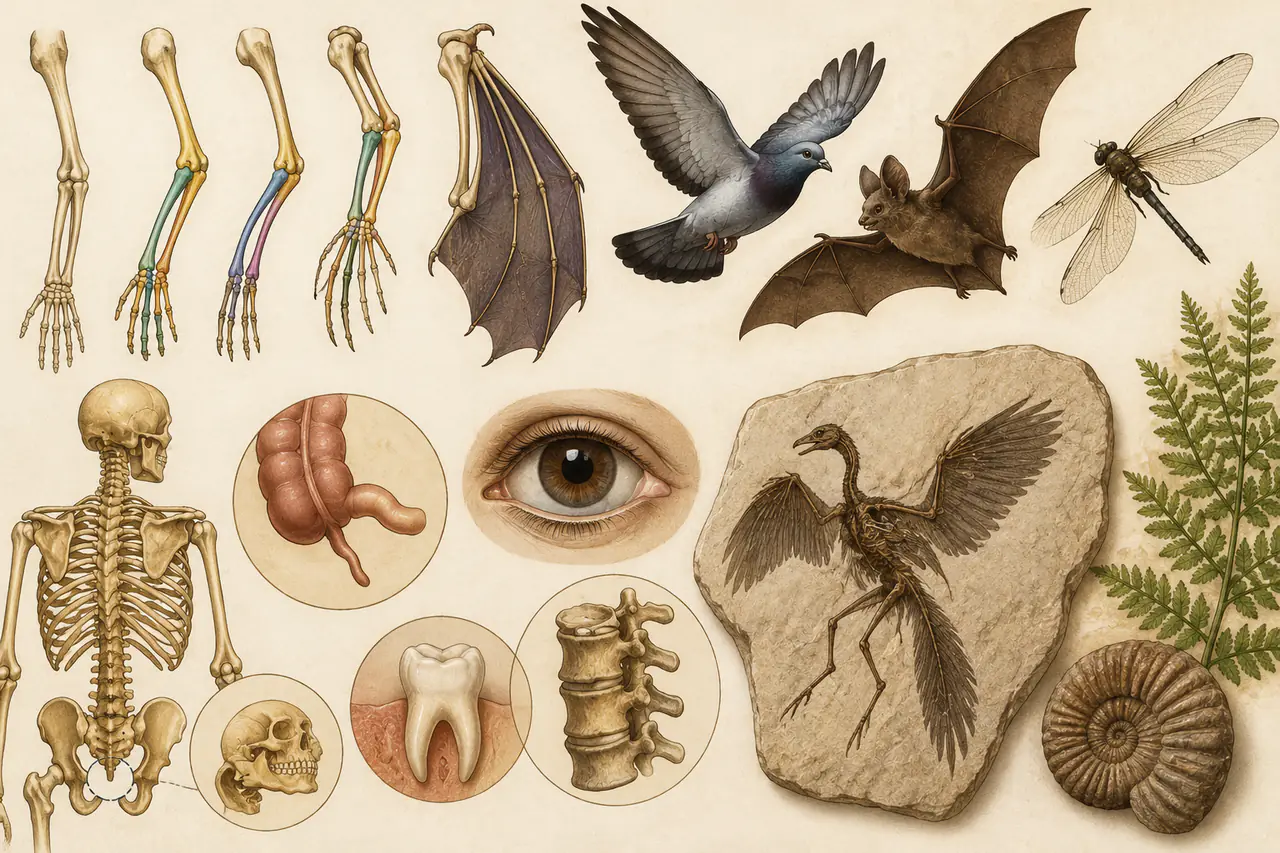
The concept of homologous organs refers to organs that share a common evolutionary origin but perform different functions. Aspirants revising through Homologous Analogous Vestigial Organs MCQs with Answers often study examples such as the forelimbs of humans, whales, bats, and horses. Although these structures are modified for grasping, swimming, flying, and running respectively, they possess the same basic structural arrangement. This similarity suggests that these organisms evolved from a common ancestor. Understanding homologous organs is extremely important because Homologous Analogous Vestigial Organs MCQs with Answers frequently includes application-based evolutionary questions.
The phenomenon associated with homologous organs is known as divergent evolution. Through Homologous Analogous Vestigial Organs MCQs with Answers, aspirants learn how species sharing common ancestry gradually evolve different characteristics due to adaptation to varied environments. Divergent evolution explains why organisms with similar anatomical structures may develop entirely different functions over time. This principle forms one of the strongest evidences supporting Darwin’s theory of evolution, and therefore Homologous Analogous Vestigial Organs MCQs with Answers remains highly important for biology preparation.
Analogous organs, on the other hand, perform similar functions but differ in structure and evolutionary origin. Aspirants studying Homologous Analogous Vestigial Organs MCQs with Answers commonly analyze examples such as the wings of birds, bats, and insects. Although all these structures are used for flight, they evolved independently in unrelated organisms. This process is called convergent evolution, where unrelated species adapt similarly because they live under comparable environmental conditions. Questions from convergent evolution are frequently included in Homologous Analogous Vestigial Organs MCQs with Answers because they test conceptual understanding rather than memorization.
The comparison between homologous and analogous organs is one of the most important parts of evolutionary biology. Aspirants practicing Homologous Analogous Vestigial Organs MCQs with Answers learn that homologous organs indicate common ancestry, while analogous organs indicate adaptation to similar environmental pressures. This distinction is very important in examinations because many objective questions intentionally confuse these concepts. Regular revision using Homologous Analogous Vestigial Organs MCQs with Answers helps aspirants identify structural differences and evolutionary significance more confidently.
Vestigial organs are another crucial topic covered in Homologous Analogous Vestigial Organs MCQs with Answers. Vestigial organs are reduced or functionless structures that were once fully developed and functional in ancestors. In humans, examples include the vermiform appendix, wisdom teeth, coccyx, and nictitating membrane. These structures provide strong evidence for evolution because they indicate that modern organisms evolved from ancestors with different lifestyles and requirements. Aspirants revising Homologous Analogous Vestigial Organs MCQs with Answers often focus on these examples since they are frequently asked in NEET examinations.
The appendix is among the most commonly discussed vestigial organs in Homologous Analogous Vestigial Organs MCQs with Answers. In herbivorous ancestors, it helped in cellulose digestion, but in humans, it has become greatly reduced and mostly non-functional. Similarly, the coccyx represents the remnant of a tail present in ancestral organisms. By practicing Homologous Analogous Vestigial Organs MCQs with Answers, aspirants develop a better understanding of how vestigial structures support the idea of descent with modification.
Embryological evidence also connects closely with Homologous Analogous Vestigial Organs MCQs with Answers. During early embryonic development, vertebrate embryos show structures such as gill slits and tails. These similarities indicate common ancestry among vertebrates. Aspirants often study these developmental similarities while revising Homologous Analogous Vestigial Organs MCQs with Answers because embryology provides another major line of evidence supporting evolution.
Comparative anatomy, fossil records, and molecular biology together strengthen evolutionary theories explained in Homologous Analogous Vestigial Organs MCQs with Answers. Fossils such as Archaeopteryx display both reptilian and avian characteristics, making them connecting links between two groups of organisms. Such transitional fossils are frequently discussed alongside homologous and analogous organs in Homologous Analogous Vestigial Organs MCQs with Answers because they provide direct evidence for evolutionary relationships.
Another important topic included in Homologous Analogous Vestigial Organs MCQs with Answers is adaptive radiation. Adaptive radiation refers to the evolution of different species from a common ancestor to occupy various ecological niches. Darwin’s finches are a famous example. Their beaks evolved differently depending on food availability, even though all species descended from a common ancestor. Aspirants practicing Homologous Analogous Vestigial Organs MCQs with Answers frequently revise adaptive radiation because it is directly linked with divergent evolution and homologous structures.
The concepts discussed in Homologous Analogous Vestigial Organs MCQs with Answers are not limited to theoretical biology. They also help explain practical evolutionary patterns observed in nature. Similar environmental conditions may produce analogous adaptations in unrelated species, while inherited ancestral structures may diversify into homologous organs. Vestigial organs reveal the evolutionary history hidden within modern organisms. Because of this, Homologous Analogous Vestigial Organs MCQs with Answers remains one of the most valuable resources for aspirants studying evolution comprehensively.
Aspirants preparing for board examinations and NEET benefit greatly from repeatedly practicing Homologous Analogous Vestigial Organs MCQs with Answers because the topic combines anatomy, evolution, embryology, and adaptation into one conceptual framework. Questions may appear in assertion-reason format, matching format, or application-based MCQs. Consistent revision of Homologous Analogous Vestigial Organs MCQs with Answers improves retention and reduces confusion between convergent and divergent evolution.
Modern biology strongly supports evolutionary relationships using molecular evidence alongside anatomical evidence explained in Homologous Analogous Vestigial Organs MCQs with Answers. Similarities in DNA sequences and proteins among organisms confirm common ancestry predicted by homologous structures. Vestigial genes and non-functional DNA sequences also provide evidence of evolutionary history. Therefore, Homologous Analogous Vestigial Organs MCQs with Answers helps aspirants connect classical evolutionary theories with modern molecular biology.
Homologous Analogous Vestigial Organs MCQs with Answers:
- What are the wings of bat, locust, and pigeon examples of?
A. Vestigial organs
B. Analogous organs
C. Homologous organs
D. Exoskeletal structure
Answer: B. Analogous organs
Explanation:
The wings of bat, locust, and pigeon are examples of analogous organs because they perform the same function, which is flying, but they differ in structure and evolutionary origin. The bat’s wing is a modified forelimb of a mammal, the pigeon’s wing is a modified forelimb of a bird, while the locust’s wing is an outgrowth of the exoskeleton. These structures evolved independently in different organisms due to similar environmental needs, a phenomenon called convergent evolution.
- What did Birbal Sahni work on?
A. Algae
B. Bryophytes
C. Fossil plants
D. Angiosperms
Answer: C. Fossil plants
Explanation:
Birbal Sahni was a famous Indian paleobotanist known for his work on fossil plants. He made major contributions to the study of ancient plant life and established the Birbal Sahni Institute of Palaeobotany in Lucknow. His research helped scientists understand plant evolution and the history of vegetation on Earth.
- Which organs are considered vestigial?
A. Vermiform appendix, wings of bat, and coccyx of man
B. Vermiform appendix, nictitating membrane, and coccyx of man
C. Forelimbs of whale, lizard, and bat
D. Wings of bat, nictitating membrane, and wings of insects
Answer: B. Vermiform appendix, nictitating membrane, and coccyx of man
Explanation:
Vestigial organs are structures that have lost most or all of their original function through evolution. In humans, the vermiform appendix, nictitating membrane, and coccyx are considered vestigial. The appendix is a reduced digestive organ, the nictitating membrane is a remnant of a third eyelid, and the coccyx represents the reduced tail structure of ancestors.
- Match the following: Seymouria, Ichthyostegia, Archaeopteryx, Australopithecus with their corresponding categories
List I
A. Seymouria
B. Ichthyostegia
C. Archaeopteryx
D. Australopithecus
List II
i. Connecting link between fishes and amphibians
ii. Connecting link between reptiles and birds
iii. Early human ancestor
iv. Connecting link between amphibians and reptiles
Options
A. A-iv, B-i, C-ii, D-iii
B. A-iii, B-ii, C-iv, D-i
C. A-i, B-iii, C-ii, D-iv
D. A-iv, B-ii, C-iii, D-i
Answer: A. A-iv, B-i, C-ii, D-iii
Long Explanation:
- Seymouria is considered a connecting link between amphibians and reptiles because it had reptilian body features but amphibian reproductive characteristics.
- Ichthyostegia is regarded as a connecting link between fishes and amphibians because it showed both aquatic and terrestrial adaptations.
- Archaeopteryx is the famous connecting link between reptiles and birds, possessing feathers like birds and teeth plus a long tail like reptiles.
- Australopithecus was an early human ancestor showing ape-like and human-like features.
These organisms provide strong fossil evidence supporting organic evolution and transitional evolutionary stages.
- Who proposed the Cosmozoic theory?
A. Helmholtz
B. Richter
C. Pasteur
D. Arrhenius
Answer: B. Richter
Explanation:
Richter proposed the Cosmozoic theory, also called the theory of panspermia. According to this theory, life did not originate on Earth but came from outer space in the form of spores or microscopic life particles carried by meteorites and cosmic dust.
- Which scientist proposed the theory of use and disuse of organs?
A. Darwin
B. Lamarck
C. de Vries
D. Hooker
Answer: B. Lamarck
Explanation:
Jean Baptiste Lamarck proposed the theory of use and disuse of organs. According to Lamarck, organs that are frequently used become stronger and more developed, while unused organs degenerate over time. He also believed that acquired characters could be inherited by offspring, although this theory was later disproved.
- S. L. Miller’s closed flask contained
A. CH₄
B. H₂
C. NH₃ and water vapour
D. All of the above
Answer: D. All of the above
Explanation:
Stanley Miller used methane (CH₄), hydrogen (H₂), ammonia (NH₃), and water vapour in his famous experiment simulating primitive Earth conditions. Electrical sparks were passed through the apparatus to imitate lightning. After several days, amino acids and other organic compounds formed, supporting the theory of chemical evolution.
- The first fossil evidence of life dates from about
A. 4.0 billion years ago
B. 3.6 billion years ago
C. 4.5 billion years ago
D. 2.5 billion years ago
Answer: B. 3.6 billion years ago
Explanation:
The earliest fossil evidence of life dates back approximately 3.6 billion years ago and includes fossils of cyanobacteria. These ancient microorganisms were among the earliest known life forms and played a major role in oxygenating Earth’s atmosphere through photosynthesis.
- An important evidence in favor of organic evolution is the occurrence of
A. Homologous and vestigial organs
B. Analogous and vestigial organs
C. Homologous organs only
D. Homologous and analogous organs
Answer: A. Homologous and vestigial organs
Explanation:
Homologous organs indicate common ancestry because they share the same basic structural design but perform different functions. Vestigial organs are reduced structures inherited from ancestors. Together, they strongly support the concept of organic evolution and descent with modification.
- Which isotope is used for finding fossils older than 4500 years?
A. U²³⁸
B. U²³⁵
C. Po²³⁵
D. ¹²C
Answer: A. U²³⁸
Explanation:
Uranium-238 is commonly used for dating very old fossils and rocks because of its extremely long half-life of about 4.5 billion years. Carbon-14 dating is suitable only for relatively recent fossils, usually up to about 50,000 years old.
- Sweet potato and potato are examples of
A. Homologous structure
B. Analogous structure
C. Both A and B
D. None of the above
Answer: B. Analogous structure
Explanation:
Sweet potato and potato perform the same function of food storage but originate from different plant parts. Potato is a stem tuber, while sweet potato is a modified root. Therefore, they are analogous structures formed through convergent evolution.
- Which character provides strong evidence for organic evolution?
A. Gill clefts in vertebrate embryo
B. Wings in insects, birds, and bats
C. Jointed legs in arthropods and mammals
D. Excretory organs of earthworm and frog
Answer: A. Gill clefts in vertebrate embryo
Explanation:
Gill clefts in vertebrate embryos provide embryological evidence for evolution. During early development, embryos of fishes, amphibians, reptiles, birds, and mammals show similar structures, indicating a common ancestry among vertebrates.
- The bimodal distribution of bill sizes in West African seedcracker birds is due to
A. Directional selection
B. Stabilising selection
C. Disruptive selection
D. Sexual selection
Answer: C. Disruptive selection
Explanation:
Disruptive selection favors individuals at both extremes of a trait distribution while selecting against intermediate forms. In seedcracker birds, birds with either very small or very large bills survive better because they specialize in different food sources, resulting in a bimodal distribution of bill sizes.
Conclusion on Homologous Analogous Vestigial Organs MCQs with Answers:
In conclusion, Homologous Analogous Vestigial Organs MCQs with Answers is an essential resource for aspirants preparing for NEET and Class 12 Biology examinations. The topic explains homologous organs, analogous organs, vestigial organs, divergent evolution, convergent evolution, adaptive radiation, embryological evidence, and evolutionary relationships in a detailed yet understandable way. Continuous practice using Homologous Analogous Vestigial Organs MCQs with Answers helps aspirants strengthen conceptual clarity, improve memory retention, and gain confidence in solving biology questions accurately during examinations.
Related reading
Ultimate Jean Baptiste Lamarck Evolution Theory MCQs with Answers for Smart NEET Prepraration
Master Jean Baptiste Lamarck Evolution Theory MCQs with Answers for NEET , Class 12 Biology. Learn Lamarckism, acquired characters, evolution concepts examples.
Powerful Common Ancestor of Apes and Humans MCQs with Answers for Competitive Exams
Learn Common Ancestor of Apes and Humans MCQs with Answers for NEET and Class 12 Biology. Explore fossils, evolution, primates, and human ancestry concepts exam