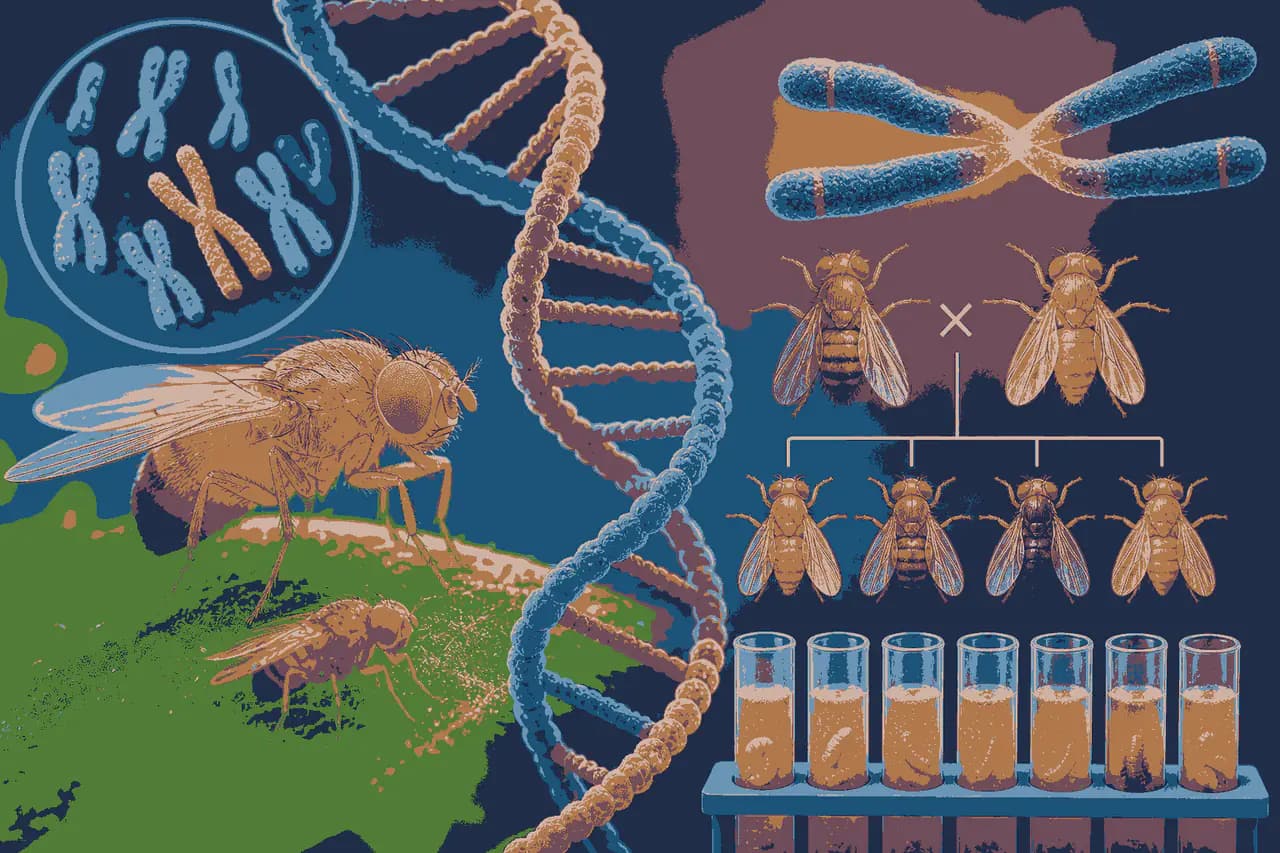
Genetics becomes truly interesting when aspirants move beyond basic Mendelian principles and begin exploring linkage and recombination. One of the most effective ways to master these advanced topics is through Drosophila Linkage Recombination MCQs Class 12 Biology with Answers, which combine conceptual understanding with real exam-level application. The study of linkage was significantly advanced through experiments on Drosophila melanogaster, a model organism that has become central to genetics research due to its short life cycle and easily observable traits.
The importance of Drosophila Linkage Recombination MCQs Class 12 Biology with Answers lies in their ability to simplify complex genetic interactions. Linkage refers to the tendency of genes located close together on the same chromosome to be inherited together. Through Drosophila Linkage Recombination MCQs Class 12 Biology with Answers, aspirants learn that linked genes do not follow Mendel’s law of independent assortment strictly, which is a crucial concept for board and competitive exams.
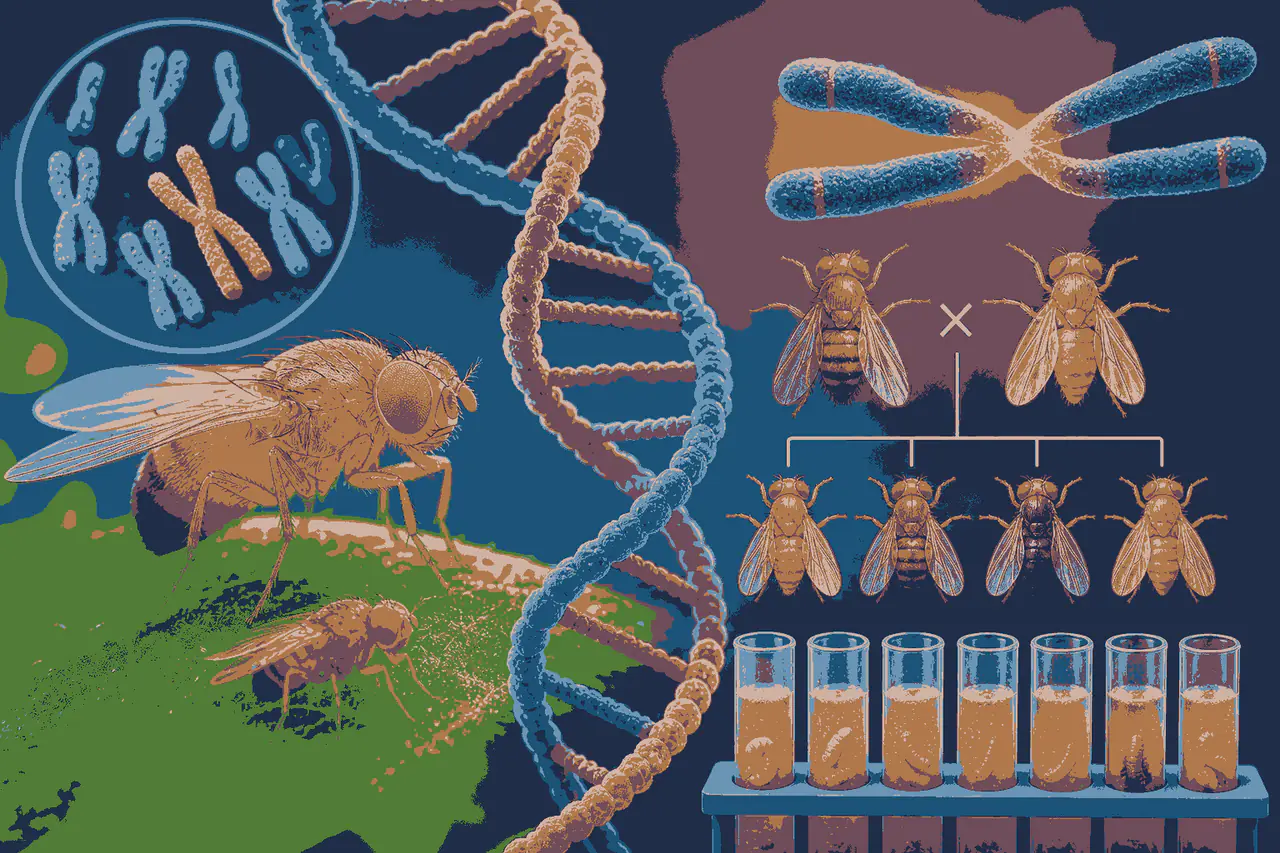
When aspirants practice Drosophila Linkage Recombination MCQs Class 12 Biology with Answers, they begin to understand how recombination occurs during meiosis. Crossing over leads to the exchange of genetic material between homologous chromosomes, producing new allele combinations. These recombination events are fundamental to genetic variation, and Drosophila Linkage Recombination MCQs Class 12 Biology with Answers help aspirants identify how often such events occur.
Another key concept reinforced through Drosophila Linkage Recombination MCQs Class 12 Biology with Answers is recombination frequency. It is expressed as a percentage and reflects the distance between genes on a chromosome. The closer the genes, the lower the recombination frequency. By solving Drosophila Linkage Recombination MCQs Class 12 Biology with Answers, aspirants gain the ability to interpret gene mapping problems quickly and accurately.
The work of Thomas Hunt Morgan is frequently highlighted in Drosophila Linkage Recombination MCQs Class 12 Biology with Answers. His experiments with fruit flies demonstrated that genes are arranged linearly on chromosomes and that recombination frequency can be used to map their positions. This discovery laid the foundation for modern genetic mapping and continues to be a key topic in exams.
Practicing Drosophila Linkage Recombination MCQs Class 12 Biology with Answers also helps aspirants distinguish between complete linkage and incomplete linkage. In complete linkage, genes are inherited together without recombination, while in incomplete linkage, crossing over leads to recombinant offspring. Understanding this difference is essential, and Drosophila Linkage Recombination MCQs Class 12 Biology with Answers provide repeated exposure to these scenarios.
In addition, Drosophila Linkage Recombination MCQs Class 12 Biology with Answers improve analytical thinking by encouraging aspirants to interpret phenotypic ratios. Instead of the typical 9:3:3:1 ratio seen in dihybrid crosses, linked genes often produce deviations from expected ratios. Recognizing these deviations is a key skill developed through Drosophila Linkage Recombination MCQs Class 12 Biology with Answers.
Another benefit of Drosophila Linkage Recombination MCQs Class 12 Biology with Answers is improved speed and accuracy. Competitive exams like NEET and CUET often include tricky genetics questions where time management is crucial. Regular practice ensures that aspirants can quickly identify whether a question involves linkage, recombination, or independent assortment.
Furthermore, Drosophila Linkage Recombination MCQs Class 12 Biology with Answers help integrate multiple genetics concepts such as meiosis, chromosomal behavior, and gene interaction. This holistic understanding makes it easier to tackle higher-order questions and reduces confusion during exams.
Aspirants also gain clarity about real-world applications through Drosophila Linkage Recombination MCQs Class 12 Biology with Answers. Genetic mapping, disease inheritance, and evolutionary variation all rely on principles of linkage and recombination. These connections make the topic more meaningful and easier to retain.
Consistency is key when preparing for genetics, and incorporating Drosophila Linkage Recombination MCQs Class 12 Biology with Answers into daily study routines can significantly boost performance. Even a small number of practice questions each day can strengthen concepts and improve confidence.
Drosophila Linkage Recombination MCQs Class 12 Biology with Answers:
1. Which statement does NOT agree with chromosomal theory?
A. During gamete formation, homologous chromosomes remain together
B. Nucleus contains diploid set
C. Somatic cells are diploid
D. Gametes carry hereditary characters
Answer: A
Explanation: Homologous chromosomes separate during meiosis, not remain together.
2. Gametic chromosome number if somatic cell has 40?
A. 10
B. 20
C. 30
D. 40
Answer: B
Explanation: Gametes are haploid → 40/2 = 20.
3. Incorrect statement about polytene chromosome band region?
A. Feulgen negative area
B. Absorb UV at 2600 Å
C. Chromonemata tightly packed
D. Stains with basic dye
Answer: A
Explanation: Bands are Feulgen positive (DNA rich).
4. Correct organism-chromosome pair?
A. Human – 42
B. Fruit fly – 10
C. Onion – 28
D. House fly – 12
Answer: D
Explanation: Housefly has 2n = 12.
5. Meiocyte chromosome number 34 organism?
A. Dog
B. Apple
C. Ophioglossum
D. Onion
Answer: B
Explanation: Apple has 2n = 34.
6. Chromosomes consist of:
A. DNA & ATP
B. DNA & histone
C. RNA & histone
D. DNA & RNA
Answer: B
Explanation: DNA wrapped around histone proteins.
7. Haploid ratio fruit fly : housefly : potato?
A. 24 : 4 : 6
B. 6 : 4 : 24
C. 4 : 6 : 24
D. 1 : 2 : 3
Answer: C
Explanation: Haploid numbers → 4, 6, 24.
8. Lampbrush chromosomes present in:
A. Drosophila
B. Ascaris
C. Hydra
D. None
Answer: D
Explanation: Found in amphibian oocytes.
9. Same genotypic & phenotypic ratio seen in:
A. Sex linkage
B. Pseudoalleles
C. Incomplete dominance
D. Complete dominance
Answer: C
Explanation: Both ratios = 1:2:1.
10. Gene mapping developed by:
A. Mendel
B. Tschermak
C. Correns
D. Sturtevant
Answer: D
Explanation: First linkage map.
11. Term ‘linkage’ coined by:
A. Mendel
B. Sutton
C. Morgan
D. Boveri
Answer: C
Explanation: T.H. Morgan.
12. Genotype for fair skin:
A. AABBCC
B. AaBbCc
C. aabbcc
D. aaBBcc
Answer: C
Explanation: More recessive alleles → lighter skin.
13. Unit of recombination:
A. Muton
B. Recon
C. Cistron
D. None
Answer: B
Explanation: Smallest recombination unit.
14. Linked genes do NOT show:
A. Chromosome mapping
B. Recombination
C. Independent assortment
D. Cell division
Answer: C
Explanation: Linked genes inherited together.
15. Gene arrangement A-B 9%, A-C 17%, B-C 26%
A. ACB
B. BAC
C. BCA
D. ABC
Answer: B
Explanation: A lies between B and C.
16. Crossing over leads to:
A. Dominance
B. Linkage
C. Recombination
D. Segregation
Answer: C
Explanation: Exchange of genetic material.
17. Chromosomal theory of linkage was formulated by:
A. Morgan & Castle
B. Stern & Hotta
C. Pontecorvo
D. Bridges & Burns
Answer: A
Explanation: T.H. Thomas Hunt Morgan and W. Castle proposed the chromosomal theory of linkage. They explained that genes located on the same chromosome tend to be inherited together and the strength of linkage depends on the distance between them.
18. What is the exception of Mendel’s law of segregation?
A. Linkage
B. Dominance
C. Allele
D. Homozygous
Answer: A
Explanation: Linkage acts as an exception because genes located close together on the same chromosome do not segregate independently. Instead, they are inherited together unless separated by crossing over.
19. Genes that are located close together on a chromosome are called:
A. Linkage
B. Mutation
C. Translation
D. Transcription
Answer: A
Explanation: Closely located genes show linkage, meaning they tend to be inherited together. This reduces genetic variation compared to independently assorting genes.
20. In the cross TTRR × ttrr, how many types of gametes will the F₁ produce?
A. One
B. Three
C. Four
D. Eight
Answer: C
Explanation: The F₁ genotype is TtRr (dihybrid). The number of gametes = 2ⁿ (n = number of heterozygous pairs = 2). Therefore, 2² = 4 types of gametes are formed.
21. Who is considered the father of experimental genetics?
A. Thomas Hunt Morgan
B. Strasburger
C. Muller
D. Bridges
Answer: A
Explanation: Thomas Hunt Morgan is called the father of experimental genetics because his work on Drosophila provided strong evidence for the chromosomal theory of inheritance and linkage.
22. Crossing over frequency varies from:
A. 50–100%
B. 0–50%
C. 75–100%
D. 100–150%
Answer: B
Explanation: The maximum recombination frequency is 50% because beyond that genes behave as if they are independently assorting. Therefore, crossover frequency ranges from 0% (complete linkage) to 50% (independent assortment).
23. Mutation is defined as:
A. Irreversible gradual change
B. Sudden change in genetic material
C. Non-heritable change
D. Continuous variation
Answer: B
Explanation: Mutation refers to a sudden and heritable change in the DNA sequence, leading to new traits or variations.
24. Which of the following is an example of sex-linked inheritance?
A. Colour blindness
B. Retinitis pigmentosa
C. Myopia
D. Nephritis
Answer: A
Explanation: Colour blindness is a classic example of X-linked recessive inheritance where the gene is located on the X chromosome.
25. Recombination occurs during:
A. Cytokinesis
B. Spindle formation
C. Crossing over
D. Chromosome duplication
Answer: C
Explanation: Recombination occurs during crossing over in prophase I of meiosis, where homologous chromosomes exchange genetic material.
26. A characteristic feature of sex-linked inheritance is:
A. Atavism
B. Reversion
C. Gene flow
D. Criss-cross inheritance
Answer: D
Explanation: Criss-cross inheritance refers to the transmission of traits from father to daughter and then to grandson, which is typical of X-linked traits.
27. Number of linkage groups in human males:
A. 22
B. 24
C. 23
D. 46
Answer: B
Explanation: In males, linkage groups correspond to the number of chromosomes (22 autosomes + X + Y = 24 linkage groups).
28. Lack of independent assortment in Drosophila is due to:
A. Repulsion
B. Recombination
C. Linkage
D. Crossing over
Answer: C
Explanation: Genes located on the same chromosome show linkage and therefore do not assort independently.
29. Mendel’s observations that led to discovery of linkage were due to:
A. Crossing over
B. Dominance
C. Both (a) and (b)
D. Non-independent assortment of traits
Answer: D
Explanation: Mendel observed that some traits did not assort independently, which later led scientists to discover linkage between genes.
30. When genes are very close on a chromosome, F₂ generation shows:
A. Higher number of parental types
B. Higher number of recombinants
C. 9 : 3 : 3 : 1 ratio
D. 3 : 1 ratio
Answer: A
Explanation: When genes are closely linked, recombination is very low. Hence, parental combinations appear more frequently than recombinant types.
Conclusion on Drosophila Linkage Recombination MCQs Class 12 Biology with Answers
In conclusion, Drosophila Linkage Recombination MCQs Class 12 Biology with Answers are an essential resource for mastering linkage and recombination. They not only enhance conceptual clarity but also improve problem-solving skills and exam readiness.
Ultimately, regular practice of Drosophila Linkage Recombination MCQs Class 12 Biology with Answers ensures that aspirants are well-prepared to tackle genetics questions with confidence and precision in both board and competitive examinations.
Related reading
Don't Miss These Ultimate High-Scoring Class 12 Biology Linkage Crossing Over Recombination Frequency MCQs with Answers PDF
Master genetics easily with Class 12 Biology Linkage Crossing Over Recombination Frequency MCQs with Answers PDF for quick revision, practice, and exam success.
Don't Ignore These Important Tricky Epistasis Inheritance Ratio MCQs Class 12 Biology with Answers Before Your Exams
Master Epistasis Inheritance Ratio MCQs Class 12 Biology with Answers to understand gene interactions , improve accurac , and score higher in competitive exams.