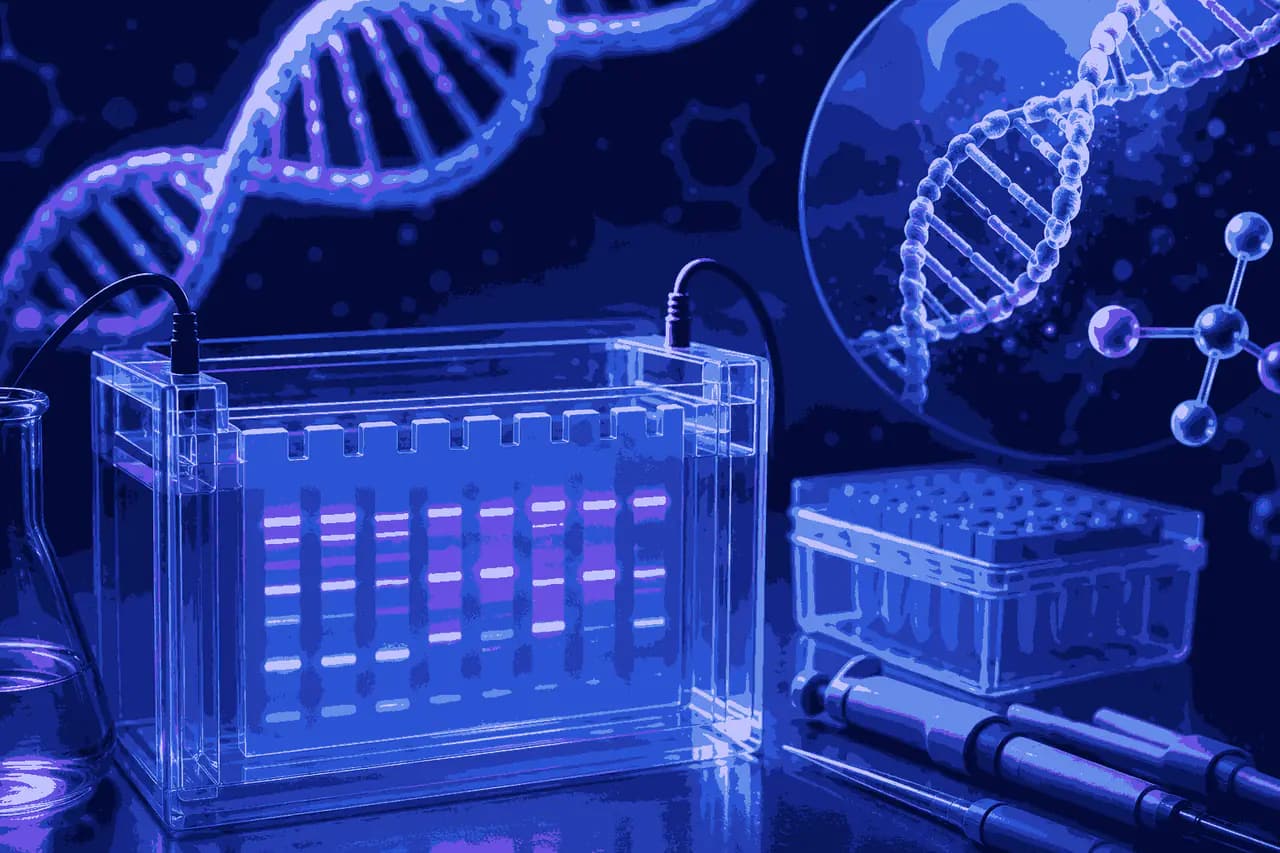
Agarose Gel Electrophoresis MCQs NEET is one of the most searched biology preparation topics among NEET aspirants because it combines molecular biology concepts with practical biotechnology applications. Understanding Agarose Gel Electrophoresis MCQs NEET helps aspirants strengthen their grasp of DNA separation techniques, recombinant DNA technology, and genetic analysis. In modern biology, agarose gel electrophoresis is widely used in laboratories to separate DNA fragments according to their size, making it an essential concept for competitive examinations. Since biotechnology and molecular genetics carry significant weightage in NEET Biology, mastering Agarose Gel Electrophoresis MCQs NEET becomes highly important for aspirants aiming for excellent scores.
The topic of Agarose Gel Electrophoresis MCQs NEET introduces aspirants to the principle that DNA molecules are negatively charged because of phosphate groups. When an electric field is applied, DNA migrates towards the positively charged electrode. Agarose gel acts like a molecular sieve that separates DNA fragments based on their length. Smaller fragments move faster while larger fragments move slowly through the gel matrix. This concept appears repeatedly in Agarose Gel Electrophoresis MCQs NEET because it forms the foundation of many biotechnology-based questions asked in examinations.
Another reason why Agarose Gel Electrophoresis MCQs NEET is extremely important is that it helps aspirants understand how recombinant DNA technology works in practical settings. In biotechnology laboratories, DNA fragments generated by restriction enzymes are loaded into agarose gel for separation. After electrophoresis, these fragments can be visualized using ethidium bromide staining under ultraviolet light. Many questions in Agarose Gel Electrophoresis MCQs NEET focus on the movement of DNA fragments, gel preparation, staining methods, and interpretation of DNA bands. Therefore, repeated revision of Agarose Gel Electrophoresis MCQs NEET improves conceptual understanding as well as exam confidence.
Aspirants preparing through Agarose Gel Electrophoresis MCQs NEET also learn about molecular markers and DNA ladders. DNA ladders contain fragments of known sizes and are used as references during gel electrophoresis. Understanding the role of DNA markers becomes easier when practicing Agarose Gel Electrophoresis MCQs NEET regularly. Questions often test the ability of aspirants to compare DNA band sizes, determine fragment lengths, and identify migration patterns inside agarose gel. Such application-based learning makes Agarose Gel Electrophoresis MCQs NEET extremely valuable for conceptual clarity.
The importance of Agarose Gel Electrophoresis MCQs NEET extends beyond NEET examinations because the topic also forms the basis of higher studies in genetics, microbiology, biotechnology, and molecular medicine. Many aspirants discover that solving Agarose Gel Electrophoresis MCQs NEET improves analytical thinking and scientific reasoning. Since the topic involves visualization of DNA movement and interpretation of experimental results, aspirants develop better understanding of practical biology rather than memorizing isolated facts. This makes Agarose Gel Electrophoresis MCQs NEET highly effective for long-term biology preparation.
A major advantage of practicing Agarose Gel Electrophoresis MCQs NEET is that it familiarizes aspirants with commonly repeated examination patterns. Questions often involve the direction of DNA movement, role of agarose, electric field application, gel concentration, restriction digestion, and DNA visualization techniques. By repeatedly solving Agarose Gel Electrophoresis MCQs NEET, aspirants become comfortable with tricky concepts that are frequently tested in competitive examinations. This repeated exposure reduces confusion and increases speed during the actual NEET examination.
Another important aspect covered through Agarose Gel Electrophoresis MCQs NEET is the use of electrophoresis in forensic science and genetic fingerprinting. DNA fingerprinting relies heavily on electrophoretic separation of DNA fragments. As a result, NEET aspirants are expected to understand how DNA fragments are isolated and analyzed. Agarose Gel Electrophoresis MCQs NEET therefore helps connect textbook biotechnology concepts with real-world medical and forensic applications. This practical relevance makes the topic more interesting and easier to remember for aspirants.
In addition, Agarose Gel Electrophoresis MCQs NEET enhances understanding of advanced concepts like cloning vectors, recombinant DNA, restriction enzymes, and polymerase chain reaction. Since all these techniques are interconnected, aspirants who practice Agarose Gel Electrophoresis MCQs NEET often perform better in broader biotechnology chapters. The topic also supports revision of DNA structure, nucleic acids, and molecular genetics. Because NEET frequently includes assertion-reason and application-based questions, mastering Agarose Gel Electrophoresis MCQs NEET provides a significant advantage during preparation.
Time management is another benefit of revising Agarose Gel Electrophoresis MCQs NEET consistently. Aspirants who repeatedly practice these questions become faster at identifying keywords such as negatively charged DNA, migration toward anode, ethidium bromide staining, and molecular separation. This accuracy and speed are essential in highly competitive examinations like NEET. Many aspirants lose marks due to conceptual confusion, but systematic practice of Agarose Gel Electrophoresis MCQs NEET helps eliminate such mistakes effectively.
30 Agarose Gel Electrophoresis MCQs NEET :
1. Which statements are true for agarose-gel electrophoresis?
A. Agarose is a natural polymer obtained from seaweed
B. Separation of DNA molecules depends on DNA size
C. DNA migrates from negatively charged electrode to positively charged electrode
D. DNA migrates from positively charged electrode
Options:
A. (A) and (B) only
B. (A), (B) and (C) only
C. (A), (B) and (D) only
D. (B), (C) and (D) only
Answer: B. (A), (B) and (C) only
Explanation: Agarose gel electrophoresis separates DNA fragments according to size, and DNA migrates toward the positive electrode.
2. Which of the following statements are correct?
A. Euchromatin is loosely packed chromatin
B. Heterochromatin is transcriptionally active
C. Histone octamer is wrapped by negatively charged DNA in nucleosome
D. Histones are rich in lysine and arginine
E. A typical nucleosome contains 400 bp DNA helix
Options:
A. (A), (C), (E) only
B. (B), (D), (E) only
C. (A), (C), (D) only
D. (B), (E) only
Answer: C. (A), (C), (D) only
Explanation: Euchromatin is loosely packed, histones are rich in lysine and arginine, and DNA wraps around histone octamers.
3. Which statement is correct?
A. Adenine pairs with thymine through one H-bond
B. Adenine pairs with thymine through three H-bonds
C. Adenine does not pair with thymine
D. Adenine pairs with thymine through two H-bonds
Answer: D. Adenine pairs with thymine through two H-bonds
Explanation: Adenine and thymine are connected by two hydrogen bonds.
4. If the distance between two consecutive base pairs is 0.34 nm and total base pairs are 6.6 × 10⁹ bp, then DNA length is approximately
A. 2.5 meters
B. 2.2 meters
C. 2.7 meters
D. 2.0 meters
Answer: B. 2.2 meters
Explanation: DNA length = 6.6 × 10⁹ × 0.34 × 10⁻⁹ m = 2.2 m.
5. Complete the flow chart on central dogma.
A. (a)-Transduction; (b)-Translation; (c)-Replication; (d)-Protein
B. (a)-Replication; (b)-Transcription; (c)-Transduction; (d)-Protein
C. (a)-Translation; (b)-Replication; (c)-Transcription; (d)-Transduction
D. (a)-Replication; (b)-Transcription; (c)-Translation; (d)-Protein
Answer: D. (a)-Replication; (b)-Transcription; (c)-Translation; (d)-Protein
Explanation: Central dogma explains DNA replication, transcription into RNA, and translation into protein.
6. Which scientist experimentally proved that DNA is the sole genetic material in bacteriophage?
A. Jacob and Monod
B. Beadle and Tatum
C. Meselson and Stahl
D. Hershey and Chase
Answer: D. Hershey and Chase
Explanation: Hershey and Chase proved DNA is the genetic material using bacteriophages.
7. The association of histone H1 with nucleosome indicates
A. Transcription is occurring
B. DNA replication is occurring
C. DNA is condensed into chromatin
D. DNA double helix is exposed
Answer: C. DNA is condensed into chromatin
Explanation: Histone H1 helps in higher-order chromatin packing.
8. Chromosomes in bacterial cells are
A. Always circular
B. Always linear
C. Either circular or linear but never both
D. Circular as well as linear within same cell
Answer: A. Always circular
Explanation: Bacterial chromosomes are generally circular DNA molecules.
9. In a 3.2 kbp DNA piece, 820 adenine bases are present. Number of cytosine bases is
A. 780
B. 1560
C. 740
D. 1480
Answer: A. 780
Explanation: According to Chargaff’s rule, A=T and G=C.
10. Satellite of chromosome is
A. Rich in RNA and deficient in DNA
B. Rich in DNA and deficient in RNA
C. Rich in protein
D. Lacks DNA
Answer: A. Rich in RNA and deficient in DNA
Explanation: Satellite regions contain repetitive non-coding sequences.
11. Which of the following is incorrect?
A. Fructose is a reducing sugar
B. Cellulose has β-D glucose units
C. DNA has D-ribose
D. Amylopectin is insoluble in water
Answer: C. DNA has D-ribose
Explanation: DNA contains deoxyribose sugar.
12. Which statement is wrong about satellite DNA?
A. Shows high polymorphism
B. Does not take part in protein synthesis
C. Does not inherit from parents to offspring
D. None
Answer: C. Does not inherit from parents to offspring
Explanation: Satellite DNA is inherited genetically.
13. A nucleosome contains
A. Both DNA and histones
B. Only histones
C. Both DNA and RNA
D. Only DNA
Answer: A. Both DNA and histones
Explanation: DNA wraps around histone proteins to form nucleosomes.
14. DNA probes tagged with radioactive isotopes help detect DNA by autoradiography. Choose correct option.
A. Both statements are correct and statement 2 explains statement 1
B. Both statements correct but no explanation
C. Statement 1 correct and statement 2 incorrect
D. Both incorrect
Answer: A. Both statements are correct and statement 2 explains statement 1
Explanation: Radioactive probes hybridize with complementary DNA sequences.
15. Match the following:
a. Pitch of helix
b. Number of bp per turn
c. Distance between two successive bp
d. Nature of helix
Options:
A. (a-i), (b-ii), (c-iii), (d-iv)
B. (a-ii), (b-i), (c-iii), (d-iv)
C. (a-i), (b-ii), (c-iv), (d-iii)
D. (a-ii), (b-i), (c-iv), (d-iii)
Answer: B. (a-ii), (b-i), (c-iii), (d-iv)
Explanation: B-DNA has 10 bp per turn and pitch of 3.4 nm.
16.
Match Column I with Column II and choose the correct option.
| Column I | Column II |
|---|---|
| 1. Taylor and colleagues | A. Lac operon |
| 2. Hershey and Chase | B. DNA replicates semi-conservatively |
| 3. Griffith | C. Transforming principle |
| 4. Jacob and Monod | D. DNA is the genetic material |
Options:
A. 1 - B, 2 - E, 3 - A, 4 - C
B. 1 - C, 2 - D, 3 - B, 4 - A
C. 1 - B, 2 - D, 3 - C, 4 - A
D. 1 - A, 2 - E, 3 - D, 4 - B
Answer: C. 1 - B, 2 - D, 3 - C, 4 - A
Explanation:
Taylor and colleagues demonstrated semiconservative replication of DNA. Hershey and Chase proved DNA is the genetic material. Griffith discovered the transforming principle, while Jacob and Monod proposed the lac operon model.
17. DNA is mainly found in
A. Nucleus only
B. Cytoplasm only
C. Nucleus and cytoplasm
D. Nucleolus
Answer: A. Nucleus only
Explanation: Most cellular DNA is located inside the nucleus.
18. Which statement about DNA is incorrect?
A. DNA denatures at high temperature
B. DNA absorbs UV at 260 nm
C. DNA directly participates in protein synthesis
D. Pyrimidines are cytosine and thymine
Answer: C. DNA directly participates in protein synthesis
Explanation: DNA transfers information through RNA.
19. Most mutations are
A. Harmful
B. Harmful and recessive
C. Beneficial
D. Dominant
Answer: B. Harmful and recessive
Explanation: Most mutations negatively affect organisms and remain recessive.
20. If DNA strand sequence is ATCTG, complementary RNA strand is
A. AACTG
B. ATCGU
C. TTAGU
D. UAGAC
Answer: D. UAGAC
Explanation: RNA pairs A-U and C-G with DNA bases.
21. Segments of DNA which move in genome are
A. Transposons
B. Introns
C. Exons
D. Cistrons
Answer: A. Transposons
Explanation: Transposons are mobile genetic elements.
22.
The introduction of nematode-specific genes into host using Agrobacterium vectors causes the following action.
I. Production of both sense and antisense RNA in host cells
II. Formation of double-stranded RNA
III. Silencing of specific mRNA of nematode
IV. Prevention of infestation by nematodes
Options:
A. II, III, IV
B. I, II, III
C. I, II, IV
D. I, III, IV
Answer: C. I, II, IV
Explanation:
Introduction of nematode-specific genes through Agrobacterium vectors produces both sense and antisense RNA, leading to dsRNA formation and RNA interference, thereby preventing nematode infestation.
23. Which is an incorrect combination?
A. RNA polymerase I – rRNA
B. RNA polymerase II – hnRNA
C. RNA polymerase III – mRNA
D. DNA polymerase – DNA
Answer: C. RNA polymerase III – mRNA
Explanation: RNA polymerase III synthesizes tRNA.
24.
Match the following lists correctly:
| List-I | List-II | List-III |
|---|---|---|
| A. HIV | i. Shelter | I. Auxospore |
| B. Mycobiont | ii. TMV | II. RNA |
| C. Deuteromycetes | iii. Pennales | III. Trichoderma |
| D. Cell wall with silica | iv. Conidia | IV. Mineral absorption |
Options:
A. ii II i IV iv III iii I
B. ii III i IV iii II iv I
C. ii II iv III i IV iii I
D. ii I iii II iv III i IV
Answer: A. ii II i IV iv III iii I
Explanation:
HIV contains RNA like TMV. Mycobiont provides shelter and helps mineral absorption. Deuteromycetes reproduce by conidia and include Trichoderma. Diatoms with silica walls belong to Pennales and form auxospores.
25. Match molecules with functions.
A. Starch
B. Haemoglobin
C. RNA
D. Steroid
Functions:
p. Protein synthesis
q. Sex hormone
r. Storage product
s. Transport of gases
Options:
A. A=r; B=p; C=s; D=q
B. A=r; B=s; C=p; D=q
C. A=s; B=r; C=p; D=q
D. A=r; B=s; C=q; D=p
Answer: B. A=r; B=s; C=p; D=q
Explanation: Starch stores food; haemoglobin transports gases.
26. Spliceosomes are absent in
A. Plants
B. Fungi
C. Animals
D. Bacteria
Answer: D. Bacteria
Explanation: Bacteria lack spliceosomes because they lack introns in mRNA.
27. RNA is not found in
A. Chromosome
B. Plasmalemma
C. Nucleolus
D. Ribosome
Answer: B. Plasmalemma
Explanation: RNA is absent in the plasma membrane.
28. Purines in RNA are
A. Adenine and Guanine
B. Thymine and Cytosine
C. Thymine and Uracil
D. Uracil and Cytosine
Answer: A. Adenine and Guanine
Explanation: RNA contains adenine and guanine as purines.
29. Against codon 5'-UAC-3', anticodon on tRNA is
A. 5'-AUG-3'
B. 5'-ATG-3'
C. 5'-GTA-3'
D. 5'-GUA-3'
Answer: D. 5'-GUA-3'
Explanation: Anticodon pairs complementarily with codon.
30. Which form of RNA resembles a clover leaf?
A. hn-RNA
B. m-RNA
C. t-RNA
D. r-RNA
Answer: C. t-RNA
Explanation: Transfer RNA has a cloverleaf secondary structure.
Conclusion on Agarose Gel Electrophoresis MCQs NEET
Finally, Agarose Gel Electrophoresis MCQs NEET remains one of the most reliable preparation tools for mastering biotechnology concepts in Class 12 Biology. It combines theory, practical application, and analytical interpretation into a single topic that strengthens overall biology preparation. Aspirants who dedicate regular revision time to Agarose Gel Electrophoresis MCQs NEET often develop stronger confidence in molecular biology sections. With proper understanding and continuous practice, Agarose Gel Electrophoresis MCQs NEET can significantly improve conceptual accuracy, examination performance, and long-term retention of biotechnology concepts.
Related reading
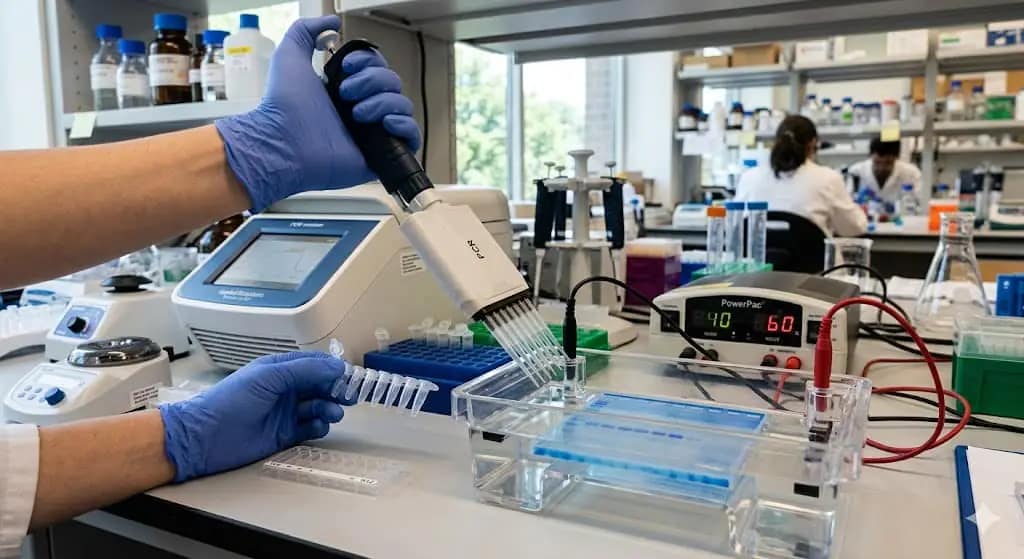
Ultimate PCR and Gel Electrophoresis MCQs PDF - Powerful Questions for Class 12 Biology
Master DNA amplification, PCR steps, agarose gel electrophoresis, Taq polymerase, biotechnology concepts easily with PCR ,Gel Electrophoresis MCQs PDF resources
Powerful Allolactose and Repressor Molecular Biology MCQs with Answers for NEET JEE & CUET
Master lac operon concepts with Allolactose and Repressor Molecular Biology MCQs for NEET , JEE and Class 12 aspirants. Learn gene regulation easily and quickly