
- Keneitsino Lydia
- April 7, 2026
Top 30 Thermoplastics and Thermosetting MCQs with Answers to Crack Exams Easily
Understanding polymers is essential for mastering chemistry, especially when focusing on thermoplastics and thermosetting materials. A well-structured approach like Thermoplastics and Thermosetting MCQs with Answers helps learners build clarity and confidence in this topic. By studying Thermoplastics and Thermosetting MCQs with Answers,aspirants can clearly differentiate between these two important classes of polymers.
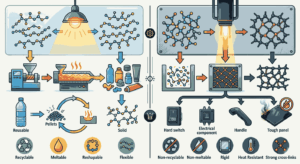
Thermoplastics are polymers that soften on heating and can be reshaped multiple times without significant chemical change. On the other hand, thermosetting polymers harden permanently after heating due to cross-linking. Practicing Thermoplastics and Thermosetting MCQs with Answers allows learners to understand these differences in a practical and exam-oriented manner. Through Thermoplastics and Thermosetting MCQs with Answers, aspirants can also identify examples like polyethylene, PVC, and polystyrene as thermoplastics.
Similarly, thermosetting polymers such as Bakelite, melamine, and urea-formaldehyde are commonly covered in Thermoplastics and Thermosetting MCQs with Answers. These materials cannot be remoulded once set, which makes them ideal for applications requiring durability and heat resistance. When aspirants solve Thermoplastics and Thermosetting MCQs with Answers, they become familiar with real-life applications such as electrical switches, handles of utensils, and insulating materials.
Another advantage of studying Thermoplastics and Thermosetting MCQs with Answers is that it strengthens conceptual understanding. Instead of rote memorization, learners begin to analyze why thermoplastics are recyclable while thermosetting plastics are not. Regular practice with Thermoplastics and Thermosetting MCQs with Answers also improves problem-solving speed and accuracy.
In competitive exams like NEET, JEE, and CUET, questions related to polymer classification are very common. Preparing through Thermoplastics and Thermosetting MCQs with Answers ensures that aspirants are well-prepared for such questions. Moreover, Thermoplastics and Thermosetting MCQs with Answers provide a systematic way to revise important properties, structures, and uses of polymers.
The importance of cross-linking in thermosetting polymers is another key concept often highlighted in Thermoplastics and Thermosetting MCQs with Answers. Cross-linking makes these polymers rigid and heat-resistant. By solving Thermoplastics and Thermosetting MCQs with Answers, aspirants learn how intermolecular forces differ in thermoplastics and thermosetting plastics.
Additionally, Thermoplastics and Thermosetting MCQs with Answers help in understanding industrial applications. Thermoplastics are widely used in packaging, pipes, and containers, whereas thermosetting plastics are used in circuit boards and adhesives. This practical knowledge gained from Thermoplastics and Thermosetting MCQs with Answers is highly valuable for both exams and real-world applications.
Environmental impact is another important topic covered in Thermoplastics and Thermosetting MCQs with Answers. Thermoplastics can be recycled, making them more environmentally friendly compared to thermosetting plastics. Through Thermoplastics and Thermosetting MCQs with Answers, learners also understand the importance of sustainable material usage.
Furthermore, repeated practice using Thermoplastics and Thermosetting MCQs with Answers enhances retention and conceptual clarity. Aspirants become more confident in identifying polymer types based on their properties and structures. This makes Thermoplastics and Thermosetting MCQs with Answers an essential resource for exam preparation.
Thermoplastics and Thermosetting MCQs with Answers:
1. In Buna-S, the symbol Bu stands for
A. 1-butene
B. n-butane
C. 2-butene
D. butadiene
Answer: D
2. The s-block element used as a catalyst in the manufacture of Buna-S rubber is
A. Ca
B. Ba
C. Na
D. Mg
Answer: C
3. The monomers of Buna-S rubber are
A. Vinyl chloride and sulphur
B. Butadiene
C. Styrene and butadiene
D. Isoprene and butadiene
Answer: C
4. A thermoplastic among the following is
A. Bakelite
B. Polystyrene
C. Terylene
D. Urea-formaldehyde resin
Answer: B
5. Novolac, the linear polymer used in paints is
A. Copolymer of 1,3-butadiene and styrene
B. Obtained by polymerization of caprolactam
C. Copolymer of melamine and formaldehyde
D. Initial product of condensation of phenol and formaldehyde in acidic medium
Answer: D
6. Starch is the polymer of
A. Glucose
B. Fructose
C. Both glucose and fructose
D. None
Answer: A
7. β-pleated sheets of polypeptide chains are present in
A. Secondary structure
B. Primary structure
C. Tertiary structure
D. Quaternary structure
Answer: A
8. Which among the following is not a semi-synthetic polymer?
A. Terylene
B. Viscose rayon
C. Cuprammonium silk
D. Acetate rayon
Answer: A
9. Which of the following polymer is used in paints?
A. Gutta percha
B. Melamine
C. Buna-S
D. Novolac
Answer: D
10. How many isoprene units are present in abscisic acid?
A. Three
B. Two
C. Four
D. Five
Answer: A
11. Which polymer is used to manufacture clothes for firefighters?
A. Thiokol
B. Kevlar
C. Nomex
D. Dynel
Answer: C
12. The polymer used in making handles of cookers and frying pans is
A. Bakelite
B. Nylon-2-nylon-6
C. Orlon
D. PVC
Answer: A
13. The monomers used in preparation of dextron are
A. Lactic acid and glycolic acid
B. 3-hydroxybutanoic acid and 3-hydroxypentanoic acid
C. Styrene and butadiene
D. Hexamethylenediamine and adipic acid
Answer: A
14. Select the correct statement for thermoplastic polymer
A. Does not soften on heating
B. Cannot be remoulded
C. Linear or branched chain polymer
D. Cross-linked polymer
Answer: C
15. Which polymer does not soften on heating?
A. Bakelite
B. Polythene
C. Polystyrene
D. PVC
Answer: A
16. Natural rubber is the polymer of
A. 1,3-butadiene
B. Polyamide
C. Isoprene
D. None
Answer: C
17. Rayon is
A. Natural silk
B. Artificial silk
C. Regenerated fibre
D. Synthetic fibre
Answer: C
18. Terylene is the polyester of
A. Hexamethylenediamine and adipic acid
B. Vinyl chloride and formaldehyde
C. Melamine and formaldehyde
D. Ethylene glycol and terephthalic acid
Answer: D
19. Caprolactam is used for the manufacture of
A. Teflon
B. Terylene
C. Nylon-6,6
D. Nylon-6
Answer: D
20. The polymer used as a substitute for wool is
A. Melamine
B. Nylon-6,6
C. Polyacrylonitrile
D. Buna-N
Answer: C
21. Which of the following is a polyamide molecule?
A. Terylene
B. Rayon
C. Nylon-6
D. Polystyrene
Answer: C
22. Which one is a polyester polymer?
A. Nylon-66
B. Terylene
C. Bakelite
D. Melamine
Answer: B
23. Which of the following is a polymer?
A. Carnauba wax
B. Carbowax
C. Beeswax
D. Paraffin wax
Answer: B
24. Which polymer is used for non-stick cookware coating?
A. PET
B. PAN
C. Teflon
D. Perlon
Answer: C
25. Teflon is a polymer of
A. Vinyl chloride
B. Tetrachloroethylene
C. Tetrafluoroethylene
D. Buta-1,3-diene
Answer: C
26. Petrol pump hose pipes are made up of
A. Natural rubber
B. Vulcanized rubber
C. Neoprene
D. Butadiene rubber
Answer: D
27. Forces present in vulcanised rubber are
A. Weak intermolecular forces
B. Hydrogen bonding
C. Three-dimensional cross-linked bonds
D. Metallic bonding
Answer: C
28. Which pair of polymers have similar properties?
A. Nylon, PVC
B. PAN, PTFE
C. PCTFE, PTFE
D. Bakelite, alkyl resin
Answer: B
29. Which of the following are addition polymers?
A. Nylon
B. Melamine formaldehyde
C. Orlon
D. All of these
Answer: C
30. Buna-S rubber is
A. Addition polymer
B. Condensation polymer
C. Copolymer
D. None
Answer: C
Conclusion on Thermoplastics and Thermosetting MCQs with Answers
In conclusion, mastering polymers requires consistent practice and conceptual understanding. Resources like Thermoplastics and Thermosetting MCQs with Answers play a crucial role in achieving this goal. By regularly studying Thermoplastics and Thermosetting MCQs with Answers, aspirants can improve their knowledge, accuracy, and confidence. Ultimately, Thermoplastics and Thermosetting MCQs with Answers serve as a powerful tool for learning, revision, and exam success.