
- Keneitsino Lydia
- April 4, 2026
Power-Packed Teflon and Neoprene MCQs with Answers for Guaranteed Success
Understanding polymers like Teflon and neoprene is essential for aspirants preparing for competitive exams. That is why many learners actively search for Teflon and Neoprene MCQs with Answers to strengthen their conceptual clarity and improve their problem-solving skills. These polymers are frequently asked topics in chemistry exams, making Teflon and Neoprene MCQs with Answers an important resource for revision.
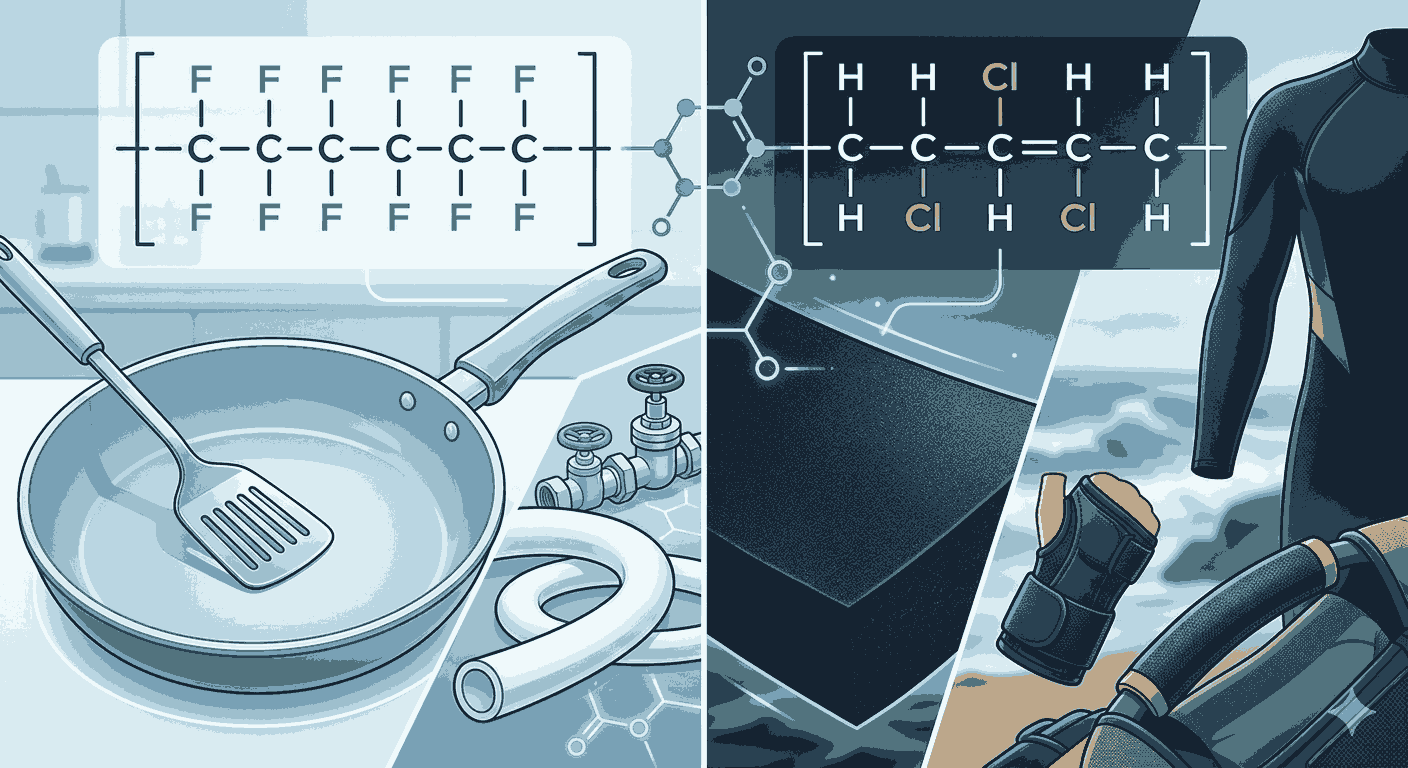
Teflon, scientifically known as polytetrafluoroethylene (PTFE), is a synthetic polymer formed by the polymerization of tetrafluoroethylene. When students practice Teflon and Neoprene MCQs with Answers, they begin to understand why Teflon is highly resistant to heat, chemicals, and friction. This property makes it widely used in non-stick cookware and industrial applications. By solving Teflon and Neoprene MCQs with Answers, aspirants can easily remember these key properties.
Neoprene, on the other hand, is a synthetic rubber produced by the polymerization of chloroprene. It is known for its excellent resistance to oil, heat, and weathering. Practicing Teflon and Neoprene MCQs with Answers helps aspirants distinguish between natural rubber and synthetic rubber like neoprene. This distinction is crucial for exams, where conceptual understanding is often tested through application-based questions.
One major advantage of studying through Teflon and Neoprene MCQs with Answers is that it reinforces knowledge about polymerization processes. Teflon is formed through addition polymerization, while neoprene is also an addition polymer but with unique structural properties. Regular exposure to Teflon and Neoprene MCQs with Answers ensures that aspirants can identify these reactions quickly during exams.
Another important concept covered through Teflon and Neoprene MCQs with Answers is the classification of polymers. Teflon is a thermoplastic polymer, whereas neoprene behaves as an elastomer. By practicing Teflon and Neoprene MCQs with Answers, aspirants can clearly understand these classifications and their real-life applications.
In addition, Teflon and Neoprene MCQs with Answers help learners understand the molecular structure and bonding present in these polymers. Teflon has strong carbon-fluorine bonds, which contribute to its stability and non-reactivity. Neoprene contains chlorine atoms that enhance its resistance to degradation. These concepts are often tested, making Teflon and Neoprene MCQs with Answers highly valuable for preparation.
From an exam perspective, questions related to uses and properties are very common. Teflon is used in coatings, electrical insulation, and chemical-resistant containers, while neoprene is used in wetsuits, hoses, and gaskets. Practicing Teflon and Neoprene MCQs with Answers helps aspirants recall these applications quickly and accurately.
Another benefit of using Teflon and Neoprene MCQs with Answers is improved speed and accuracy. Since competitive exams are time-bound, aspirants need to answer questions quickly. Regular practice of Teflon and Neoprene MCQs with Answers builds confidence and enhances time management skills.
Furthermore, Teflon and Neoprene MCQs with Answers help aspirants identify common mistakes and misconceptions. For example, confusing Teflon with condensation polymers or neoprene with natural rubber is a frequent error. By solving Teflon and Neoprene MCQs with Answers, aspirants can avoid such mistakes.
The importance of Teflon and Neoprene MCQs with Answers also lies in their ability to promote active learning. Instead of memorizing theory, aspirants engage with questions that require understanding and application. This approach makes learning more effective and long-lasting.
Additionally, Teflon and Neoprene MCQs with Answers are useful for quick revision before exams. They cover important concepts such as polymer structure, properties, preparation methods, and uses in a concise format. This makes Teflon and Neoprene MCQs with Answers an ideal last-minute study tool.
Aspirants preparing for exams like NEET, JEE, and board exams can greatly benefit from consistent practice. Incorporating Teflon and Neoprene MCQs with Answers into daily study routines ensures better retention and improved performance.
Teflon and Neoprene MCQs with Answers:
1. Which of the following is a natural polymer?
a) Nylon
b) Teflon
c) Linen
d) Orlon
Answer: c
2. Identify the heteropolymer from the list given below
a) Polyethylene
b) Nylon-6
c) Teflon
d) Nylon-6,6
Answer: d
3. Nylon-66 is
a) Polyester
b) Polyamide
c) Polyacrylate
d) None of these
Answer: b
4. Nylon-6,6 is not a
a) Condensation polymer
b) Polyamide
c) Both condensation polymer and polyamide
d) None of these
Answer: d
5. Which one of the following polymers is prepared by condensation polymerization?
a) Teflon
b) Natural rubber
c) Styrene
d) Nylon-6,6
Answer: d
6. Nylon is an example of
a) Polyamide
b) Polythene
c) Polyester
d) Polysaccharide
Answer: a
7. Natural rubber has
a) Alternate cis- and trans-configuration
b) Random cis- and trans-configuration
c) All cis-configuration
d) All trans-configuration
Answer: c
8. Which of the following is a natural polymer?
a) cis-1,4-polyisoprene
b) Poly(butadiene-styrene)
c) Polybutadiene
d) Poly(butadiene-acrylonitrile)
Answer: a
9. Which of these is not a macromolecule?
a) Proteins
b) Salt
c) Chlorophyll
d) Sugar
Answer: b
10. Neoprene is
a) A monomer of rubber
b) Synthetic rubber
c) Natural rubber
d) Vulcanized rubber
Answer: b
11. Among the following, a natural polymer is:
a) Cellulose
b) PVC
c) Polyethylene
d) Teflon
Answer: a
12. Which of the following is not an example of addition polymer?
a) Polythene
b) Polystyrene
c) Neoprene
d) Nylon-6,6
Answer: d
13. A polymer commonly used as a packaging material is
a) PVC
b) Bakelite
c) Polythene
d) Polypropylene
Answer: c
14. Which of the following is not a polymer?
a) Cholesterol
b) Oxytocin
c) Amylose
d) RNA
Answer: a
15. Which one of the following is a copolymer?
a) Saran
b) Orlon
c) PVC
d) Teflon
Answer: a
16. Bakelite is a
a) Natural polymer
b) Addition polymer
c) Condensation polymer
d) Homopolymer
Answer: c
17. Which one of the following is an example of copolymer?
a) Buna-S
b) Teflon
c) PVC
d) Polypropylene
Answer: a
18. Copolymerization of 1,3-butadiene and acrylonitrile gives
a) Buna-S
b) Buna-N
c) Nylon-6
d) Teflon
Answer: b
19. Which of the following is a biodegradable polymer?
a) Polythene
b) Bakelite
c) PHBV
d) PVC
Answer: c
20. Which one of the following is not a biopolymer?
a) Cellulose
b) Nylon-6
c) Insulin
d) DNA
Answer: b
21. Example of a biodegradable polymer pair is
a) Nylon-66 and terylene
b) PHBV and dextron
c) Bakelite and PVC
d) PET and polyethylene
Answer: b
22. Which one of the following is used in the preparation of cellulose nitrate?
a) KNO₃
b) HNO₃
c) KNO₂
d) HNO₂
Answer: b
23. Which of the following will form a biodegradable polymer?
a) Glycine and aminocaproic acid
b) Ethylene glycol and phthalic acid
c) Hexamethylenediamine and adipic acid
d) 1,3-Butadiene and acrylonitrile
Answer: a
24. Biodegradable polymer is
a) Polystyrene
b) Bakelite
c) PHBV
d) PVC
Answer: c
25. Which one of the following compounds is used to obtain polymer Teflon?
a) Difluoro ethane
b) Monofluoro ethane
c) Tetrafluoro ethane
d) None of these
Answer: c
26. A biodegradable polyamide can be made from
a) Glycine and isoprene
b) Hexamethylene diamine and adipic acid
c) Glycine and aminocaproic acid
d) Styrene and caproic acid
Answer: c
27. Which among the following polymers is non-biodegradable?
a) Teflon
b) Cellulose
c) PHBV
d) Nylon-2-nylon-6
Answer: a
28. Which of the following is a biodegradable polymer?
a) Cellulose
b) Polythene
c) Polyvinyl chloride
d) Nylon-6
Answer: a
29. Which of the following detergent is least biodegradable?
a) CH₃-(CH₂)₁₁-OSO₃Na
b) C₁₇H₃₅COONa
c) Branched alkyl benzene sulphonate
d) Linear alkyl benzene sulphonate
Answer: c
30. Which of the following is not a biodegradable polymer?
a) Glyptol
b) PHBV
c) Polyhydroxybutyrate-co-β-hydroxy valerate
d) Nylon-2-nylon-6
Answer: a
Teflon and Neoprene MCQs with Answers
In conclusion, mastering polymers like Teflon and neoprene becomes much easier with regular practice. Using Teflon and Neoprene MCQs with Answers not only strengthens conceptual understanding but also enhances exam readiness. If you aim to score high in chemistry, make sure to include Teflon and Neoprene MCQs with Answers in your preparation strategy.