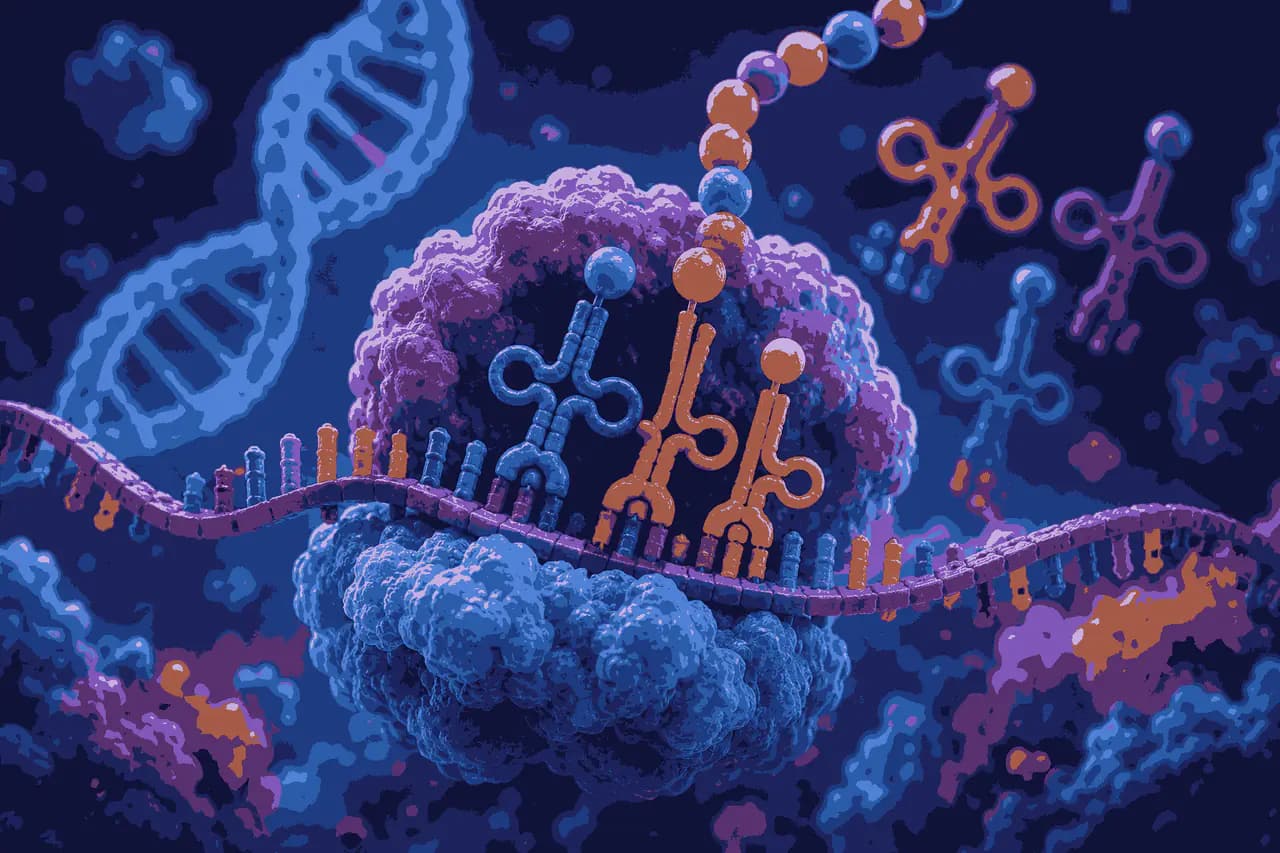
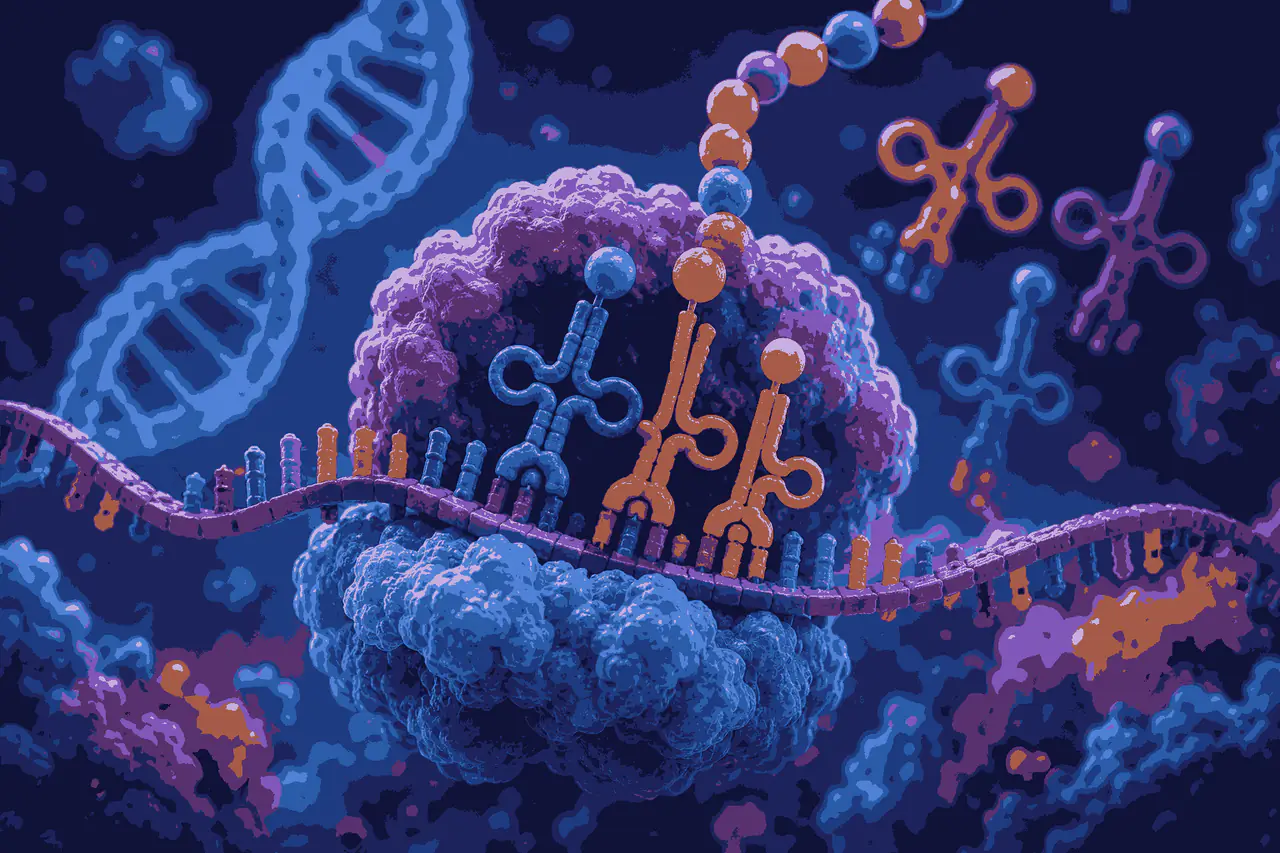
Protein Synthesis and Anticodon MCQs with Answers is one of the most important topics for aspirants preparing for Class 12 Biology board examinations and competitive exams like NEET. The process of protein synthesis forms the foundation of molecular biology because it explains how genetic information stored in DNA is converted into functional proteins. Protein Synthesis and Anticodon MCQs with Answers help aspirants understand the detailed mechanisms of transcription and translation in a simple and conceptual manner. Since these concepts are frequently asked in examinations, regular practice of Protein Synthesis and Anticodon MCQs with Answers improves both accuracy and confidence.
Protein synthesis mainly occurs in two stages known as transcription and translation. In transcription, the genetic information from DNA is copied into messenger RNA or mRNA. Protein Synthesis and Anticodon MCQs with Answers often focus on how RNA polymerase helps in the formation of mRNA inside the nucleus in eukaryotic cells. During translation, this mRNA moves to ribosomes where proteins are synthesized with the help of transfer RNA or tRNA. Aspirants who thoroughly practice Protein Synthesis and Anticodon MCQs with Answers usually develop a better understanding of how codons and anticodons interact during protein formation.
The concept of anticodon is especially important in molecular genetics. Protein Synthesis and Anticodon MCQs with Answers frequently explain that anticodons are sequences of three nucleotides present on tRNA molecules. These anticodons are complementary to codons present on mRNA strands. During translation, the anticodon recognizes the corresponding codon and brings the correct amino acid to the ribosome. Protein Synthesis and Anticodon MCQs with Answers therefore help aspirants understand the specificity and accuracy involved in protein synthesis.
Ribosomes also play a crucial role in translation. Protein Synthesis and Anticodon MCQs with Answers often describe ribosomes as the site of protein synthesis. Ribosomes are made of ribosomal RNA and proteins and consist of large and small subunits. The mRNA attaches to the ribosome, and tRNA molecules carrying amino acids bind sequentially according to codon sequences. Protein Synthesis and Anticodon MCQs with Answers provide aspirants with a detailed understanding of how peptide bonds form between amino acids to create polypeptide chains.
Another important topic included in Protein Synthesis and Anticodon MCQs with Answers is the genetic code. The genetic code consists of codons that specify amino acids. AUG is known as the initiation codon and codes for methionine, while UAA, UAG, and UGA are termination codons. Protein Synthesis and Anticodon MCQs with Answers help aspirants remember these codons through repeated conceptual learning and application-based questions. Understanding codons and anticodons is extremely important because even small mistakes in these sequences can lead to mutations or defective proteins.
Aspirants should also focus on differences between transcription and translation. Protein Synthesis and Anticodon MCQs with Answers commonly compare prokaryotic and eukaryotic protein synthesis processes. In prokaryotes, transcription and translation occur simultaneously in the cytoplasm, whereas in eukaryotes transcription occurs in the nucleus and translation occurs in the cytoplasm. Protein Synthesis and Anticodon MCQs with Answers help aspirants organize these differences clearly for examination preparation.
The role of enzymes in protein synthesis is another significant area. Protein Synthesis and Anticodon MCQs with Answers often include questions on aminoacyl tRNA synthetase, RNA polymerase, peptidyl transferase, and ligase enzymes. These enzymes ensure proper attachment of amino acids and smooth progression of translation. Aspirants who revise these enzymatic functions repeatedly through Protein Synthesis and Anticodon MCQs with Answers generally perform better in conceptual biology sections.
Practicing molecular biology questions also improves analytical thinking and problem-solving abilities. Protein Synthesis and Anticodon MCQs with Answers are especially useful because they frequently involve sequence analysis, codon identification, and interpretation-based learning. Such practice helps aspirants become familiar with exam patterns and improves speed during competitive tests.
Protein Synthesis and Anticodon MCQs with Answers:
(A) Expressed sequences of eukaryotic genes are exons.
(B) Intervening gene sequences of eukaryotes that do not appear in processed RNA are cistrons.
(C) Process of removal of introns and joining of exons in defined order is splicing.
(D) Monocistronic transcriptional unit has only exons.
A. A, B
B. B, C
C. A, D
D. B, D
Answer: D. B, D
Explanation: The incorrect statements are B and D. Intervening sequences are introns, not cistrons. Monocistronic transcriptional units may contain both exons and introns.
- DNA chromosome replication takes place during:
A. G1-phase
B. G2-phase
C. S-phase
D. Prophase
Answer: C. S-phase
Explanation: DNA replication occurs during the S-phase of the cell cycle.
- Which of the following first suggested the conservative model of DNA replication?
A. Cairns
B. Meselson and Stahl
C. Watson and Crick
D. Taylor
Answer: B. Meselson and Stahl
Explanation: Meselson and Stahl experimentally studied DNA replication models.
- Match the following lists:
List-I:
(A) Template strand
(B) Location of promoter
(C) Okazaki fragments
(D) Taylor experiments
List-II:
(i) Before structural gene
(ii) Faba beans
(iii) Transcriptase
(iv) 5'-3' polarity
List-III:
(I) DNA replication semi-conservative mode
(II) DNA with 3'-5' polarity
(III) 5' end of coding strand
(IV) DNA ligase
A. ii, II; i, III; iii, IV; iv, I
B. iii, II; i, III; iv, IV; ii, I
C. iii, III; ii, IV; i, I; iv, II
D. iv, II; ii, IV; i, III; iii, I
Answer: B. iii, II; i, III; iv, IV; ii, I
Explanation:
- Template strand → Transcriptase → DNA with 3'-5' polarity
- Promoter → Before structural gene → 5' end of coding strand
- Okazaki fragments → 5'-3' polarity → DNA ligase
- Taylor experiments → Faba beans → Semi-conservative replication
- The place where RNA polymerase attaches with the DNA is called:
A. Promoter site
B. Operator site
C. Activator site
D. Repressor site
Answer: A. Promoter site
Explanation: RNA polymerase binds to the promoter region to initiate transcription.
- Transcription of DNA is aided by:
A. Exonuclease
B. Recombinase
C. DNA polymerase
D. RNA polymerase
Answer: D. RNA polymerase
Explanation: RNA polymerase synthesizes RNA during transcription.
- Read the following statements and choose the correct option.
- RNA polymerase associates transiently with ‘Rho’ factor to initiate transcription.
- In bacteria, transcription and translation take place in the same compartment.
- RNA polymerase I is responsible for transcription of tRNA.
- During capping, adenylate residues are added at the 3′ end.
- hnRNA is the precursor of mRNA.
A. 2 only is correct
B. 2, 3 and 5 only are correct
C. 3 and 4 only are correct
D. 2 and 5 only are correct
Answer: D. 2 and 5 only are correct
Explanation: In bacteria, transcription and translation occur in the same compartment. hnRNA acts as precursor of mRNA.
- The heavy isotope used for proving semi-conservative replication of DNA by Meselson and Stahl was:
A. 15N
B. 14N
C. 14C
D. 31N
Answer: A. 15N
Explanation: Meselson and Stahl used heavy nitrogen isotope 15N in their experiment.
- Arrange the following events of DNA replication in correct order:
(i) Bonds between complementary bases break
(ii) Bonds between complementary bases form
(iii) DNA molecules uncoil
(iv) Opposite strands separate
(v) Sugar phosphate bonds form
(vi) Free nucleotides align with complementary nucleotides
A. (vi), (i), (iii), (iv), (v), (ii)
B. (iii), (vi), (i), (iv), (v), (ii)
C. (i), (iii), (vi), (iv), (ii), (v)
D. (iii), (i), (iv), (vi), (ii), (v)
Answer: D. (iii), (i), (iv), (vi), (ii), (v)
Explanation: DNA first uncoils, hydrogen bonds break, strands separate, nucleotides align, base pairing occurs, and sugar-phosphate bonds form.
- Which option correctly shows the labelled regions in the given diagram of DNA replication?
A. Only r
B. p, r
C. p, q
D. q, r
Answer: A. Only r
Explanation: DNA replication involves replacement of RNA primers and joining of DNA fragments.
- For the given DNA sequence identify the complementary mRNA sequence:
DNA: 3′ - ATGCATGCATGC - 5′
A. 5′ - UACGUACGUACG - 3′
B. 5′ - TACGTACGTACG -3′
C. 3′ - UACGUACGUACG -5′
D. 5′ – GCATGCATGCAT -3′
Answer: A. 5′ - UACGUACGUACG - 3′
Explanation: During transcription adenine pairs with uracil in RNA.
- During replication of retrovirus, what is introduced into the host cell?
A. Viral protein
B. Viral RNA
C. Viral DNA
D. Transcriptase enzyme
Answer: B. Viral RNA
Explanation: Retroviruses introduce RNA into host cells.
- In the given transcription unit, identify regions I and II respectively.
A. Promoter and Terminator
B. Rho factor and Sigma factor
C. Terminator and Promoter
D. Operator and Inhibitor
Answer: C. Terminator and Promoter
Explanation: Promoter initiates transcription while terminator ends transcription.
- Match Column I with Column II correctly:
Column I:
- DNA replication
- Translation
- Transcription
- Reverse transcription
Column II:
I. RNA polymerase
II. DNA polymerase
III. Reverse transcriptase
IV. Aminoacyl synthetase
A. II IV III I
B. II IV I III
C. II III IV I
D. II I IV III
Answer: B. II IV I III
Explanation:
- DNA replication → DNA polymerase
- Translation → Aminoacyl synthetase
- Transcription → RNA polymerase
- Reverse transcription → Reverse transcriptase
- When DNA replication starts, what happens initially?
A. Hydrogen bonds between strands break
B. Phosphodiester bonds break
C. Bonds between sugar and base break
D. Leading strand produces Okazaki fragments
Answer: A. Hydrogen bonds between strands break
Explanation: Helicase breaks hydrogen bonds to separate DNA strands.
- After transcription of sequence 3'AAA TGC GCG ATA 5', what is the mRNA and anticodon sequence?
A. 5' UUU ACG CGC UAU 3' and 3' AAA-UGC-GCG-AUA5'
B. 5'UAU CGC GCA UUU 3' and 3' AUA-GCG-CGU-AAA5'
C. 5'UUU ACC TUG UAU 3' and 3' AAA-UGG-UAC-AUA5'
D. 5'UAU GUT CCA UUU 3' and 3' AUA-CAU-GGU-AAA5'
Answer: A. 5' UUU ACG CGC UAU 3' and 3' AAA-UGC-GCG-AUA5'
Explanation: Codons and anticodons are complementary to each other.
- What initiation and termination factors are involved in transcription in Eukaryotes?
A. α and σ, respectively
B. σ and ρ, respectively
C. α and β, respectively
D. β and γ, respectively
Answer: B. σ and ρ, respectively
Explanation: Sigma (σ) factor helps in the initiation of transcription by enabling RNA polymerase to recognize the promoter region. Rho (ρ) factor is involved in the termination of transcription by helping release the newly formed RNA strand from the DNA template.
- DNA gyrase belongs to which type of enzyme?
A. Reverse transcriptase
B. DNA topoisomerase
C. DNA polymerase
D. DNA ligase
Answer: B. DNA topoisomerase
Explanation: DNA gyrase is a topoisomerase that relieves supercoiling.
- DNA gyrase, the enzyme involved in DNA replication, belongs to which type of enzyme?
A. Reverse Transcriptase
B. DNA Topoisomerase
C. DNA Polymerase
D. DNA Ligase
Answer: B. DNA Topoisomerase
Explanation: DNA gyrase is a type of DNA topoisomerase that helps relieve supercoiling tension during DNA replication.
- Which of the following statements are correct regarding gene structure and transcription?
I. A promoter is a region of DNA which initiates transcription of a single RNA.
II. Only one strand of DNA acts as the template strand during transcription.
III. RNA polymerase moves in the 3′→5′ direction on the template strand.
IV. Complementary RNA nucleotides are added in the 5′→3′ direction.
A. II, III and IV
B. II and IV
C. I, II and IV
D. I, II, III and IV
Answer: D. I, II, III and IV
Explanation: A promoter is the DNA sequence where transcription begins. During transcription, only one DNA strand acts as the template strand. RNA polymerase reads the template strand in the 3′→5′ direction and synthesizes RNA in the 5′→3′ direction by adding complementary nucleotides.
- During transcription, RNA polymerase holoenzyme assumes a saddle-like structure and binds to a gene promoter. What is its DNA-binding sequence?
A. TATA
B. TTAA
C. AATT
D. CACC
Answer: A. TATA
Explanation: The TATA box is a promoter sequence recognized by RNA polymerase during initiation of transcription.
- The molecular basis of organ differentiation depends on the modulation in transcription by which of the following?
A. Anticodon
B. RNA polymerase
C. Ribosome
D. Transcription factor
Answer: D. Transcription factor
Explanation: Transcription factors regulate gene expression and play a major role in organ differentiation.
- What is the function of transcription factors in genetic regulation?
A. Bind to enhancer regions of DNA
B. Bind to promoter regions of DNA
C. Bind to both enhancer and promoter regions of DNA
D. Bind to introns of DNA
Answer: C. Bind to both enhancer and promoter regions of DNA
Explanation: Transcription factors regulate gene activity by binding to enhancer and promoter regions.
- What is the role of an anticodon in protein synthesis?
A. It is a trinucleotide sequence in mRNA
B. It is a trinucleotide sequence in tRNA
C. It is a trinucleotide sequence in rRNA
D. It is a trinucleotide sequence in DNA
Answer: B. It is a trinucleotide sequence in tRNA
Explanation: The anticodon is present on tRNA and pairs with the complementary codon on mRNA during translation.
- What is the function of RNA polymerase in genetic processes?
A. Replicating DNA into RNA
B. Replicating RNA into DNA
C. Transcribing DNA into RNA
D. Translating RNA into proteins
Answer: C. Transcribing DNA into RNA
Explanation: RNA polymerase synthesizes RNA using DNA as the template during transcription.
- In prokaryotes, what is the nature of the structural gene?
A. Polycistronic
B. Monocistronic
C. Bicistronic
D. Tricistronic
Answer: A. Polycistronic
Explanation: In prokaryotes, structural genes are usually polycistronic, meaning one mRNA codes for multiple proteins.
- What are the expressed gene sequences defined as?
A. Introns
B. Exons
C. Promoters
D. Enhancers
Answer: B. Exons
Explanation: Exons are the coding sequences that remain in mature mRNA after splicing.
- What is the corresponding sequence of mRNA when a polynucleotide template DNA strand is 3' – TAC GGT AAG CGG ATC – 5'?
A. 5'-AUG CCA UUC GCC UAG-3'
B. 3'-AUG CCA UUE GCC UAG-5'
C. 5'-UAC GGU AAG CGG AUC-3'
D. 3'-UAC GGU AAG CGG AUC-5'
Answer: A. 5'-AUG CCA UUC GCC UAG-3'
Explanation: mRNA is synthesized complementary to the DNA template strand using RNA base pairing rules.
- What is Rho factor associated with?
A. RNA polymerase
B. Catalysis process of elongation
C. Initiates the transcription
D. Transcription of r-RNA
Answer: A. RNA polymerase
Explanation: Rho factor is associated with RNA polymerase and helps terminate transcription in prokaryotes.
- When a radioactive DNA of bacterium E.coli (incorporated with N15 isotope) was placed in a medium containing N14 isotope for three generations, what percentage of the radioactive strand is expected?
A. 25%
B. 100%
C. 75%
D. 37.5%
Answer: A. 25%
Explanation: After three generations in N14 medium, only 25% of DNA strands retain the original N15 isotope.
- Which process involves the synthesis of mRNA by the polymerase enzyme that moves to the ribosome to direct protein synthesis?
A. Translation
B. Mechanism of protein synthesis
C. Transcription
D. Replication
Answer: C. Transcription
Explanation: Transcription is the process in which mRNA is synthesized from DNA and later moves to ribosomes for protein synthesis.
Conclusion on Protein Synthesis and Anticodon MCQs with Answers
Protein synthesis remains one of the most fascinating biological processes because it connects genetics with cellular function. Protein Synthesis and Anticodon MCQs with Answers provide a strong conceptual framework for understanding how living organisms produce proteins necessary for growth, metabolism, repair, and regulation. With regular revision and continuous practice, aspirants can master these topics effectively. Ultimately, Protein Synthesis and Anticodon MCQs with Answers not only strengthen examination preparation but also deepen the understanding of molecular biology and genetic mechanisms.
Related reading
Ultimate Polypeptide Synthesis MCQs with Answers for Competitive Exams - Boost Your Biology Preparation Fast
Master Polypeptide Synthesis MCQs with Answers for NEET , Class 12 Biology. Learn translation, codons, anticodons, ribosomes, protein synthesis concepts easily.
Ultimate 30 Transcription in Eukaryotes MCQs NEET with Answers - Powerful Practice to Crack Biology Fast
Master Transcription in Eukaryotes MCQs NEET with Answers through detailed concepts on RNA synthesis, splicing, RNA polymerases , gene expression for aspirants.