
- Keneitsino Lydia
- March 30, 2026
30 Peptide Bond and Disulfide Bond MCQs with Answers – Powerful Practice to Boost Your Score
Understanding protein structure is essential for mastering biomolecules in chemistry, especially for competitive exams like CUET, NEET, and JEE. One of the most important topics within this chapter is the concept of peptide bonds and disulfide bonds. Aspirants often search for Peptide bond and disulfide bond mcqs with answers to strengthen their conceptual clarity and problem-solving skills.
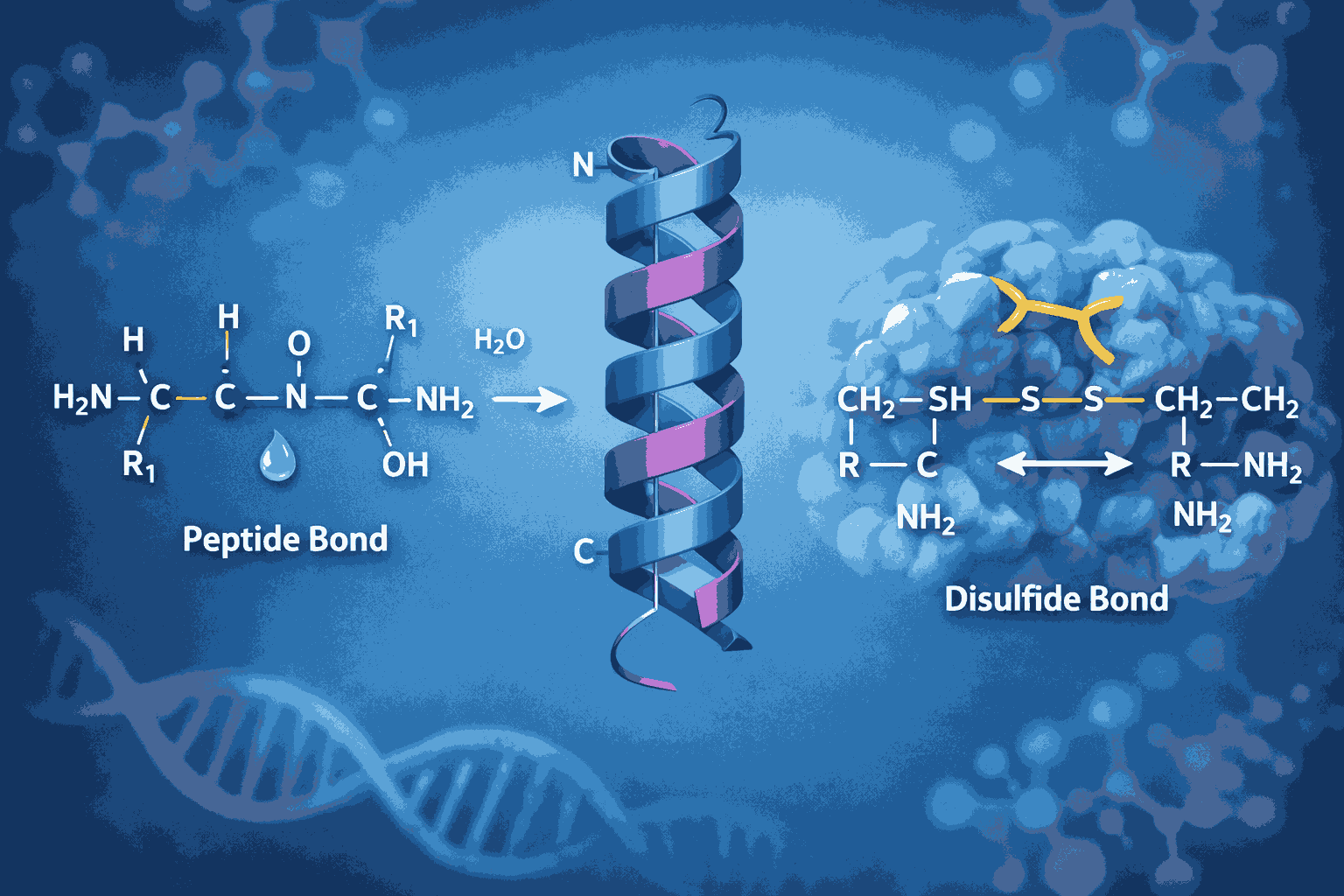
When preparing for exams, practicing Peptide bond and disulfide bond mcqs with answers helps in identifying how proteins are formed and stabilized. A peptide bond is a covalent bond formed between the carboxyl group of one amino acid and the amino group of another. This bond is the backbone of protein structure, and mastering it is crucial for any chemistry aspirant.
To build a strong foundation, solving Peptide bond and disulfide bond mcqs with answers allows aspirants to understand how amino acids link together in a specific sequence. This sequence determines the primary structure of proteins, which further folds into complex shapes. Without a clear understanding of peptide bonds, it becomes difficult to grasp higher levels of protein structure.
Another key concept that appears frequently in Peptide bond and disulfide bond mcqs with answers is the disulfide bond. These bonds are formed between two cysteine amino acids through the oxidation of their thiol (-SH) groups. Disulfide bonds play a critical role in stabilizing the tertiary and quaternary structures of proteins.
While practicing Peptide bond and disulfide bond mcqs with answers, aspirants learn that peptide bonds are planar and have partial double bond character due to resonance. This restricts rotation and contributes to the stability of protein structures. Such conceptual questions are common in exams and require a clear understanding rather than rote learning.
Similarly, Peptide bond and disulfide bond mcqs with answers often emphasize the importance of disulfide bonds in maintaining protein shape under different environmental conditions. For example, keratin in hair and nails contains strong disulfide bonds, giving it durability and strength.
Regular practice of Peptide bond and disulfide bond mcqs with answers also helps aspirants differentiate between various types of bonds present in proteins, such as hydrogen bonds, ionic interactions, and hydrophobic interactions. Among these, peptide and disulfide bonds are particularly significant due to their structural roles.
Aspirants preparing for competitive exams should focus on Peptide bond and disulfide bond mcqs with answers to understand how denaturation affects proteins. During denaturation, secondary and tertiary structures are disrupted, but peptide bonds usually remain intact, while disulfide bonds may break under strong conditions.
Another advantage of solving Peptide bond and disulfide bond mcqs with answers is that it enhances analytical thinking. Questions may involve identifying the type of bond responsible for stability or predicting changes in protein structure under certain conditions.
In many cases, Peptide bond and disulfide bond mcqs with answers include real-life applications. For instance, the role of disulfide bonds in insulin structure or the importance of peptide bonds in enzyme function. Such applications make learning more relatable and easier to remember.
Consistent practice with Peptide bond and disulfide bond mcqs with answers ensures that aspirants are well-prepared for both theoretical and application-based questions. It also improves speed and accuracy, which are crucial during exams.
Furthermore, Peptide bond and disulfide bond mcqs with answers help reinforce concepts like protein folding, stability, and biological activity. Understanding these concepts is essential not only for exams but also for advanced studies in biochemistry and molecular biology.
By regularly revising Peptide bond and disulfide bond mcqs with answers, aspirants can identify their weak areas and work on them effectively. This targeted preparation strategy leads to better performance in exams.
Another important aspect covered in Peptide bond and disulfide bond mcqs with answers is the distinction between covalent and non-covalent interactions in proteins. Peptide and disulfide bonds are covalent, making them stronger compared to other interactions.
Practicing Peptide bond and disulfide bond mcqs with answers also helps aspirants understand the biochemical significance of these bonds in maintaining life processes. Proteins are involved in nearly every biological function, and their structure determines their function.
In addition, Peptide bond and disulfide bond mcqs with answers are useful for quick revision before exams. They provide a concise way to review key concepts and test understanding.
Aspirants should make it a habit to solve Peptide bond and disulfide bond mcqs with answers regularly to stay confident and exam-ready. This approach ensures a thorough understanding of the topic.
Peptide Bond and Disulfide Bond MCQs with Answers:
1. Which functional group participates in disulphide bond formation in proteins?
a) Thiocarbonate
b) Thiol
c) Thiother
d) Thioclate
Answer: b
2. Which of the following is generally water insoluble?
a) Fibrous protein
b) Vitamin-C
c) Amylose
d) Glycine
Answer: a
3. Which of the following is correct about H-bonding in DNA?
a) A–T, G–C
b) A–G, T–C
c) G–T, A–C
d) A–A, T–T
Answer: a
4. Dialysis can be used to separate
a) Protein and starch
b) Glucose and protein
c) Glucose and NaCl
d) Glucose and fructose
Answer: b
5. Myosin is
a) Fibrous protein
b) Globular protein
c) Enzyme
d) None
Answer: a
6. Which of the following proteins is globular?
a) Collagen
b) Albumin
c) Myosin
d) Fibrin
Answer: b
7. The prosthetic group of haemoglobin is
a) Porphin
b) Globin
c) Haem
d) Gelatin
Answer: c
8. Protein gives blue colour with
a) Benedict reagent
b) Iodine solution
c) Ninhydrin
d) Biuret
Answer: c
9. Peptization denotes
a) Digestion of food
b) Hydrolysis of proteins
c) Breaking and dispersion into colloidal state
d) Precipitation of solid
Answer: c
10. Which of the following statements is not correct?
a) Ovalbumin is food reserve
b) Thrombin & fibrinogen in clotting
c) Denaturation makes proteins more active
d) Insulin maintains sugar level
Answer: c
11. Which is not true statement?
a) α-carbon is asymmetric
b) All proteins are L-form
c) Body synthesizes all proteins
d) Zwitterion at pH 7
Answer: b
12. Which structure remains intact during denaturation?
a) Secondary and tertiary
b) Primary only
c) Secondary only
d) Tertiary only
Answer: b
13. The linkage present in proteins is
a) Peptide bond
b) Ester bond
c) Ionic bond
d) –NH
Answer: a
14. Ninhydrin gives blue colour with
a) Proteins
b) Peptides
c) α-amino acids
d) All of these
Answer: d
15. Which functional group forms disulphide bond?
a) Thiocarbonate
b) Thiol
c) Thiother
d) Thioclate
Answer: b
16. Proteins are
a) Low MW polypeptides
b) High MW polypeptides
c) Polymers of amides
d) Secondary amides
Answer: b
17. Incorrect statement about enzymes
a) Specific
b) Biocatalysts
c) Lower activation energy
d) Polysaccharides
Answer: d
18. Enzyme inhibitor drugs
a) Competitive & non-competitive
b) Bind active & allosteric sites
c) Competitive block allosteric site
d) Non-competitive block active site
Answer: c
19. Animal starch is
a) Amylose
b) Maltose
c) Glycogen
d) Amylopectin
Answer: c
20.
Match the Following (Enzymes and Reactions)
Match List-I with List-II:
| List-I (Enzyme) | List-II (Function) |
|---|---|
| A. Invertase | I. Maltose → Glucose |
| B. Pepsin | II. Sucrose → Glucose + Fructose |
| C. Diastase | III. Proteins → Peptides |
| IV. Starch → Maltose |
Options:
a) A–II, B–III, C–IV
b) A–I, B–III, C–IV
c) A–I, B–II, C–IV
d) A–II, B–IV, C–III
Answer: a
21.
Assertion–Reason MCQ (Enzyme Inhibition)
Assertion (A): Action of an enzyme can be blocked only when an inhibitor blocks the active site of the enzyme.
Reason (R): An inhibitor can form a strong covalent bond with the enzyme.
a) Both Assertion and Reason are true
b) Both Assertion and Reason are false
c) Assertion is true but Reason is false
d) Assertion is false but Reason is true
Answer: d
22. Hormone increasing blood glucose
a) Insulin
b) Glucagon
c) Epinephrine
d) Estrogen
Answer: b
23. Maltase hydrolysis gives
a) Sucrose
b) Cellulose
c) Lactose
d) Maltose → glucose
Answer: d
24. Number of amino acids in insulin
a) 55
b) 1051
c) 51
d) 100
Answer: c
25. Not a lipid
a) Vitamin-A
b) Tristearin
c) Cholesterol
d) Alanine
Answer: d
26. Fermentation purpose in wine making
a) Accelerate ethanol
b) Oxidize ethanol
c) Prevent oxidation
d) None
Answer: a
27. Metabolic functions carried by
a) Lipids
b) Peptides
c) Nucleic acid
d) Enzymes
Answer: d
28. Enzymes are
a) Only catalysts
b) Only proteins
c) Both
d) None
Answer: c
29. Hormone maintaining glucose level
a) Thyroxine
b) Insulin
c) Testosterone
d) Epinephrine
Answer: b
30. Which one is an emulsion?
a) Milk
b) Soap lather
c) Butter
d) Vanishing cream
Answer: a
Conclusion on Peptide Bond and Disulfide Bond MCQs with Answers
To conclude, mastering protein chemistry requires consistent practice and conceptual clarity. Using Peptide bond and disulfide bond mcqs with answers as a study tool is one of the most effective ways to achieve this. With proper preparation and regular revision, aspirants can confidently tackle any question related to peptide and disulfide bonds in their exams.