
- Keneitsino Lydia
- March 23, 2026
30 Organic Nitrogen Compounds MCQs with Answers and Explanations – Boost Your Score Fast
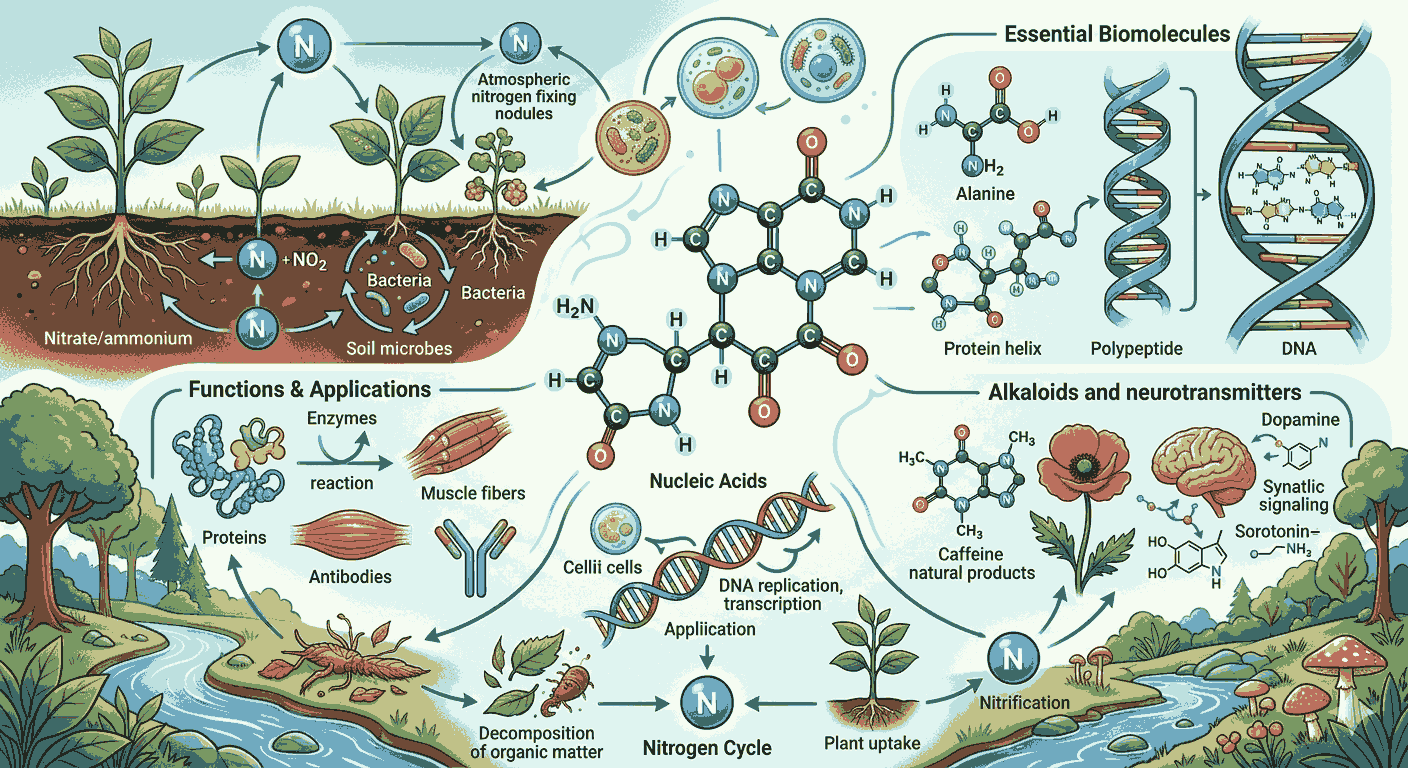
Organic nitrogen compounds form a significant part of Class 12 Chemistry and are extremely important for competitive exams like NEET and JEE. These compounds include amines, amides, nitro compounds, nitriles, and diazonium salts, each having unique properties and reactions. To master this chapter effectively, practicing Organic Nitrogen Compounds MCQs with answers and explanations is essential, as it helps aspirants build both conceptual clarity and problem-solving skills.
Understanding organic nitrogen compounds requires a strong grasp of their structure, classification, and reactivity. By regularly solving Organic Nitrogen Compounds MCQs with answers and explanations, aspirants can reinforce their understanding of how these compounds behave under different conditions. This type of practice ensures that learners are not just memorizing reactions but actually understanding the underlying concepts.
One of the most important topics in this chapter is amines. Amines are classified as primary, secondary, and tertiary, and their basicity depends on factors like inductive effect, resonance, and steric hindrance. Practicing Organic Nitrogen Compounds MCQs with answers and explanations helps students compare these factors effectively and understand why certain amines are more basic than others.
Another key area is the reactions of amines, such as the carbylamine test, diazotization, and acylation. These reactions are frequently asked in exams and require a clear understanding of mechanisms. By solving Organic Nitrogen Compounds MCQs with answers and explanations, aspirants can become familiar with these reactions and learn to identify the correct conditions and products quickly.
Nitro compounds are also an important part of organic nitrogen chemistry. Their reduction reactions lead to different products depending on the reagents used, such as aniline, hydroxylamine, or azobenzene. Practicing Organic Nitrogen Compounds MCQs with answers and explanations helps aspirants understand these variations and avoid confusion during exams.
Amides and nitriles are equally important, especially when it comes to their preparation and conversion reactions. For example, amides can be converted into amines through Hoffmann bromamide degradation, while nitriles can be reduced to primary amines. Regular practice of Organic Nitrogen Compounds MCQs with answers and explanations allows students to connect these reactions and understand their applications.
Diazonium salts play a crucial role in aromatic chemistry. They undergo various substitution reactions such as Sandmeyer, Gattermann, and Balz–Schiemann reactions. These reactions are widely tested, and practicing Organic Nitrogen Compounds MCQs with answers and explanations ensures that students remember the reagents and conditions required for each transformation.
One of the major benefits of Organic Nitrogen Compounds MCQs with answers and explanations is that they improve analytical thinking. Instead of simply recalling information, students learn to interpret reaction pathways and predict products. This skill is particularly useful in solving complex, multi-step reaction questions.
Another advantage of practicing Organic Nitrogen Compounds MCQs with answers and explanations is that it enhances speed and accuracy. With regular practice, aspirants become more confident in identifying the correct answers and avoiding common mistakes. This is especially important in time-bound exams.
Revision also becomes more efficient with Organic Nitrogen Compounds MCQs with answers and explanations, as aspirants can quickly go through important concepts and reactions. This method of revision is more engaging and effective compared to traditional note-reading.
Furthermore, Organic Nitrogen Compounds MCQs with answers and explanations expose aspirants to different question formats, including assertion-reason and case-based questions. This prepares them for the variety of questions that may appear in exams.
Consistency in practice is key to success in organic chemistry. By regularly solving Organic Nitrogen Compounds MCQs with answers and explanations, aspirants can strengthen their understanding, improve retention, and perform better in exams. These MCQs also help in identifying weak areas, allowing students to focus on topics that need improvement.
Organic Nitrogen Compounds MCQs with Answers and Explanations:
1. Benzamide and benzyl amine can be distinguished by:
a) Cold dilute HCl
b) Cold dilute NaOH
c) Both (a) and (b)
d) NaNO₂, HCl, β-naphthol
Answer: a
2. Compare boiling points of isomeric alkyl amines:
a) 1° > 2° > 3°
b) 1° > 3° > 2°
c) 1° < 2° < 3°
d) 1° < 3° < 2°
Answer: a
3. Which amine gives yellow oily liquid with HNO₂?
a) Ethyl methyl amine
b) Aniline
c) 3-methyl benzyl amine
d) Methyl amine
Answer: a
4. N-ethyl-N-methylpropan-1-amine is:
a) 1° amine
b) 2° amine
c) 3° amine
d) 4° amine
Answer: c
5. False statement about primary amines:
a) Alkyl amines are stronger bases than aryl amines
b) Alkyl amines react with HNO₂ to form alcohol
c) Alkyl amines react with HNO₂ to form phenol
d) Alkyl amines are stronger bases than NH₃
Answer: c
6. Acetamide gives methyl amine with:
a) NaOH + Br₂
b) Sodalime
c) Hot conc. H₂SO₄
d) PCl₅
Answer: a
7. Not a usual method for preparing primary amines:
a) Hoffmann method
b) Gabriel synthesis
c) Curtius method
d) Reductive amination
Answer: a
8. Least basic amine:
a) Ethylamine
b) Diethylamine
c) Aniline
d) Benzylamine
Answer: c
9.Which of the following represents an amide functional group?
a) R–CO–NH₂
b) R–NH₂
c) R–CN
d) R–NO₂
Answer: a
10. Reagent converting acetamide to methanamine:
a) P₂O₅
b) NaOBr
c) LiAlH₄
d) Na(Hg)/EtOH
Answer: b
11. Converts CH₃CONH₂ to CH₃NH₂:
a) NaBr
b) NaOBr
c) Br₂
d) None
Answer: b
12. Compound forming yellow oily liquid with HNO₂:
a) 2-methyl aniline
b) Methyl amine
c) Benzyl amine
d) Diethyl amine
Answer: d
13. Iso-propyl amine is:
a) Primary amine
b) Secondary amine
c) Tertiary amine
d) Quaternary amine
Answer: a
14. Which gives carbylamine test?
a) N,N-dimethyl aniline
b) 2,4-dimethyl aniline
c) N-methyl-2-methyl aniline
d) N-methyl benzylamine
Answer: b
15. Method to separate 1°, 2°, 3° amines:
a) Hoffmann method
b) Lucas method
c) Victor Meyer method
d) Kolbe method
Answer: a
16. Carbylamine is:
a) RCN
b) RCONH₂
c) RCH=NH
d) RNC
Answer: d
17. Diethyl oxalate distinguishes:
a) Alcohols
b) Amines
c) Alkyl halides
d) Hydrocarbons
Answer: b
18. Chlorobenzene from aniline is prepared using:
a) Cl₂/UV
b) Cl₂/AlCl₃
c) HNO₂ then Cu₂Cl₂
d) HCl + Cu₂Cl₂
Answer: c
19. Secondary amide can be prepared from:
a) Alkyl isocyanide
b) Alkyl cyanide
c) Alkanamide
d) Phthalimide + alkyl halide
Answer: a
20. Reaction producing aniline:
a) C₆H₅NO₂ + Zn/KOH
b) C₆H₅NO₂ + Zn/NH₄Cl
c) C₆H₅NO₂ + LiAlH₄
d) C₆H₅NO₂ + Zn/HCl
Answer: d
21. In acetylation of amines, acetyl replaces:
a) H on nitrogen
b) H on carbon
c) One or more H on nitrogen
d) H on C or N
Answer: c
22. Reaction R₂C=NNH₂ → R₂CH₂ is:
a) Clemmensen reduction
b) Hinsberg reaction
c) Tishchenko reaction
d) Wolff–Kishner reduction
Answer: d
23. Compound forming oily nitroamine with HNO₂:
a) CH₃NH₂
b) C₂H₅NH₂
c) C₂H₅NHCH₂CH₃
d) (C₂H₅)₃N
Answer: c
24. Number of primary amines (C₄H₁₁N):
a) 1
b) 2
c) 3
d) 4
Answer: d
25. Benzamide → benzonitrile using:
a) H₂O⁺
b) OH⁻
c) KCN
d) P₂O₅
Answer: d
26. Benzyl amine + CHCl₃/KOH gives:
a) Benzyl alcohol
b) Benzaldehyde
c) Benzonitrile
d) Benzyl isocyanide
Answer: d
27. Acetamide + Br₂/NaOH gives:
a) N-bromoamide
b) Bromoacetic acid
c) Methanamine
d) Ethanamine
Answer: c
28. Compound giving oily nitrosoamine:
a) CH₃NH₂
b) (CH₃)₂CHNH₂
c) CH₃NHCH₃
d) (CH₃)₃N
Answer: c
29. End product Y in sequence is:
a) Ethanitrile
b) Acetic acid
c) Ethanamine
d) Chloroethane
Answer: c
30.Aniline is first diazotized and then treated with CuCl (Sandmeyer reaction). What is the final product formed?
a) Phenol
b) Chlorobenzene
c) Benzene
d) Nitrobenzene
Answer: b
Conclusion on Organic Nitrogen Compounds MCQs with Answers and Explanations
In conclusion, mastering organic nitrogen compounds requires both theoretical knowledge and practical application. Organic Nitrogen Compounds MCQs with answers and explanations provide the perfect balance of both, making them an indispensable tool for aspirants. By incorporating Organic Nitrogen Compounds MCQs with answers and explanations into their study routine, learners can build confidence, enhance their problem-solving abilities, and achieve excellent results in their examinations.