Understanding reproduction is essential in biology, and one of the most important processes is oogenesis. For aspirants, especially at the Class 12 level, learning this topic clearly can make a huge difference in exam performance. This guide on Oogenesis stages explained simply class 12 biology will help you grasp the concept step by step in an easy and structured manner.
To begin with, Oogenesis stages explained simply class 12 biology focuses on how female gametes, or ova, are formed in the ovaries. Unlike spermatogenesis, which is continuous, oogenesis is a cyclic and highly regulated process. This makes Oogenesis stages explained simply class 12 biology slightly more complex but also more interesting.
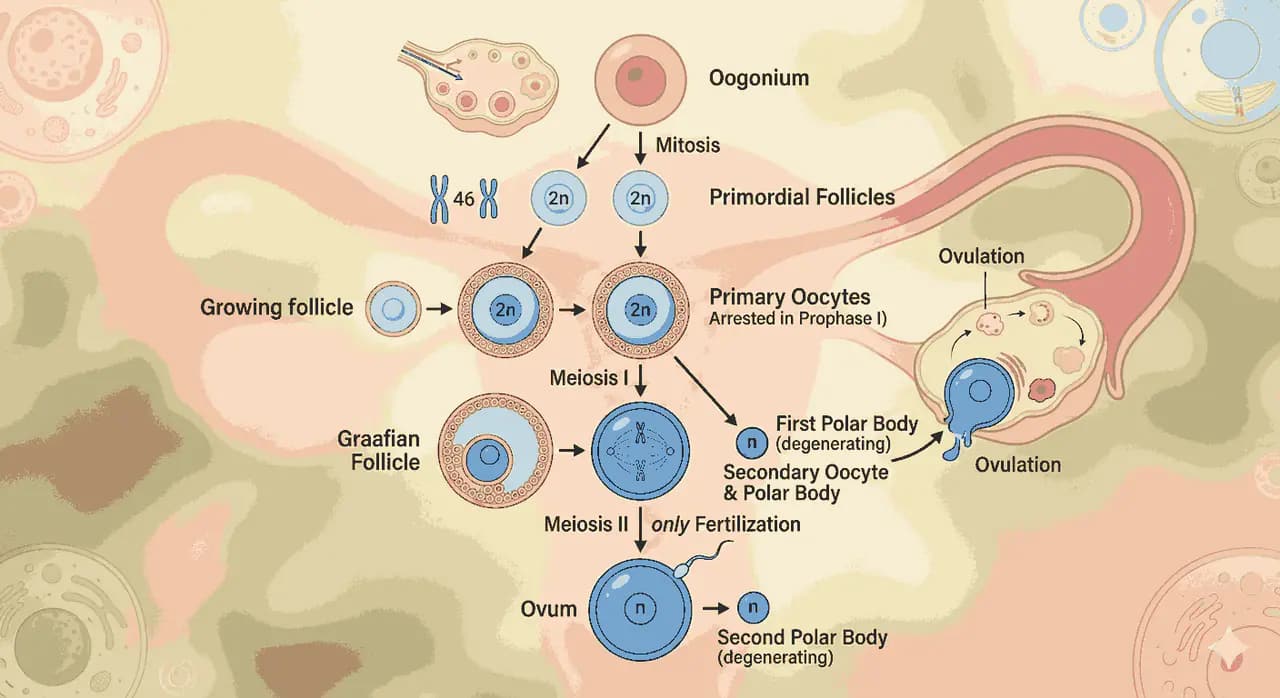
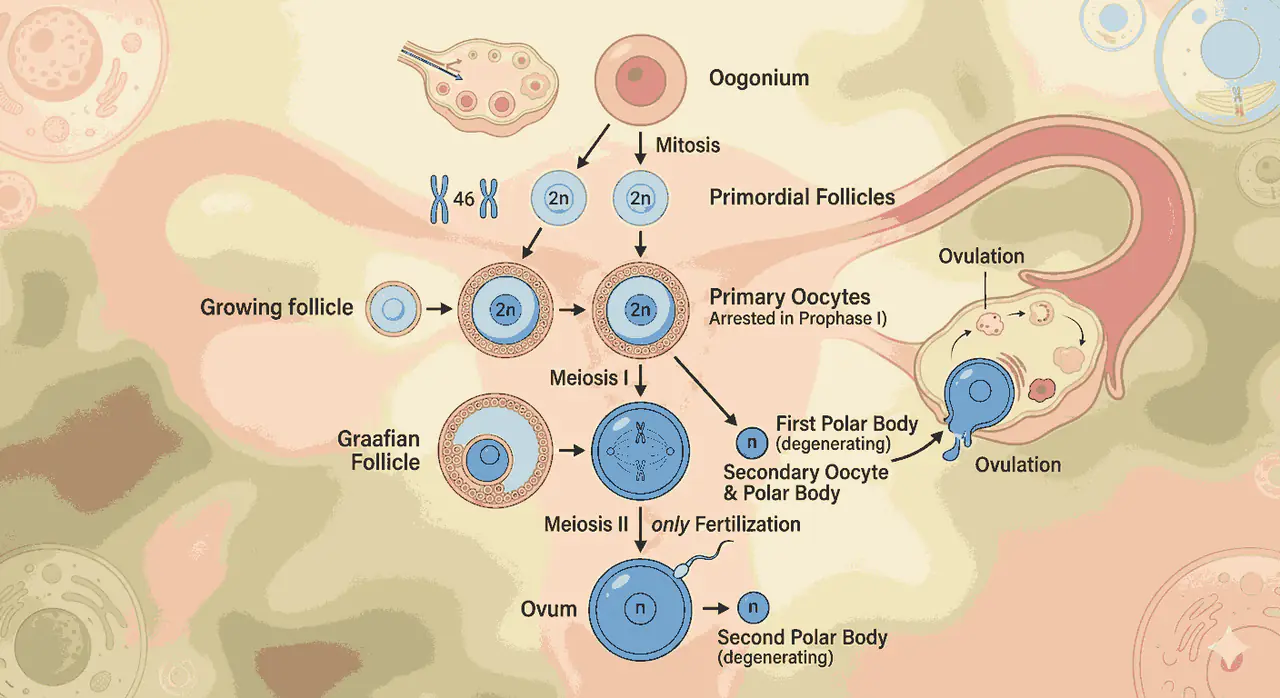
The process of Oogenesis stages explained simply class 12 biology begins during embryonic development. At this stage, primordial germ cells differentiate into oogonia. These oogonia multiply through mitosis, forming a large number of cells. Understanding this initial step is crucial in mastering Oogenesis stages explained simply class 12 biology.
As development continues, these oogonia transform into primary oocytes. This marks the start of the growth phase in Oogenesis stages explained simply class 12 biology. Each primary oocyte gets surrounded by a layer of follicular cells, forming a primary follicle. At this stage, the primary oocyte enters meiosis but gets arrested in prophase I.
A key highlight in Oogenesis stages explained simply class 12 biology is this arrest phase. The primary oocytes remain in this suspended state from birth until puberty. This unique feature makes Oogenesis stages explained simply class 12 biology different from other cell division processes in the human body.
When puberty begins, hormonal changes trigger the continuation of Oogenesis stages explained simply class 12 biology. During each menstrual cycle, a few primary oocytes resume meiosis. However, usually only one completes the process. This selective development is an important concept in Oogenesis stages explained simply class 12 biology.
As meiosis I completes, the primary oocyte divides into a secondary oocyte and a first polar body. This unequal division is a defining characteristic of Oogenesis stages explained simply class 12 biology. The secondary oocyte receives most of the cytoplasm, while the polar body is much smaller.
Another critical point in Oogenesis stages explained simply class 12 biology is that the secondary oocyte begins meiosis II but again gets arrested, this time at metaphase II. This stage continues until fertilization occurs. This pause ensures proper timing in Oogenesis stages explained simply class 12 biology.
Ovulation is the next major step discussed in Oogenesis stages explained simply class 12 biology. During ovulation, the secondary oocyte is released from the ovary into the fallopian tube. It is important to remember that at this stage, the cell is not yet a fully mature ovum.
If fertilization occurs, the secondary oocyte completes meiosis II, forming a mature ovum and a second polar body. This final step completes the process described in Oogenesis stages explained simply class 12 biology. Without fertilization, the secondary oocyte degenerates.
One of the most important takeaways from Oogenesis stages explained simply class 12 biology is the concept of unequal division. Unlike spermatogenesis, which produces four functional sperms, oogenesis results in one functional ovum and polar bodies. This ensures that the ovum has enough cytoplasm to support early development.
Hormonal control is another key aspect of Oogenesis stages explained simply class 12 biology. Hormones like FSH (Follicle Stimulating Hormone) and LH (Luteinizing Hormone) regulate the development and release of the oocyte. These hormones ensure that Oogenesis stages explained simply class 12 biology occur in a coordinated manner.
In addition, understanding follicular development is essential when studying Oogenesis stages explained simply class 12 biology. The progression from primary follicle to Graafian follicle plays a major role in preparing the oocyte for ovulation.
The importance of Oogenesis stages explained simply class 12 biology goes beyond exams. It helps aspirants understand fertility, reproductive health, and developmental biology. This makes it a vital concept in both academic and real-world contexts.
To summarize, Oogenesis stages explained simply class 12 biology includes three main phases: multiplication, growth, and maturation. Each phase has unique characteristics that contribute to the formation of a functional ovum.
Repeated revision of Oogenesis stages explained simply class 12 biology helps in better retention and clarity. Visualizing the stages and practicing diagrams can further enhance understanding.
Oogenesis stages explained simply class 12 biology:
1. What do you mean by the term spermateleosis?
a) Conversion of spermatids to sperm
b) Conversion of spermatogonium to spermatid
c) Conversion of spermatid to spermatogonium
d) Conversion of primary spermatocyte to secondary spermatocyte
Answer: a
Explanation: Spermateleosis (spermiogenesis) is the conversion of spermatids into mature spermatozoa.
2. Which of the following groups of cells in the male gonad represent haploid cells?
a) Germinal epithelial cells
b) Spermatogonial cells
c) Primary spermatocytes
d) Secondary spermatocytes
Answer: d
Explanation: Secondary spermatocytes are haploid cells formed after meiosis I.
3. At what stage of life is oogenesis initiated in a human female?
a) During menarche
b) During menopause
c) During birth
d) During embryonic development
Answer: d
Explanation: Oogenesis begins during embryonic development in the fetal ovary.
4. When is oogenesis initiated in human females?
a) During puberty
b) During menopause
c) During adulthood
d) During embryonic development
Answer: d
Explanation: Oogenesis starts before birth during embryonic life.
5. What hormone induces the growth and maturation of follicles?
a) FSH
b) ACTH
c) ICSH
d) LH
Answer: a
Explanation: FSH stimulates growth and maturation of ovarian follicles.
6. What hormone induces spermatogenesis in males?
a) FSH
b) ACTH
c) ICSH
d) ATH
Answer: a
Explanation: FSH acts on Sertoli cells to promote spermatogenesis.
7. How many sperms are formed from one primary spermatocyte?
a) One
b) Two
c) Three
d) Four
Answer: d
Explanation: One primary spermatocyte produces four sperms after meiosis.
8. What phases does oogenesis comprise?
a) Multiplication phase
b) Growth phase
c) Maturation phase
d) All of the above
Answer: d
Explanation: Oogenesis includes multiplication, growth, and maturation phases.
9. What covers the ovum in the vesicular follicle?
a) Ovary
b) Embryo
c) Cumulus
d) All of these
Answer: c
Explanation: Cumulus cells surround the ovum.
10. Where is gamete formation found in animals?
a) Ovaries
b) Gonads
c) Gall bladder
d) Testes
Answer: b
Explanation: Gametes are formed in gonads (testes and ovaries).
11. What is spermiation?
a) Spermiogenesis
b) Spermiation
c) Spermatogenesis
d) Fertilisation
Answer: b
Explanation: Spermiation is the release of sperm from seminiferous tubules.
12. Which statements are correct about menstrual cycle?
a) A, C and D only
b) A and D only
c) A and B only
d) A, B and C only
Answer: a
Explanation: Menstrual cycle includes cyclic hormonal changes between menarche and menopause.
13. Why does menstruation not occur in a regularly cycling female?
a) Corpus luteum retention
b) Fertilization
c) Endometrium maintenance
d) High hormone levels
Answer: b
Explanation: Fertilization prevents menstruation.
14. Correct matching of menstrual cycle events:
a) Menstruation – myometrium breakdown
b) Ovulation – LH & FSH peak
c) Proliferative phase – myometrium regeneration
d) Corpus luteum – progesterone secretion
Answer: d
Explanation: Corpus luteum produces progesterone in secretory phase.
15. Incorrect match:
a) Menstrual phase – 3-5 days
b) Follicular phase – hormones decrease
c) Ovulatory phase – LH surge
d) Luteal phase – corpus luteum formation
Answer: b
Explanation: Hormones increase during follicular phase.
16. Ovulation date if menses on 5 April:
a) 18 April
b) 14 April
c) 10 April
d) 29 April
Answer: a
Explanation: Ovulation occurs ~14 days after menstruation.
17. If ovum is not fertilized, what is unlikely?
a) Corpus luteum disintegrates
b) Estrogen decreases
c) Progesterone declines
d) New follicle develops
Answer: b
Explanation: Estrogen does not decrease immediately.
18. Menstruation occurs due to:
a) Reduction of FSH
b) Increase of LH
c) Reduction in estrogen & progesterone
d) None
Answer: c
Explanation: Hormone drop leads to shedding of endometrium.
19. LH surge occurs around:
a) 11th day
b) 14th day
c) 20th day
d) 5th day
Answer: b
Explanation: LH surge triggers ovulation around day 14.
20. Hormone inducing corpus luteum formation:
a) LH
b) Estrogen
c) FSH
d) LTH
Answer: a
Explanation: LH transforms follicle into corpus luteum.
21. Hormone peak during ovulation:
a) FSH
b) LH
c) Progesterone
d) Estrogen
Answer: b
Explanation: LH surge causes ovulation.
22. Incorrect statement about menstruation:
a) Hormones increase at menopause
b) Start is menarche
c) ~40 ml blood lost
d) Fluid clots easily
Answer: d
Explanation: Menstrual fluid does not clot due to anticoagulants.
23. Hormones to delay menstruation:
a) FSH
b) LH
c) FSH + LH
d) Estrogen + progesterone
Answer: d
Explanation: These maintain endometrium.
24. Not associated with menstruation:
a) Menstrual phase
b) Estrus phase
c) Follicular phase
d) Luteal phase
Answer: b
Explanation: Estrus cycle is in non-primates.
25. True statement about oocytes:
a) Produced at menopause
b) Produced throughout life
c) Stored in seminiferous tubules
d) Formed before birth
Answer: d
Explanation: All oocytes form before birth.
26. Immediate cause of ovulation:
a) Progesterone
b) Estradiol
c) LH
d) FSH
Answer: c
Explanation: LH surge triggers ovulation.
27. Hormone peak in luteal phase:
a) LH
b) Progesterone
c) FSH
d) Estrogen
Answer: b
Explanation: Corpus luteum secretes progesterone.
28. Animals with menstrual cycle:
a) Apes
b) Cow
c) Tiger
d) Rat
Answer: a
Explanation: Only primates show menstrual cycle.
29. Ovarian cycle begins when:
a) Estrogen peak
b) Hypothalamus stimulates pituitary
c) Progesterone drops
d) FSH increases
Answer: c
Explanation: Drop in progesterone initiates cycle.
30. Ovulation occurs between:
a) 11–14 days
b) 14–16 days
c) 15–28 days
d) 21–26 days
Answer: b
Explanation: Ovulation typically occurs around day 14–16.
Conclusion on Oogenesis stages explained simply class 12 biology
In conclusion, mastering Oogenesis stages explained simply class 12 biology requires a clear understanding of each step and its significance. By breaking down the process into simple stages, aspirants can easily grasp even the most complex concepts. Consistent study and revision will ensure success in exams and a deeper appreciation of human biology.
Related reading
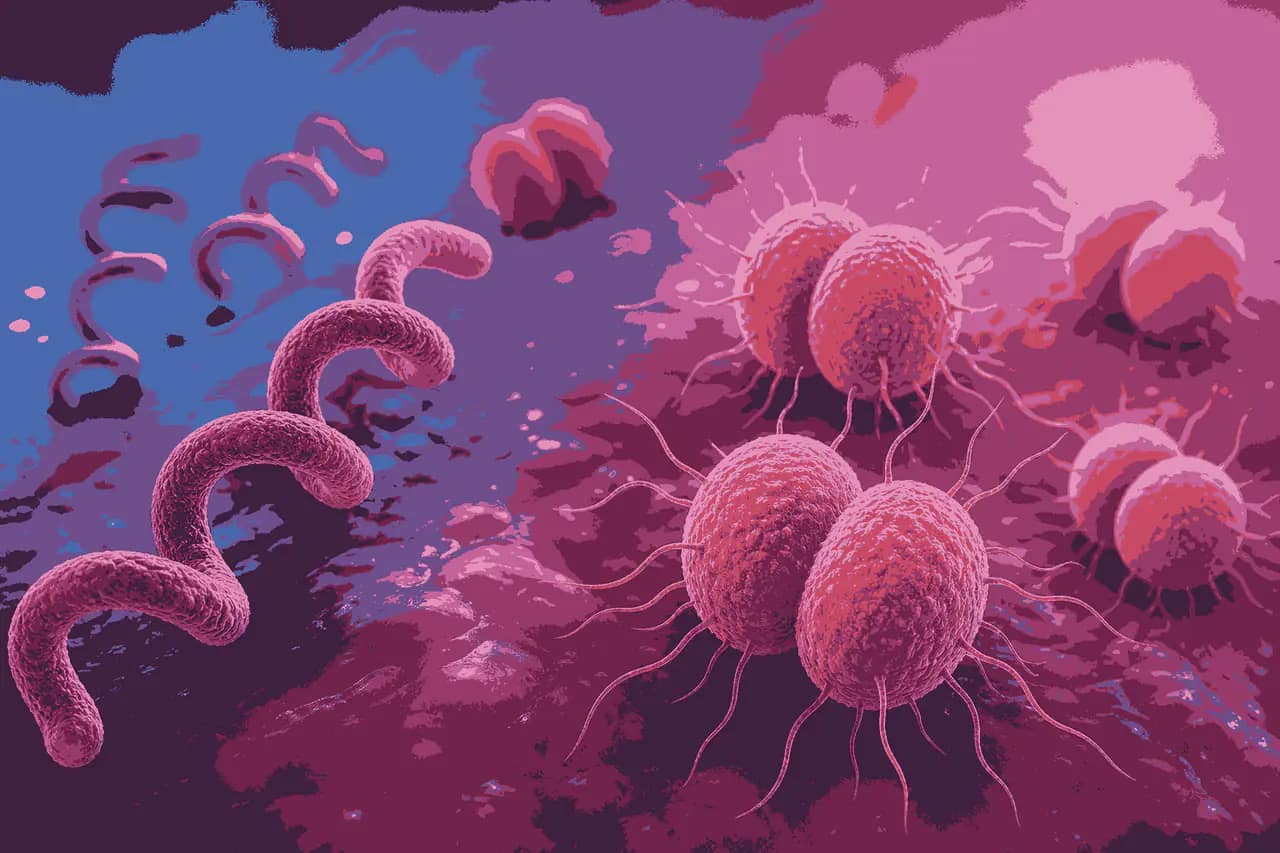
Boost Your Score with Syphills Gonorrhea Bacterial STD MCQs Class 12 Biology for Competitive Exams
Master Syphills Gonorrhea Bacterial STD MCQs Class 12 Biology with clear concepts , symptoms, causes, treatments to boost exam preparation and improve accuracy.
Master These Essential Vasectomy and Tubectomy MCQs for Class 12 Biology Exams
Practice Vasectomy and Tubectomy mcqs for class 12 Biology exams. Boost your preparation with important questions answers and explanations for NEET,JEE and CUET