- Keneitsino Lydia
- March 31, 2026
Ultimate 30 DNA Structure Nucleoside Nucleotide MCQs With Answers PDF – Boost Your Exam Score Fast
Creating high-quality study material for competitive exams requires clarity, repetition, and strong conceptual grounding. One such important topic in biomolecules is DNA and its related components. This is where DNA Structure Nucleoside Nucleotide MCQs With Answers PDF becomes extremely useful for aspirants preparing for exams like NEET, CUET, and other entrance tests. Understanding the structure of DNA, along with nucleosides and nucleotides, is essential for mastering this chapter.
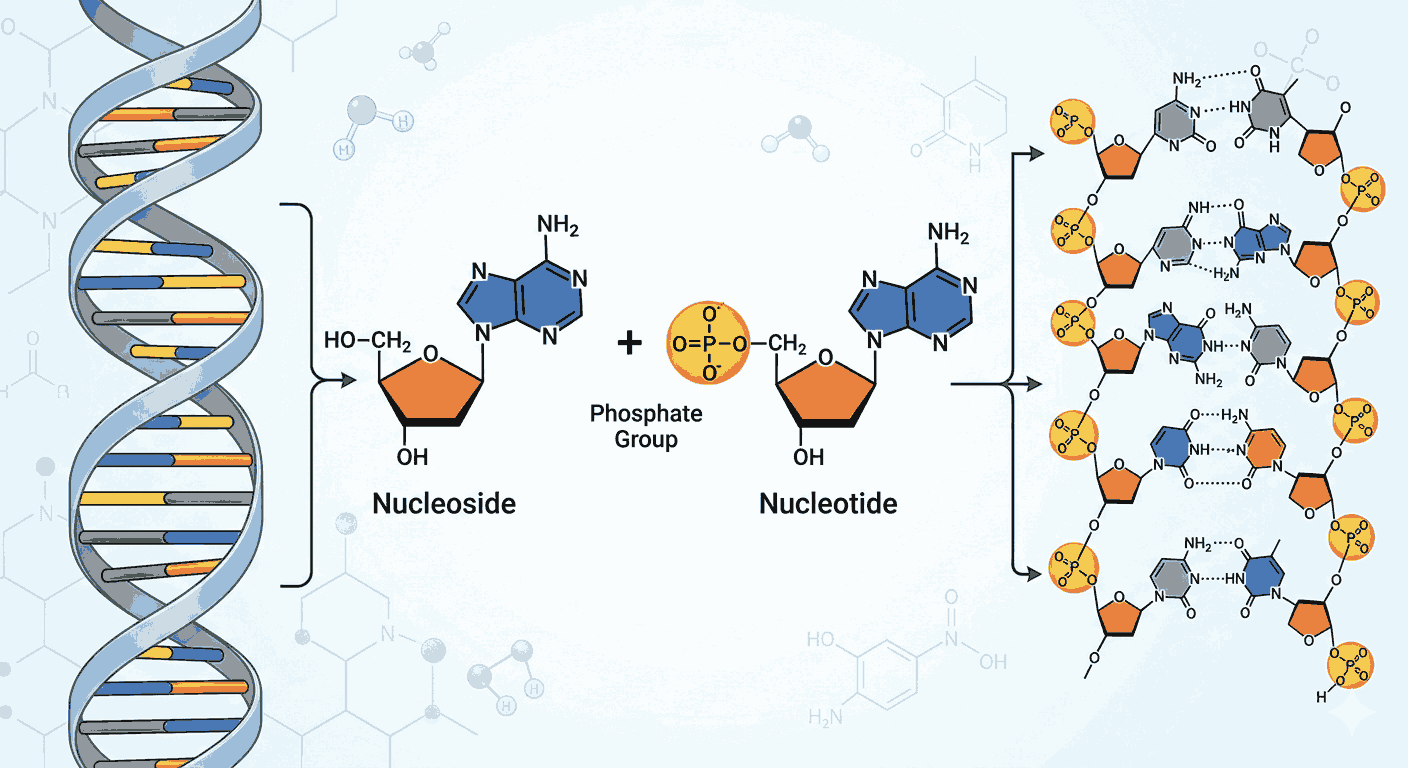
The concept of DNA structure begins with the famous double helix model proposed by Watson and Crick. This model explains how two polynucleotide strands are coiled around each other. Practicing with DNA Structure Nucleoside Nucleotide MCQs With Answers PDF helps aspirants visualize this structure better and understand the base pairing rules effectively. These MCQs are designed to test both theoretical knowledge and application-based understanding.
When studying nucleosides and nucleotides, it is important to remember their structural differences. A nucleoside consists of a nitrogenous base and a sugar, while a nucleotide contains a phosphate group in addition. Solving DNA Structure Nucleoside Nucleotide MCQs With Answers PDF repeatedly ensures that students do not confuse these definitions, which is a common mistake in exams.
Another key concept is the types of nitrogenous bases—purines and pyrimidines. Adenine and guanine are purines, whereas cytosine, thymine, and uracil are pyrimidines. By practicing DNA Structure Nucleoside Nucleotide MCQs With Answers PDF, learners can easily memorize these classifications and apply them correctly in objective questions.
Hydrogen bonding plays a crucial role in stabilizing the DNA structure. Adenine pairs with thymine through two hydrogen bonds, while guanine pairs with cytosine through three hydrogen bonds. Regular practice using DNA Structure Nucleoside Nucleotide MCQs With Answers PDF helps reinforce these facts and improves accuracy in answering direct and tricky MCQs.
In addition, the concept of antiparallel strands is another important feature of DNA. One strand runs in the 5’ to 3’ direction, while the other runs in the opposite direction. Solving questions from DNA Structure Nucleoside Nucleotide MCQs With Answers PDF ensures that aspirants clearly understand this orientation and its significance in replication and transcription.
Nucleotides are linked together by phosphodiester bonds, forming the backbone of DNA. This concept is frequently tested in exams. By using DNA Structure Nucleoside Nucleotide MCQs With Answers PDF, aspirants can repeatedly revise such key points and avoid conceptual errors.
Another important area is the difference between DNA and RNA. DNA contains deoxyribose sugar and thymine, whereas RNA contains ribose sugar and uracil. Practicing DNA Structure Nucleoside Nucleotide MCQs With Answers PDF allows aspirants to compare these differences efficiently and retain them for longer periods.
For exam preparation, consistency is key. Regularly solving DNA Structure Nucleoside Nucleotide MCQs With Answers PDF enhances problem-solving speed and builds confidence. These MCQs also help identify weak areas, allowing aspirants to focus on concepts that need improvement.
Moreover, competitive exams often include application-based questions. This is why using DNA Structure Nucleoside Nucleotide MCQs With Answers PDF is highly recommended, as it exposes aspirants to a wide variety of question patterns.
Revision becomes much easier when aspirants rely on structured materials like DNA Structure Nucleoside Nucleotide MCQs With Answers PDF. It acts as a quick reference guide before exams and helps reinforce all major topics effectively.
Another advantage of using DNA Structure Nucleoside Nucleotide MCQs With Answers PDF is that it improves retention through repeated exposure. The more questions a student solves, the stronger their conceptual clarity becomes.
Aspirants aiming for top ranks should make it a habit to practice DNA Structure Nucleoside Nucleotide MCQs With Answers PDF daily. This not only improves accuracy but also reduces exam anxiety.
In addition, timed practice using DNA Structure Nucleoside Nucleotide MCQs With Answers PDF can significantly enhance time management skills, which is crucial during competitive exams.
Teachers and educators also recommend DNA Structure Nucleoside Nucleotide MCQs With Answers PDF as a reliable tool for quick assessments and classroom revisions.
By consistently solving DNA Structure Nucleoside Nucleotide MCQs With Answers PDF, aspirants can strengthen their understanding of biomolecules and perform better in exams.
DNA Structure Nucleoside Nucleotide MCQs With Answers PDF:
1. The efficiency of enzyme catalysis is due to its capacity to:
a) Form a strong enzyme-substrate complex
b) Change the shape of the substrate
c) Lower the activation energy of the reaction
d) Form a colloidal solution in water
Answer: c
2. Which one of the following forms the constituent of cell wall of plant cells?
a) Starch
b) Glycogen
c) Cellulose
d) Amylopectin
Answer: c
3. The enzyme which converts maltose to glucose is:
a) Maltase
b) Insulin
c) Lysine
d) Zymase
Answer: a
4. The cell membranes are mainly composed of:
a) Fats
b) Proteins
c) Phospholipids
d) Carbohydrates
Answer: c
5. Which hormone is produced under stress and stimulates glycogenolysis?
a) Thyroxine
b) Insulin
c) Adrenaline
d) Estradiol
Answer: c
6. Which of the following is an amine hormone?
a) Insulin
b) Progesterone
c) Thyroxine
d) Oxytocin
Answer: c
7. Which one of the following is a peptide hormone?
a) Adrenaline
b) Glucagon
c) Testosterone
d) Thyroxine
Answer: b
8. Enzymes that utilize ATP require which cofactor?
a) Sr
b) Be
c) Mg
d) Ca
Answer: c
9. Which metal ion helps in ATP production and nerve transmission?
a) Iron
b) Copper
c) Calcium
d) Potassium
Answer: d
10. Enzymes increase reaction rate:
a) By increasing activation energy
b) By decreasing activation energy
c) By taking part in reaction
d) By altering concentration
Answer: b
11. Enzymes having control site in addition to active site are:
a) Holozymes
b) Coenzymes
c) Apoenzymes
d) Allosteric enzymes
Answer: d
12. Enzymes converting starch to alcohol are:
a) Maltase, diastase
b) Diastase, maltase, zymase
c) Invertase, zymase
d) Invertase, diastase, maltase
Answer: b
13. Sugar present in DNA is:
a) β-D-2-ribose
b) β-D-2-deoxyribose
c) α-D-2-ribose
d) α-D-2-deoxyribose
Answer: b
14. Choose the correct statements:
A. DNA does not contain uracil
B. RNA does not contain thymine
C. RNA and DNA both have uracil
D. RNA has both uracil and thymine
a) A, B, C
b) A, B, D
c) A, B
d) B, C, D
Answer: c
15. Number of hydrogen bonds (G-C and A-T) is:
a) 1,2
b) 3,2
c) 3,1
d) 2,1
Answer: b
16. The base present in cytidine is:
a) Adenine
b) Guanine
c) Thymine
d) Cytosine
Answer: d
17. DNA has how many bases per turn?
a) 4
b) 6
c) 8
d) 10
Answer: d
18. A nucleoside on hydrolysis gives:
a) Base + phosphoric acid
b) Sugar + base + phosphate
c) Sugar + base
d) Sugar + phosphate
Answer: c
19. In DNA, bases are linked by:
a) Phosphate linkage
b) Hydrogen bonding
c) Glycosidic linkage
d) Peptide linkage
Answer: b
20. Nucleotides are linked by:
a) Ester linkage
b) Amide linkage
c) Peptide linkage
d) Glycosidic linkage
Answer: a
21. RNA sequence from GCATA DNA strand:
a) CGUAU
b) GCATAT
c) TACGC
d) ACGGC
Answer: a
22. Thymine is:
a) 5-methyluracil
b) 4-methyluracil
c) 3-methyluracil
d) 1-methyluracil
Answer: a
23. Incorrect statement is:
a) Oxyhaemoglobin has paramagnetic Fe²⁺
b) Fe²⁺ size increases during respiration
c) Four heme groups present
d) Heme is prosthetic group
Answer: a
24. Chargaff’s rule states:
a) A = G, T = C
b) A = C, T = G
c) A = T, G = C
d) All bases equal
Answer: c
25. Incorrect statement about denaturation:
a) Secondary & tertiary structures lost
b) DNA strands separate
c) Primary structure affected
d) None
Answer: c
26. Pair with iron in both:
a) Nitrogenase, cytochromes
b) Carboxypeptidase, haemoglobin
c) Haemocyanin, nitrogenase
d) Haemoglobin, cytochromes
Answer: d
27. Human body does not produce:
a) Vitamins
b) Hormones
c) Enzymes
d) DNA
Answer: a
28. Base present in RNA but not DNA:
a) Uracil
b) Thymine
c) Cytosine
d) Guanine
Answer: a
29. Purine base with two binding sites:
a) Thymine
b) Cytosine
c) Guanine
d) Adenine
Answer: c
30. Energy stored in cells is in form of:
a) Fats
b) Glucose
c) ATP
d) Proteins
Answer: c