Understanding early embryonic development is essential for mastering human reproduction, and the topic Cleavage and Blastulation MCQs Class 12 Biology plays a crucial role in this learning process. Aspirants often encounter questions from this area because it forms the foundation of developmental biology. By focusing on Cleavage and Blastulation MCQs Class 12 Biology, learners can build strong conceptual clarity and improve their exam performance.
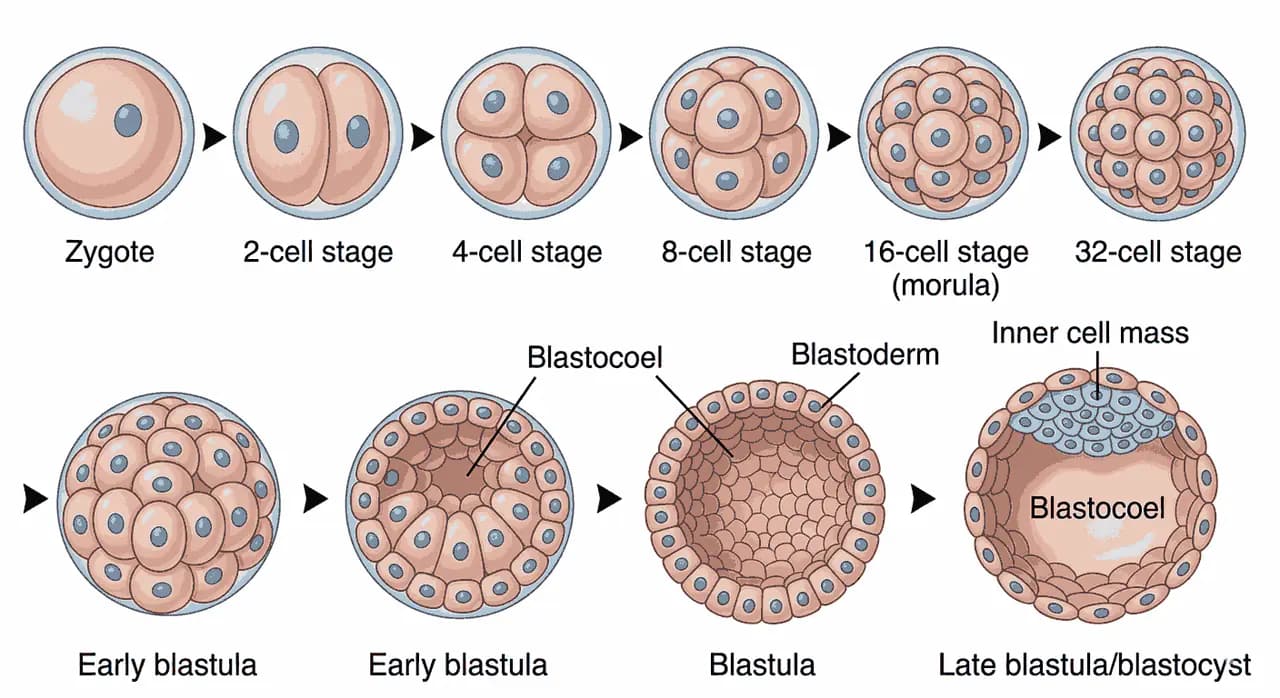
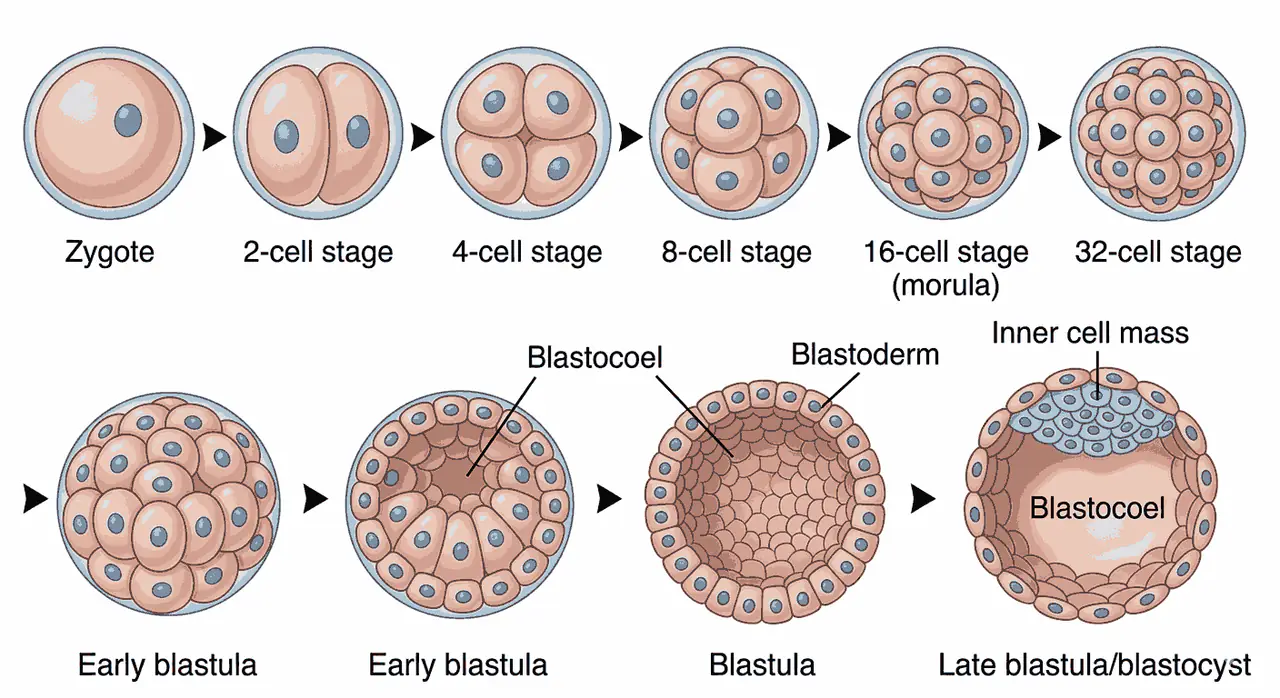
The concept of cleavage is central to Cleavage and Blastulation MCQs Class 12 Biology. Cleavage refers to a series of rapid mitotic divisions that occur immediately after fertilization. These divisions transform the zygote into a multicellular structure without increasing its overall size. This unique feature is often emphasized in Cleavage and Blastulation MCQs Class 12 Biology because it differentiates cleavage from normal cell division.
During cleavage, the zygote divides into smaller cells known as blastomeres. In the context of Cleavage and Blastulation MCQs Class 12 Biology, it is important to understand that these blastomeres become progressively smaller with each division. Despite the increase in cell number, the total volume remains the same, which is a key point frequently tested.
Another important stage covered in Cleavage and Blastulation MCQs Class 12 Biology is the formation of the morula. The morula is a solid ball of cells formed after several rounds of cleavage. This stage represents an intermediate phase before the development of the blastocyst. Understanding the transition from zygote to morula is essential for answering questions related to Cleavage and Blastulation MCQs Class 12 Biology.
Blastulation is the next major phase discussed in Cleavage and Blastulation MCQs Class 12 Biology. During this stage, the morula develops into a blastocyst, a hollow structure with a fluid-filled cavity called the blastocoel. The formation of this cavity is a defining feature of blastulation and is frequently highlighted in Cleavage and Blastulation MCQs Class 12 Biology.
The blastocyst consists of two main components: the inner cell mass and the trophoblast. In Cleavage and Blastulation MCQs Class 12 Biology, aspirants are often required to distinguish between these two structures. The inner cell mass gives rise to the embryo, while the trophoblast contributes to the formation of the placenta.
A key concept in Cleavage and Blastulation MCQs Class 12 Biology is the timing of these developmental stages. Cleavage begins soon after fertilization and continues as the embryo moves through the fallopian tube. By the time it reaches the uterus, the blastocyst is ready for implantation. This sequence is crucial for understanding the overall reproductive process.
In Cleavage and Blastulation MCQs Class 12 Biology, aspirants must also understand the types of cleavage. In humans, cleavage is holoblastic, meaning the entire zygote divides. This contrasts with meroblastic cleavage seen in organisms with yolk-rich eggs. Recognizing these differences is important for solving conceptual questions.
Another important aspect of Cleavage and Blastulation MCQs Class 12 Biology is the role of genetic regulation. The early stages of cleavage are controlled by maternal RNA and proteins, while later stages involve activation of the embryonic genome. This transition is critical for proper development.
The process of compaction is also frequently discussed in Cleavage and Blastulation MCQs Class 12 Biology. During compaction, blastomeres become tightly packed, increasing cell-to-cell contact. This leads to the differentiation of cells and the formation of distinct layers within the embryo.
In Cleavage and Blastulation MCQs Class 12 Biology, the concept of polarity is equally important. Polarity refers to the spatial differences in the embryo that guide future development. Establishing polarity ensures that cells differentiate correctly and form proper structures.
Another point often emphasized in Cleavage and Blastulation MCQs Class 12 Biology is the importance of blastocoel formation. The blastocoel not only creates space within the embryo but also facilitates cell movement during later developmental stages.
Aspirants preparing for exams should focus on the sequence of events described in Cleavage and Blastulation MCQs Class 12 Biology. Understanding how the zygote progresses through cleavage, morula, and blastocyst stages makes it easier to answer application-based questions.
In addition, Cleavage and Blastulation MCQs Class 12 Biology often include questions about implantation readiness. The blastocyst must reach a certain stage before it can attach to the uterine lining. This highlights the importance of proper timing and coordination in development.
Another key concept in Cleavage and Blastulation MCQs Class 12 Biology is the distinction between growth and division. While cleavage involves rapid cell division, there is no actual growth in size. This unique characteristic is frequently tested in exams.
Understanding cell differentiation is also essential in Cleavage and Blastulation MCQs Class 12 Biology. As the embryo develops, cells begin to specialize, leading to the formation of tissues and organs. This process begins during the blastocyst stage.
The importance of environmental factors is sometimes explored in Cleavage and Blastulation MCQs Class 12 Biology. Conditions such as temperature and nutrient availability can influence early development, although genetic control remains dominant.
Finally, mastering Cleavage and Blastulation MCQs Class 12 Biology requires consistent revision and conceptual understanding. By focusing on the sequence, structure, and function of each stage, aspirants can confidently tackle exam questions.
Cleavage and Blastulation MCQs Class 12 Biology:
1. What hormone acts on the anterior pituitary gland and stimulates the secretion of LH and FSH?
A. GnRH
B. Oxytocin
C. Relaxin
D. FSH
Answer: A
Explanation: GnRH stimulates the anterior pituitary to release LH and FSH.
2. In human fertilization, what is the process of fusion of a sperm with an ovum called?
A. Base pairing of DNA and RNA
B. Formation of hydrogen bonds
C. Mutual attraction due to electrical charges
D. Attraction of their protoplasts
Answer: D
Explanation: Fusion of sperm and ovum (syngamy) occurs due to attraction of protoplasts.
3. When does cleavage in the fertilized egg start in humans?
A. When the egg is in fallopian tube
B. When the egg reaches uterus
C. Meroblastic
D. Identical to mitosis
Answer: A
Explanation: Cleavage begins in the fallopian tube after fertilization.
4. What indicates the termination of gastrulation?
A. Obliteration of blastocoel
B. Obliteration of archenteron
C. Closure of blastopore
D. Closure of neural tube
Answer: A
Explanation: Gastrulation ends with disappearance of blastocoel.
5. Sequence: Infundibulum, Fertilization, Endometrium, Blastocyst represents:
A. Infundibulum, Fertilization, Myometrium, Morula
B. Infundibulum, Fertilization, Endometrium, Blastocyst
C. Isthmus, Fertilization, Myometrium, Blastocyst
D. Isthmus, Fertilization, Endometrium, Morula
Answer: B
Explanation: Correct sequence of structures/events in reproduction.
6. Which is a mismatch pair?
A. Karyogamy – Mixing of pronuclei
B. Gastrulation – Germ layer formation
C. Discharge of semen – Fertilization
D. Cleavage – Rapid mitosis
Answer: C
Explanation: Discharge of semen is ejaculation, not fertilization.
7. Type of placenta in humans?
A. Haemochorial
B. Hemochorial
C. Hemochorionic
D. Hemochorial
Answer: A
Explanation: Maternal blood directly contacts chorion.
8. Which hormone is NOT secreted by placenta?
A. hCG
B. Prolactin
C. Estrogen
D. Progesterone
Answer: B
Explanation: Prolactin is secreted by pituitary gland.
9. In surrogacy, which organ supports embryo development?
A. Uterus
B. Fallopian tube
C. Ovary
D. Oviduct
Answer: A
Explanation: Uterus supports fetal growth.
10. Match pregnancy events with timing:
A. 4 weeks – Heart
B. 8 weeks – Limbs
C. 12 weeks – Genital organs
D. 24 weeks – Hair & eyelids
Answer: B
Explanation: All developmental milestones are correctly matched.
11. Arrange the following events in the correct order of occurrence in an angiospermic flower:
A. Megasporogenesis
B. Syngamy
C. Embryosac development
D. Pollen-pistil interaction
Options:
A. BDCA
B. ACBD
C. ACDB
D. DACB
Answer: C (ACDB)
Explanation:
The correct sequence is:
- Megasporogenesis (A) – Formation of megaspores in ovule
- Embryosac development (C) – Formation of female gametophyte
- Pollen-pistil interaction (D) – Pollination and pollen tube growth
- Syngamy (B) – Fusion of male and female gametes
So, the correct order is A → C → D → B (ACDB).
12. ZIFT stands for:
A. Embryo transfer
B. Zygote intra fallopian transfer
C. Ovum transfer
D. Donor ovum transfer
Answer: B
Explanation: Zygote is transferred into fallopian tube.
13. Morula in humans:
A. Same cytoplasm, more DNA
B. Less cytoplasm and DNA
C. Same cytoplasm and DNA
D. More cytoplasm and DNA
Answer: A
Explanation: Cell number increases but size remains same.
14. Foetal placenta is derived from:
A. Allantois
B. Chorion
C. Yolk sac
D. Amnion
Answer: B
Explanation: Chorion forms placenta.
15. Removal of endoderm leads to absence of:
A. Heart
B. Brain
C. Kidney
D. Visceral organs
Answer: D
Explanation: Endoderm forms internal organs.
16. Extra embryonic membranes arise from:
A. Inner cell mass
B. Trophoblast
C. Formative cells
D. Follicle cells
Answer: B
Explanation: Trophoblast forms membranes and placenta.
17. Embryo at implantation stage:
A. Embryo
B. Blastocyst
C. Zygote
D. Foetus
Answer: B
Explanation: Blastocyst implants in uterus.
18. First foetal movement appears in:
A. 4th month
B. 5th month
C. 6th month
D. 3rd month
Answer: B
Explanation: Quickening occurs in 5th month.
19. Embryonic urinary bladder:
A. Amnion
B. Allantois
C. Chorion
D. Yolk sac
Answer: B
Explanation: Allantois stores waste.
20. Gonads are derived from:
A. Ectoderm
B. Mesoderm
C. Endoderm
D. None
Answer: B
Explanation: Mesoderm forms reproductive organs.
21. Gonadotropin activity in pregnancy:
A. High FSH & LH
B. High hCG
C. High FSH & LH for implantation
D. High hCG for endometrium
Answer: B
Explanation: hCG maintains corpus luteum.
22. Role of oxytocin:
A. Milk production
B. Childbirth
C. Diuresis
D. Gametogenesis
Answer: B
Explanation: Stimulates uterine contractions.
23. How many fetal membranes are formed during the development of a human embryo?
Options:
A. 3
B. 4
C. 2
D. 1
Answer: B (4)
Explanation:
In human embryonic development, four fetal membranes are formed:
- Amnion – Protects embryo with amniotic fluid
- Chorion – Forms part of placenta
- Yolk sac – Early nutrient supply
- Allantois – Helps in waste removal and blood vessel formation
These membranes play essential roles in protection, nutrition, respiration, and waste removal of the developing embryo.
24. Size of 12-week embryo:
A. 7.5 cm, 14 g
B. 7.5 cm, 650 g
C. 42 cm, 1800 g
D. 32 cm, 650 g
Answer: A
Explanation: Standard fetal measurement.
25. Eyelid separation occurs in:
A. 1st month
B. 2nd month
C. 5th month
D. 6th month
Answer: D
Explanation: Occurs in sixth month.
26. Hormones in pregnancy:
A. hCG, progesterone, estradiol, FSH
B. hCG, hPL, progesterone, estrogen, LH
C. LH, estrogen, estradiol
D. hCG, hPL
Answer: D
Explanation: hCG and hPL dominate.
27. Mesoderm forms:
A. Spinal cord
B. Bony skeleton
C. Epidermis
D. Lens
Answer: B
Explanation: Mesoderm forms bones and muscles.
28. Pore in gastrula:
A. Gonophore
B. Blastopore
C. Oospore
D. Zoospore
Answer: B
Explanation: Opening is called blastopore.
29. Embryonic heartbeat begins at:
A. 4th week
B. 7th week
C. 6th week
D. 5th week
Answer: D
Explanation: Heartbeat starts around 5th week.
Conclusion on Cleavage and Blastulation MCQs Class 12 Biology
In conclusion, Cleavage and Blastulation MCQs Class 12 Biology provide a comprehensive framework for understanding early embryonic development. From the initial divisions of the zygote to the formation of the blastocyst, each step is crucial. With a clear understanding of these processes, students can excel in their exams and develop a deeper appreciation for the complexity of life.
Related reading
Boost Your Score with Syphills Gonorrhea Bacterial STD MCQs Class 12 Biology for Competitive Exams
Master Syphills Gonorrhea Bacterial STD MCQs Class 12 Biology with clear concepts , symptoms, causes, treatments to boost exam preparation and improve accuracy.
Master These Essential Vasectomy and Tubectomy MCQs for Class 12 Biology Exams
Practice Vasectomy and Tubectomy mcqs for class 12 Biology exams. Boost your preparation with important questions answers and explanations for NEET,JEE and CUET