
- Keneitsino Lydia
- April 18, 2026
Boost Your Score Fast: Haploid Plant Production Methods MCQs Class 12 Biology for NEET, JEE & CUET Exams
When preparing for board exams and competitive tests, aspirants often come across the topic Haploid Plant Production Methods MCQs Class 12 Biology, which plays a crucial role in modern plant breeding and biotechnology. Understanding this concept deeply not only strengthens theoretical knowledge but also helps in solving conceptual questions with confidence. The phrase Haploid Plant Production Methods MCQs Class 12 Biology is frequently searched by aspirants aiming to master this topic efficiently.
To begin with, haploid plant production refers to the development of plants that contain a single set of chromosomes (n). These plants are extremely valuable in genetics and breeding because they allow rapid development of homozygous lines. This is why mastering Haploid Plant Production Methods MCQs Class 12 Biology becomes essential for aspirants targeting high scores in exams.
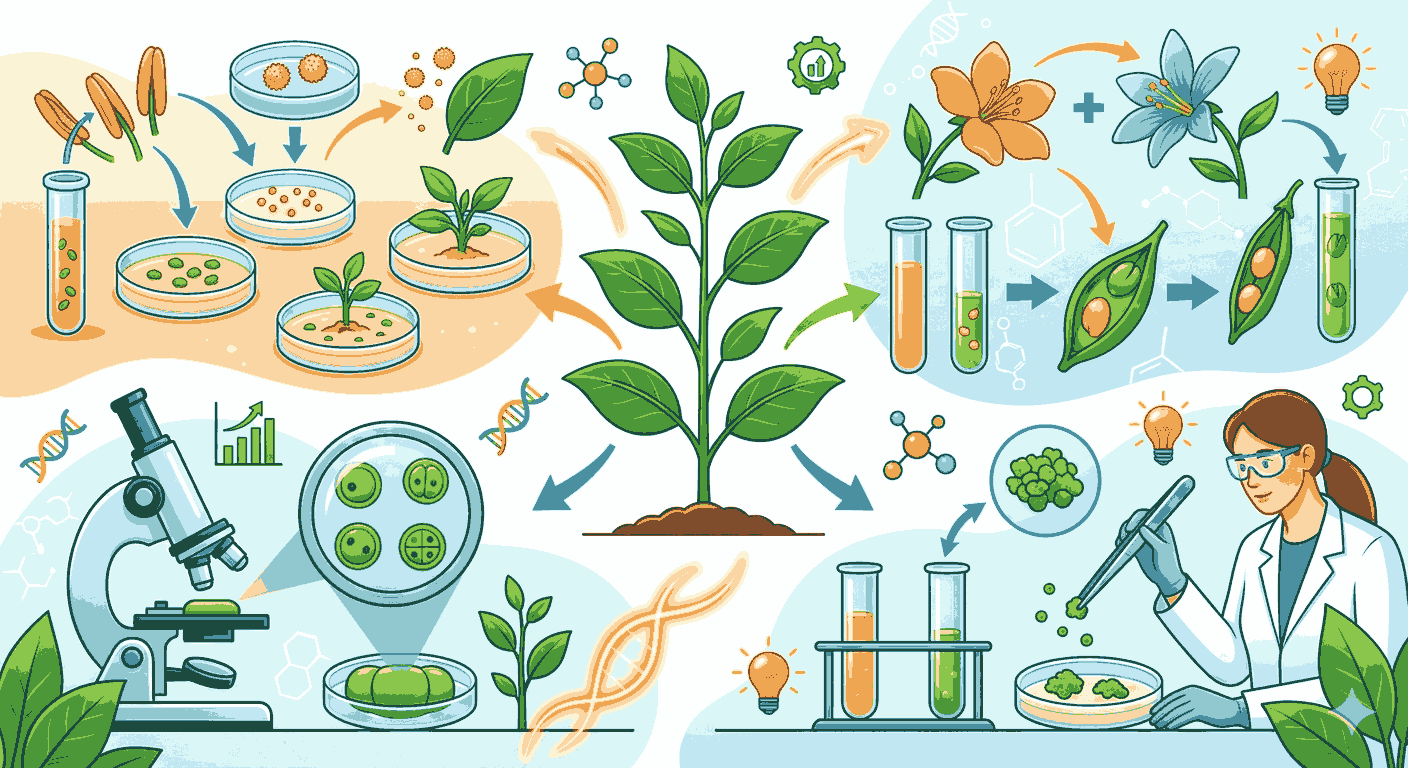
One of the most common methods used in haploid plant production is anther culture. In this method, anthers containing microspores are cultured in a suitable nutrient medium, leading to the formation of haploid plants. The importance of this method is often highlighted in Haploid Plant Production Methods MCQs Class 12 Biology, making it a key concept for aspirants to remember.
Another important technique is pollen culture, where isolated pollen grains are cultured to produce haploid embryos. This method is closely related to anther culture and is frequently discussed in Haploid Plant Production Methods MCQs Class 12 Biology. Aspirants should understand the difference between these techniques to avoid confusion during exams.
Ovule and ovary culture also contribute to haploid plant production, although they are less commonly used compared to anther culture. These methods are still relevant and appear in conceptual discussions related to Haploid Plant Production Methods MCQs Class 12 Biology, especially in advanced-level questions.
A major advantage of haploid plant production is the rapid development of homozygous plants through chromosome doubling. Chemicals like colchicine are used to double the chromosome number, converting haploid plants into diploid homozygous lines. This concept is frequently tested in Haploid Plant Production Methods MCQs Class 12 Biology, so aspirants should pay close attention to it.
The role of haploid plants in plant breeding cannot be overstated. They help in identifying recessive traits quickly and accelerate the breeding process. This practical application is a recurring theme in Haploid Plant Production Methods MCQs Class 12 Biology, making it highly relevant for exam preparation.
In addition to breeding, haploid plants are useful in mutation studies and genetic mapping. Researchers use these plants to study gene expression and inheritance patterns. Such applications are often integrated into higher-order questions in Haploid Plant Production Methods MCQs Class 12 Biology, requiring aspirants to think beyond basic definitions.
It is also important to understand the limitations of haploid plant production. Not all plant species respond well to tissue culture techniques, and the success rate may vary. These limitations are sometimes included in tricky questions in Haploid Plant Production Methods MCQs Class 12 Biology, testing the depth of understanding of aspirants.
Another interesting aspect is the use of haploid plants in crop improvement programs. By producing pure lines quickly, breeders can develop high-yielding and disease-resistant varieties. This application reinforces the importance of Haploid Plant Production Methods MCQs Class 12 Biology in real-world agriculture.
From an exam perspective, aspirants should focus on key terms such as anther culture, androgenesis, gynogenesis, and chromosome doubling. These terms frequently appear in Haploid Plant Production Methods MCQs Class 12 Biology, and a clear understanding of them can significantly improve accuracy.
Moreover, diagrams and process-based questions are commonly asked from this topic. Aspirants should practice interpreting experimental setups and outcomes related to Haploid Plant Production Methods MCQs Class 12 Biology to gain an edge in exams.
Consistency in revision is crucial. By repeatedly going through concepts and practicing related questions, aspirants can master Haploid Plant Production Methods MCQs Class 12 Biology effectively. This ensures better retention and faster recall during exams.
Haploid Plant Production Methods MCQs Class 12 Biology:
1. Apomixis is
a) Formation of seeds by fusion of gametes
b) Formation of seeds without syngamy and meiosis
c) Formation of seeds with syngamy but no meiosis
d) None of the above
Answer: b
Explanation: Apomixis is seed formation without fertilization and meiosis, producing genetically identical offspring.
2. Prothallus (gametophyte) gives rise to fern plant (sporophyte) without fertilization. It is
a) Apospory
b) Apogamy
c) Parthenocarpy
d) Parthenogenesis
Answer: b
Explanation: Apogamy is the development of a sporophyte from a gametophyte without fertilization.
3. Which of the following process is helpful in hybrid seed production
a) Embryo rescue
b) Apomixis
c) Polyembryony
d) Somatic hybridisation
Answer: b
Explanation: Apomixis helps preserve hybrid traits without segregation.
4. Formation of gametophyte from sporophyte without meiosis is called
a) Apospory
b) Apogamy
c) Parthenogenesis
d) None
Answer: a
Explanation: Apospory bypasses meiosis to form gametophyte directly.
5. Embryo development from nucellus and integument is called
a) Apospory
b) Apogamy
c) Apomixis
d) Adventive embryony
Answer: d
Explanation: Adventive embryony involves embryo formation from somatic tissues.
6. What is apogamy?
a) Reproduction of virus
b) Failure of fusion of gametes
c) Development of bacteria
d) Loss of function
Answer: b
Explanation: Apogamy occurs without gamete fusion.
7. Parthenogamy represents
a) Union of vegetative nuclei
b) Union of hyphae
c) Union of gametes of one sex
d) Union of three gametes
Answer: c
Explanation: Parthenogamy involves same-sex gamete fusion.
8. Fusion of pronuclei is called
a) Fertilization
b) Conjugation
c) Amphimixis
d) Panmixis
Answer: c
Explanation: Amphimixis = fusion of male and female pronuclei.
9. Absence of sexual union and meiosis is
a) Anisospory
b) Apomixis
c) Amphimixis
d) Anisogamy
Answer: b
Explanation: Apomixis bypasses both meiosis and fertilization.
10. Cleavage polyembryony occurs in
a) Pinus
b) Cycas
c) Ephedra
d) All
Answer: a
Explanation: Pinus shows cleavage polyembryony.
11.Match the methods with their corresponding activities:
Column I
A. Development of haploid plants
B. Induction of polyembryony
C. Production of parthenocarpic fruits
D. Method of breaking prolonged dormancy of seeds
Column II
- Anther culture
- Stratification
- Auxin / Growth regulators
- Embryo culture
Options:
a) 2, 4, 3, 1
b) 2, 3, 4, 1
c) 4, 1, 3, 2
d) 1, 4, 3, 2
Answer: d (A-1, B-4, C-3, D-2)
Explanation:
- Haploid plants → Anther culture
- Polyembryony → Embryo culture
- Parthenocarpy → Auxins
- Dormancy breaking → Stratification
12. Haploid plants are produced by
a) Anther culture
b) Ovule culture
c) Ovary culture
d) Embryo culture
Answer: a
Explanation: Anther culture produces haploid plants.
13. Population reproducing sexually is
a) Panmictic
b) Ecotype
c) Apomictic
d) Amphimictic
Answer: a
Explanation: Panmictic populations reproduce sexually.
14.Assertion–Reason (Apomixis)
Assertion (A): In apomixis, plants with new genetic combinations are produced.
Reason (R): In apomixis, individuals of the same genetic constitution are formed.
Options:
a) Both A and R are true and R is the correct explanation of A
b) Both A and R are true but R is not the correct explanation of A
c) A is true but R is false
d) Both A and R are false
Answer: d
Explanation:
- Assertion is false → apomixis does not produce variation
- Reason is also false → it produces genetically identical clones
15. Nucellar polyembryony occurs in
a) Brassica
b) Citrus
c) Gossypium
d) Triticum
Answer: b
Explanation: Citrus shows nucellar polyembryony.
16. Artificial polyploidy is induced by
a) Colchicine
b) Inbreeding
c) Line breeding
d) Selfing
Answer: a
Explanation: Colchicine inhibits spindle formation.
17. Capsomeres in TMV are
a) 3210
b) 1230
c) 2130
d) 2031
Answer: c
Explanation: TMV has 2130 capsomeres.
18. Which lacks nucleic acid?
a) Virus
b) Viroid
c) Prion
d) Mycoplasma
Answer: c
Explanation: Prions are proteinaceous infectious particles.
19. Apomixis includes
a) Vegetative propagation
b) Apogamy
c) Diplospory
d) All
Answer: d
Explanation: All are forms of apomixis.
20. Diploid embryo sac without meiosis is
a) Apospory
b) Apomixis
c) Diplospory
d) Adventive embryony
Answer: a
Explanation: Apospory forms diploid gametophyte.
21. Pathway of sperm transport
a) Rete testis → Vasa efferentia → Epididymis → Vas deferens
b) Wrong order
c) Wrong
d) Wrong
Answer: a
Explanation: This is correct sequence.
22.Find out the correct transportation of sperm cells in the male reproductive system:
a) Seminiferous tubules → Rete testis → Vasa efferentia → Epididymis → Vas deferens → Ejaculatory duct → Urethra
b) Seminiferous tubules → Rete testis → Epididymis → Vas deferens → Urethra → Ejaculatory duct
c) Seminiferous tubules → Vas deferens → Rete testis → Urethra → Ejaculatory duct
d) Testes → Seminiferous tubules → Ejaculatory duct → Rete testis → Vas deferens → Vasa efferentia → Urethra
Answer: a
Explanation:
Sperm pathway follows a strict sequence:
Seminiferous tubules → Rete testis → Vasa efferentia → Epididymis → Vas deferens → Ejaculatory duct → Urethra
23. Vasa efferentia connect
a) Testes to rete testis
b) Rete testis to vas deferens
c) Vas deferens to epididymis
d) Epididymis to urethra
Answer: b
Explanation: They connect rete testis to epididymis.
24. Sertoli cells are found in
a) Ovary
b) Adrenal
c) Seminiferous tubules
d) Pancreas
Answer: c
Explanation: Sertoli cells nourish sperms.
25. Seminal plasma contains
a) Fructose only
b) Fructose + calcium + enzymes
c) Glucose
d) None
Answer: b
Explanation: Provides nourishment to sperm.
26.
Given below is a diagrammatic sketch of male reproductive system. Identify A, B, C, D:
(Diagram-based question — interpreted as standard labeling)
Options:
a) Ureter, Seminal vesicle, Prostate, Bulbourethral gland
b) Ureter, Prostate, Seminal vesicle, Bulbourethral gland
c) Vas deferens, Seminal vesicle, Prostate, Bulbourethral gland
d) Vas deferens, Seminal vesicle, Bulbourethral gland, Prostate
Answer: c
Explanation:
- Vas deferens transports sperm
- Seminal vesicle adds fructose-rich fluid
- Prostate adds enzymes
- Bulbourethral gland secretes mucus for lubrication
27. Movement of sperm is by
a) Tail
b) Head
c) Acrosome
d) Mitochondria
Answer: a
Explanation: Tail provides motility.
28. Seminal plasma is rich in
a) Fructose only
b) Calcium only
c) Fructose + calcium + enzymes
d) Glucose
Answer: c
Explanation: Helps sperm survival.
29. Nourishing cells in seminiferous tubules
a) Leydig
b) Spermatogonia
c) Follicular
d) Sertoli
Answer: d
Explanation: Sertoli cells provide nutrition.
30. Accessory gland in male mammals
a) Cowper’s gland
b) Bartholin gland
c) Prostate gland
d) Perineal gland
Answer: c
Explanation: Prostate is male-specific accessory gland.
Conclusion on Haploid Plant Production Methods MCQs Class 12 Biology
In conclusion, the topic Haploid Plant Production Methods MCQs Class 12 Biology is not just about memorizing methods but understanding their applications and significance. For aspirants, a strong grasp of this topic can make a noticeable difference in performance. With consistent practice and conceptual clarity, mastering Haploid Plant Production Methods MCQs Class 12 Biology becomes much easier and more rewarding.