
- Keneitsino Lydia
- March 26, 2026
30 Lactose Sucrose Maltose MCQs with Answers – Avoid Common Exam Mistakes
Understanding disaccharides is an essential part of organic chemistry, especially for aspirants preparing for competitive exams. The topic Lactose Sucrose Maltose MCQs with Answers helps learners build a strong conceptual foundation regarding the structure, properties, and reactions of these important carbohydrates. These sugars are commonly asked in exams like NEET, JEE, and CUET, making Lactose Sucrose Maltose MCQs with Answers highly relevant.
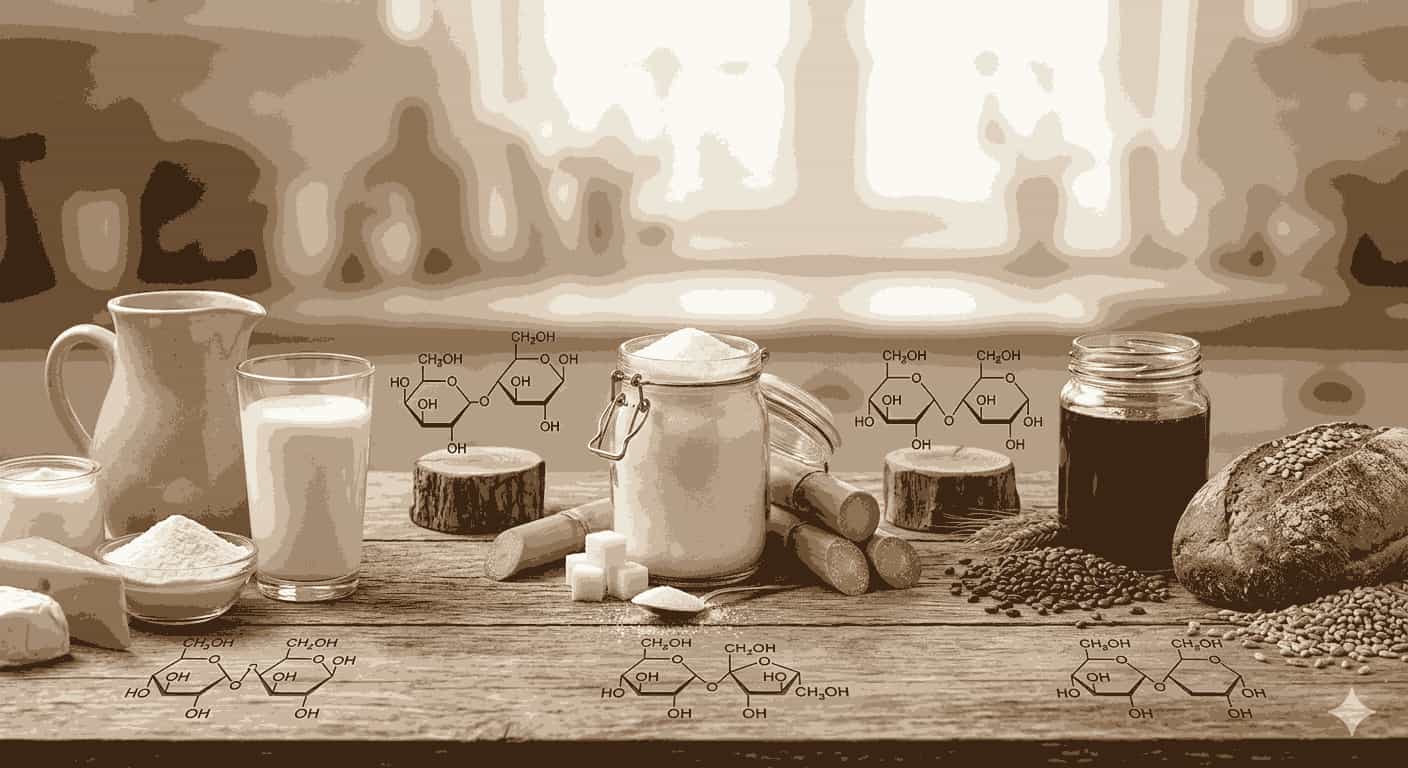
The study of Lactose Sucrose Maltose MCQs with Answers mainly revolves around three important disaccharides: lactose, sucrose, and maltose. Each of these sugars has a unique structure and chemical behavior. Lactose is composed of glucose and galactose units, sucrose consists of glucose and fructose, while maltose contains two glucose units. Practicing Lactose Sucrose Maltose MCQs with Answers helps aspirants easily differentiate between these sugars.
One key concept in Lactose Sucrose Maltose MCQs with Answers is glycosidic linkage. Lactose has a β-1,4 glycosidic bond, maltose has an α-1,4 glycosidic bond, and sucrose has an α-1,2 linkage between glucose and fructose. These differences play a crucial role in determining their chemical properties. Through Lactose Sucrose Maltose MCQs with Answers, aspirants can better understand how bonding affects reactivity.
Another important aspect covered in Lactose Sucrose Maltose MCQs with Answers is reducing and non-reducing nature. Lactose and maltose are reducing sugars because they have a free aldehyde or ketone group, while sucrose is a non-reducing sugar due to the involvement of both anomeric carbons in the glycosidic bond. This distinction is frequently tested, making Lactose Sucrose Maltose MCQs with Answers crucial for exam preparation.
Hydrolysis reactions are also a major focus in Lactose Sucrose Maltose MCQs with Answers. On hydrolysis, lactose yields glucose and galactose, sucrose gives glucose and fructose, and maltose produces two glucose molecules. Understanding these reactions through Lactose Sucrose Maltose MCQs with Answers helps saspirants solve reaction-based questions easily.
In addition, Lactose Sucrose Maltose MCQs with Answers highlights various chemical tests used to identify these sugars. For example, Fehling’s and Benedict’s tests are used to detect reducing sugars, while sucrose does not respond to these tests unless hydrolyzed. Learning such details through Lactose Sucrose Maltose MCQs with Answers improves conceptual clarity.
The biological importance of these sugars is also emphasized in Lactose Sucrose Maltose MCQs with Answers. Lactose is known as milk sugar and is important in nutrition, sucrose is commonly known as table sugar, and maltose is produced during the digestion of starch. Studying Lactose Sucrose Maltose MCQs with Answers helps connect chemistry concepts to real-life applications.
Furthermore, Lactose Sucrose Maltose MCQs with Answers helps aspirants understand stereochemistry and isomerism in carbohydrates. These sugars exhibit different configurations and forms, which are important for understanding their properties. Regular practice of Lactose Sucrose Maltose MCQs with Answers ensures better retention of such concepts.
Another key advantage of studying Lactose Sucrose Maltose MCQs with Answers is quick revision. Since these sugars are part of frequently asked topics, revising them through structured content ensures better exam performance. Aspirants can easily recall important points after practicing Lactose Sucrose Maltose MCQs with Answers.
From an exam perspective, Lactose Sucrose Maltose MCQs with Answers plays a significant role in scoring marks. Questions are often direct but require strong conceptual understanding. Practicing Lactose Sucrose Maltose MCQs with Answers regularly helps in improving accuracy and speed.
Lactose Sucrose Maltose MCQs with Answers:
1. The synthesis of each molecule of glucose in photosynthesis involves
a) 6 molecules of ATP
b) 8 molecules of ATP
c) 10 molecules of ATP
d) 18 molecules of ATP
Answer: d
2. Sucrose and glucose can be distinguished by
a) Molisch’s reagent
b) Baeyer’s reagent
c) Fehling’s solution
d) Iodine solution
Answer: c
3. Glucose is obtained from
a) Starch
b) Molasses
c) Aspartame
d) None of these
Answer: a
4. Which artificial sweetener is unstable at cooking temperature?
a) Sucralose
b) Aspartame
c) Alitame
d) Saccharin
Answer: b
5. Name the sweetener which is a trichloro derivative of sucrose
a) Saccharin
b) Sucralose
c) Alitame
d) Aspartame
Answer: b
6. From the following substances, which carbohydrate has the maximum sweetness?
a) Sucralose
b) Saccharin
c) Aspartame
d) Alitame
Answer: a
7. Why is glucose called gluco-pyranose?
a) Glucose is aldohexose
b) Glucose is a cyclic compound containing five carbon atoms and one oxygen atom
c) Glucose is ketohexose
d) Glucose is a cyclic compound containing six carbon atoms and one oxygen atom
Answer: b
8. In which of the following compounds are all the monosaccharide units not joined by C₁–O–C₄ chain?
a) Amylopectin
b) Lactose
c) Cellulose
d) Maltose
Answer: a
9. Glucose and galactose have identical configuration at all positions except
a) C-3
b) C-4
c) C-2
d) C-5
Answer: b
10. Biuret test is not given by
a) Carbohydrates
b) Polypeptides
c) Urea
d) Proteins
Answer: a
11. A, B and C are three biomolecules. The results of tests are:
- A: Molisch positive, Barfoed negative, Biuret negative
- B: Molisch positive, Barfoed positive, Biuret negative
- C: Molisch negative, Barfoed negative, Biuret positive
Choose the correct identification:
a) A = Lactose, B = Glucose, C = Albumin
b) A = Lactose, B = Fructose, C = Albumin
c) A = Albumin, B = Fructose, C = Lactose
d) A = Fructose, B = Albumin, C = Lactose
Answer: a
12. The peptide that gives positive ceric ammonium nitrate and carbylamine tests is
a) Lys-Asp
b) Ser-Lys
c) Gln-Asp
d) Asp-Gln
Answer: b
13. Which one of the following compounds contains β-C₁–C₄ glycosidic linkage?
a) Lactose
b) Sucrose
c) Maltose
d) Amylose
Answer: a
14. Hydrolysis of sucrose gives
a) α-D-(+)-glucose and β-D-(+)-fructose
b) β-D-(+)-glucose and β-D-(+)-fructose
c) α-D-(+)-glucose and β-D-(-)-fructose
d) α-D-(-)-glucose and β-D-(+)-fructose
Answer: c
15. Compound A gives D-galactose and D-glucose on hydrolysis. The compound A is
a) Amylose
b) Sucrose
c) Maltose
d) Lactose
Answer: d
16. Identify the incorrect statement from the following
a) Amylose is a branched chain polymer of glucose
b) Starch is a polymer of α-D-glucose
c) β-glycosidic linkage makes cellulose polymer
d) Glycogen is called animal starch
Answer: a
17. Which one among the following chemical tests is used to distinguish monosaccharide from disaccharide?
a) Seliwanoff’s test
b) Iodine test
c) Barfoed test
d) Tollen’s test
Answer: c
18. A non-reducing sugar A hydrolyses to give two reducing monosaccharides. Sugar A is
a) Fructose
b) Galactose
c) Glucose
d) Sucrose
Answer: d
19. Consider the following reactions:
- Glucose + ROH, dry HCl → Acetal → X eq. of (CH3CO)2O(CH₃CO)₂O → Acetyl derivative
- Glucose →Ni/H2\xrightarrow{Ni/H₂} A → Y eq. of (CH3CO)2O(CH₃CO)₂O → Acetyl derivative
- Glucose → Z eq. of (CH3CO)2O(CH₃CO)₂O → Acetyl derivative
X, Y and Z are respectively
a) 4, 5 and 3
b) 5, 4 and 3
c) 5, 6 and 3
d) 4, 6 and 5
Answer: d
20. The correct observation in the following reactions is
Sucrose→HydrolysisA+B→Seliwanoff’s reagentSucrose \xrightarrow{\text{Hydrolysis}} A + B \xrightarrow{\text{Seliwanoff’s reagent}}
a) Formation of blue colour
b) Gives no colour
c) Formation of red colour
d) Formation of violet colour
Answer: c
21. What are the functional groups present in the structure of maltose?
a) One ketal and one hemiketal
b) One acetal and one ketal
c) One acetal and one hemiacetal
d) Two acetals
Answer: c
22. The number of chiral carbons present in sucrose is
a) 5
b) 6
c) 7
d) 9
Answer: d
23. Which one of the following statements is not true?
a) Lactose contains α-glycosidic linkage between C₁ of galactose and C₄ of glucose
b) Lactose is a reducing sugar and it gives Fehling’s test
c) Lactose (C12H22O11)(C₁₂H₂₂O₁₁) is a disaccharide and it contains 8 hydroxyl groups
d) On acid hydrolysis, lactose gives one molecule of D-(+)-glucose and one molecule of D-(+)-galactose
Answer: a
24. Which of the following statements is not true for glucose?
a) The pentaacetate of glucose does not react with hydroxylamine to give oxime
b) Glucose exists in two crystalline forms α and β
c) Glucose gives Schiff’s test for aldehyde
d) Glucose reacts with hydroxylamine to form oxime
Answer: c
25. Which of the following statements is correct?
a) Gluconic acid is obtained by oxidation of glucose with HNO₃
b) Gluconic acid is a dicarboxylic acid
c) Gluconic acid can form cyclic acetal/hemiacetal structure
d) Gluconic acid is a partial oxidation product of glucose
Answer: d
26. Two monomers in maltose are
a) α-D-glucose and β-D-glucose
b) α-D-glucose and α-D-glucose
c) α-D-glucose and β-D-galactose
d) α-D-glucose and α-D-fructose
Answer: b
27. Maltose on treatment with dilute HCl gives
a) D-glucose and D-fructose
b) D-fructose
c) D-galactose
d) D-glucose
Answer: d
28. Fructose and glucose can be distinguished by
a) Fehling’s test
b) Barfoed’s test
c) Benedict’s test
d) Seliwanoff’s test
Answer: d
29. Which of the following statements is not true about sucrose?
a) It is also named as invert sugar
b) The glycosidic linkage is present between C₁ of α-glucose and C₁ of β-fructose
c) It is a non-reducing sugar
d) On hydrolysis, it produces glucose and fructose
Answer: b
30. Amylopectin is composed of
a) β-D-glucose, C₁–C₄ and C₁–C₆ linkages
b) β-D-glucose, C₁–C₄ and C₂–C₅ linkages
c) β-D-glucose, C₂–C₄ and C₂–C₅ linkages
d) α-D-glucose, C₁–C₄ and C₁–C₆ linkages
Answer: d
Conclusion on Lactose Sucrose Maltose MCQs with Answers
In conclusion, the importance of Lactose Sucrose Maltose MCQs with Answers cannot be ignored. It covers essential concepts like structure, bonding, reactions, and properties of disaccharides. By focusing on Lactose Sucrose Maltose MCQs with Answers, aspirants can strengthen their preparation, enhance their understanding, and perform better in competitive exams.