
- Keneitsino Lydia
- March 12, 2026
Best Positive and Negative Catalyst MCQs Class 12 to Boost NEET, JEE & CUET Preparation
Catalysts play a crucial role in chemical reactions, especially in the study of chemical kinetics. A catalyst is a substance that alters the rate of a chemical reaction without being consumed in the process. In many reactions, catalysts help increase the speed of the reaction by lowering the activation energy required for reactants to convert into products. Understanding catalysts is an important part of the Class 12 chemistry syllabus, and many examination questions are framed around this topic. Practicing Positive and Negative catalyst MCQs class 12 helps aspirants strengthen their conceptual understanding of catalytic behavior and reaction mechanisms.
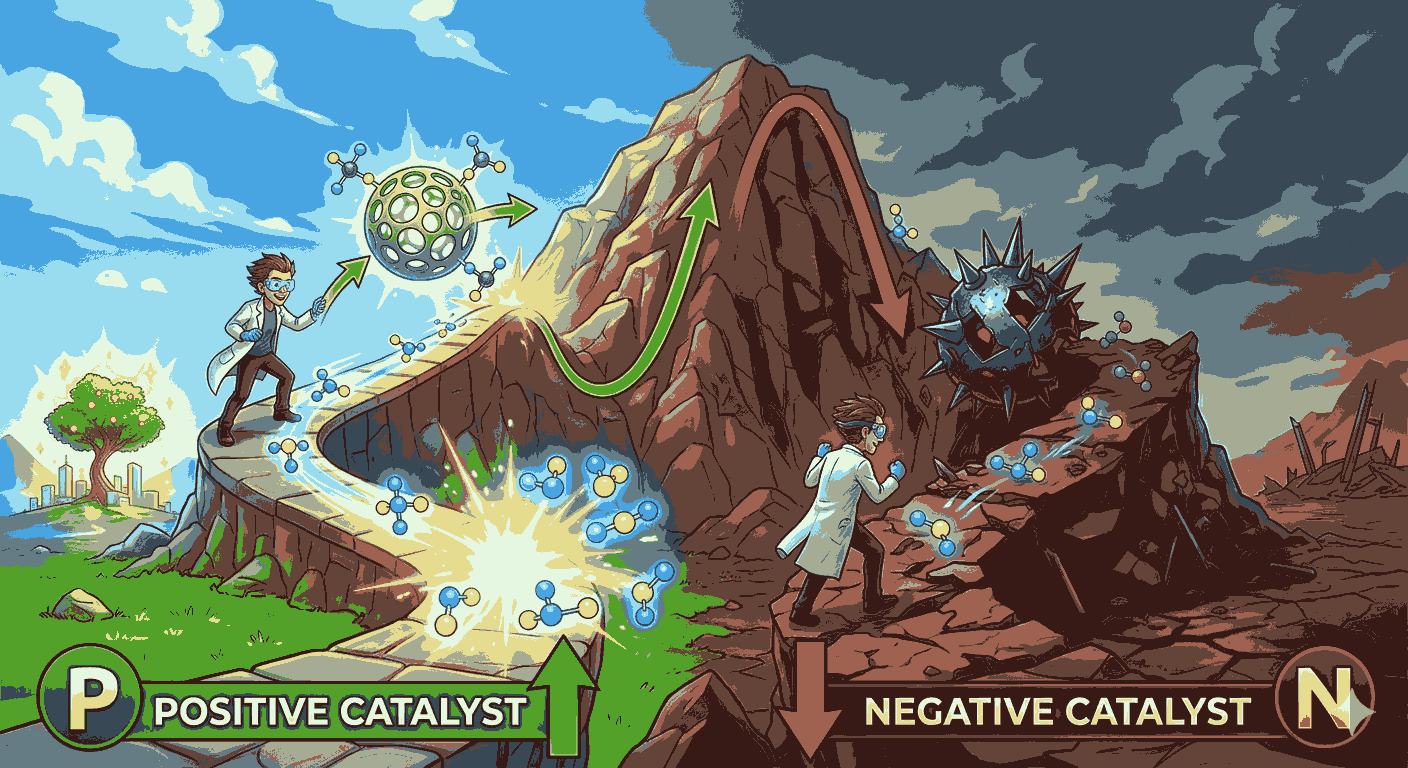
In general, catalysts are classified into two main types: positive catalysts and negative catalysts MCQs class 12. A positive catalyst increases the rate of a chemical reaction, while a negative catalyst decreases the rate of a reaction. These two types of catalysts i.e., positive and negative catalyst MCQs class 12 are widely studied in chemical kinetics, and questions related to them are commonly included in board and competitive exams. Aspirants often practice Positive and Negative catalyst MCQs class 12 to become familiar with how different catalysts influence reaction rates.
In positive and negative catalyst MCQs class 12, a positive catalyst works by providing an alternative reaction pathway with lower activation energy. When the activation energy barrier is reduced, a larger number of molecules can acquire the necessary energy to react. As a result, the rate of reaction increases significantly. For example, the decomposition of hydrogen peroxide occurs much faster in the presence of manganese dioxide, which acts as a positive catalyst. Such examples frequently appear in Positive and Negative catalyst MCQs class 12, helping aspirants connect theoretical concepts with real chemical reactions.
On the other hand, a negative catalyst slows down the rate of a chemical reaction. Negative catalysts are also known as inhibitors because they prevent or delay the progress of reactions. These substances increase the stability of reactants or interfere with the reaction pathway so that the reaction proceeds more slowly. Questions involving reaction inhibition and reaction control are often included in Positive and Negative catalyst MCQs class 12, allowing aspirants to analyze how different substances affect reaction rates.
In positive and negative catalyst MCQs class 12, another important characteristic of catalysts is that they do not change the equilibrium position of a reversible reaction. Instead, catalysts accelerate both the forward and backward reactions equally. This means that equilibrium is reached faster, but the equilibrium constant remains unchanged. Understanding this concept is essential when solving Positive and Negative catalyst MCQs class 12, because many questions test whether aspirants understand the difference between reaction rate and equilibrium.
In positive and negative catalyst MCQs class 12,catalysts also play an important role in industrial chemical processes. Many large-scale reactions would be too slow or inefficient without the use of catalysts. For instance, the Haber process for ammonia synthesis uses iron as a catalyst to increase the reaction rate between nitrogen and hydrogen. Similarly, catalysts are widely used in petroleum refining, polymer production, and environmental chemistry. Learning these real-world applications often helps aspirants perform better when solving Positive and Negative catalyst MCQs class 12.
In addition to industrial applications,positive and negative catalyst MCQs class 12 also important in biological systems. Enzymes are natural catalysts that speed up biochemical reactions inside living organisms. Without enzymes, many essential metabolic reactions would occur far too slowly to sustain life. Because enzymes function as catalysts, questions related to enzyme activity sometimes appear in Positive and Negative catalyst MCQs class 12, connecting chemical kinetics with biological chemistry.
In positive and negative catalyst MCQs class 12, catalysts can also be classified based on their physical state relative to the reactants. Homogeneous catalysts exist in the same phase as the reactants, while heterogeneous catalysts exist in a different phase. For example, solid catalysts used in gas-phase reactions represent heterogeneous catalysis. Understanding the difference between homogeneous and heterogeneous catalysis is another concept frequently tested in Positive and Negative catalyst MCQs class 12.
Another interesting aspect of catalysts is that even a small amount can significantly influence the reaction rate. Catalysts are not consumed during the reaction and can often be reused multiple times. This property makes catalysts extremely valuable in industrial processes where efficiency and cost-effectiveness are important. Aspirants preparing for examinations often review these properties through Positive and Negative catalyst MCQs class 12, which highlight the practical importance of catalysts in chemistry.
The mechanism of catalysis also helps explain how catalysts influence chemical reactions. In many cases, catalysts form temporary intermediate compounds with reactants. These intermediates then break down to produce the final products while regenerating the catalyst. Understanding catalytic mechanisms allows students to better interpret reaction pathways and solve conceptual problems included in Positive and Negative catalyst MCQs class 12.
Environmental protection is another field where catalysts are widely used. For example, catalytic converters in automobiles reduce harmful emissions by converting toxic gases into less harmful substances. These devices rely on catalysts such as platinum, palladium, and rhodium to accelerate chemical reactions that neutralize pollutants. Awareness of such environmental applications often helps students answer application-based questions in Positive and Negative catalyst MCQs class 12.
Finally, mastering the concept of positive and negative MCQs class 12 catalysts requires both theoretical understanding and problem-solving practice. By regularly studying examples and solving questions related to positive and negative catalyst MCQs class 12 catalysis, aspirants can build a strong foundation in chemical kinetics. Practicing Positive and Negative catalyst MCQs class 12 enables students to identify reaction patterns, understand catalyst behavior, and apply kinetic principles effectively.
Positive or Negative Catalyst MCQs Class 12:
A reaction is first order with respect to reactant A and second order with respect to reactant B. What happens to the rate when the concentration of both A and B are doubled?
A. Eight times
B. Quadrupled
C. Doubled
D. Sixteen times
Answer: C
Q2.
For the reaction A + B → Products, doubling the concentration of A increases the rate four times, but doubling B has no effect. The rate equation is
A. rate = k[A][B]
B. rate = k[A]²
C. rate = k[A]²[B]
D. rate = k[A]²[B]²
Answer: B
Q3.
The reaction 2A + B₂ → 2AB is an elementary reaction. If the volume of the vessel is reduced by a factor of 3, the rate increases by
A. 3
B. 9
C. 27
D. 81
Answer: C
Q4.
Two reactions A and B occur at the same temperature and concentration, but the rate of A is double that of B. If the pre-exponential factor is the same, the difference in activation energy EA−EBE_A – E_B is
A. −RT ln 2
B. RT ln 4
C. 2RT
D. RT
Answer: A
Q5.
Which factor does NOT affect the rate of a reaction?
A. Molecularity
B. Concentration
C. Nature of reactants
D. Temperature
Answer: A
Q6.
A negative catalyst is a substance that
A. Increases the rate of a chemical reaction
B. Decreases the rate of a chemical reaction
C. Stops the reaction permanently
D. Changes the equilibrium constant
Answer:B
Q7.
The role of a catalyst is to change
A. Gibbs free energy
B. Enthalpy of reaction
C. Activation energy of reaction
D. Equilibrium constant
Answer: C
Q8.
Assertion (A): A catalyst increases the rate of a reaction.
Reason (R): In presence of a catalyst, activation energy increases.
A. Both true and R explains A
B. Both true but R not explanation
C. A true, R false
D. A false, R true
Answer: D
Q9.
If a reaction rate doubles for every 10°C rise, increasing temperature from 10°C to 80°C increases rate by
A. 14 times
B. 16 times
C. 64 times
D. 128 times
Answer: C
Q10.
If rate constants at 300 K and 280 K are k₁ and k₂ respectively
A. k₂ = 2k₁
B. k₂ = 4k₁
C. k₂ = 0.25k₁
D. k₂ = 0.5k₁
Answer: C
Q11.
For reversible gaseous reactions, a positive catalyst
A. Increases rate by increasing activation energy
B. Increases forward and backward rate by lowering activation energy
C. Increases only forward reaction rate
D. Does not affect rate
Answer: B
Q12.
If pressure increases threefold for reaction 2H₂S + O₂ → products, rate increases
A. 3 times
B. 9 times
C. 27 times
D. 81 times
Answer: C
Q13.
The doubling or tripling of rate constant for a 10 K temperature rise occurs because
A. Collision frequency increases 2–3 times
B. Molecules with threshold energy increase 2–3 times
C. Activation energy decreases
D. None
Answer: B
Q14.
Correct statements about catalyst
-
Reduces activation energy
-
Increases activation energy
-
Increases rate of attainment of equilibrium
-
Decreases rate of attainment of equilibrium
A. 2 and 4
B. 1 and 4
C. 1 and 3
D. 2 and 3
Answer: C
Q15.
If reaction is second order in CO and its concentration doubles, the rate
A. Remains unchanged
B. Triples
C. Increases four times
D. Doubles
Answer: C
Q16.
A catalyst is a substance which
A. Increases forward reaction rate only
B. Increases both forward and backward reaction rates
C. Does not affect reversible reaction
D. Increases backward reaction rate only
Answer: B
Q17.
According to collision theory, increasing temperature increases reaction rate because
A. Molecules move faster
B. Collisions increase
C. Molecules with activation energy increase
D. None
Answer: C
Q18.
Why do reaction rates increase rapidly with temperature?
A. More molecules have energy greater than activation energy
B. Average kinetic energy increases
C. Activation energy decreases
D. More collisions occur
Answer: A
Q19.
For reaction 3X + Y ⇌ X₃Y with positive ΔH, equilibrium yield changes by
A. Changing temperature
B. Changing pressure
C. Changing temperature and pressure
D. Temperature, pressure and catalyst
Answer: C
Q20.
The rate of reaction intermediates can be determined by studying
A. Catalyst effects
B. Concentration of reactants
C. Temperature effects
D. Solvent effects
Answer: B
Q21.
A catalyst
A. Lowers activation energy
B. Changes rate constant
C. Changes product
D. Is destroyed
Answer: A
Q22.
A catalyst
A. Increases equilibrium constant
B. Increases equilibrium concentration
C. Does not alter mechanism
D. Changes activation energy
Answer: D
Q23.
If number of molecules with energy greater than threshold energy increases fivefold between 27°C and 42°C, activation energy is
A. 8000 J/mol
B. 9000 J/mol
C. 92539 J/mol
D. 84297.47 J/mol
Answer: D
Q24.
Reaction quotient Q for reduction of O₂ to H₂O in acidic solution is
A. Q=P0aH+4PO2Q = \frac{P^0}{a_{H^+}^4 P_{O_2}}
B. Q=PO2aH+4P0Q = \frac{P_{O_2}}{a_{H^+}^4 P^0}
C. Q=aH+4PO2P0Q = \frac{a_{H^+}^4 P_{O_2}}{P^0}
D. Q=aH+4P0PO2Q = \frac{a_{H^+}^4 P^0}{P_{O_2}}
Answer: A
Q25.
If activation energy is 30 kcal mol⁻¹, a 10°C rise in temperature increases rate constant approximately
A. Three-fold
B. Two-fold
C. Three and half-fold
D. Four-fold
Answer: B
Q26.
The reason reaction rate almost doubles for 10°C rise is
A. Threshold energy increases
B. Collision frequency increases
C. More molecules have energy ≥ activation energy
D. Activation energy decreases
Answer: B

Conclusion on Positive and Negative Catalyst MCQs Class 12
In conclusion, catalysts are essential in controlling the speed of chemical reactions, both in laboratory experiments and industrial processes. Positive catalysts accelerate reactions, while negative catalysts slow them down. Understanding these concepts is crucial for aspirants studying chemical kinetics in Class 12. Regular practice with Positive and Negative catalyst MCQs class 12 helps aspirants gain confidence in solving conceptual and numerical problems related to catalysis, ultimately improving their performance in chemistry examinations.