
- Keneitsino Lydia
- March 21, 2026
30 Best Organic Chemistry Amines Mechanism Practice MCQs With Answers for Competitive Exams: Master Reactions Fast
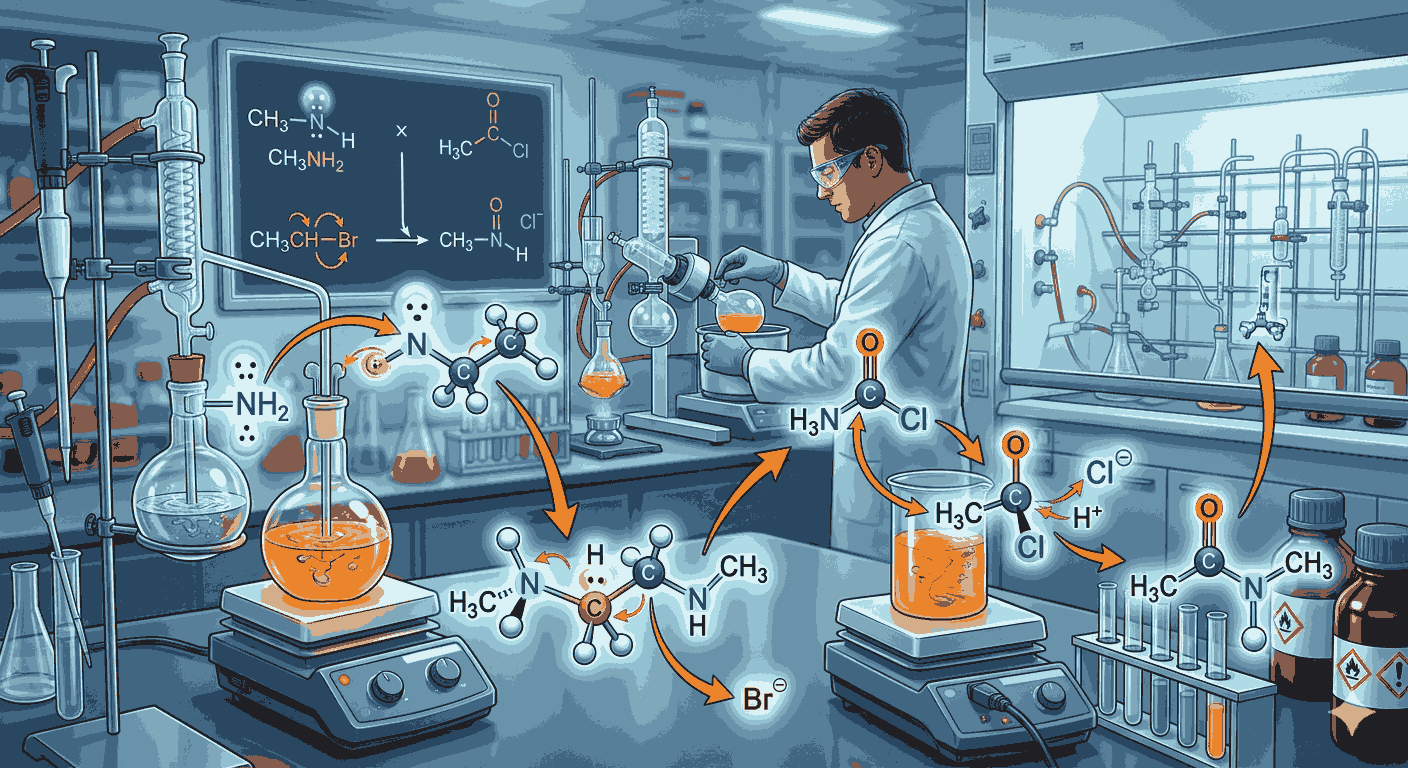
Organic chemistry, particularly the chapter on amines, plays a crucial role in Class 12 Chemistry and competitive exams like NEET and JEE. One of the most challenging yet important aspects of this topic is understanding reaction mechanisms. This is where Organic Chemistry Amines Mechanism Practice MCQs With Answers become extremely valuable. They help students move beyond rote learning and develop a deeper conceptual understanding of how reactions actually occur at the molecular level.
Amines undergo a wide variety of reactions such as nucleophilic substitution, electrophilic substitution, diazotization, and reduction. Each of these reactions follows a specific mechanism involving intermediates, electron movement, and reaction conditions. Practicing Organic Chemistry Amines Mechanism Practice MCQs With Answers allows aspirants to visualize these steps and understand the reasoning behind each transformation. This is essential because mechanism-based questions are very common in entrance exams.
One of the key reactions in this chapter is the Hoffmann bromamide degradation reaction. It involves the conversion of an amide into a primary amine with one carbon less. Understanding the step-by-step mechanism, including the formation of isocyanate intermediate, is much easier when aspirants practice Organic Chemistry Amines Mechanism Practice MCQs With Answers. These practice questions reinforce the concept and help aspirants remember the reaction pathway effectively.
Another important mechanism is diazotization of primary aromatic amines. This reaction involves the formation of a diazonium salt at low temperatures. The mechanism includes the generation of nitrosonium ion (NO⁺), which reacts with the amine. By working through Organic Chemistry Amines Mechanism Practice MCQs With Answers, aspirants can clearly understand how temperature, reagents, and intermediates influence the reaction.
Electrophilic substitution reactions of aniline also require careful attention. The –NH₂ group is a strong activating group, directing substitutions to ortho and para positions. However, under acidic conditions, it gets protonated to form anilinium ion, which becomes deactivating. These subtle differences are often tested in exams, and Organic Chemistry Amines Mechanism Practice MCQs With Answers help aspirants grasp these variations in reactivity.
Reduction reactions of nitro compounds to amines are another major topic. Depending on the reaction conditions, different products like aniline, hydroxylamine, or azobenzene can be formed. Understanding these pathways becomes much clearer with repeated exposure to Organic Chemistry Amines Mechanism Practice MCQs With Answers, which present different scenarios and conditions.
The Carbylamine reaction is another important mechanism where primary amines react with chloroform and alcoholic KOH to form isocyanides. The mechanism involves the formation of dichlorocarbene intermediate. Practicing Organic Chemistry Amines Mechanism Practice MCQs With Answers helps aspirants understand why only primary amines give this test and how the reaction proceeds step by step.
In addition, nucleophilicity and basicity trends in amines are closely related to their mechanisms. Factors such as inductive effect, resonance, and steric hindrance play a major role. By solving Organic Chemistry Amines Mechanism Practice MCQs With Answers, students can connect these theoretical concepts with actual reaction behavior.
Another benefit of practicing Organic Chemistry Amines Mechanism Practice MCQs With Answers is improved problem-solving speed. Since mechanisms can be complex, regular practice helps aspirants quickly identify the correct pathway during exams. This is especially important in time-bound competitive exams.
Revision also becomes more effective with Organic Chemistry Amines Mechanism Practice MCQs With Answers, as aspirants can quickly review important reactions and mechanisms without going through lengthy notes. This makes it an excellent tool for last-minute preparation.
Moreover, Organic Chemistry Amines Mechanism Practice MCQs With Answers expose aspirants to different question formats such as assertion-reason, match-the-following, and case-based questions. This variety ensures comprehensive preparation and boosts confidence.
Aspirants can also identify and correct common mistakes through Organic Chemistry Amines Mechanism Practice MCQs With Answers, such as misunderstanding intermediates or reaction conditions. This leads to better accuracy in exams.
Organic Chemistry Amines Mechanism Practice MCQs With Answers:
1. Which of the following on reduction gives amine?
a) RCONH₂
b) R–NO₂
c) R–CN
d) All of these
Answer: d
2. Organic compound containing double and triple bonds showing UV absorption is called:
a) Auxochromes
b) Chromophores
c) Lithophones
d) All of these
Answer: b
3. Correct order of basic nature is:
a) NH₃ > CH₃NH₂ > C₆H₅NH₂
b) CH₃NH₂ > C₆H₅NH₂ > NH₃
c) CH₃NH₂ > NH₃ > C₆H₅NH₂
d) None of these
Answer: c
4. Ester and acetamide can be distinguished by:
a) Grignard reagent
b) Fatty acid derivatives
c) Hydrolysis with acid/alkali
d) Both (b) and (c)
Answer: d
5. Diethylamine + nitrous acid gives:
a) Diethyl ammonium nitrite
b) Ethyl alcohol
c) N-nitroso diethylamine
d) Diethyl ammonium nitrite
Answer: c
6. Reaction: R–CN → RCHO is called:
a) Friedel reaction
b) Stephen reaction
c) HVZ reaction
d) Balz–Schiemann
Answer: b
7. Replacement of diazonium group by fluorine is called:
a) Gattermann
b) Sandmeyer
c) Balz–Schiemann
d) Etard
Answer: c
8. Method by which aniline cannot be prepared:
a) Benzamide degradation
b) Nitrobenzene reduction
c) Gabriel synthesis with chlorobenzene
d) Hydrolysis of phenyl isocyanide
Answer: c
9. Electrolytic reduction of nitrobenzene in acidic medium gives:
a) Azobenzene
b) Aniline
c) p-Aminophenol
d) Azoxybenzene
Answer: c
10. Which is soluble in NaNO₂ + dil. HCl forming salt?
a) (CH₃)₂NH
b) (CH₃)₃N
c) (CH₃)₂CHNH₂
d) (CH₃)₃CNH₂
Answer: b
11. Acid anhydride + primary amine gives:
a) Amide
b) Imide
c) Secondary amine
d) Imine
Answer: a
12. In the reaction sequence, X is:
a) Cyclohexanone
b) Caprolactam
c) HO(CH₂)₆NH₂
d) Hexamethylene diisocyanate
Answer: b
13.In the reaction of an alkyl halide with ammonia, which of the following is the major product when excess ammonia is used?
a) Secondary amine
b) Tertiary amine
c) Primary amine
d) Quaternary ammonium salt
Answer: c
14. Separation of methylamine and dimethylamine is done using:
a) CHCl₃ + HCl
b) C₆H₅SO₂Cl + KOH
c) C₆H₅SO₂Cl + HCl
d) CHCl₃ + KOH
Answer: b
15. Increasing order of basic strength (gaseous):
a) (C₂H₅)₂NH < C₂H₅NH₂ < C₆H₅NH₂ < NH₃
b) C₆H₅NH₂ < NH₃ < (C₂H₅)₂NH < C₂H₅NH₂
c) C₆H₅NH₂ < NH₃ < C₂H₅NH₂ < (C₂H₅)₂NH
d) None
Answer: c
16.An amide is treated with bromine and aqueous KOH (Hoffmann bromamide reaction). The product formed is:
a) Alcohol
b) Amine with same number of carbons
c) Amine with one less carbon
d) Aldehyde
Answer: c
17. Phenyl isocyanide is prepared by:
a) Rosenmund
b) Kolbe
c) Reimer–Tiemann
d) Carbylamine reaction
Answer: d
18. RCONH₂ → RCN reagent is:
a) Sodalime
b) B₂O₃
c) NaOBr
d) P₂O₅
Answer: d
19. Maximum basic strength is shown by:
a) C₆H₅NH₂
b) C₆H₄(NO₂)NH₂
c) C₆H₅NHCH₃
d) C₆H₅CH₂NHC₂H₅
Answer: d
20.Which of the following is the final product when aniline undergoes diazotization followed by reduction with hypophosphorous acid (H₃PO₂)?
a) Phenol
b) Benzene
c) Aniline
d) Nitrobenzene
Answer: b
21. Aniline + CHCl₃ + alkali gives:
a) Phenyl cyanide
b) Phenyl isocyanide
c) Phenyl cyanate
d) Phenyl isocyanate
Answer: b
22. C₃H₉N (insoluble Hinsberg product) is:
a) Primary amine
b) Secondary amine
c) Tertiary amine
d) Isocyanide
Answer: b
23. Reagent used for separation of 1°, 2°, 3° amines:
a) p-Toluenesulphonyl chloride
b) Benzene sulphonyl chloride
c) p-Aminobenzene sulphonyl chloride
d) m-Toluenesulphonyl chloride
Answer: a
24. Amines are prepared by:
a) Reduction of nitro compounds
b) Ammonolysis
c) Reduction of nitriles/amides
d) All of these
Answer: d
25.Which of the following reactions converts amide into nitrile?
a) Hoffmann bromamide
b) Dehydration with P₂O₅
c) Reduction with LiAlH₄
d) Hydrolysis
Answer: b
26. Compound giving carbylamine test:
a) N-methyl-o-methyl aniline
b) N,N-diethyl aniline
c) 2,4-diethyl aniline
d) p-methyl-N-methyl benzylamine
Answer: c
27. Reagent to convert benzamide to acetanilide derivative:
a) KOH/Br₂; CH₃COCl
b) KOH/Br₂; H₂N
c) KOH/Br₂; LiAlH₄
d) HNO₃/CuCl₂
Answer: a
28.Which of the following compounds has the most nucleophilic nitrogen atom?
a) Aniline
b) Nitroaniline
c) Alkyl amine
d) Amide
Answer: c
29. Final product Z is:
a) C₆H₅CO₂H
b) C₆H₅OH
c) C₆H₅CHO
d) C₆H₆
Answer: c
30. Alkyl iodide + excess NH₃ gives:
a) Primary amine
b) Secondary amine
c) Tertiary amine
d) Quaternary ammonium salt
Answer: a
Conclusion on Organic Chemistry Amines Mechanism Practice MCQs With Answers:
Overall, mastering amine mechanisms requires both conceptual understanding and consistent practice. By regularly working through Organic Chemistry Amines Mechanism Practice MCQs With Answers, aspirants can strengthen their foundation, improve analytical skills, and excel in exams. Ultimately, Organic Chemistry Amines Mechanism Practice MCQs With Answers serve as a powerful resource for achieving success in organic chemistry.