
- Keneitsino Lydia
- March 19, 2026
Top Diazotization Reaction MCQs Class 12 Amines – Crack Exams with Confidence
The study of diazotization reactions is a vital part of the amines chapter in Class 12 Chemistry, especially for aspirants preparing for board exams and competitive exams like NEET and JEE. A strategic way to master this topic is through consistent practice using Diazotization reaction mcqs class 12 amines, which helps bridge the gap between theory and application.
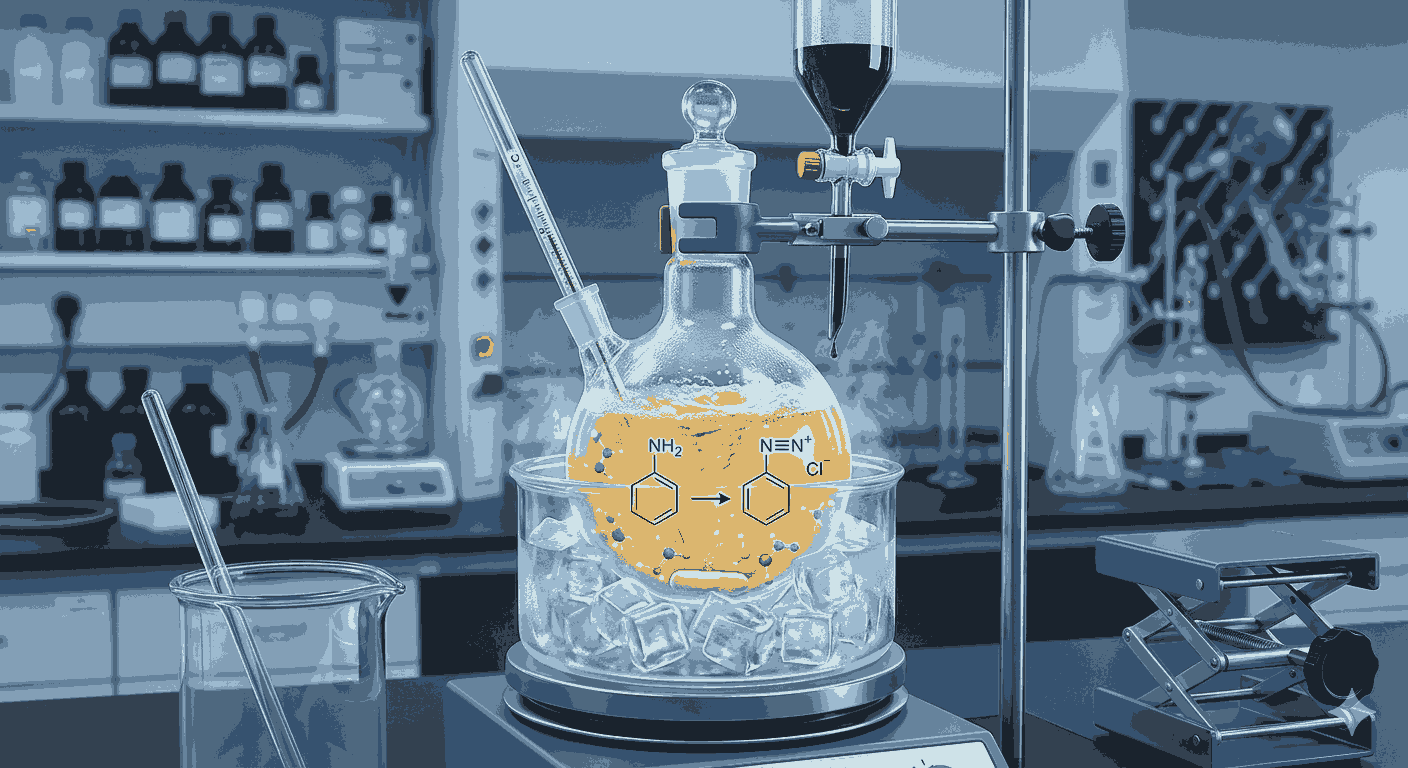
Diazotization is a chemical reaction in which primary aromatic amines react with nitrous acid (generated in situ from sodium nitrite and hydrochloric acid) at low temperatures, typically between 273–278 K, to form diazonium salts. These salts are highly reactive intermediates and are widely used in organic synthesis. By practicing Diazotization reaction mcqs class 12 amines, students can better understand the conditions required for this reaction and why temperature control is critical.
When aspirants work through Diazotization reaction mcqs class 12 amines, they become familiar with the mechanism of the reaction. The formation of the nitrosonium ion (NO⁺) and its subsequent attack on the amine group is a key concept. Understanding this mechanism allows aspirants to confidently answer conceptual and application-based questions in exams.
One of the most important aspects emphasized in Diazotization reaction mcqs class 12 amines is the difference between aromatic and aliphatic amines. While aromatic primary amines form stable diazonium salts, aliphatic diazonium salts are unstable and decompose easily. This distinction is frequently tested, and practicing Diazotization reaction mcqs class 12 amines helps aspirants avoid confusion.
Another key area covered through Diazotization reaction mcqs class 12 amines is the variety of reactions that diazonium salts can undergo. These include substitution reactions such as Sandmeyer reactions, where the diazonium group is replaced by halides, cyanides, or other functional groups. Regular exposure to Diazotization reaction mcqs class 12 amines ensures that aspirants can identify these transformations quickly.
In addition, Diazotization reaction mcqs class 12 amines help students understand coupling reactions, where diazonium salts react with phenols or aromatic amines to form azo compounds. These reactions are important in the synthesis of dyes and are commonly asked in exams. Practicing Diazotization reaction mcqs class 12 amines makes it easier to recognize such reactions and predict products.
Temperature and reaction conditions play a crucial role in diazotization. Through Diazotization reaction mcqs class 12 amines, aspirants learn that maintaining low temperatures is essential to prevent decomposition of diazonium salts. This concept is often tested in assertion-reason questions, making Diazotization reaction mcqs class 12 amines a valuable resource for preparation.
Another advantage of using Diazotization reaction mcqs class 12 amines is the ability to identify common mistakes, such as confusing diazotization with nitration or reduction reactions. By practicing regularly, aspirants can clearly differentiate between these processes and apply the correct concepts in exams.
Furthermore, Diazotization reaction mcqs class 12 amines enhance problem-solving skills by exposing aspirants to a variety of question types, including mechanism-based, conceptual, and application-oriented questions. This comprehensive approach ensures better retention and understanding.
From an exam perspective, Diazotization reaction mcqs class 12 amines are extremely useful for quick revision. Instead of revisiting lengthy notes, students can revise key concepts efficiently through practice questions. This saves time and improves confidence before exams.
Additionally, Diazotization reaction mcqs class 12 amines help improve speed and accuracy, which are crucial in competitive exams. Regular practice enables aspirants to solve questions quickly while minimizing errors.
Diazotization Reaction MCQs Class 12 Amines:
1. In the given reactions, A and B respectively are:
a) H₃PO₂ and CH₃CH₂Cl
b) CH₃CH₂OH and H₃PO₂
c) H₃PO₂ and CH₃CH₂OH
d) CH₃CH₂Cl and H₃PO₂
Answer: a
2. Diazotization of aniline is carried out at:
a) 0 – 5ºC
b) 25ºC
c) 50ºC
d) 100ºC
Answer: a
3. Which regent is used for diazotization of primary aromatic amines?
a) NaNO2 + HCI
b) NaNO3 + HCI
c)NH3 + HCI
d)HNO3
Answer: a
4. Increasing order of pKb values:
a) II < IV < III < I
b) I < II < IV < III
c) II < I < III < IV
d) I < II < III < IV
Answer: b
5. In the reaction sequence, major product B is:
a) [Image]
b) [Image]
c) [Image]
d) [Image]
Answer: b
6. The product formed when anlinr reacts with NaNO2 and HCI at low temperature is:
a)Nitrobenzene
b)Benzene diazonium chloride
c)Phenol
d) Aniline hydrochloride
Answer: b
7. Diazotization reaction is given by:
a) Primary amine + HNO2→ Diazonium salt
b) Secondary amine + HNO2→ Diazonium salt
c) Tertiary amine + HNO2→ Diazonium salt
d)All of these
Answer: a
8. Which gives yellow oily liquid with nitrous acid?
a) Methylamine
b) Aniline
c) Dimethylamine
d) Trimethylamine
Answer: a
9. Increasing order of reactivity with alkyl halides:
a) (A) < (C) < (D) < (B)
b) (B) < (A) < (C) < (D)
c) (B) < (A) < (D) < (C)
d) (A) < (B) < (C) < (D)
Answer: b
10. Nitrobenzene with H₃PO₂ gives:
a) Aniline
b) p-aminophenol
c) Phenylhydroxylamine
d) Phenylhydrazine
Answer: b
11. Compound A and B respectively are:
a) Benzene diazonium chloride and Fluorobenzene
b) Nitrobenzene and Fluorobenzene
c) Nitrobenzene and Chlorobenzene
d) Benzene and Phenol
Answer: a
12. Benzene diazonium chloride reacts with KI to form:
a) Chlorobenzene
b) Iodobenzene
c) Bromobenzene
d) Fluorobenzene
Answer: b
13. Most stable diazonium salt is:
a) CH₃N₂⁺X⁻
b) C₆H₅N₂⁺X⁻
c) CH₃CH₂N₂⁺X⁻
d) C₆H₅CH₂N₂⁺X⁻
Answer: b
14. Benzene diazonium chloride on hydrolysis gives:
a) Benzene
b)Phenol
c) Aniline
d) Nitrobenzene
Answer: b
15. Product X after hydrolysis is:
a) Benzamide
b) Benzoic acid
c) Benzonitrile
d) Phenylacetic acid
Answer: b
16. Most reactive towards nitration:
a) Benzene
b) Toluene
c) m-xylene
d) Mesitylene
Answer: d
17. Reaction type C₆H₅NH₂ + C₆H₅CHO:
a) Addition-elimination
b) Substitution
c) Addition
d) Elimination
Answer: a
18. Cyclohexylamine with NaNO₂/HCl gives:
a) Benzene diazonium chloride
b) Nitrosocyclohexane
c) Nitrocyclohexane
d) Cyclohexanol
Answer: d
19. Which gas is evolved during diazotization?
a) H2
b) O2
c) N2
d) CO2
Answer: c
20. Benzene diazonium chloride reacts with CuCI to give:
a)Chlorobenzene
b)Bromobenzene
c)Phenol
d)Nitrobenzene
Answer: a
21. Nitration of aniline gives:
a) o & p only
b) p & m major
c) o & p major, m minor
d) o & m major
Answer: c
22. Decreasing order of basic strength:
a) 2 > 1 > 3
b) 1 > 2 > 3
c) 3 > 1 > 2
d) 3 > 2 > 1
Answer: c
23. Best reagent for amide → amine:
a) Br₂/NaOH
b) H₂
c) I₂/P
d) LiAlH₄
Answer: d
24. Optically active C₄H₁₁N is:
a) Primary amine
b) Secondary amine
c) Tertiary amine
d) None
Answer: a
25. Reactants forming benzene, N₂, HCl:
a) C₆H₅NH₂ + HCl + NaNO₂
b) C₆H₅NH₂ + HCl + H₂O
c) C₆H₅NH₂ + NaNO₂ + H₂O
d) C₆H₅N₂Cl + H₃PO₂ + H₂O
Answer: d
26. Which of the following is unstable and decomposes easily?
a) Aliphatic diazonium salts
b) Aromatic diazonium
c) Secondary amines
d)Tertiary amines
Answer: a
27. Product of phthalimide + Br₂/NaOH:
a) Aniline
b) Phthalamide
c) Phthalic acid
d) Anthranilic acid
Answer: d
28. Bonds in reduced nitrobenzene product:
a) 24σ, 7π
b) 24σ, 6π
c) 27σ, 7π
d) 27σ, 6π
Answer: d
29. Decreasing acidity of nitrophenols:
a) o > p > m
b) o > m > p
c) p > m > o
d) p > o > m
Answer: d
30. Reagent X in reaction is:
a) NaS
b) Sn/HCl
c) Zn/NH₄Cl
d) Fe/H₃O⁺
Answer: b
Conclusion on Diazotization Reaction MCQs Class 12 Amines
In conclusion, diazotization reactions are an essential topic in Class 12 Chemistry that require a strong conceptual foundation and consistent practice. By using Diazotization reaction mcqs class 12 amines, aspirants can strengthen their understanding, improve their analytical skills, and perform confidently in exams. Ultimately, Diazotization reaction mcqs class 12 amines serve as an effective tool for mastering this topic and achieving academic success.