
- Keneitsino Lydia
- March 28, 2026
Stop Losing Marks! 30 Casein Albumin Haemoglobin MCQs with Answers Biomolecules You Must Practice Now
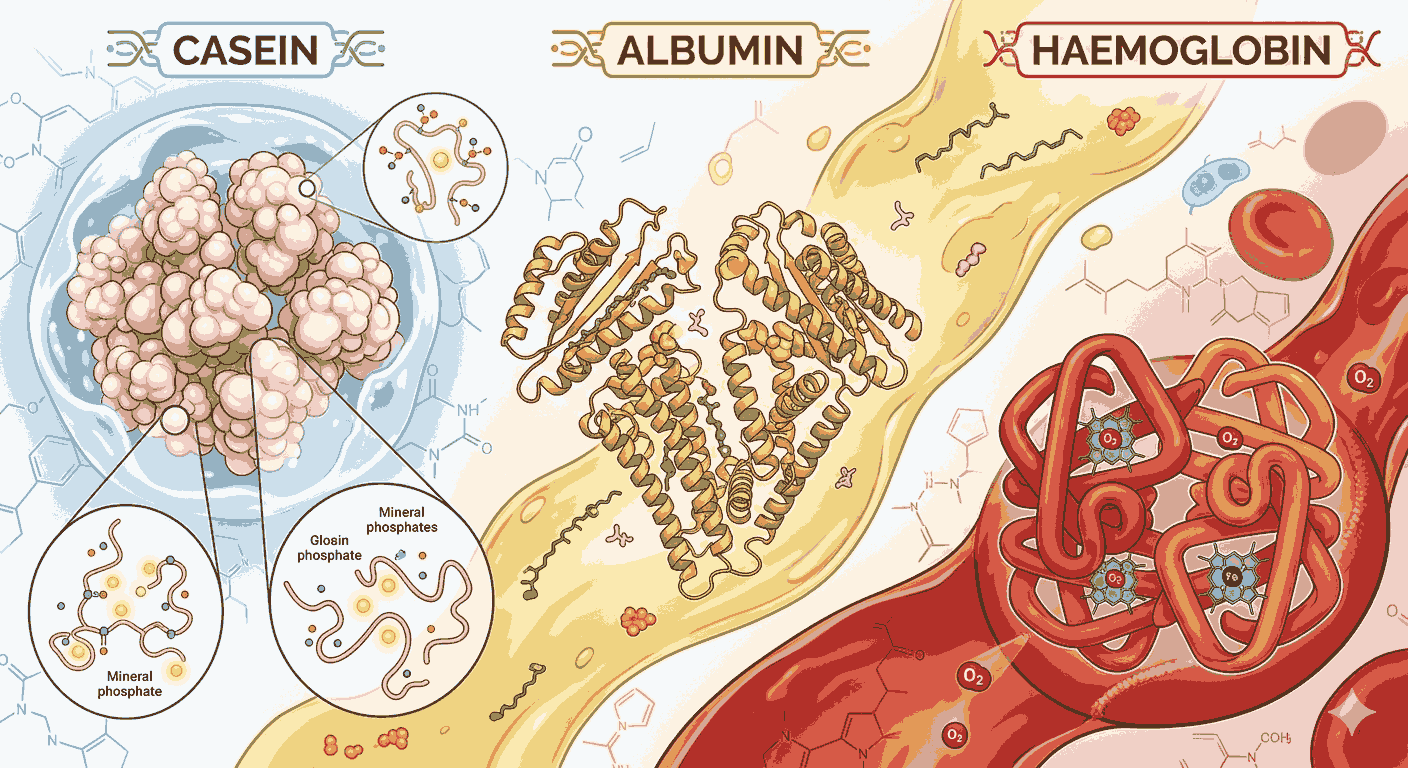
Biomolecules form the foundation of life, and among them, proteins like casein, albumin, and haemoglobin play crucial roles in biological systems. Foraspirants preparing for competitive exams, practicing Casein albumin haemoglobin mcqs with answers biomolecules is one of the most effective ways to understand these essential proteins in depth. These MCQs help bridge the gap between theoretical knowledge and practical application.
Casein is a phosphoprotein found in milk and is responsible for providing essential amino acids to growing organisms. By solving Casein albumin haemoglobin mcqs with answers biomolecules, aspirants can easily grasp its structure, properties, and importance in nutrition. It also helps learners understand why casein is widely used in the food and pharmaceutical industries.
Albumin, another important protein, is present in blood plasma and egg white. Practicing Casein albumin haemoglobin mcqs with answers biomolecules enables students to understand its role in maintaining osmotic pressure and transporting various substances in the bloodstream. These questions often focus on its solubility and functional importance.
Haemoglobin is perhaps the most studied protein in human biology. It is responsible for oxygen transport in the blood. Through Casein albumin haemoglobin mcqs with answers biomolecules, aspirants can learn about its structure, including the presence of iron-containing heme groups, and how it binds oxygen efficiently. This concept is frequently tested in exams.
One major advantage of practicing Casein albumin haemoglobin mcqs with answers biomolecules is that it strengthens conceptual clarity. Instead of memorizing isolated facts, students begin to understand the relationship between structure and function in proteins.
Moreover, Casein albumin haemoglobin mcqs with answers biomolecules are highly useful for quick revision. They summarize important concepts such as types of proteins, their biological roles, and their chemical properties in a concise manner.
Another benefit of solving Casein albumin haemoglobin mcqs with answers biomolecules is improved retention. Repeated exposure to these questions helps aspirants remember key facts like casein being a storage protein, albumin being a transport protein, and haemoglobin being a respiratory pigment.
Aspirants often struggle with differentiating between various proteins. Practicing Casein albumin haemoglobin mcqs with answers biomolecules helps eliminate confusion by clearly highlighting their distinct functions and characteristics.
In competitive exams like NEET and CUET, questions are often application-based. By solving Casein albumin haemoglobin mcqs with answers biomolecules, aspirants become familiar with tricky question patterns and develop problem-solving skills.
Time management is another crucial factor during exams. Regular practice of Casein albumin haemoglobin mcqs with answers biomolecules improves speed and accuracy, allowing aspirants to attempt more questions confidently.
Additionally, Casein albumin haemoglobin mcqs with answers biomolecules often include assertion-reason type questions, which require deeper understanding. This makes them highly valuable for mastering complex topics.
Another important aspect covered in Casein albumin haemoglobin mcqs with answers biomolecules is protein denaturation. Aspirants learn how factors like heat and pH affect protein structure without altering the primary structure.
These MCQs also emphasize biochemical properties such as peptide bonds, secondary structures like α-helix and β-pleated sheets, and functional roles in metabolism. Practicing Casein albumin haemoglobin mcqs with answers biomolecules ensures that these concepts are well understood.
Furthermore, Casein albumin haemoglobin mcqs with answers biomolecules help aspirants connect chemistry with biology. This interdisciplinary understanding is essential for scoring well in modern competitive exams.
Consistency is key when preparing for exams. Students who regularly solve Casein albumin haemoglobin mcqs with answers biomolecules tend to perform better due to their strong conceptual foundation.
Another advantage is self-assessment. By attempting Casein albumin haemoglobin mcqs with answers biomolecules, aspirants can identify their weak areas and focus on improving them.
Teachers and educators often recommend Casein albumin haemoglobin mcqs with answers biomolecules because they provide a structured way to revise biomolecules effectively.
In addition, these MCQs help aspirants understand real-life applications of proteins, such as how haemoglobin deficiency leads to anemia or how albumin maintains fluid balance in the body.
Practicing Casein albumin haemoglobin mcqs with answers biomolecules also enhances confidence. As aspirants become familiar with the topic, they can tackle even the most challenging questions with ease.
Casein albumin haemoglobin mcqs with answers biomolecules:
1. Deficiency of vitamin B₁ cause the disease
a) convulsions
b) cheliosis
c) beri-beri
d) dermatitis
Answer: c
2. In which of these metal is not present?
a) Chlorophyll
b) Haemoglobin
c) Vitamin B₁₂
d) Vitamin C
Answer: d
3. Ascorbic acid is a
a) hormone
b) fat soluble vitamin
c) water soluble vitamin
d) enzyme
Answer: c
4. Which one of the following is a vitamin?
a) Benzoic acid
b) Ascorbic acid
c) Oxalic acid
d) Formic acid
Answer: b
5. Which one of the following represents a peptide linkage in proteins?
a) –CO–O–
b) –CO–NH–
c) –NH–NH–
d) –CO–CO–
Answer: b
6. During the denaturation of proteins, which of these structures will remain intact?
a) Primary
b) Secondary
c) Tertiary
d) Quaternary
Answer: a
7. In which of the following, Keratin, a fibrous protein is absent?
a) Hair
b) Silk
c) Wool
d) Muscles
Answer: d
8. Which among the following are peptide based hormones?
(i) Estrogen (ii) Insulin (iii) Endorphin (iv) Androgen
a) i and iv
b) ii and iii
c) i and iii
d) ii and iv
Answer: b
9.An improved combination of baking powder contains starch, NaHCO₃, NaAl(SO₄)₂ and Ca(H₂PO₄)₂. Which of the following statements are correct?
- Starch acts as a filler.
- Ca(H₂PO₄)₂ is acidic and generates CO₂ from NaHCO₃.
- NaAl(SO₄)₂ slows down the release of CO₂.
a) 1 and 2 only
b) 2 and 3 only
c) 1 and 3 only
d) 1, 2 and 3
Answer: d
10. Tissues in the organs of living beings are made up of:
a) fats
b) carbohydrate
c) proteins
d) vitamins
Answer: c
11. Which one of the following statements about proteins is not correct?
a) It has α-helix
b) It has double helix
c) It is a polymer of α-amino acids
d) It has β-pleated sheet
Answer: b
12. The protein present in the hair is
a) Lysine
b) Myosine
c) Keratin
d) Alanine
Answer: c
13. The secondary structure of a protein refers to
a) α-helical backbone
b) hydrophobic interactions
c) sequence of α-amino acids
d) fixed configuration of polypeptide backbone
Answer: a
14.Which of the following statements about carbohydrates is correct?
(i) Sucrose is a non-reducing sugar
(ii) Glucose is oxidized by bromine water
(iii) Glucose is dextrorotatory
(iv) Fructose is an aldose
a) (i) and (ii) only
b) (ii) and (iii) only
c) (i) and (iii) only
d) (i), (ii) and (iii)
Answer: d
15. A distinctive functional group of fat is
a) peptide group
b) ester group
c) alcohol group
d) ketonic group
Answer: b
16. Protein synthesis from genetic code is called
a) Reproduction
b) Replication
c) Translation
d) Transcription
Answer: c
17. Denaturation of proteins does not involve
a) breaking H-bonds
b) loss of biological activity
c) loss of primary structure
d) loss of secondary structure
Answer: c
18. Hydrolysis of proteins gives
a) α-amino acids
b) β-amino acids
c) All of these
d) None of these
Answer: a
19. Secondary structure stabilisation is due to
a) van der Waals forces
b) peptide bond
c) hydrogen bonding
d) glycosidic bond
Answer: c
20. Which of the following is not of lipid series?
a) Fat
b) Soap
c) Oil
d) Lard
Answer: a
21. Proteins can be hydrolysed by using
a) dilute acids
b) dilute alkalies
c) enzymes
d) All of these
Answer: d
22. Which of the following is NOT a protein?
a) Wool
b) Cellulose
c) Hair
d) Nail
Answer: b
23. α-helix and β-pleated sheet belong to
a) primary structure
b) secondary structure
c) tertiary structure
d) quaternary structure
Answer: b
24. Which ion causes coagulation of proteins?
a) Ca²⁺
b) Na⁺
c) Mg²⁺
d) Ag⁺
Answer: d
25. Biuret test is given by
a) proteins
b) ketones
c) oils and fats
d) primary amines
Answer: a
26. Transport protein is
a) Casein
b) Albumin
c) Haemoglobin
d) Oxytocin
Answer: c
27. Protein responsible for blood clotting is
a) albumins
b) globulins
c) fibrin
d) fibrinogen
Answer: d
28. Which lipid is not obtained by hydrolysis?
a) Terpenes
b) Carotenoid
c) Neutral fats
d) Cholesterol
Answer: c
29. Stabilisation of α-helix is due to
a) van der Waals forces
b) covalent bonding
c) ionic bonding
d) hydrogen bonding
Answer: d
30. In primary structure, amino acids are linked by
a) hydrogen bonds
b) ionic bonds
c) peptide bonds
d) glycosidic linkages
Answer: c
Conclusion on Casein Albumin Haemoglobin MCQs with Answers Biomolecules
Finally, mastering Casein albumin haemoglobin mcqs with answers biomolecules is not just about exam preparation but also about understanding fundamental biological processes. These proteins are essential for life, and learning about them provides valuable insights into human health and nutrition.
To conclude, Casein albumin haemoglobin mcqs with answers biomolecules are an indispensable resource for aspirants. With regular practice, they improve conceptual clarity, boost confidence, and ensure excellent performance in competitive exams.