
- Keneitsino Lydia
- March 20, 2026
30 Carbylamine Test MCQs With Answers Chemistry: Powerful Practice for Guaranteed Success
The Carbylamine test is one of the most distinctive and important qualitative tests in organic chemistry, especially in the chapter on amines for Class 12 aspirants. It is widely used to identify primary amines, both aliphatic and aromatic, through the formation of foul-smelling isocyanides. A strong understanding of this concept can be effectively built through consistent practice using Carbylamine test MCQs with answers chemistry, which helps aspirants reinforce theoretical knowledge and apply it confidently in exams.
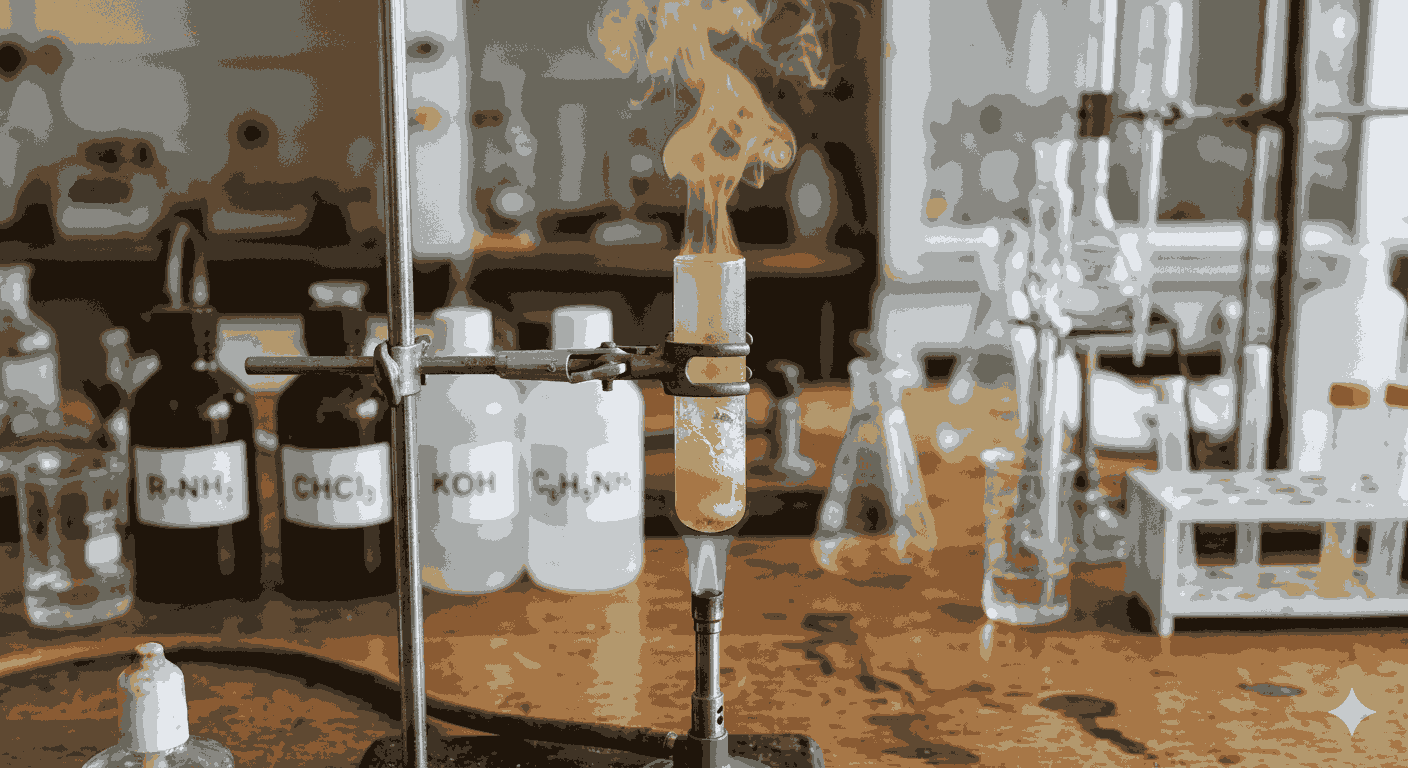
The Carbylamine test, also known as the isocyanide test, involves heating a primary amine with chloroform (CHCl₃) and alcoholic potassium hydroxide (KOH). This reaction leads to the formation of isocyanide (carbylamine), which has a very unpleasant odor. By practicing Carbylamine test MCQs with answers chemistry, students can clearly understand the reaction mechanism and the conditions required for this transformation.
One of the key features highlighted in Carbylamine test MCQs with answers chemistry is that this test is specific only to primary amines. Secondary and tertiary amines do not give this reaction, making it a reliable method for distinguishing between different classes of amines. This concept is frequently tested in exams, and solving Carbylamine test MCQs with answers chemistry helps apirants avoid common conceptual mistakes.
Another important aspect covered through Carbylamine test MCQs with answers chemistry is the reaction mechanism. The formation of dichlorocarbene as an intermediate and its reaction with the amine group is a crucial step. Understanding this mechanism allows aspirants to confidently tackle mechanism-based questions, which are common in competitive exams.
In addition, Carbylamine test MCQs with answers chemistry help aspirants understand the role of reagents involved in the reaction. Chloroform provides the necessary carbon atom, while alcoholic KOH facilitates the formation of the reactive intermediate. By repeatedly practicing Carbylamine test MCQs with answers chemistry, aspirants can remember these details more effectively.
The Carbylamine test also has practical significance in laboratory identification of compounds. It is often used to confirm the presence of primary amines in unknown organic samples. Through Carbylamine test MCQs with answers chemistry, aspirants can connect theoretical concepts with laboratory applications, enhancing their overall understanding.
Furthermore, Carbylamine test MCQs with answers chemistry expose students to a wide variety of question types, including conceptual, assertion-reason, and reaction-based problems. This variety ensures that students are well-prepared for different exam formats and question patterns.
Another advantage of practicing Carbylamine test MCQs with answers chemistry is improved problem-solving speed. Since competitive exams are time-bound, regular practice helps aspirants answer questions quickly and accurately. This leads to better time management during exams.
Conceptual clarity is further strengthened when aspirants work through Carbylamine test MCQs with answers chemistry, as repeated exposure reinforces key ideas such as reagent roles, reaction conditions, and product formation. This reduces confusion and builds confidence.
Additionally, Carbylamine test MCQs with answers chemistry serve as an excellent revision tool. Instead of going through lengthy notes, aspirants can quickly revise important concepts through practice questions, making revision more efficient and effective.
Aspirants also benefit from identifying common mistakes through Carbylamine test MCQs with answers chemistry, such as incorrectly assuming that secondary amines give a positive test. Recognizing these errors early helps improve accuracy in exams.
Moreover, Carbylamine test MCQs with answers chemistry help students differentiate this test from other qualitative tests like Hinsberg test or nitrous acid test. This distinction is important for solving multi-concept questions in exams.
Carbylamine Test MCQs With Answers Chemistry:
1.Which reaction converts diazonium salt to bromobenzene?
a) Sandmeyer reaction
b) Wurtz reaction
c) Friedel-Crafts
d) Cannizzaro
Answer: a
2.Diazonium salts react with CuCl to give:
a) Chlorobenzene
b) Benzene
c) Phenol
d) Nitrobenzene
Answer: a
3. The most basic compound among the following is:
a) Aniline
b) p-Nitroaniline
c) Acetanilide
d) Benzylamine
Answer: d
4. Gabriel’s synthesis is frequently used for the preparation of:
a) Primary amines
b) Primary alcohols
c) Tertiary amines
d) Tertiary alcohols
Answer: a
5. When aniline is heated with concentrated H₂SO₄ at 455–475 K, it forms:
a) Aniline hydrogen sulphate
b) Sulphanilic acid
c) Amino benzene sulphonic acid
d) Benzene sulphonic acid
Answer: b
6. Primary, secondary and tertiary amines can be distinguished by:
a) Schiff’s test
b) Fehling’s test
c) Tollen’s test
d) Hinsberg test
Answer: d
7. Mark the correct statement:
a) Methyl amine is acidic
b) Methyl amine is less basic than NH₃
c) Methyl amine is a stronger base than NH₃
d) Methyl amine forms salts with bases
Answer: c
8. Amine that cannot be prepared by Gabriel phthalimide synthesis is:
a) Aniline
b) Benzylamine
c) Methylamine
d) iso-Butylamine
Answer: a
9. Basic strength of amines is in the order of:
a) NH₃ > CH₃NH₂ > (CH₃)₂NH
b) (CH₃)₂NH > CH₃NH₂ > NH₃
c) CH₃NH₂ > (CH₃)₂NH > NH₃
d) NH₃ > (CH₃)₂NH > CH₃NH₂
Answer: b
10. Nitrobenzene on treatment with zinc dust and aqueous ammonium chloride gives:
a) C₆H₅NH₂
b) C₆H₅NHOH
c) C₆H₆
d) C₆H₅NO
Answer: b
11. From which of the following reactions is a primary amine produced?
a) Reduction of nitrile compounds
b) Reduction of amide compounds
c) Hoffmann bromamide degradation reaction
d) All of these
Answer: d
12. Hinsberg test distinguishes amines based on:
a) Solubility
b) Colour
c) Odour
d) Boiling point
Answer: a
13. Which of the following is not a correct statement for primary aliphatic amines?
a) The intermolecular association in primary amines is less than that in secondary amines
b) Primary amines on treating with nitrous acid solution form corresponding alcohols except methyl amine
c) Primary amines are less basic than secondary amines
d) Primary amines can be prepared by Gabriel phthalimide synthesis
Answer: a
14.Nitrobenzene reduction in acidic medium gives:
a) Aniline
b) Azobenzene
c) Hydrazobenzene
d) Phenol
Answer: a
15. The method by which aniline cannot be prepared is:
a) Nitration of benzene followed by reduction with Sn and concentrated HCl
b) Degradation of benzamide with bromine in alkaline solution
c) Reduction of nitrobenzene with H₂/Pd in ethanol
d) Potassium salt of phthalimide treated with chlorobenzene followed by hydrolysis with aqueous NaOH solution
Answer: d
16. A. Phenyl methanamine B. N,N-dimethyl aniline C. N-methyl aniline D. Benzenamine. Choose the correct order of basic nature of the above amines.
a) A > C > B > D
b) D > C > B > A
c) B > C > A
d) A > B > C > D
Answer: d
17.Carbylamine test is given by:
a) Primary amines
b) Secondary amines
c) Tertiary amines
d) Alcohols
Answer: a
18.Ninhydrin reacts with amino acids to give:
a) Blue/violet colour
b) Red colour
c) Green colour
d) Colourless
Answer: a
19.
Hoffmann bromamide reaction gives:
a) Primary amine
b) Secondary amine
c) Alcohol
d) Aldehyde
Answer: a
20. An amine on reaction with benzene sulphonyl chloride produces a compound insoluble in alkaline solution. This amine can be prepared by ammonolysis of ethyl chloride. The correct structure of the amine is:
a) None of these
b) CH₃CH₂NH₂
c) CH₃CH₂CH₂NHCH₃
d) CH₃CH₂CH₂NHCH₂CH₃
Answer: d
21.Electron-donating groups:
a) Activate benzene ring
b) Deactivate ring
c) Neutral
d) Destroy ring
Answer: a
22.
Which of the following is more basic than aniline?
a) C₆H₅CH₂NH₂
b) (C₆H₅)₂NH
c) (C₆H₅)₃N
d)
<img src=”https://itquiz.in/wp-content/uploads/2024/09/chem_YCT_Chem_Vol_II_ch13.Q122.option4.png” style=”height:200px; width:200px” alt=”Option D”>
Answer: a
23. The product of the following transformation is:
a) CH₃CH₂CH₂CH₂NH₂
b) CH₃CH₂CH₂NH₂
c) CH₃NH
d) CH₃CH₂OH
Answer: b
24. A 2° amine is obtained by reduction of which compound?
a) Nitrile
b) Nitro
c) Isonitrile
d) Amide
Answer: c
25. The amines that undergo carbylamine reaction are:
a) 2° aliphatic amines, 1° aromatic amines
b) 1° aliphatic amines, 1° aromatic amines
c) 2° aliphatic amines, 2° aromatic amines
d) 1° aliphatic amines, 2° aromatic amines
Answer: b
26.Diazonium salts are stable at:
a) High temperature
b) Room temperature
c) Low temperature
d) Vacuum
Answer: c
27. Products formed in the reaction including by-products are:
CH₃CH₂CH₂CH₂CONH₂ + Br₂ + 4NaOH →
a) CH₃CH₂CH₂CH₂NH₂ + Na₂CO₃ + Na₂Br + 2H₂O
b) None of these
c) CH₃CH₂CH₂CH₂NH₂ + Na₂CO₃ + 2NaOH + 2Br₂
d) CH₃CH₂CH₂CH₂NH₂ + Na₂CO₃ + 2NaBr + 2H₂O
Answer: d
28. Correct statement about the given chemical reaction is:
a) –NH₂ group is ortho and para directing, so product (B) is not possible
b) Reaction is possible and compound (B) will be the major product
c) The reaction will form sulphonated product instead of nitration
d) Reaction is possible and compound (A) will be the major product
Answer: d
29.Semicarbazone formation is a reaction of:
a) Aldehydes/ketones
b) Alcohols
c) Amines
d) Alkanes
Answer: a
30. A 90 g sample of ethyl amine on reaction with methyl chloride produced a tertiary amine as an exclusive product. The amount of methyl chloride required is:
[Mass in amu: H = 1, C = 12, N = 14, Cl = 35.5]
a) 50.5 g
b) 101 g
c) 202 g
d) 303 g
Answer: c
Conclusion on Carbylamine Test MCQs With Answers Chemistry
In conclusion, the Carbylamine test is a vital concept in organic chemistry that requires both theoretical understanding and practical application. By consistently practicing Carbylamine test MCQs with answers chemistry, aspirants can strengthen their concepts, improve their analytical skills, and perform confidently in exams. Ultimately, Carbylamine test MCQs with answers chemistry provide a structured and effective approach to mastering this topic and achieving academic success.