
- Keneitsino Lydia
- March 20, 2026
Aromatic vs Aliphatic Amines MCQs Class 12 – Ultimate Practice to Boost Your Score Fast
Understanding the difference between aromatic and aliphatic amines is a crucial part of Class 12 organic chemistry, especially for aspirants preparing for competitive exams like NEET and JEE. A strong conceptual foundation can be built effectively through consistent practice of Aromatic vs Aliphatic Amines MCQs Class 12, which helps aspirants identify patterns, trends, and reaction behaviors. These concepts are not only theoretical but also frequently tested in examinations, making Aromatic vs Aliphatic Amines MCQs Class 12 an essential study resource.
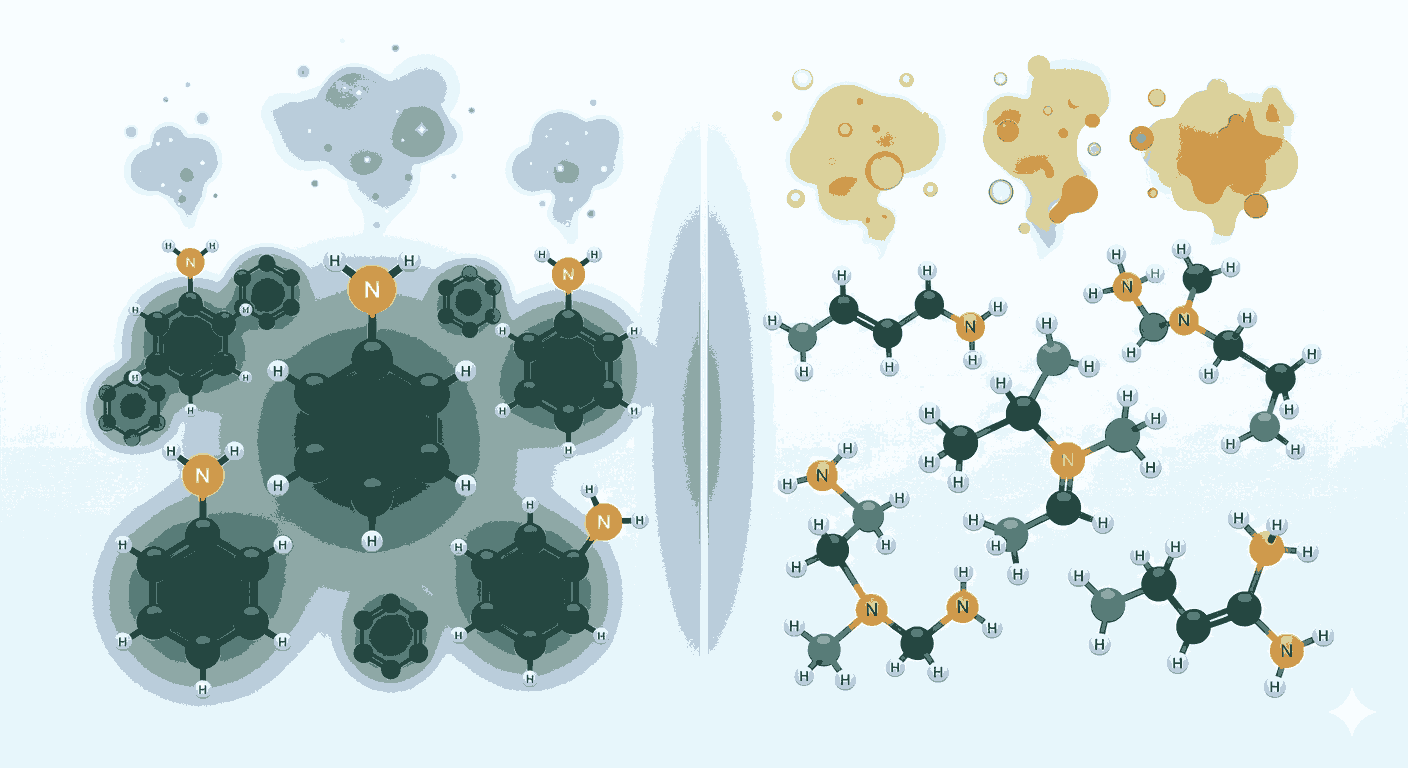
Amines are organic compounds derived from ammonia, where one or more hydrogen atoms are replaced by alkyl or aryl groups. The key distinction lies in the type of group attached to the nitrogen atom. In aliphatic amines, the nitrogen is bonded to alkyl groups, whereas in aromatic amines, it is directly attached to an aromatic ring. Practicing Aromatic vs Aliphatic Amines MCQs Class 12 helps aspirants clearly differentiate between these two categories based on structure and properties.
One of the most important differences between these amines is their basic strength. Aliphatic amines are generally more basic than aromatic amines due to the +I (inductive) effect of alkyl groups, which increases electron density on nitrogen. In contrast, aromatic amines like aniline are less basic because the lone pair of electrons on nitrogen gets delocalized into the benzene ring through resonance. These subtle differences are often tested, and solving Aromatic vs Aliphatic Amines MCQs Class 12 ensures better understanding of such concepts.
Another important area is reactivity. Aromatic amines participate in electrophilic substitution reactions, while aliphatic amines typically undergo nucleophilic substitution or elimination reactions. These reaction differences are critical for exam preparation, and Aromatic vs Aliphatic Amines MCQs Class 12 provide excellent practice for identifying reaction types and predicting products.
Physical properties such as boiling point and solubility also vary between aromatic and aliphatic amines. Aliphatic amines are generally more soluble in water due to hydrogen bonding, whereas aromatic amines are less soluble because of the hydrophobic benzene ring. Understanding these trends becomes easier when students practice Aromatic vs Aliphatic Amines MCQs Class 12 regularly.
The behavior of amines with reagents is another key topic. For example, aromatic amines can undergo diazotization to form diazonium salts, while aliphatic amines form unstable diazonium compounds that decompose quickly. These differences are frequently asked in exams, making Aromatic vs Aliphatic Amines MCQs Class 12 highly valuable for mastering reaction-based questions.
Qualitative tests such as the Carbylamine test and Hinsberg test are also used to distinguish between types of amines. These tests behave differently depending on whether the amine is aromatic or aliphatic. By solving Aromatic vs Aliphatic Amines MCQs Class 12, aspirants can better understand how these tests work and when to apply them.
Moreover, Aromatic vs Aliphatic Amines MCQs Class 12 help aspirants improve their analytical thinking by exposing them to assertion-reason questions, match-the-following formats, and case-based problems. This variety ensures comprehensive exam preparation and builds confidence.
Time management is another advantage of practicing Aromatic vs Aliphatic Amines MCQs Class 12. Regular practice enables aspirants to solve questions quickly and accurately, which is essential during time-bound exams. It also helps in reducing errors and improving overall performance.
Revision becomes much more efficient with Aromatic vs Aliphatic Amines MCQs Class 12, as aspirants can quickly go through important concepts without revisiting lengthy notes. This makes it an ideal tool for last-minute preparation.
In addition, solving Aromatic vs Aliphatic Amines MCQs Class 12 helps identify weak areas, allowing aspirants to focus on topics that need improvement. This targeted learning approach is highly effective for achieving better results.
Aromatic vs Aliphatic Amines MCQs Class 12:
1. Which of the following is least basic?
a) (CH₃CO)₂NH
b) (C₂H₅)₂NH
c) (CH₃CO)NHC₂H₅
d) (C₂H₅)₃N
Answer: a
2. The best reagent for converting 2-Phenyl propanamide into 1-Phenyl ethanamine is:
a) H₃PO₄
b) NaBH₄
c) LiAlH₄
d) NaOH/Br₂
Answer: d
3. Kjeldahl’s method cannot be used to estimate nitrogen in:
a) C₆H₅NO₂
b) None of these
c) CH₃CH₂CN
d) C₆H₅NH₂
Answer: a
4. The most appropriate reagent for conversion of C₂H₅CN into CH₃CH₂CH₂NH₂ is:
a) Na(CN)BH₃
b) LiAlH₄
c) NaBH₄
d) CaH₂
Answer: b
5. The reagent used to distinguish between a secondary amine and a tertiary amine is:
a) p-toluenesulphonyl chloride
b) dil. HCl
c) CHCl₃ and alc. KOH
d) bromine water
Answer: a
6. Order of boiling points of the following compounds:
-
(CH₃)₃N
-
CH₃CH₂CH₂NH₂
-
CH₃CH₂NHCH₃
a) 3 > 1 > 2
b) 1 > 3 > 2
c) 1 > 2 > 3
d) 2 > 3 > 1
Answer: d
7. Which statement about aniline is false?
a) Aniline is a stronger base than ammonia
b) Aniline is less basic than methylamine
c) pK_b of aniline is greater than ammonia
d) Aniline reacts with bromine water
Answer: a
8. Primary amine + CHCl₃ + alc. KOH gives:
a) Isocyanide
b) Aldehyde
c) Cyanide
d) Alcohol
Answer: a
9. Acetylation of secondary amine gives:
a) N,N-dialkyl acetamide
b) N,N-dialkyl amine
c) N,N-dialkyl amide
d) Acetyl dialkyl amine
Answer: a
10. Nitrobenzene reduction in acidic medium uses:
a) LiAlH₄
b) Sn/HCl
c) Na/Alcohol
d) H₂/Ni
Answer: b
11. Alkyl halide + alc. NH₃ gives:
a) 1° amine
b) 2° amine
c) 3° amine
d) All of these
Answer: d
12. Number of primary amines for C₃H₉N:
a) 1
b) 2
c) 3
d) 4
Answer: b
13. Product formed from ethyltrimethyl ammonium iodide + AgOH + heat:
a) C₂H₅N(CH₃)₃
b) C₂H₅NH₂
c) CH₃CH₂NH₂
d) (CH₃)₃N
Answer: d
14. Benzenediazonium chloride + Zn/HCl gives:
a) Aniline
b) Phenyldiazine
c) Azobenzene
d) Hydrazobenzene
Answer: a
15. Hinsberg test statements:
a) Both true
b) (i) true, (ii) false
c) (i) false, (ii) true
d) Both false
Answer: b
16. Carbylamine reaction is shown by:
a) Primary amines
b) Secondary amines
c) Tertiary amines
d) Quaternary
Answer: a
17. Least soluble in water at 298 K:
a) CH₃NH₂
b) (CH₃)₂NH
c) (CH₃)₃N
d) C₆H₅NH₂
Answer: b
18. Ethylamine from N-ethylphthalimide is obtained using:
a) NaBH₄
b) NH₂NH₂
c) H₂O
d) CaH₂
Answer: b
19. Incorrect method for preparing benzylamine:
a) H₂/Ni
b) HCl/H₂O then NaBH₄
c) LiAlH₄ then H₃O⁺
d) SnCl₂/HCl then NaBH₄
Answer: b
20.An aromatic compound with molecular formula C₇H₆O₂ reacts with aqueous ammonia and on heating gives an amide. This amide on treatment with Br₂/KOH forms an amine (C₆H₇N). Identify compound A.
a) Benzaldehyde
b) Benzoic acid
c) Phenol
d) Toluene
Answer:
21.Which of the following undergoes nitration most easily?
a) Aniline
b) Nitrobenzene
c) Benzoic acid
d) Benzaldehyde
Answer: a
22.Which product is formed when aniline is brominated in aqueous bromine?
a) Bromobenzene
b) m-bromoaniline
c) 2,4,6-tribromoaniline
d) p-bromoaniline
Answer: c
23.Arrange the following in increasing order of basic strength (pK_b increases as basicity decreases):
a) Aniline < Ammonia < Methylamine
b) Methylamine < Ammonia < Aniline
c) Ammonia < Methylamine < Aniline
d) Aniline < Methylamine < Ammonia
Answer: a
24. Compound X gives C₃H₉N with Br₂/NaOH:
a) CH₃COCH₂NHCH₃
b) CH₃CH₂CH₂CONH₂
c) CH₃CON(CH₃)₂
d) CH₃CH₂COCH₂NH₂
Answer: b
25.Assertion (A): Tertiary aliphatic amines react with nitrous acid to form soluble nitrites.
Reason (R): Tertiary amines lack hydrogen attached to nitrogen.
a) Both A and R are correct and R explains A
b) Both A and R are correct but R does not explain A
c) A is correct but R is incorrect
d) Both A and R are incorrect
Answer: a
26.Which of the following reactions involves the formation of a diazonium salt?
a) Aniline + NaNO₂ + HCl (0–5°C)
b) Aniline + Br₂
c) Aniline + CHCl₃/KOH
d) Aniline + H₂SO₄
Answer: a
27. Acetanilide nitration + hydrolysis gives:
a) o-nitroaniline
b) p-nitroaniline
c) m-nitroaniline
d) trinitroaniline
Answer: b
28.Assertion (A): Tert-butyl amine cannot be prepared by Gabriel phthalimide synthesis.
Reason (R): The reaction involves Sₙ2 mechanism, which is hindered in tertiary substrates.
a) Both A and R are correct and R explains A
b) Both A and R are correct but R does not explain A
c) A is correct but R is incorrect
d) Both A and R are incorrect
Answer: a
29. Identify A and D:
a) R–NH₂, Ph–SO₂–NR–(C₂H₅)₂⁺I⁻
b) R–NH–R, Ph–SO₂–NR₂–C₂H₅
c) R–NH₂, Ph–SO₂–NR–I
d) None
Answer: a
30. Conversion of alkyl halide to primary amine is done by:
a) Cannizzaro reaction
b) Tischenko reaction
c) Hoffmann bromamide
d) Gabriel phthalimide synthesis
Answer: d
Conclusion on Aromatic vs Aliphatic Amines MCQs Class 12
Overall, the study of aromatic and aliphatic amines is incomplete without sufficient practice. By consistently working through Aromatic vs Aliphatic Amines MCQs Class 12, aspirants can strengthen their conceptual understanding, improve problem-solving skills, and gain confidence. Ultimately, Aromatic vs Aliphatic Amines MCQs Class 12 serve as a powerful tool for mastering this important chapter and excelling in exams.