
- Keneitsino Lydia
- March 24, 2026
Master 30 Antihistamines and Drugs MCQs for CUET Chemistry – Proven Questions to Boost Your Score
When preparing for competitive exams like CUET, one of the most important areas in organic chemistry is the study of drugs and their classifications. Among these, antihistamines hold a special place due to their practical applications and frequent appearance in exam questions. This is why focusing on Antihistamines and drugs MCQs for CUET chemistry becomes essential for aspirants aiming to score high.
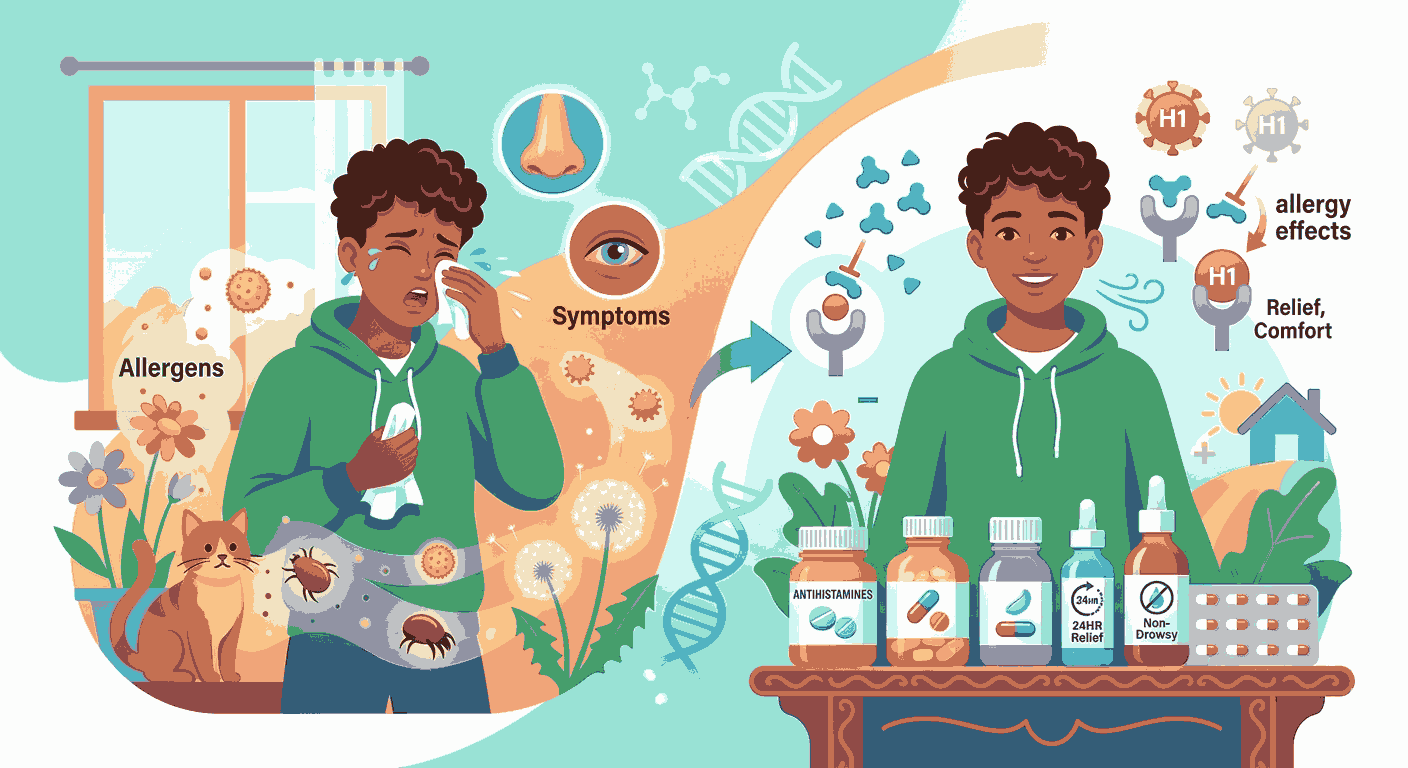
Understanding the concept behind Antihistamines and drugs MCQs for CUET chemistry starts with knowing what antihistamines are. Antihistamines are chemical substances that interfere with the action of histamine, a compound responsible for allergic reactions in the body. When histamine binds to receptors, it causes symptoms like sneezing, itching, and inflammation. Studying Antihistamines and drugs MCQs for CUET chemistry helps aspirants understand how these drugs block such responses.
There are two main types of antihistamines commonly discussed in Antihistamines and drugs MCQs for CUET chemistry: H₁-receptor antagonists and H₂-receptor antagonists. H₁ antihistamines are used to treat allergies, while H₂ antihistamines are used to reduce stomach acid secretion. Questions from Antihistamines and drugs MCQs for CUET chemistry often test the difference between these two types.
Another important aspect covered in Antihistamines and drugs MCQs for CUET chemistry is the classification of drugs. Drugs are broadly classified as analgesics, antibiotics, antiseptics, disinfectants, and tranquilizers. Antihistamines fall under a specialized category of therapeutic drugs. Practicing Antihistamines and drugs MCQs for CUET chemistry strengthens conceptual clarity regarding these classifications.
Aspirants also need to understand examples of common antihistamines while preparing through Antihistamines and drugs MCQs for CUET chemistry. Drugs like diphenhydramine, cetirizine, and ranitidine are frequently mentioned. Knowing their structure, function, and application is crucial when solving Antihistamines and drugs MCQs for CUET chemistry.
Another key concept linked to Antihistamines and drugs MCQs for CUET chemistry is the idea of drug-target interaction. Drugs interact with specific biological targets such as enzymes or receptors. Antihistamines specifically target histamine receptors. This concept is often tested in Antihistamines and drugs MCQs for CUET chemistry to evaluate deeper understanding.
Side effects of drugs are another important area. While studying Antihistamines and drugs MCQs for CUET chemistry, aspirants should note that first-generation antihistamines can cause drowsiness, whereas newer ones have fewer side effects. Such differences are frequently asked in Antihistamines and drugs MCQs for CUET chemistry.
The role of synthetic drugs and their advantages over natural drugs is also discussed in Antihistamines and drugs MCQs for CUET chemistry. Synthetic drugs are often more stable, cost-effective, and easier to produce. Questions based on these advantages commonly appear in Antihistamines and drugs MCQs for CUET chemistry.
Another important topic is the difference between antiseptics and disinfectants. While studying Antihistamines and drugs MCQs for CUET chemistry, aspirants should remember that antiseptics are safe for living tissues, whereas disinfectants are used on non-living surfaces. This distinction is often included in Antihistamines and drugs MCQs for CUET chemistry.
Moreover, tranquilizers and their function in reducing anxiety are also part of the syllabus. Preparing with Antihistamines and drugs MCQs for CUET chemistry helps aspirants understand their role and examples like diazepam. Such topics frequently overlap with questions in Antihistamines and drugs MCQs for CUET chemistry.
Another concept is antibiotics, which are used to kill or inhibit the growth of microorganisms. While this may seem separate, it is often integrated into Antihistamines and drugs MCQs for CUET chemistry to test overall knowledge of medicinal chemistry.
To master this topic, consistent practice is necessary. Solving Antihistamines and drugs MCQs for CUET chemistry regularly helps improve accuracy and speed. It also builds confidence in tackling exam-level questions related to drugs and their mechanisms.
Antihistamines and Drugs MCQs for CUET Chemistry:
1.Which reagent oxidizes glucose to gluconic acid?
a) HNO₃
b) Br₂ water
c) HI
d) KMnO₄
Answer: b
2. Glycosidic linkage between C₁ of α-glucose and C₂ of β-fructose is found in:
a) Maltose
b) Sucrose
c) Lactose
d) Amylose
Answer: b
3. A sugar ‘X’ dehydrates slowly to give furfural and reacts with resorcinol. ‘X’ is:
a) Aldopentose
b) Aldotetrose
c) Oxalic acid
d) Ketotetrose
Answer: a
4. Which of the following is a non-reducing sugar?
a) Glucose
b) Maltose
c) Lactose
d) Sucrose
Answer: d
5. The formulas of A and B in the given reaction are:
a) A = C₇H₁₄O₈, B = C₆H₁₄
b) A = C₇H₁₃O₇, B = C₇H₁₄O
c) A = C₇H₁₂O₆, B = C₇H₁₄O₆
d) A = C₇H₈O₆, B = C₇H₁₀O₆
Answer: a
6.Assertion (A): Maltose consists of two α-D-glucose units linked by a glycosidic bond and is a reducing sugar.
Reason (R): Maltose is formed by α-D-glucose and β-D-glucose and is non-reducing.
Options:
a) Both A and R are true
b) Both A and R are false
c) A is true, R is false
d) A is false, R is true
Answer: c
7. Substance forming zwitter ion contains:
a) –NH₂, –COOH
b) –NH₂, –SO₃H
c) Both
d) None
Answer: c
8. α-D and β-D glucose are:
a) Conformers
b) Epimers
c) Anomers
d) Enantiomers
Answer: c
9. Protein structure unaffected by heating:
a) Secondary
b) Tertiary
c) Primary
d) Quaternary
Answer: c
10. Chloroxylenol + terpineol mixture is:
a) Antiseptic
b) Pesticide
c) Disinfectant
d) Analgesic
Answer: a
11. Water soluble vitamin not easily excreted:
a) B₆
b) B₂
c) B₁
d) B₁₂
Answer: d
12. Which enzyme converts glucose into ethanol?
a) Diastase
b) Maltase
c) Zymase
d) Invertase
Answer: c
13. Artificial sweetener:
a) Biothonal
b) Alitame
c) Salvarsan
d) Lactose
Answer: b
14. Number of carbons in product B:
a) 2
b) 3
c) 1
d) 4
Answer: c
15. Sugar in DNA and RNA respectively:
a) Deoxyribose, Deoxyribose
b) Deoxyribose, Ribose
c) Ribose, Deoxyribose
d) Deoxyribose, 2-deoxyribose
Answer: b
16. Compound without sulfur:
a) Cimetidine
b) Ranitidine
c) Saccharin
d) Histamine
Answer: d
17. Polysaccharide with β-linkages:
a) Amylose
b) Starch
c) Cellulose
d) Amylopectin
Answer: c
18. Polysaccharide example:
a) Lactose
b) Maltose
c) Sucrose
d) Glycogen
Answer: d
19. Compound ‘X’ is:
a) Maltose
b) Sucrose
c) Lactose
d) Starch
Answer: b
20. Oxygen atoms in nucleotide (RNA base):
a) 6
b) 7
c) 8
d) 9
Answer: d
21. Incorrect nitrate test statement:
a) Brown ring formed
b) Nitroferrous complex
c) None
d) Brown fumes
Answer: b
22. Chemical stimulating pepsin secretion:
a) Antihistamine
b) Cimetidine
c) Histamine
d) Zantac
Answer: c
23. Number of peptide linkages:
a) 2
b) 3
c) 4
d) 5
Answer: c
24. COVID-19 drug approval institute:
a) Ministry of Health
b) DCGI
c) ICMR
d) WHO
Answer: b
25. Nucleotide contains:
a) Base + acid
b) Base + sugar + acid
c) Base + sugar
d) Purine + sugar + acid
Answer: b
26. Positive Biuret test compounds:
a) 1
b) 2
c) 3
d) 4
Answer: b
27. Minimum molar mass:
a) 25
b) 40
c) 50
d) 30
Answer: a
28. Match enzymes with sources:
a) II, III, IV, I
b) II, III, I, IV
c) I, III, II, IV
d) I, II, III, IV
Answer: a
29. D- and L- forms of sugars are examples of:
a) Epimers
b) Anomers
c) Enantiomers
d) Conformers
Answer: c
Conclusion on Antihistamines and Drugs MCQs for CUET Chemistry
In conclusion, the importance of Antihistamines and drugs MCQs for CUET chemistry cannot be overstated. They not only help in understanding theoretical concepts but also improve problem-solving skills. By focusing on Antihistamines and drugs MCQs for CUET chemistry, aspirants can ensure better preparation and achieve higher scores in their exams.