
- Keneitsino Lydia
- April 10, 2026
Ultimate Exam Guide: Antibiotics and Antiseptics MCQs Class 12 Chemistry Solved Questions
Understanding the topic of drugs and their classifications is an essential part of Class 12 Chemistry, especially in the chapter “Chemistry in Everyday Life.” Among these, antibiotics and antiseptics play a crucial role in both examinations and real-world applications. Practicing Antibiotics and Antiseptics MCQs Class 12 Chemistry Solved Questions helps aspirants strengthen their conceptual clarity and improve problem-solving skills effectively.
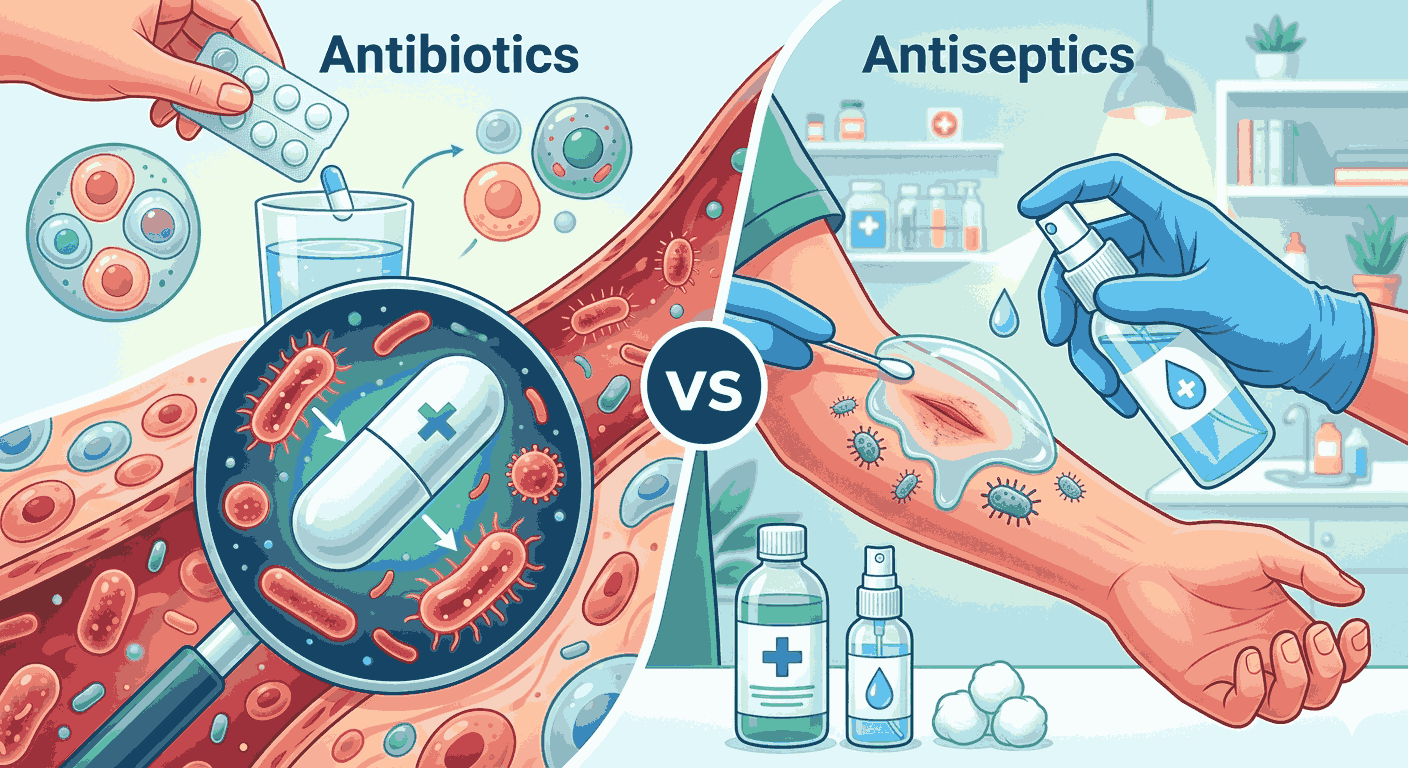
To begin with, antibiotics are chemical substances that are used to kill or inhibit the growth of microorganisms. They are widely used in treating bacterial infections and are one of the most important discoveries in medical science. When aspirants practice Antibiotics and Antiseptics MCQs Class 12 Chemistry Solved Questions, they gain a deeper understanding of how antibiotics function, their classification, and their spectrum of activity.
On the other hand, antiseptics are substances that prevent the growth of microorganisms on living tissues. They are commonly used on cuts, wounds, and skin surfaces to avoid infections. Regular practice of Antibiotics and Antiseptics MCQs Class 12 Chemistry Solved Questions allows aspirants to differentiate clearly between antiseptics and disinfectants, which is a frequently tested concept in board exams.
One of the key advantages of solving Antibiotics and Antiseptics MCQs Class 12 Chemistry Solved Questions is that it enhances conceptual understanding rather than rote learning. Aspirants begin to identify patterns in questions, such as identifying examples of broad-spectrum antibiotics or distinguishing between bactericidal and bacteriostatic drugs. This repeated exposure helps in quick recall during exams.
Moreover, Antibiotics and Antiseptics MCQs Class 12 Chemistry Solved Questions are extremely useful for competitive exams like NEET and CUET. These exams often include tricky conceptual questions that require a clear understanding of drug action and classification. By practicing Antibiotics and Antiseptics MCQs Class 12 Chemistry Solved Questions, aspirants can significantly improve their accuracy and speed.
Another important aspect covered in Antibiotics and Antiseptics MCQs Class 12 Chemistry Solved Questions is the mechanism of drug action. Aspirants learn how antibiotics interfere with bacterial cell walls or protein synthesis, while antiseptics act on the surface to prevent microbial growth. This conceptual clarity becomes crucial when answering application-based questions.
Additionally, Antibiotics and Antiseptics MCQs Class 12 Chemistry Solved Questions help aspirants understand the importance of proper drug usage. Misuse of antibiotics can lead to antibiotic resistance, a major global health concern. Questions based on this topic frequently appear in exams, making Antibiotics and Antiseptics MCQs Class 12 Chemistry Solved Questions highly relevant.
From an exam preparation perspective, Antibiotics and Antiseptics MCQs Class 12 Chemistry Solved Questions also help in time management. Since MCQs require quick thinking, practicing them regularly enables aspirants to solve questions faster and more efficiently during exams. This ultimately boosts confidence and performance.
Furthermore, Antibiotics and Antiseptics MCQs Class 12 Chemistry Solved Questions expose aspirants to a wide variety of question formats, including assertion-reason, match the following, and application-based questions. This variety ensures that aspirants are well-prepared for any type of question that may appear in the exam.
Another benefit of practicing Antibiotics and Antiseptics MCQs Class 12 Chemistry Solved Questions is that it reinforces memory retention. When aspirants repeatedly solve questions, they naturally remember important examples such as penicillin, tetracycline, chloroxylenol, and bithionol, which are frequently asked in exams.
Antibiotics and Antiseptics MCQs Class 12 Chemistry Solved Questions:
1.
Assertion: Tetracycline is a broad spectrum antibiotic.
Reason: Tetracycline is effective against a number of types of bacteria, large viruses and typhus fever.
a) Both Assertion and Reason are correct and the Reason is a correct explanation of the Assertion
b) Both Assertion and Reason are correct but Reason is not a correct explanation
c) Assertion is correct but Reason is incorrect
d) Both Assertion and Reason are incorrect
Answer: a
2.
Assertion: The addition of BHA to butter increases its storage life from months to years.
Reason: Butylated hydroxyanisole (BHA) is an antioxidant.
a) Both Assertion and Reason are correct and the Reason is a correct explanation
b) Both correct but not explanation
c) Assertion correct, Reason incorrect
d) Both incorrect
Answer: a
3.
Assertion: Penicillin is an antibiotic.
Reason: The drugs which act on the central nervous system and reduce anxiety are called antibiotics.
a) Both correct and explanation
b) Both correct but not explanation
c) Assertion correct, Reason incorrect
d) Both incorrect
Answer: c
4.
Which of the following is used for inducing sleep?
a) Paracetamol
b) Chloroquine
c) Bithionol
d) Barbituric acid derivatives
Answer: d
5.
Arsenic drugs are mainly used in the treatment of
a) Jaundice
b) Typhoid
c) Diabetes
d) Syphilis
Answer: d
6.
A broad spectrum antibiotic is
a) Paracetamol
b) Penicillin
c) Aspirin
d) Chloramphenicol
Answer: d
7.
Which of the following is an antidiabetic drug?
a) Insulin
b) Penicillin
c) Chloroquine
d) Aspirin
Answer: a
8.
Which of the following compounds is not an antacid?
a) Phenelzine
b) Ranitidine
c) Aluminium hydroxide
d) Cimetidine
Answer: a
9.
Which is incorrect?
a) Novestrol – Antifertility
b) Serotonin – Tranquilizer
c) Narrow spectrum – Chloramphenicol
d) Ranitidine – Antacid
Answer: c
10.
Which of the following is used as a ‘morning after pill’?
a) Norethindrone
b) Ethynylestradiol
c) Mifepristone
d) Bithional
Answer: c
11.
Which of the following is a local anaesthetic?
a) Diazepam
b) Procaine
c) Chloramphenicol
d) Penicillin-G
Answer: b
12.
Which radioactive element is used in the treatment of cancer?
a) Uranium
b) Thorium
c) Cerium
d) Plutonium
Answer: b
13.
The drug designed to prevent histamine interaction in stomach is
a) Cimetidine
b) Nardil
c) Pirenzepine
d) Phenelzine
Answer: a
14.
The antibiotic that contains arsenic is
a) Pronostol
b) Ofloxacin
c) Bithionol
d) Salvarsan
Answer: d
15.
Which of the following is antipyretic and analgesic?
a) Sulfaguanidine
b) Paracetamol
c) Penicillin
d) Phenol
Answer: b
16.
Mammals’ fats are hydrolysed by
a) Amylase
b) Lactase
c) Lipase
d) Urease
Answer: c
17.
Amphetamine is used as an
a) Anaesthetic
b) Antidepressant
c) Antimalarial
d) Analgesic
Answer: b
18.
Which compound is known as antisterility factor?
a) α-Tocopherol
b) Retinol
c) Calciferol
d) Thiamine
Answer: a
19.
Bacteriostatic antibiotic is
a) Penicillin
b) Erythromycin
c) Aminoglycoside
d) Ofloxacin
Answer: d
20.
Which compound is not an antidepressant?
a) Iproniazid
b) Phenelzine
c) Equanil
d) Salvarsan
Answer: d
21.
Which is not a bactericidal antibiotic?
a) Penicillin
b) Aminoglycosides
c) Ofloxacin
d) Tetracycline
Answer: c
22.
Chemically aspirin is known as
a) Salicylic acid
b) Salicylaldehyde
c) 2-acetoxybenzoic acid
d) Phenyl salicylate
Answer: c
23.
Paracetamol is an
a) Antibiotic
b) Antipyretic
c) Antimalarial
d) Analgesic
Answer: b
24.
Blood cells do not shrink because blood is
a) Hypotonic
b) Isotonic
c) Equimolar
d) Hypertonic
Answer: b
25.
Aspirin is
a) Antibiotic
b) Sedative
c) Tranquilizer
d) Antipyretic
Answer: d
26.
A substance acting as both antiseptic and disinfectant is
a) Aspirin
b) Chloroxylenol
c) Bithionol
d) Phenol
Answer: d
27.
Reagent used in preparation of aspirin is
a) SOCl₂
b) CH₃COOH/HCl
c) CH₃Cl/AlCl₃
d) (CH₃CO)₂O, H⁺
Answer: d
28.
Substances used to reduce fever are
a) Antiseptics
b) Pyretics
c) Antibiotics
d) Antipyretics
Answer: d
29.
Equanil belongs to
a) Antibiotic
b) Tranquilizer
c) Analgesic
d) Antiseptic
Answer: b
30.
Bithional is added to soaps as
a) Dryer
b) Buffering agent
c) Antiseptic
d) Softener
Answer: c

Antibiotics and Antiseptics MCQs Class 12 Chemistry Solved Questions
In conclusion, Antibiotics and Antiseptics MCQs Class 12 Chemistry Solved Questions serve as a powerful tool for mastering this important chapter. They not only improve conceptual understanding but also enhance accuracy, speed, and confidence. By consistently practicing Antibiotics and Antiseptics MCQs Class 12 Chemistry Solved Questions, aspirants can ensure better performance in board exams as well as competitive exams.