
- Keneitsino Lydia
- April 1, 2026
Boost Your Score Instantly: 30 Amino Acids Classification and Zwitter Ion MCQs with Answers
Understanding amino acids is a fundamental part of biomolecules chemistry, especially for aspirants preparing for competitive exams. One of the most important areas within this topic is classification and the concept of zwitter ions. This is where Amino Acids Classification and Zwitter Ion MCQs with Answers become extremely helpful for building clarity and confidence.
Amino acids are the building blocks of proteins and are classified based on different criteria such as the nature of their side chain, polarity, and functional groups. To master these classifications, aspirants often rely on Amino Acids Classification and Zwitter Ion MCQs with Answers, as they provide repeated exposure to different types of questions and scenarios. This helps in understanding whether an amino acid is acidic, basic, or neutral.
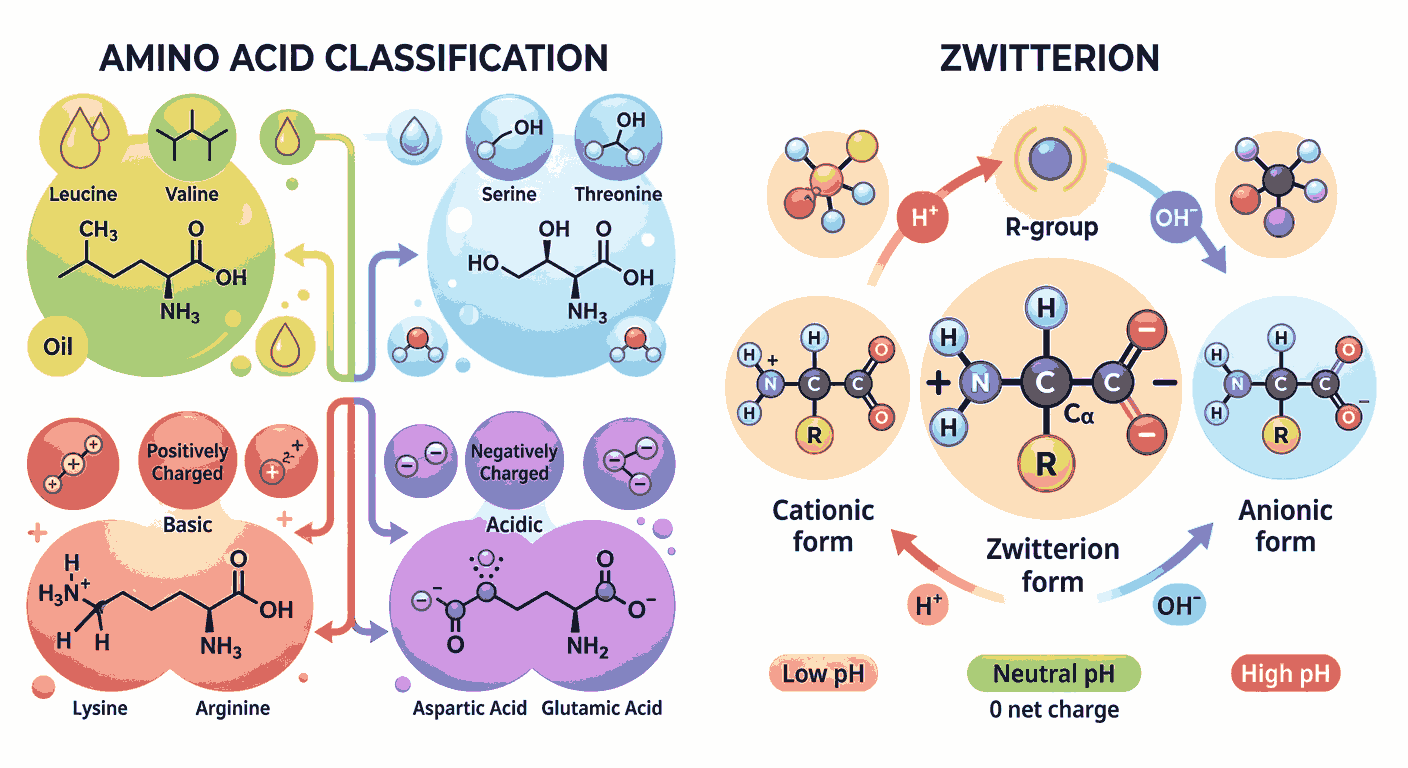
One of the key classifications is based on the side chain (R group). Amino acids can be categorized as non-polar, polar, acidic, or basic. Practicing Amino Acids Classification and Zwitter Ion MCQs with Answers allows aspirants to quickly identify these categories and apply their knowledge effectively during exams. This is especially important in objective-type questions where speed and accuracy matter.
Another important concept is the isoelectric point (pI), which is the pH at which an amino acid carries no net charge. This concept is closely related to the formation of zwitter ions. By solving Amino Acids Classification and Zwitter Ion MCQs with Answers, aspirants can understand how pH affects the ionic form of amino acids and how they behave in different environments.
The zwitter ion form is one of the most unique features of amino acids. In aqueous solutions, amino acids exist as dipolar ions where the amino group is protonated (–NH₃⁺) and the carboxyl group is deprotonated (–COO⁻). Regular practice with Amino Acids Classification and Zwitter Ion MCQs with Answers helps aspirants grasp this concept clearly and avoid confusion in exams.
Classification based on the number of amino and carboxyl groups is also crucial. Amino acids can be monoamino-monocarboxylic, diamino-monocarboxylic, or monoamino-dicarboxylic. Using Amino Acids Classification and Zwitter Ion MCQs with Answers, learners can easily differentiate between these types and remember their examples.
Another classification is based on essential and non-essential amino acids. Essential amino acids cannot be synthesized by the human body and must be obtained through diet. Practicing Amino Acids Classification and Zwitter Ion MCQs with Answers ensures that aspirants remember these important examples, which are frequently asked in exams.
The concept of optical activity is also significant. Except glycine, all amino acids are optically active due to the presence of a chiral carbon atom. Solving Amino Acids Classification and Zwitter Ion MCQs with Answers helps reinforce this fact and improves conceptual understanding.
Zwitter ions play a major role in determining the physical properties of amino acids, such as their high melting points and solubility in water. Through Amino Acids Classification and Zwitter Ion MCQs with Answers, aspirants can learn how these properties arise due to ionic interactions within the molecule.
In addition, amino acids behave differently in acidic and basic media. In acidic solutions, they exist as cations, while in basic solutions, they exist as anions. Practicing Amino Acids Classification and Zwitter Ion MCQs with Answers helps aspirants understand these transformations and apply them correctly in problem-solving.
For competitive exams like NEET and CUET, mastering this topic is essential. Regular practice using Amino Acids Classification and Zwitter Ion MCQs with Answers improves accuracy and builds confidence. These MCQs are designed to test both theoretical understanding and application skills.
Another advantage of using Amino Acids Classification and Zwitter Ion MCQs with Answers is that it helps in quick revision. Aspirants can go through multiple questions in a short time, reinforcing key concepts efficiently.
Teachers often recommend Amino Acids Classification and Zwitter Ion MCQs with Answers as an effective study tool because it provides structured learning and helps identify weak areas.
Consistent practice with Amino Acids Classification and Zwitter Ion MCQs with Answers also enhances analytical thinking, enabling aspirants to solve even tricky questions with ease.
Moreover, these MCQs help in improving time management during exams. By regularly solving Amino Acids Classification and Zwitter Ion MCQs with Answers, aspirants can increase their speed and reduce errors.
For aspirants aiming to score high marks, incorporating Amino Acids Classification and Zwitter Ion MCQs with Answers into their daily study routine is highly beneficial. It ensures thorough preparation and better retention of concepts.
30 Amino Acids Classification and Zwitter Ion MCQs with Answers:
1. A sequence of how many nucleotides in messenger RNA makes a codon for an amino acid?
a) Three
b) Four
c) One
d) Two
Answer: a
2. In RNA pentose sugar unit present is
a) glucose
b) deoxyribose
c) ribose
d) fructose
Answer: c
3. A Zwitter ion is
a) a negatively charged ion without metal atom
b) a heavy ion with a small charge on it
c) an ion with positive and negative charge at different points on it
d) a positively charged ion without a metal atom
Answer: c
4.Which of the following represents the correct structure of the tripeptide Gly–Ala–Gly?
a) NH₂–CH₂–CO–NH–CH(CH₃)–CO–NH–CH₂–COOH
b) NH₂–CH(CH₃)–CO–NH–CH₂–CO–NH–CH₂–COOH
c) NH₂–CH₂–CO–NH–CH₂–CO–NH–CH(CH₃)–COOH
d) NH₂–CH₂–CO–NH–CH(CH₃)–CO–NH–CH(CH₃)–COOH
Answer: a
5. Fate of amino acids at pH 6
a) Glutamic acid → anode, Arginine → cathode, Alanine neutral
b) Glutamic acid → cathode, others neutral
c) All remain neutral
d) All move to cathode
Answer: a
6. Which one is not a constituent of nucleic acid?
a) Uracil
b) Guanidine
c) Phosphoric acid
d) Ribose sugar
Answer: b
7. ADP and ATP differ in the number of
a) phosphate units
b) ribose units
c) adenine base
d) nitrogen atom
Answer: a
8. In a linear tetrapeptide, (amino acids – peptide bonds) =
a) 1
b) 2
c) 3
d) 4
Answer: a
9. Which amino acid is optically inactive?
a) Glycine
b) Proline
c) Tyrosine
d) Alanine
Answer: a
10. Glycylalanine is a dipeptide of
a) Glycine + Alanine
b) Alanine + Glycine
c) Glycine + Glycine
d) Alanine + Alanine
Answer: a
11.Assertion (A): In aqueous solution, amino acids exist in dipolar (zwitterionic) form.
Reason (R): Amino acids contain both acidic (–COOH) and basic (–NH₂) groups.
a) Both A and R are correct and R is the correct explanation of A
b) Both A and R are correct but R is not the correct explanation of A
c) A is correct but R is incorrect
d) A is incorrect but R is correct
Answer: a
12. Functional group in serine (apart from NH₂ and COOH)
a) -OH
b) -SH
c) -NH-
d) None
Answer: a
13. Optically inactive α-amino acid
a) Glycine
b) Alanine
c) Leucine
d) Valine
Answer: a
14. Sequence of amino acids is called
a) Primary structure
b) Secondary structure
c) Tertiary structure
d) Quaternary structure
Answer: a
15. Basic amino acid
a) Arginine
b) Glycine
c) Alanine
d) Serine
Answer: a
16. Difference between RNA and DNA depends on
a) 2nd carbon
b) 1st carbon
c) 3rd carbon
d) 4th carbon
Answer: a
17. Incorrect statement about amino acids
a) All α-amino acids
b) All have primary amino group
c) All optically active are L
d) Can be neutral/acidic/basic
Answer: c
18. Amino acids are obtained from hydrolysis of
a) nucleic acid
b) carbohydrates
c) fats
d) proteins
Answer: d
19.Assertion (A): Adenine and guanine are purine bases present in RNA.
Reason (R): Uracil is present in RNA instead of thymine.
a) Both A and R are correct and R is the correct explanation of A
b) Both A and R are correct but R is not the correct explanation of A
c) A is correct but R is incorrect
d) A is incorrect but R is correct
Answer: b
20. Number of tripeptides from Gly, Ala, Phe
a) One
b) Three
c) Six
d) Twelve
Answer: c
21. Essential amino acids set
a) Alanine, tyrosine, cysteine
b) Leucine, lysine, tryptophan
c) Alanine, glutamine, leucine
d) Leucine, proline, glycine
Answer: b
22.Assertion (A): Amino acids can exist in different ionic forms depending on the pH of the solution.
Reason (R): Amino acids contain both acidic and basic functional groups.
a) Both A and R are correct and R is the correct explanation of A
b) Both A and R are correct but R is not the correct explanation of A
c) A is correct but R is incorrect
d) A is incorrect but R is correct
Answer: a
23. Amino acids per helix turn
a) 1.6
b) 4.6
c) 3.6
d) 2.6
Answer: c
24. Incorrect statement
a) All except glycine active
b) Max solubility at IEP
c) Tripeptide has 2 bonds
d) Zwitter ion form
Answer: b
25. Amino acid with indole ring
a) Tryptophan
b) Tyrosine
c) Proline
d) Methionine
Answer: a
26. Correct statement
a) Same IEP
b) All optically active except glycine
c) At pH 0 → anions
d) Basic → cations
Answer: b
27. AT/GC ratio in humans
a) 1
b) 1.52
c) 9.3
d) 2
Answer: b
28. Correct statement
a) Sucrose antiseptic
b) Lactic acid antimicrobial
c) Seconal antipyretic
d) Chloroxylenol tranquilizer
Answer: b
29.DNA fingerprinting is used for:
a) Determining parentage and identifying criminals
b) Synthesizing artificial DNA
c) Designing tattoos
d) Producing vaccines
Answer: a
30. Drug blocking histamine receptors
a) prontosil
b) cimetidine
c) aspartame
d) equanil
Answer: b
Conclusion on Amino Acids Classification and Zwitter Ion MCQs with Answers
In conclusion, understanding amino acid classification and zwitter ion formation is crucial for mastering biomolecules. Amino Acids Classification and Zwitter Ion MCQs with Answers serve as a powerful tool for learning, revision, and practice. By consistently working through these questions, aspirants can strengthen their concepts, improve their performance, and achieve success in competitive examinations.