
- Keneitsino Lydia
- May 5, 2026
Ultimate Mastery: Y Chromosome Genes MCQs Class 12 Biology for Competitve Exams
Understanding sex-linked inheritance is a crucial part of genetics, and Y Chromosome Genes MCQs Class 12 Biology play an important role in strengthening this concept for aspirants preparing for competitive exams. The topic becomes particularly interesting because Y chromosome genes behave differently compared to autosomal genes and even X-linked genes. When aspirants practice Y Chromosome Genes MCQs Class 12 Biology, they begin to recognize how traits linked to the Y chromosome are passed strictly from father to son, making them unique in inheritance patterns. This distinct mode of inheritance makes Y Chromosome Genes MCQs Class 12 Biology highly valuable for conceptual clarity.
In human genetics, Y chromosome genes are often referred to as holandric genes, and their transmission does not follow typical Mendelian ratios. This is why Y Chromosome Genes MCQs Class 12 Biology are frequently included in exams like NEET and CUET to test deeper understanding. Through repeated exposure to Y Chromosome Genes MCQs Class 12 Biology, learners can identify key examples such as hypertrichosis of the pinna and understand how these traits never appear in females. Practicing Y Chromosome Genes MCQs Class 12 Biology also helps aspirants differentiate between sex-linked, sex-limited, and sex-influenced traits, which are commonly confused topics.
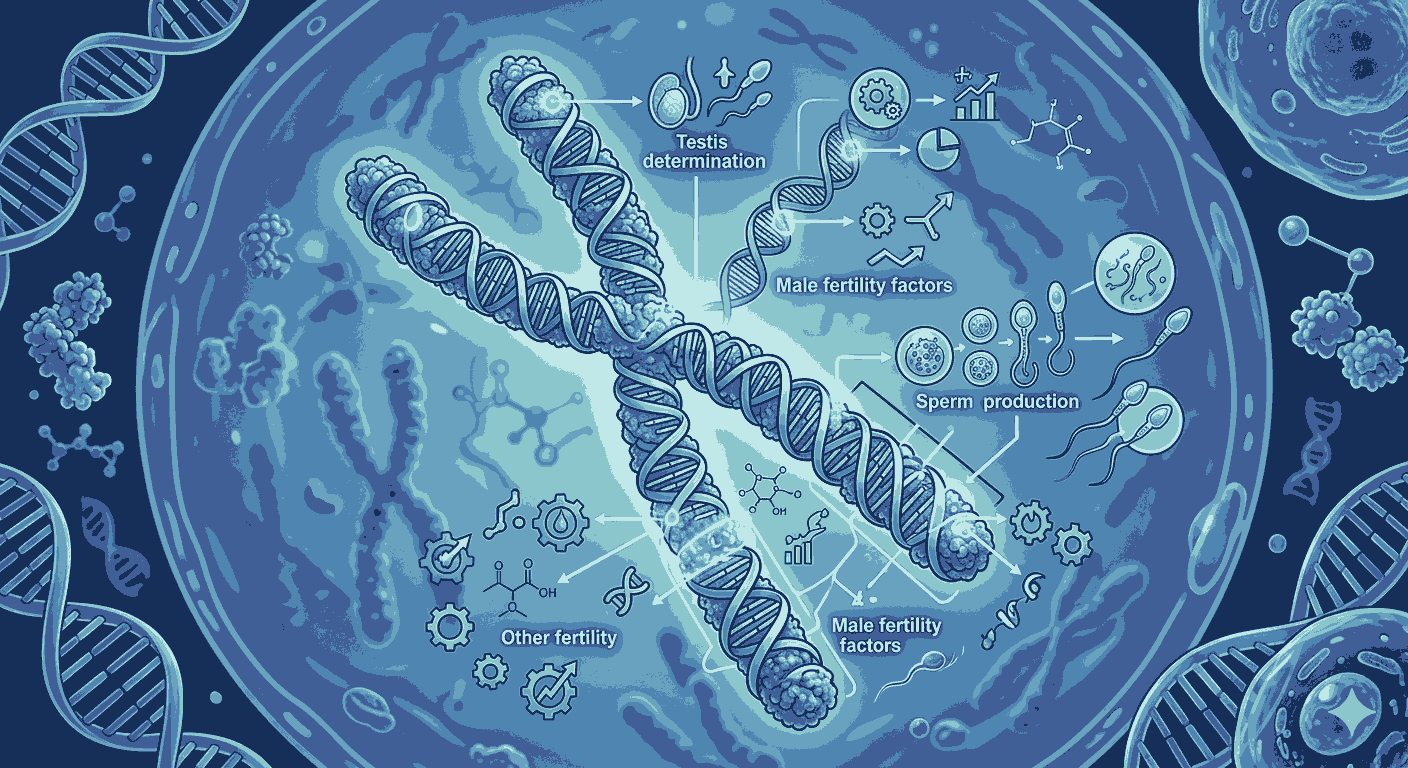
Another essential concept reinforced by Y Chromosome Genes MCQs Class 12 Biology is the role of the Y chromosome in determining male characteristics. The presence of the SRY gene (sex-determining region Y) triggers the development of male reproductive structures. This biological function is central to many exam questions, and Y Chromosome Genes MCQs Class 12 Biology ensure that aspirants grasp the importance of this gene. Unlike autosomes, the Y chromosome is smaller and contains fewer genes, but its impact on development is significant.
When solving Y Chromosome Genes MCQs Class 12 Biology, aspirants also understand that mutations in Y-linked genes can directly affect male traits without being masked by another allele, since there is no homologous pair for most regions of the Y chromosome. This makes Y Chromosome Genes MCQs Class 12 Biology especially helpful in understanding the concept of hemizygosity.
Moreover, Y Chromosome Genes MCQs Class 12 Biology provide clarity on evolutionary aspects of chromosomes. The Y chromosome has evolved over time and has lost many genes, making it distinct from the X chromosome. This evolutionary perspective is often tested in conceptual questions, and practicing Y Chromosome Genes MCQs Class 12 Biology ensures students are prepared. Aspirants also learn how Y-linked inheritance differs from other inheritance patterns such as autosomal dominant, autosomal recessive, and X-linked inheritance. By consistently solving Y Chromosome Genes MCQs Class 12 Biology, learners improve their ability to identify inheritance patterns quickly and accurately.
In addition, Y Chromosome Genes MCQs Class 12 Biology strengthen analytical thinking by presenting real-life genetic scenarios. These questions require aspirants to apply their knowledge rather than simply recall facts. For example, tracing pedigree charts involving Y-linked traits becomes easier after practicing Y Chromosome Genes MCQs Class 12 Biology. This not only helps in exams but also builds a deeper appreciation for how genetics operates in real populations. Furthermore, Y Chromosome Genes MCQs Class 12 Biology help reinforce the idea that Y-linked traits do not skip generations as long as the lineage continues through males, which is a key distinguishing feature.
Y Chromosome Genes MCQs Class 12 Biology:
1.
Why is excessive growth of hair on the pinna found only in males?
a) The gene responsible is recessive in females
b) Testosterone induces it
c) Estrogen suppresses it
d) The gene is present on the Y chromosome only
Answer: d
Explanation: This is a holandric (Y-linked) trait, so it appears only in males.
2.
Which condition leads to the birth of a normal human female child?
a) XY
b) XX
c) Only Y
d) Only X
Answer: b
Explanation: A normal female has two X chromosomes (XX).
3.
In Drosophila, match X/A ratios with sex:
a) Incorrect
b) 0.5 Male, 1.0 Female, 1.5 Metafemale, 0.33 MetaMale, 0.67 Intersex
c) Incorrect
d) Incorrect
Answer: b
Explanation: Based on Bridges’ genic balance theory, sex depends on X/A ratio.
4.
Where are Drumstick Barr bodies found?
a) All RBCs of females
b) All RBCs of males
c) Some neutrophils of females
d) Some neutrophils of males
Answer: c
Explanation: Barr bodies are seen in female neutrophils.
5.
Who determined the human chromosome number correctly?
a) Landsteiner
b) Moorehead
c) Tjio and Levan
d) Hamerton
Answer: c
Explanation: They confirmed humans have 46 chromosomes.
6.
Pattern baldness, beard growth are examples of:
a) Sex determining
b) Sex differentiating
c) Sex-linked
d) Sex-limited
Answer: d
Explanation: These traits appear only in one sex, hence sex-limited.
7.
X-chromosome of female can pass to:
a) Only daughters
b) Only sons
c) Only granddaughters
d) Both sons and daughters
Answer: d
Explanation: Females pass X chromosomes to both offspring types.
8.
Dosage compensation achieves:
a) Equal X gene expression
b) Equal Y expression
c) Sex determination
d) None
Answer: a
Explanation: One X chromosome is inactivated (Barr body) to balance expression.
9.
Mental retardation due to sex chromosomal abnormality occurs due to:
a) Reduced X
b) Increased X
c) Increased Y
d) None
Answer: b
Explanation: Extra X chromosomes (e.g., Klinefelter syndrome) cause abnormalities.
10.
Male bird chromosomes are:
a) XY
b) ZW
c) XX
d) ZZ
Answer: d
Explanation: Birds have ZZ (male) and ZW (female) system.
11.
Sex determination in humans depends on:
a) Somatic autosomes
b) Germ cell sex chromosomes
c) Germ cell autosomes
d) Somatic sex chromosomes
Answer: b
Explanation: Sex is decided by X or Y sperm.
12.
A boy receives his X chromosome from:
a) Mother
b) Father
c) Both
d) Either
Answer: a
Explanation: Males inherit X from mother and Y from father.
13.
XO type sex determination occurs in:
a) Monkeys
b) Drosophila
c) Birds
d) Grasshopper
Answer: d
Explanation: Grasshoppers show XO system.
14.
A man inherits his X chromosome from:
a) Maternal grandparents
b) Father
c) Maternal grandfather only
d) Paternal grandfather
Answer: a
Explanation: The X comes from the mother’s lineage.
15.
Genes on Y chromosome are called:
a) Polygenic
b) Basic
c) Pleiotropic
d) Holandric
Answer: d
Explanation: Y-linked genes are holandric.
16.
Rh incompatibility pairing to avoid:
a) A+ × A+
b) A+ × A-
c) O- × O+
d) O+ × O+
Answer: b
Explanation: Rh mismatch may cause erythroblastosis fetalis.
17.
Incorrect statement:
a) Grasshopper sperms lack sex chromosome
b) Fowl sex determined by sperm
c) Human male has unequal sex chromosomes
d) Male fruit fly is heterogametic
Answer: b
Explanation: In birds, egg determines sex, not sperm.
18.
Heterogametic sex means:
a) Males produce different gametes
b) Females produce different gametes
c) Males produce same gametes
d) Females produce same gametes
Answer: a
Explanation: In humans, males are XY → heterogametic.
19.
Sex in humans is determined:
a) By ovum
b) At fertilization
c) After 40 days
d) Later in development
Answer: b
Explanation: Determined at fertilization.
20.
Sex of zygote depends on:
a) Chromosomes of sperm and egg
b) Autosomes
c) Environment
d) Diet
Answer: a
Explanation: Combination of X and Y chromosomes.
21.
Chance of son after 5 daughters:
a) 0%
b) 25%
c) 50%
d) 100%
Answer: c
Explanation: Each birth is independent (50%).
22.
Male identity is determined by:
a) Sex chromosomes
b) Organelles
c) Autosomes
d) Nucleus
Answer: a
Explanation: Presence of Y chromosome determines male.
23.
Male fruit fly gamete ratio:
a) 3:1
b) 7:1
c) 1:1
d) 2:1
Answer: c
Explanation: Equal X and Y gametes → 1:1 ratio.
24.
Normal female chromosome formula:
a) 44+XXY
b) 44+XX
c) 44+XY
d) 44+XO
Answer: b
Explanation: Normal female = 44 autosomes + XX.
25.
Incorrect Barr body statement:
a) Inactive X chromosome
b) Lyonisation process
c) Becomes active later
d) Attached to nuclear membrane
Answer: c
Explanation: Barr body remains inactive permanently.
26.
Heterogametic females found in:
a) Grasshopper
b) Bird and moth
c) Drosophila
d) Humans
Answer: b
Explanation: Females are ZW in birds/moths.
27.
Correct statement:
a) XO determines male in grasshopper
b) XO in humans gives female
c) XX gives male in Drosophila
d) ZZ gives female in birds
Answer: a
Explanation: XO → male in grasshopper.
28.
Double lines in pedigree indicate:
a) Unknown sex
b) Consanguineous marriage
c) Normal mating
d) Unaffected
Answer: b
Explanation: Shows marriage between relatives.
29.
Non-sex chromosomes are called:
a) Sex chromosomes
b) Autosomes
c) Chromomeres
d) Autophages
Answer: b
Explanation: Autosomes control general body traits.
30.
Carrier daughters in pedigree:
a) 25% daughters
b) 75% sons
c) 50% daughters carriers & 50% sons affected
d) 100% daughters
Answer: c
Explanation: Typical X-linked recessive inheritance pattern.
Conclusion on Y Chromosome Genes MCQs Class 12 Biology:
Finally, the importance of Y Chromosome Genes MCQs Class 12 Biology cannot be overstated in modern biology education. They serve as an effective revision tool, enabling aspirants to consolidate their understanding of sex determination and inheritance. Regular practice of Y Chromosome Genes MCQs Class 12 Biology leads to better accuracy, improved confidence, and stronger conceptual foundations. For students aiming to excel in board exams and competitive tests, mastering Y Chromosome Genes MCQs Class 12 Biology is an essential step toward achieving high scores and developing a clear understanding of genetics.